Kafka vs. Kafka: The Only Choice for Data Engineers
Why is this BigData meme funny?
Level 1: One Word, Two Meanings
Imagine someone uses a word that can mean two totally different things, and you only really care about one of them. For example, think of the word “apple.” An apple could mean the fruit you eat, but it’s also the name of a famous tech company that makes iPhones and iPads. Now picture a kid who loves playing on an iPad. If you show him a real apple fruit, he might make a “no, not that one” face. But if you show him an Apple iPad, he’ll light up with a big “yes, that one!” smile. That’s exactly what this meme is showing, but with the word “Kafka.” One “Kafka” is a man who wrote books (which is like the apple fruit to the kid – something our developer in the meme isn’t excited about). The other “Kafka” is a cool computer tool that helps different programs talk to each other (that’s like the iPad – the thing that makes our developer happy). In the meme, the man in the red jacket (Drake) first turns away from the Kafka he doesn’t want (the author and his books) and then he points joyfully to the Kafka he likes (the software tool). It’s a funny way to show how the same name can mean two things, and how people will choose the one they’re a fan of.
Level 2: From Books to Bytes
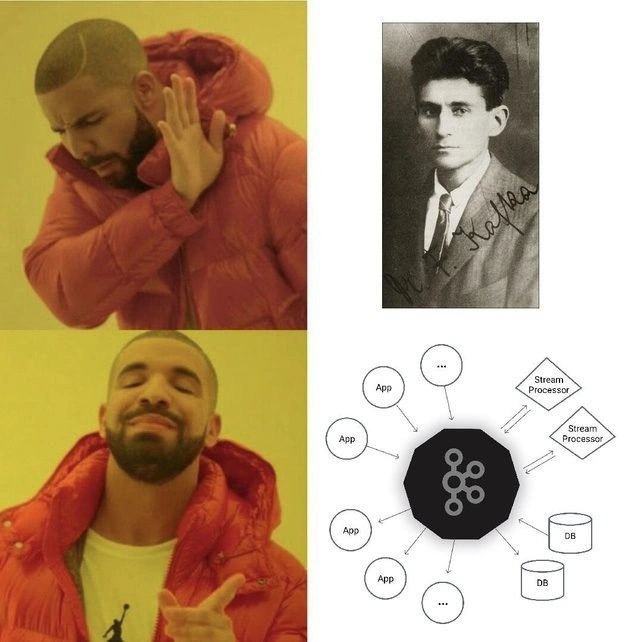
Let’s break down the meme for someone new to this. On the left side, we have the rapper Drake in two poses from a popular meme template. In the top-left, Drake is turning away with his hand up, a gesture meaning “nope, not liking that.” In the bottom-left, he’s pointing forward approvingly with a smile, meaning “yes, that’s the one I want!” Now, on the right side of those images, they’ve placed two different things corresponding to what Drake is reacting to. The top-right is a portrait of Franz Kafka, who was a famous early 20th-century novelist known for writing very complex and surreal stories. The bottom-right image is a diagram representing Apache Kafka, which is not a person at all, but a piece of technology – specifically, an open-source distributed streaming platform often used in backend systems. The joke is that Drake (representing software developers) is “rejecting” Franz Kafka (the author) and “choosing” Apache Kafka (the software). It’s a play on the shared name Kafka.
Now, why would a developer choose Apache Kafka over Franz Kafka? Of course, it’s not a serious question of picking one person over another; it’s humor. Apache Kafka is very popular in modern software development, especially in areas like data engineering and distributed systems. It’s a system that allows different applications to send messages to each other in the form of events. Think of it as a high-speed, central messaging hub for a company’s software. For example, when you use an app and do something (like make a purchase or post a comment), that action can be sent as an event to Kafka. Then, many different parts of the company’s system (maybe the billing service, the notification service, an analytics database, etc.) can all get that event from Kafka and react to it. This style of building software is called event-driven architecture – instead of calling each service directly, an app just publishes events and other services subscribe to those events. Apache Kafka is one of the go-to tools to implement this because it can handle a huge number of events (messages) quickly, store them reliably, and distribute them to many receivers.
In the diagram in the meme’s bottom-right, the black hexagon with the Apache Kafka logo (which looks like three connected circles) in the center represents a Kafka cluster (a group of Kafka servers working together). Around it, bubbles labeled “App” represent applications that send data to Kafka (producers). Other shapes like cylinders labeled “DB” (databases) or diamonds labeled “Stream Processor” are consumers that read data from Kafka. The “...’’ bubble suggests that there can be many more producers or consumers. This picture is basically a typical Kafka use-case: multiple apps write events into Kafka, and multiple other systems read those events to do their jobs. It shows how Kafka decouples producers and consumers — they don’t talk to each other directly, they all talk to Kafka. This makes the system more robust and scalable. If one part (say a database loader) is slow or down, Kafka will buffer the events until it’s ready, rather than everything breaking immediately.
Now, contrast that with Franz Kafka – he’s completely unrelated to computers. He wrote famous books like “The Metamorphosis” and “The Trial”. His stories are quite dark and complex, leading to the adjective “Kafkaesque” to describe absurdly complex and illogical situations. The humor is that, in a developer meme, the poor guy is only known as the namesake for our beloved tech. Many developers might jokingly say, “Kafka? Oh, you mean the message broker, not the author!” It’s a classic example of tech wordplay where a term from normal life (someone’s last name in this case) has a special meaning in the tech world. We do this a lot in tech: for instance, “Python” is not just a snake, it’s a programming language, and “Java” isn’t just an island or coffee, it’s a programming language too. Here, Kafka is both a writer and a powerful piece of software.
For someone starting out, it’s also worth noting why Apache Kafka is so praised (why Drake is grinning at it). In backend development, especially at large scales, getting many different services and databases to communicate reliably is hard. Kafka is a solution to this — it can take in streams of data (logs of events) and reliably pass them around. It’s distributed, meaning Kafka runs on a cluster of machines, not just one, for reliability and scale. If one machine fails, others take over – so your data pipeline doesn’t fall apart. It’s used for things like processing user activity streams, collecting logs, integrating microservices, and real-time analytics. So, devs are often excited to have Kafka in their toolkit because it handles a lot of the tricky parts of moving data around.
In summary, the meme uses a well-known meme format (Drake Hotline Bling) and a pun on the word “Kafka” to make a joke. Drake “rejecting” Franz Kafka and “choosing” Apache Kafka represents how, in software circles, the tech meaning of a term often overtakes the original meaning. It’s saying, in a fun way, that developers might prefer talking about a high-performance message broker over discussing high-brow literature. The categories and tags like DistributedSystems, ApacheKafka, EventDrivenArchitecture, and TechHumor all point to this context. If you’re new to this, don’t worry — it’s not that we have anything against the author Franz Kafka! It’s just a playful nod to how immersed we can get in our technology world, to the point where our brain auto-completes “Kafka” with “Apache Kafka” first.
Level 3: Brokers Over Books
This meme hits home for experienced developers because it’s playing on a classic name collision and our industry’s almost cult-like love for certain technologies. In the two-panel Drake format (a staple of meme culture), Drake dismisses one thing and enthusiastically approves another. Here he’s rejecting Franz Kafka (the famous novelist) and embracing Apache Kafka (the distributed streaming platform). The humor comes from the idea that, for many developers, mentioning “Kafka” immediately brings to mind high-throughput event pipelines and distributed systems rather than existential 20th-century literature. It’s a tongue-in-cheek way of saying: “We’d rather talk about event streaming than existential dread.”
Why is that so relatable in backend and data engineering circles? Because Apache Kafka has become a cornerstone of modern event-driven architecture. The right-side bottom panel’s architecture diagram – a Kafka cluster (depicted as a black hexagon with Kafka’s logo) with arrows connecting to many circles labeled “App”, cylinders labeled “DB”, and diamonds labeled “Stream Processor” – is a familiar sight in system design docs. It represents how Kafka acts as a central message broker (or distributed log) that decouples services. In practice, instead of apps directly integrating or calling each other (which can become a tangled mess), they publish events to Kafka topics. Downstream services (whether they are microservices updating a database, real-time analytics jobs, or other applications) subscribe to those events. This hub-and-spoke pattern is distributed systems architecture 101 nowadays, and Kafka is often the technology of choice to implement it.
The meme humorously frames that developers “choose” Apache Kafka over Franz Kafka – implying our priorities are skewed (we hype tech over humanities). It’s funny because it’s kind of true. Many of us can riff at length about Kafka’s throughput, partitions, and consumer groups, but would go blank if someone asked about The Metamorphosis or The Trial. Drake’s exaggerated expressions capture that shared self-aware joke: Nah, I’m not into Kafka’s novels; but Apache Kafka for my scalable event pipeline? Yes, please!
There’s also an undercurrent of tech wordplay here that seasoned devs enjoy. Apache Kafka was actually named after Franz Kafka by its creators (they liked his work, and perhaps the notion of writing things – Kafka’s system writes to logs). So the meme is a recursive pun: the software’s name is an homage to the author, and now the meme has the author as the “wrong Kafka.” It’s a lighthearted nod to how we repurpose words in tech. Think about other tech terms that collide with everyday words: Java (coffee vs. programming), Python (snake vs. language), Go (common verb vs. language). Here, Kafka (author) vs Kafka (event broker) is the clash. The meme format, borrowed from Drake’s Hotline Bling video, makes it visual and instantly clear even without words: Drake don’t want the boring thing (a black-and-white portrait of some serious guy), Drake likes the cool diagram thing.
For those in the know, the diagram in the second panel is itself comforting and satisfying. It shows multiple producers (“App”, “...” implying many apps) sending data into Kafka (the center), and multiple consumers (“DB”, “Stream Processor”, and so on) reading from Kafka. That’s the dream of scalable design – each part of the system doing its own job, with Kafka in the middle acting like a resilient pipeline or data highway. This architecture solves real pain points: no more spaghetti point-to-point integrations, easier ability to scale parts independently, and a reliable way to replay or buffer events when things go wrong. Seasoned engineers have lived through the bad old days of monolithic apps or cron-job data syncs, and when they finally got Kafka (or a similar broker) in their stack, it felt liberating. The meme’s subtext is basically: “We approve of Apache Kafka because it makes our distributed lives saner.”
Another layer of the joke is the implicit developer identity. Let’s face it, in tech culture it’s almost a cliché how excited we get about our tools. Kafka’s logo and its role in a system diagram can genuinely make a backend engineer smile – it means we’re using stream processing and asynchronous messaging, which are pretty “cool” modern paradigms. It’s like showing off a shiny new hammer in a toolbox. Franz Kafka’s face, on the other hand, represents something many of us haven’t thought about since school (if ever). The meme playfully jabs at this divide: our specialized world where a random person’s surname can become world-famous software, overshadowing the person himself among techies. It’s tech humor mixing a bit of self-mockery (we know we’re ignoring a classic author) with genuine enthusiasm (Apache Kafka is awesome for what we do). In short, Drake is every developer who hears “Kafka” and instantly goes “Oh, you mean the one with brokers and topics, right?” while everyone else in the room might be thinking about novels. And that collective understanding is why we smirk or chuckle when we see this meme pop up on our feed.
Level 4: Metamorphosis of Data Streams
At the core of Apache Kafka is the concept of an immutable distributed log – an ever-appending sequence of records that multiple systems can rely on as a source of truth. This isn’t just a clever design; it’s rooted in distributed systems theory. Kafka’s log-based architecture provides a totally ordered sequence of events (within each partition) that is replicated across a cluster for fault tolerance. In theoretical terms, Kafka leans on principles similar to a write-ahead log in databases and the state machine replication found in consensus algorithms. By committing events to durable storage in order, Kafka ensures that all subscribers see events in the same sequence, enabling deterministic processing of streams.
This deterministic log approach addresses some of the hardest problems in distributed computing, like eventual consistency and ordering guarantees. With Kafka, different services can agree on “what happened and in what order” without constant coordination – they just read the log. It’s fascinating because it transforms a chaotic distributed environment into something resembling a single ordered timeline of events. We could even draw parallels to Leslie Lamport’s idea of logical clocks – each Kafka partition’s offset is a kind of clock tick for event ordering. There’s deep theory beneath this meme’s humor: the Kafka platform sidesteps the nightmare of distributed transactions (which often feel Kafkaesque in their complexity) by embracing append-only logs and event-driven eventual consistency. Rather than locking everything in a two-phase commit (and waiting endlessly, like a character in The Trial), systems using Kafka accept that data will metamorphose through stages asynchronously.
Under the hood, Kafka’s design makes deliberate trade-offs outlined by the CAP theorem. A Kafka cluster chooses consistency of the log (no corrupted or out-of-order events) over availability whenever you require strong durability (acks=all and replication). If a network partition occurs or a broker goes down, producers can pause until a new leader is elected via ZooKeeper (or Kafka’s built-in Raft protocol in newer versions) – reflecting a preference for consistency during failure. On the flip side, you can configure for speed (acks=1, fewer replicas) which tilts towards availability but risks data loss if something fails. This ability to tune trade-offs is a practical engineering response to CAP’s theoretical limits. It’s thrilling from an engineering perspective: Kafka’s creators have, in essence, offered a way to balance the paradox of distributed data – you get a highly scalable pub/sub system that feels like a single, reliable commit log.
In a way, Apache Kafka turns the Kafkaesque complexity of distributed data flow into something almost elegant. Instead of a tangle of point-to-point integrations and mysterious failures, everything funnels through a clear sequence of events. The architecture diagram in the meme (Kafka’s hexagon with arrows to apps, databases, stream processors, etc.) is a snapshot of this elegant theory made real: multiple producers and consumers all dance to the tune of a single log per topic, even as the system scales out. This is the metamorphosis the subtitle hints at – like Franz Kafka’s Metamorphosis where a man becomes an insect, here our data pipeline transforms from a fragile web of connections into a robust, orderly flow of events. Event-driven architecture backed by a log means each component in the system can evolve independently, reading what it needs from Kafka, without tight coupling. It’s a beautiful synchronization of chaos through a simple, immutable sequence of bytes. And the punchline? The name Kafka itself – a nod from engineers to literature – reminding us that even in high-tech systems, there’s room for a bit of cultural (or darkly comic) reference. In theory and practice, Apache Kafka stands as a triumphant solution to distributed messaging, so it’s no wonder Drake is all smiles pointing at it in that meme.
Description
This meme uses the two-panel 'Drake Hotline Bling' format. In the top panel, Drake, looking displeased, rejects a black-and-white portrait of the author Franz Kafka, whose signature is visible on the photo. In the bottom panel, Drake smiles approvingly at a system architecture diagram representing Apache Kafka. The diagram shows a central octagonal Kafka logo connected to several circles labeled 'App', two rhombuses labeled 'Stream Processor', and two cylinders labeled 'DB', illustrating a typical event-driven architecture. The humor stems from the pun on the name 'Kafka.' For software engineers, particularly those in backend and data engineering, 'Kafka' almost exclusively refers to the Apache Kafka distributed event streaming platform, not the 20th-century novelist. The meme humorously dismisses the famous author in favor of the technology, reflecting the developer's world where technical context completely overrides literary or historical context. It’s a niche joke that resonates strongly with senior engineers who live and breathe this technology

Comments
25Comment deleted
My therapist told me to embrace my inner Kafka, so I started partitioning my feelings into immutable, sequentially written logs
I’ll take the Kafka that replicates my existential dread across three AZs with exactly-once semantics, not the one that just writes novels about it
After 15 years in the industry, I've realized the only thing more kafkaesque than debugging a distributed system at 3am is explaining to the C-suite why your perfectly functioning Kafka cluster needs a $200k hardware upgrade because 'eventual consistency' became 'eventual-ish consistency' when marketing decided to stream every mouse movement to seventeen different analytics platforms
When your architecture is so event-driven that even Franz Kafka would approve of the existential dread of infinite message queues - though he'd probably prefer the nihilistic simplicity of direct service-to-service calls over explaining to stakeholders why 'eventual consistency' means 'eventually, maybe, if the network gods smile upon us.'
Rejecting 'The Trial's' endless bureaucracy for a broker where rebalancing actually converges
Prefer the Kafka with topics and partitions - the other one wrote The Trial; ours just reenacts it every time consumer groups rebalance
Product said “use Kafka”; half the team brought paperbacks while the rest debated exactly-once semantics - then a consumer‑group rebalance nuked our SLOs. Choose the one that advances offsets, not the plot
Who is he? Comment deleted
it's written there Comment deleted
not everyone can read cursive Comment deleted
Kafka && Kafka MQ Comment deleted
Kafka Comment deleted
Thx Comment deleted
Kakafka Comment deleted
Тут все говорят на английском, никто не понял твоего юмора Everyone talks english here, nobody understood your humor Правило: добавляй перевод на английский как я делаю Rule: add translation as I do Comment deleted
well "k" exists in English, you write it in almost the same way and read it in the same way. Also for "f" and "a" that he used, so "kakafka" is understandable in english, "kaka" for some shit is in almost every europinion language Comment deleted
can konfirm, kacka is shit in german as well Comment deleted
can be stylized as kaka when needed Comment deleted
In Italy we don't use "K" but if you change it with a "c" you get the same meaning Comment deleted
so caca you mean Comment deleted
Ha-ha, Yosef K. Comment deleted
Rabbitmq better Comment deleted
Look's like: "Smokers kafka, and kafka of healthy human" Comment deleted
keeek Comment deleted
didn't get it Comment deleted