The Duality of a Developer's 'Stream'
Why is this DataEngineering meme funny?
Level 1: Homework vs. Video Games
Imagine you have a big homework assignment to do, but at the same time, your favorite video game is waiting for you. What would you rather do? Probably play the video game, right? This meme is showing that exact kind of choice, but for a software developer.
In the first part of the picture (top panel), the developer is being asked to do a really hard chore at work – something technical and not so fun (kind of like the developer’s version of homework or cleaning their room). His face says "Nope, I don’t want to!" In the second part of the picture (bottom panel), he’s offered something fun instead – in this case, it’s playing or streaming on Twitch (which is like saying “go have fun with your friends or play games”). Now his face is happy and he’s like "Yes, that’s what I want to do!"
So basically, the developer is joking that he’d rather do the fun thing than the hard work thing. It’s just like a kid choosing video games over homework or choosing playtime over chores. The word "stream" is used in both choices, but it means different things: the boring "stream" is like doing a difficult task with computers (not enjoyable, like homework), and the fun "stream" is like playing a game live online (very enjoyable, like recess or video game time). The picture with the two panels makes it really easy to see the feeling: first panel = "ugh, no thank you," second panel = "yay, yes please!"
It’s funny because everyone can understand wanting to skip the boring work and jump straight to the fun activity. Even grown-up programmers feel that way sometimes! This meme just shows that feeling in a silly, easy-to-get way. In short, the developer is just like a kid who wants to play instead of work. That’s the whole joke!
Level 2: Engineering vs. Entertainment
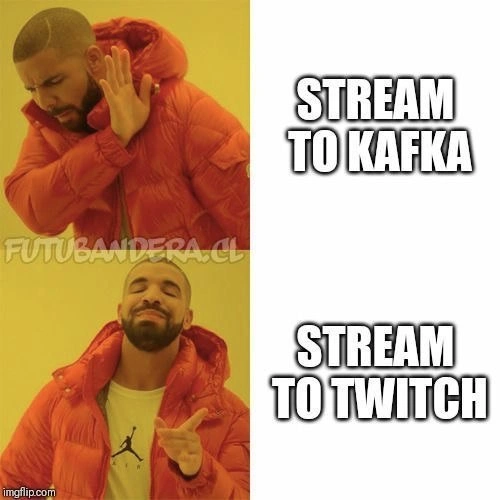
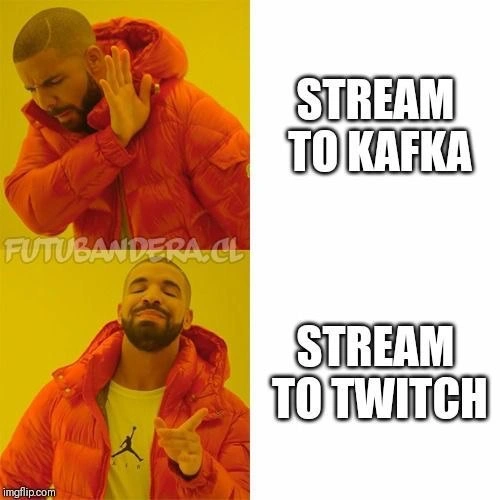
In this meme, the top panel says "STREAM TO KAFKA" and the bottom panel says "STREAM TO TWITCH", with the famous Drake images reacting to each line (unhappy at the first, happy at the second). Let’s break down what that means in simple terms, especially if you’re newer to these concepts.
Apache Kafka is a technology used in software engineering, especially in the data engineering and big data world. When the meme says "stream to Kafka," it’s talking about sending information into a Kafka system continuously, as a stream. Kafka is essentially a high-capacity messaging system or event streaming platform. Imagine you have lots of little pieces of data (like log entries, user actions on a website, sensor readings, etc.) that are coming in all the time. Kafka lets you send all those pieces into it and then have other parts of your system read them in real-time. We call this a data streaming pipeline: data flows in one end (from producers) and comes out the other end to consumers, possibly getting processed along the way. For example, one app might produce (send) messages to Kafka saying "user X clicked button Y," and another service will consume (read) those messages from Kafka to maybe update some analytics or trigger another action. Kafka is distributed, meaning it runs on multiple servers (a cluster) to handle a lot of data and not have a single point of failure. Running Kafka in production is a serious engineering task: you have to set up those servers, configure topics (which are like named queues or channels for different data streams), and ensure everything runs smoothly. The reward is you get a robust system that can handle millions of events per second, but the effort and skill required are non-trivial. So "Stream to Kafka" in the meme represents hard work – it’s the kind of task a developer might be assigned when dealing with real-time data and it can be a bit daunting or stressful, especially if something goes wrong (like data not flowing correctly or servers crashing).
Now, Twitch is something quite different: it’s an online platform for live video streaming. When someone says they "stream to Twitch," they usually mean they are broadcasting live video of themselves over the internet using Twitch’s service. This is typically an entertainment activity. Commonly, people stream themselves playing video games, but others might stream creative hobbies, doing programming (yes, coding live!), music, or just chatting. Viewers can watch these streams in real time, interact via a chat window, and follow or subscribe to their favorite streamers. From the streamer’s perspective (in this case, our developer in the meme), "streaming to Twitch" means kicking back and doing something fun or social. It doesn’t require engineering work to stream on Twitch – you use software to capture your screen and yourself, and Twitch handles broadcasting it to your audience. All the complex technology to deliver your video worldwide is managed by Twitch behind the scenes; you don’t have to build it, you just use it. So compared to "stream to Kafka," which is about building or maintaining a complex system, "stream to Twitch" is about enjoying a service that’s already built for you to have fun or maybe share your skills in a relaxed setting.
The meme uses these two meanings of "stream" to make a joke about preferring fun over work. The top image (Drake looking away in disgust) is rejecting the Kafka streaming – implying the developer doesn’t want to deal with serious data pipeline duties right now. The bottom image (Drake smiling and pointing, like he’s saying "yep, that one!") is the developer gladly choosing Twitch streaming – meaning they'd much rather be gaming or chatting on Twitch than handling data streams. Drake is a rapper, and this image of him (from his "Hotline Bling" music video) is a well-known meme template used to contrast two choices. So even if you didn’t know who Drake is, in meme language the top panel = "no/eww" and bottom panel = "yes/awesome". Here’s how the key terms from the meme correspond in each context:
| Term | Kafka Data Streaming | Twitch Video Streaming |
|---|---|---|
| Stream | Continuous flow of data (events/messages) in a pipeline | Continuous live broadcast of video content |
| Producer | An app or service that sends data into Kafka (e.g. your code emitting events) | The streamer who is broadcasting (the person on camera) |
| Consumer | An app or service that reads data from Kafka (e.g. a service using those events) | The viewer who watches the stream (the audience) |
| Topic/Channel | A named stream or category in Kafka where messages are posted (like "payments" topic, "user-clicks" topic) | The Twitch channel or category of the stream (like a personal channel named "GamerMike", or category "Just Chatting") |
As you can see, there’s a funny parallel: Kafka’s world of data uses words like producer/consumer, which map loosely to Twitch’s streamer/viewer setup. But the experiences are totally different. In one, you’re dealing with data and computers; in the other, you’re dealing with entertainment and people.
So, why is the meme funny to developers? It’s because we often use the term “streaming” in our jobs to mean data streaming, but outside of tech circles, people think of streaming as in live video or Netflix. The meme takes that confusion and runs with it. It’s basically a developer joking, “Forget setting up all these servers and pipelines... I’d rather be streaming on Twitch!” It pokes fun at the idea that sometimes developers themselves find their cutting-edge work to be overwhelming or dry, and the idea of doing something more lighthearted and instantly gratifying is very appealing. It’s a classic case of entertainment vs. engineering: dealing with Kafka might earn you a good salary and solve important problems, but it can be a headache; streaming on Twitch might not solve any serious problems (and probably won’t pay the bills unless you’re a famous streamer), but it sure sounds like a fun way to spend the time!
In summary, the top part of the meme is the boring/tricky task (managing data streams with Kafka), and the bottom part is the fun/easy alternative (livestreaming on Twitch). Even if you’re new to Kafka or Twitch, you can relate to the underlying idea: given the choice between doing something that feels like work and something that feels like play, we’d all prefer the play. The developer in the meme is just expressing that in a humorous techie way. By using the same word "stream" for both, it creates a pun and highlights how context changes the meaning: streaming data vs. streaming video. One word, two very different images in mind! That contrast is exactly what makes this a light-hearted joke in the programming community.
Level 3: From Logs to Vlogs
For seasoned developers, this meme hits on a very relatable scenario. It’s essentially showing a data engineer in a Drake-style meme format, saying "no thanks" to one kind of streaming (Kafka data streams) and "heck yes!" to another kind (Twitch video streams). The humor comes from juxtaposing a serious engineering task with a fun leisure activity that happen to share the word "stream". If you've spent any time in a big data or back-end team, you know that setting up and maintaining a Kafka pipeline can be both technically challenging and, frankly, a bit tedious at times. Kafka is often heralded as the go-to solution for real-time data streaming in modern architectures – it's the backbone for processing click streams, log aggregation, event sourcing, you name it. But with great power comes great responsibility: a Kafka cluster requires careful babysitting. You have to monitor broker health, ensure partitions are balanced, tune replication factors for fault tolerance, and avoid the dreaded scenario of a broker going down and the cluster re-electing leaders while messages pile up. Many of us have war stories of a seemingly benign Kafka configuration leading to huge data backlogs or strange consumer offset issues. For example, a mis-set retention policy that oops deletes data too soon, or a rogue consumer group that didn’t commit offsets and ended up reprocessing days of events. When you're on-call and get a 3 AM alert that "Kafka broker #5 is down", your heart sinks because you know the next few hours might be spent frantically digging through logs (server.log and application logs), rebalancing partitions, and making sure no data was lost. It’s exciting in theory (distributed systems in action!) but it can be a nightmare in practice. After wrangling with such issues, it's no wonder a developer might jokingly say, "You know what, I'd rather just stream on Twitch."
The meme nails this sentiment by using the classic Drake meme template: the top panel (Drake scowling and rejecting) is labeled "STREAM TO KAFKA", and the bottom panel (Drake smiling, pointing approvingly) is labeled "STREAM TO TWITCH". In other words, Drake is acting as the developer’s inner voice, shunning the arduous data engineering task and instead embracing a fun diversion. This format is a staple in DeveloperHumor because it vividly contrasts two options – one undesirable, one desirable – in a way every developer immediately understands. Here, "Stream to Kafka" stands for all those responsibilities and headaches of managing a data streaming pipeline. It’s the less glamorous side of working with cutting-edge tech: sure, you’re using cool tools like Kafka (which can handle millions of events per second) and dealing with BigData, but a lot of your time might be spent on infrastructure plumbing, not on shiny user-facing features. In contrast, "Stream to Twitch" represents the enticing escape from those duties. Twitch streaming is something a lot of developers enjoy either as viewers or even as hobbyist streamers. After a long day of debugging why your Kafka consumers are lagging, the idea of firing up a game or a coding session live on Twitch and interacting with a friendly audience is pure relief. No pagerDuty alerts, no cluster to maintain – if something goes wrong on Twitch, the stakes are hilariously low (worst case, your stream drops and you reboot it, and maybe joke about it to your viewers).
This comparison is poking fun at the engineer’s inner conflict: productivity vs. procrastination. It's a common trope in tech: we have important, complex work we should be doing, but something more fun is beckoning. The twist here is that both involve "streaming," which is what makes tech folks laugh. It's a pun that plays out in real life too – for instance, a data engineer might tell their non-tech friends, "I’m working on streaming at my job," and the friends reply, "Oh, like YouTube or Twitch?" and the engineer goes, "Err, not exactly... more like streaming data between databases." Cue the friends’ glazed expressions. 😅 Many of us have been in that boat, where explaining our DataEngineering work to outsiders accidentally sounds like we’re in showbiz. The meme leverages that confusion for comedic effect.
There’s also a subtle commentary on job burnout and career daydreams. In the tech industry, Kafka and similar tools (like Spark, Flink, or cloud streaming services) are hyped as the cool things to work on – they’re definitely resume boosters. But day-to-day, maintaining a distributed streaming system can drain you. You often have meetings about throughput and latency, digging through metrics in Kafka’s JMX statistics or tweaking configurations to handle peak loads. Over time, that might start to feel routine or stressful. Meanwhile, the thought might cross your mind: "What if I just became a streamer? Play games, chat with people, no epic data outages to solve..." In reality, being a professional Twitch streamer is its own kind of hard work, but in the moment of frustration it feels like the grass is greener on the entertainment side. The meme captures that fleeting fantasy perfectly.
Industry context: Over the last decade, many companies have rushed to build "real-time analytics" and "streaming platforms" because it’s the modern thing – batch processing is out, real-time is in. Tools like Kafka made it possible, but not necessarily easy. So there’s a bit of an inside joke: every enterprise wants to be like Netflix or LinkedIn (both huge Kafka users) with sophisticated event-driven architectures. They set up these pipelines, and then some poor dev or data engineer is left tuning broker heap sizes and troubleshooting consumer lag. That dev might joke with coworkers, "Instead of managing this Kafka cluster, maybe I'll just start a cooking stream on Twitch." It’s a form of gallows humor in tech – acknowledging that our cutting-edge systems can be exhausting, so much so that an unrelated job (like being a Twitch content creator) sounds heavenly by comparison.
To sum up the senior perspective: the meme is funny because it’s true. Kafka streaming and Twitch streaming are as different as night and day in terms of responsibility and stress. The Drake meme's exaggerated poses perfectly convey that truth. The developer (channeled by Drake) visibly wants nothing to do with the Kafka option – which symbolizes late-night pages about broken pipelines and endless Jira tickets for data delays. Then in the next frame, that same developer is all smiles, pointing as if to say "Now this is more like it!" at the Twitch option – symbolizing a fun, carefree activity that anyone would prefer when they’re burned out. It’s classic TechHumor making light of our reality: sometimes we glorify our big tech infrastructure jobs, but deep down we’d rather be relaxing and doing something enjoyable. And hey, some developers do stream on Twitch as a hobby (some even live-code or talk tech on Twitch, merging the two worlds). This meme resonates because it acknowledges the human side of being an engineer: no matter how advanced the systems we build, we all need a break, and ironically the word that gives us headaches at work ("stream") is the same word that promises fun after hours.
Level 4: Pub/Sub Paradox
At the highest level, this meme plays on a double meaning of "streaming" in technology, highlighting a paradox between two sophisticated systems. On one side, "stream to Kafka" refers to building a real-time data streaming pipeline with a tool like Apache Kafka. Kafka is a distributed commit log system – essentially an ordered, durable sequence of messages (events) spread across a cluster of servers. It's a cornerstone of modern BigData engineering and DistributedSystems design, enabling high-throughput, low-latency data flows. Under Kafka’s hood, producers publish events to categorized channels called topics, which are partitioned and replicated across brokers for fault tolerance. Consumers then subscribe to those topics to receive the events. This is known as the publish/subscribe (pub/sub) messaging pattern. Ensuring all these components dance in sync requires tackling some deep theoretical challenges: maintaining total order of events per partition, handling leader election for partitions (historically via Apache ZooKeeper's consensus mechanism, now shifting to Kafka’s own Raft-based consensus), and dealing with the CAP theorem trade-offs (Kafka chooses partitioned consistency and high availability, accepting temporary inconsistency during broker failures). There’s a rich vein of computer science here – from Lamport’s clocks for ordering events, to protocols for exactly-once delivery semantics (Kafka achieved this via idempotent producers and transaction APIs). In short, streaming to Kafka involves wrestling with the elegant complexity of distributed data flow: backpressure management when consumers lag, serialization formats and schema evolution for the data, and scaling out partitions to handle increasing load. It’s the realm of data engineering where math, algorithms, and careful design ensure that a firehose of events is reliably delivered. 🚀
On the other side, "stream to Twitch" references live video streaming on the platform Twitch, which at first glance is an entirely different universe – one of real-time entertainment. Interestingly, behind the scenes, Twitch’s technology is also a marvel of distributed systems, though of a different flavor. When a developer decides to stream on Twitch, they are leveraging a massive content-delivery infrastructure: video data is captured, encoded, and broadcast out to potentially thousands of viewers around the world. The system has to manage video packet streaming with low latency using protocols like RTMP or HLS, edge servers and CDNs to distribute load, and real-time messaging for chat. There’s an implicit pub/sub model here too: one broadcaster publishes a video stream, and many subscribers (followers/viewers) consume it live. The difference is that Twitch’s complexity is largely hidden from the user. The streaming protocols handle dropping or buffering frames if needed, and the platform guarantees eventual consistency in the sense that all viewers see the same sequence of video frames (give or take network delays). The developer in the meme isn't actually building Twitch’s backend, of course – they’re just using it – but it’s worth noting that even the "fun" side of this comparison runs on serious tech under the hood.
So why call it a Pub/Sub Paradox? Because the meme humorously contrasts two scenarios that sound similar but carry vastly different burdens for the engineer. In a Kafka data pipeline, the developer is responsible for engineering the whole pub-sub system: ensuring the pipeline doesn’t lose messages, scaling the cluster, monitoring consumer lag, dealing with the occasional split-brain or network partition issues – essentially acting as the caretaker of a continuous flow of data. It’s an intellectually demanding and sometimes stressful responsibility. In the Twitch scenario, the pub-sub model still exists (you stream and others subscribe to watch), but all the heavy lifting is managed by Twitch’s platform. The developer gets to simply hit "Start Streaming" and perform – be it gaming, coding, or chatting – leaving the distributed systems magic to Twitch’s SRE teams. One might say Kafka streaming is engineered real-time data flow, whereas Twitch streaming is engineered real-time content delivery, but the meme’s punchline is that from the developer’s perspective, one is work and the other is play. The paradox lies in the term stream: it encapsulates both a rigorous technical process and a casual entertainment activity. The humor is enriched by the fact that both domains even share terminology – for example, Kafka has producers and consumers, Twitch has streamers (content producers) and viewers (content consumers); Kafka has topics (named data feeds) and Twitch has channels or categories for streams. The meme captures a brilliant duality: the engineer is turning away from the serious data engineering form of streaming (which involves all the nerdy complexities mentioned) and embracing the fun entertainment form of streaming (which, ironically, sits atop its own complex stack but feels effortless to the user). It’s a cheeky nod to the idea that after wrangling distributed systems all day, even the most hardcore techies sometimes just want to relax and do something low stakes. In other words, the same person who might architect a high-volume event processing system by day could be found happily streaming a game of Minecraft by night – both involve “streams”, but only one feels like a break. 😄
Description
This image uses the popular 'Drake Hotline Bling' two-panel meme format. In the top panel, Drake is shown with a gesture of disapproval next to the text 'STREAM TO KAFKA'. In the bottom panel, he is shown smiling and pointing in approval at the text 'STREAM TO TWITCH'. The meme is a classic tech pun, playing on the double meaning of the word 'stream'. For a software or data engineer, streaming to Kafka involves the complex and often demanding work of managing high-throughput, distributed data pipelines. In contrast, streaming to Twitch is a recreational activity, typically associated with gaming and entertainment. The joke resonates with developers by contrasting the pressures of their professional life with their hobbies and leisure time
Comments
10Comment deleted
The difference between streaming to Kafka and streaming to Twitch is the acceptable amount of dropped frames
Why babysit ISR lag and tombstone compaction when I can stream to Twitch - if a message gets dropped, chat just spams it again for free retries
After 15 years of explaining distributed event streaming architectures to stakeholders, you realize the hardest part isn't implementing exactly-once semantics or managing partition rebalancing - it's explaining why your Kafka cluster can't help them become a famous gamer on Twitch
When your product manager asks about 'streaming capabilities' and you spend three sprints building a Kafka cluster with exactly-once semantics, schema registry, and multi-datacenter replication... only to discover they meant setting up an OBS instance for the company gaming tournament. At least the Kafka infrastructure will be ready when they inevitably need real-time event processing at 2AM on a Friday
Every time someone asks for streaming, I have to clarify: do you want partitions and exactly-once semantics, or RTMP with emojis flying by?
Kafka: wrestle brokers and idempotent producers. Twitch: 'Chat, hype!' and done
Asked for “streaming”; I architected Kafka, they meant Twitch - apparently the only consumer lag they care about is chat delay
Dota Comment deleted
Stream to BongaCams Comment deleted
Yes Comment deleted