Tesla's Top AI Talent Responds to Elon's Call
Why is this AI ML meme funny?
Level 1: Crashing to Impress
Imagine you want to show someone how good you are at driving a car. They say, “Show me what you can do.” Instead of driving safely, you immediately shout “We’re definitely going to crash!” and then you purposely crash the car into a wall – and then step out proudly, asking, “So, did I get the job?” That’s basically what’s happening in this joke. The big boss (Elon Musk) said he’s looking for the best people to help drive his fancy self-driving cars. A guy responds saying “I’m your man!” and as proof, he shows a tiny demo – but his demo is essentially telling the car to crash on purpose. It’s funny because he’s trying to impress the boss by doing the exact opposite of what the boss actually wants. We expect an expert to show off a way to avoid crashes, but this person’s “talent” is making a crash certain. It’s like a chef applying for a job by burning a dish to a crisp and saying “Dinner is served!” The humor is in the obvious silliness: anyone can see that causing a crash is bad, so bragging about it is ridiculous. In simple terms, the meme makes us laugh because it’s a goofy mix-up of goals – the guy thought doing something clearly wrong would somehow land him the job.
Level 2: Assignment vs Comparison
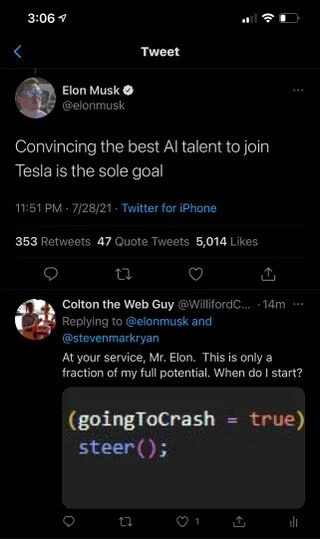
Let’s break down the technical joke here. The meme shows a pretend snippet of code for a car’s autopilot steering algorithm. It has a boolean variable named goingToCrash. In plain terms, this variable is supposed to represent whether the car is about to crash. A well-written autopilot would check this variable (perhaps after doing calculations or sensor checks) and if it’s true, then it would perform some evasive maneuver by calling a function like steer() to turn the car and avoid the crash. Normally, that logic might look like:
if (goingToCrash == true) {
steer(); // turn the wheel to avoid the crash
}
Here, == is the comparison operator in languages like C, C++, Java, and many others. goingToCrash == true asks the question “Is goingToCrash true?”. Only if the answer is yes (meaning a crash is imminent) should steer() execute. This is how you’d properly use a boolean in a condition.
Now, compare that to what the meme’s code is doing:
if ((goingToCrash = true)) {
steer(); // oops: this will ALWAYS execute, because we just set goingToCrash to true
}
Notice the single equals sign (=) inside the if. In these languages, = is the assignment operator, which means “take the value on the right (true) and store it in the variable on the left (goingToCrash)”. So (goingToCrash = true) doesn’t check anything – it assigns the value true to goingToCrash. And here’s the kicker: in C/C++/Java, an assignment expression itself has a value, and the value of (goingToCrash = true) is just true (namely the value that was assigned). So if ((goingToCrash = true)) is equivalent to if (true). In other words, that if will always run! This is the classic boolean assignment error or assignment vs comparison bug. It’s a very common mistake among new programmers. In fact, it’s such a well-known bug that many compilers will warn you about it, and some coding standards outright ban writing an if like that. Some programmers even use a trick called a “Yoda condition” – writing the constant on the left side, like if (true == goingToCrash) – so that if you accidentally use = the code won’t compile (because you can’t assign to the literal true).
In the meme, the code isn’t even wrapped in an if in the screenshot; it literally shows:
(goingToCrash = true)
steer();
This looks like just two separate statements. The first line sets goingToCrash to true, and the second line calls steer();. Effectively, it’s doing the same thing: it always sets the crash flag true and then always steers. There’s no real logic or sensor check at all – it’s a minimal “AI” steering algorithm that does the worst possible thing.
Now, why is this funny? Because the person replying to Elon Musk is claiming to be an elite Tesla AI coder, but they’re showcasing a mistake that even a beginner would blush at. It’s like someone applying to be a firefighter by saying “Look, I lit a fire to show you I can handle fires!” Tesla’s autopilot team deals with advanced topics like computer vision, machine learning, and control theory to make cars drive themselves safely. By contrast, this two-line code is absurdly simplistic. It’s AI humor poking fun at overconfident developers. The tweet reply is essentially a humorous job application – the guy says “This is only a fraction of my full potential. When do I start?”, as if this crash-inducing code is something impressive. The subtext is irony: obviously, writing code that ensures a crash is not how you get hired to build safe self-driving cars!
A junior developer reading this can learn a valuable lesson: Always know the difference between = and == (or in some languages ===). This tiny character difference can introduce a bug that flips your program’s logic. Here it turns a safety check into a self-sabotage. And in contexts like car autopilots (an area of AI/ML application), safety is everything. You don’t want a bug where your code always thinks an emergency is happening. Imagine if every time you drove, your car’s software thought “goingToCrash is true” even when it isn’t – the car might randomly slam the brakes or swerve, causing the very accident it was supposed to prevent. That’s why code quality matters so much, and why this meme tickles developers: it exaggerates a coding mistake in the most extreme scenario. It’s a perfect blend of CodingHumor and a little jab at the hype around AI talent. Even if you’re not an expert yet, you can see that a real Tesla engineer’s code would be far more complex (and carefully reviewed!) than this. And if you are a beginner programmer, let this meme be a friendly reminder: double-check your if conditions, so your programs don’t “crash” – figuratively or literally!
Level 3: Guaranteed to Crash
This meme combines AI hype vs reality with classic developer humor. Elon Musk tweets about recruiting the “best AI talent” for Tesla, and a cheeky respondent offers up a snippet of autopilot code that literally guarantees a crash. The humor comes from the stark contrast: Elon wants genius-level coders to improve Tesla’s self-driving autopilot, but the applicant demonstrates code quality that would create a self-crashing car! The code (goingToCrash = true) steer(); is a play on a notorious bug – using the assignment operator (=) instead of a comparison operator. In a normal scenario, you’d expect a check like if (goingToCrash == true) { steer(); }, meaning “if we are about to crash, then steer (to avoid it).” But our eager coder’s version sets goingToCrash to true every time, then calls steer(); unconditionally. It implies the car will always think a crash is happening and presumably jerk the steering wheel no matter what. That’s a recipe for, well, crashing. Seasoned developers recognize this as the classic assignment vs comparison bug that has haunted C/C++ and Java coders for ages – a single = instead of == can flip logic on its head. It’s the kind of mistake that prompts grim jokes during code review: “Did you mean to do that, or are we shipping the BugsInSoftware edition of the autopilot?”
Beyond the code itself, there’s autopilot_humor and a dark wink at AI safety issues. Tesla’s Autopilot and “Full Self-Driving” systems are cutting-edge AI_ML tech, but they’ve faced real-life incidents and scrutiny over safety. This meme riffs on that by implying the code driving these AI systems might be as bad as goingToCrash = true – of course it isn’t, but the joke lands because developers know even a small logic error in such software would be disastrous. The boolean assignment error here symbolizes a wider truth: if you approach complex AI problems with overconfidence and sloppy coding, you’re headed for a crash, figuratively or literally.
On the human side, the tweet reply is a humorous job application scenario. The user says, “At your service, Mr. Elon… When do I start?” while showing off a ridiculously bad “AI” snippet. It parodies the bravado of some developers who overestimate their abilities (AI_hype in personal form). Any senior engineer reading that reply can practically hear the collective facepalm. There’s an unwritten rule in serious engineering teams: if your code even smells like (goingToCrash = true) in a safety system, it’s back to the drawing board – or back to basic training. The meme gets a laugh because it’s AIHumor crossing with CodingHumor: Tesla’s lofty recruitment tweet gets answered with code so wrong it’s right (for a joke, at least). It’s an example of AIHypeVsReality – the hype: “I’m an elite AI coder ready to join Tesla!” vs. the reality: a two-line program a rookie might write on day 1, with a bug that could literally crash the car.
In sum, this meme is a nod to experienced devs (who’ve all seen or made dumb mistakes like this) and a satire of the AI recruitment frenzy. It highlights that in high-stakes AI software, bravado means nothing; correct code means everything. Elon asked for the best – but if someone actually turned in code like this, the only thing going_to_crash would be their hiring prospects.
Level 4: Safety-Critical Code
In safety-critical software (like a car’s autopilot), a tiny bug can have catastrophic consequences. The meme’s code snippet – goingToCrash = true; steer(); – is a tongue-in-cheek violation of every AI safety principle. In a real Tesla autopilot system, control algorithms rely on sensor data and complex neural networks to decide when to turn the wheel. They must obey rigorous standards (think ISO 26262 in automotive) to ensure the car doesn’t do something deadly. A line of code that unconditionally sets a crash flag to true is essentially a tautology in logical terms – it’s always true, meaning the system would always behave as if a collision is imminent. Formal verification and static analysis tools are designed to catch exactly this kind of bug. For instance, a static analyzer would flag an unconditional assignment in a supposed condition because it indicates a probable logic error. In academic terms, this creates a situation of vacuous truth: the condition to trigger steering isn’t checked against reality, it’s artificially forced. The humor is that our aspiring “AI coder” has crafted a snippet that any formal review or AI safety research effort would reject outright. It’s as if someone hard-coded Asimov’s First Law of Robotics backwards – instead of preventing harm, the code blindly assumes harm and reacts chaotically. In real autonomous driving code, thousands of lines handle sensor fusion, object detection, path planning, and control logic, all thoroughly tested so the car doesn’t crash. By contrast, this two-line pseudocode is a parody of an AI_ML algorithm: unbelievably simplistic and dangerously flawed. It highlights why code quality and correctness are paramount in AI: even the smartest neural net can’t save you if a single boolean bug in the surrounding code tells the car to steer into oblivion. In short, the meme exaggerates a failure to follow mission-critical coding standards – an AI talent boasting code that would make any AI safety engineer spit out their coffee.
Description
This image is a screenshot of a Twitter exchange. The top tweet is from Elon Musk, stating, 'Convincing the best AI talent to join Tesla is the sole goal.' Below is a reply from a user named 'Colton the Web Guy', who eagerly offers his services: 'At your service, Mr. Elon. This is only a fraction of my full potential. When do I start?'. Attached to his reply is an image of a code snippet that reads '(goingToCrash = true) steer();'. The humor is multilayered for experienced developers. The code is comically bad and dangerous; it uses an assignment operator '=' instead of a comparison '==', a classic beginner mistake that would create an always-true condition. Furthermore, the logic itself is absurdly simplistic and reactive, implying that the 'solution' to crashing is to simply 'steer()', with no further logic. The meme satirizes the Dunning-Kruger effect, where aspiring developers overestimate their abilities while applying for highly complex roles, in this case, AI development for autonomous vehicles
Comments
16Comment deleted
I see he's implemented the 'steer into the skid' feature. It's a bold strategy, let's see if it pays off for him in the interview
Shipping (goingToCrash = true) steer(); as your autopilot MVP is a bold reminder that, in some orgs, A/B testing the airbags outranks formal verification
The real talent Tesla needs is someone who can refactor that steering function to check if (goingToCrash) BEFORE calling steer() - though given their production deployment strategy, maybe this IS their unit test
When your job application includes a code sample that literally sets 'goingToCrash = true' before calling steer(), you're either demonstrating radical honesty about technical debt in autonomous systems, or you've perfectly captured the essence of every 'move fast and break things' startup culture. Either way, this is the kind of self-documenting code that makes senior engineers simultaneously laugh and cry - because we've all seen production systems where this boolean wasn't just a joke, it was a feature flag someone forgot to remove
Tesla FSD hiring: Top AI talent pitches by injecting the crash vector before consensus on steer()
Elon wants top AI; the applicant shows “if (goingToCrash = true) steer();” - one operator and you’ve turned crash detection into a feature, QA into NHTSA, and the next sprint into a recall
Assigning in a predicate is a bold strategy - 100% crash-detection recall, 0% precision, and approximately 0% ISO 26262 compliance; even clang-tidy asked for hazard pay
I hope goingToCrash was defined as boolean or it will not steer. Comment deleted
It just got defined as boolean. Comment deleted
But when it‘s a strict declaration language and it got defined before as everything but boolean, we get a crash here (if the compiler didn‘t complained before) Comment deleted
Oh yeah boi, big brain time Comment deleted
I hope this is just a joke Comment deleted
If he actually gets hired, it'll be one heck of a story Comment deleted
Should be == Comment deleted
assignment aquired instead of comparison Comment deleted
Well it will crash anyway, sooner or later. So assignment is valid too 😃 Comment deleted