The Only Kind of 'Spicy Pics' an Engineer Gets at 3 AM
Why is this OnCall ProductionIssues meme funny?
Level 1: Late Night Alarm
Imagine you text a friend really late at night asking for a funny or nice picture to make you smile. But instead of sending something cute or silly, they send you a photo of a big red warning alert! It’s like you expected a present, but got a fire alarm notice instead. In the meme, the person was expecting a fun 3AM picture, maybe something secret or playful. But their friend is a developer who’s working on a big problem at that moment. So the only “picture” they have to share is basically an emergency alarm from their work. It’s as if you asked for a bedtime joke, and they replied, “I can’t, everything is on fire here – see?” It’s funny because it’s so unexpected: the late-night surprise isn’t a goofy photo, but a serious “uh-oh!” message. The humor comes from that twist, showing how sometimes a developer’s job can jump into their personal life at the strangest hour, turning a normal request into a snapshot of a digital emergency.
Level 2: On-Call Crash Course
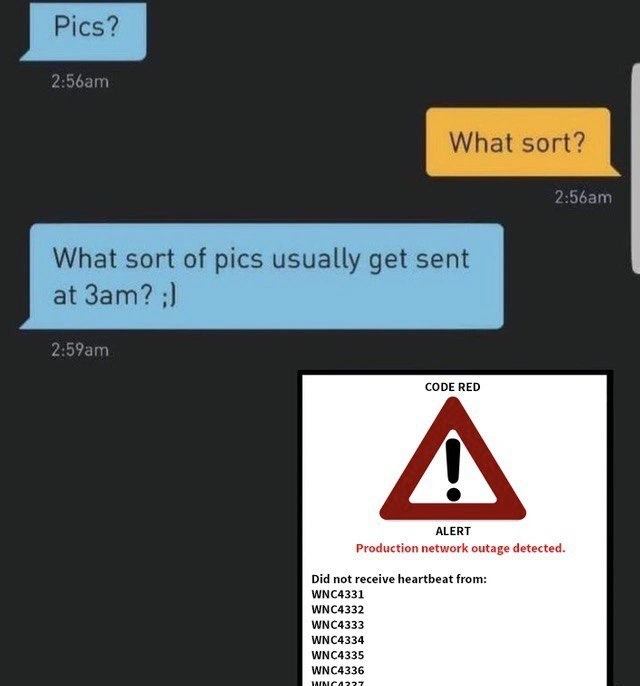
Let’s break down the scene for those new to this chaos. It’s just before 3:00 AM. One person texts “Pics?” expecting, you know, a fun or personal picture (maybe a cute selfie or something cheeky). But the other person happens to be an on-duty developer in the middle of a production incident. So instead of a normal photo, they send back a screenshot of an ALERT reading “CODE RED – Production network outage detected.” That giant warning symbol and list of gibberish like WNC4331, WNC4332... are actually the names of servers or devices that went dark. In other words, our poor developer isn’t thinking about late-night flirting; they’re busy freaking out about a major outage at work.
Now, some definitions to clarify the jargon here:
- On-call duty: This is like being the firefighter for a software team. If you’re “on-call,” it’s your responsibility to respond if anything breaks, even at 3AM. Companies set up rotations so someone is always ready to tackle emergencies. When it’s your turn, you keep your phone on high volume and pray you get to sleep through the night.
- Production incident: “Production” means the live system that real users are currently using (as opposed to a test or development system). An incident in production is a big deal because it can affect customers. If production is down, it’s all hands on deck to fix it ASAP.
- Monitoring systems: These are tools that constantly check the health of applications and servers (part of what we call observability). Think of them as automated watchguards. They can track all sorts of signals – CPU usage, memory, error rates, and yes, heartbeats.
- Heartbeat: In computing, a heartbeat is a simple periodic signal that says “I’m alive.” For example, a server might send a heartbeat message every 30 seconds to a central monitor. If the monitor doesn’t receive a few in a row, it suspects that server has either crashed or become unreachable. In the meme’s alert, “Did not receive heartbeat from: WNC4331, ... WNC4336” means six servers stopped reporting in. It’s like six people simultaneously stopped answering their phones – a strong sign of a major problem (perhaps that whole group is in the same data center rack that lost power or network).
- CODE RED: This is essentially a label for the highest-severity alert. Different teams have different terms (Sev1, P1, Critical), but “Code Red” universally screams emergency. It means something vital is broken. The fact it’s being sent at 3AM is another clue: nobody would wake you up for a minor issue. Code Red is reserved for “the site is down” or “we’re losing money every minute” kind of problems.
- PagerDuty alert: PagerDuty is a popular service that many companies use to manage on-call rotations and alerts. When a monitoring system detects a problem, it can create a PagerDuty incident, which then causes the on-call person’s phone to ring, buzz, text – whatever it takes to get their attention. In the old days this was literally a pager device beeping on your belt (hence the name), now it’s an app or phone call. The meme’s screenshot looks exactly like the kind of message you’d get from PagerDuty or a similar alert app (complete with a scary red icon).
- Alert fatigue: This term refers to becoming desensitized to alarms because you’ve seen too many. Imagine if a car alarm kept going off every night – after a while, you stop reacting to it. In IT, if an on-call engineer gets bombarded with dozens of alerts (especially false alarms or non-critical ones), they might start to mentally tune them out or just get extremely stressed. It’s a big issue because you want alerts to be taken seriously. Teams combat alert fatigue by fine-tuning what triggers an alert, so that when your phone does explode at 3AM, you know it’s truly important.
Now, tie it all together: The friend in the chat asks for a late-night picture expecting something fun. The dev’s phone, however, is literally flashing a big red WARNING about a system outage. So the dev basically responds, “Here’s the only thing I’ve got going on right now.” It’s funny in a nerdy way — their version of a “3AM selfie” is a screenshot of error messages and failing servers. For a junior developer, it’s also a glimpse into what being on-call can entail. It means carrying the responsibility for your software 24/7. Yes, even during the wee hours, if something breaks, you might find yourself bleary-eyed, laptop open, troubleshooting why those heartbeats vanished.
The meme highlights SRE (Site Reliability Engineering) culture: the mix of seriousness and humor that comes with the job. SREs and DevOps folks pride themselves on keeping systems running, but they also joke about the absurdity of their nocturnal adventures. The Orange Bubble’s reaction – sending an outage screenshot – is a tongue-in-cheek way of saying “this is my life now.” And for anyone new to the field, it’s a heads up: on-call duty is not just technical skill, it’s also about staying cool when your phone jolts you awake with a crisis. In simpler words, the developer isn’t trying to kill the mood; their job became the mood. When production is down, everything else has to wait, even flirty banter. That’s on-call life in a nutshell.
Level 3: Sexy vs SEV-1 Snapshots
Remember when a 3AM text ping meant something spicy or romantic? Well, in DevOps-land it means something’s on fire and not in a good way. This meme nails the dark humor of on-call life by smashing together two completely different 3am scenarios. On one side, Blue Bubble is playfully asking for pictures with a winking “What sort of pics usually get sent at 3am? ;)”. The subtext: they’re expecting something NSFW or at least personally intriguing. On the other side, Orange Bubble (our poor on-call developer) delivers an epic curveball: a screenshot of a CODE RED production outage alert. It’s the ultimate expectation-vs-reality gag. Expectation: a risqué late-night selfie. Reality: a scandalous graph of servers flatlining. 😅
For seasoned developers and SREs, this scenario is hilariously relatable (and just a tad traumatic). We’ve all been there: the pager (or phone) erupts in the dead of night, yanking you out of whatever you were doing – sleeping, gaming, maybe even texting someone – and thrusting you into incident response mode. The meme’s humor lands because it’s so absurdly true. That flirty “pics?” message might as well be coming from Murphy’s Law itself, because of course the moment you engage in some personal time, Production decides to implode. The veteran crowd sees “WNC4331...WNC4336 did not receive heartbeat” and nods knowingly: yep, looks like a whole rack went down – time to grab the runbook (and a strong coffee). The big red exclamation-triangle is basically the bat-signal for Ops folks. It’s not romantic, but it sure gets the heart racing (for all the wrong reasons).
The contrast in this meme is everything. It’s like a rom-com suddenly turning into a disaster movie. One second it’s “hey ;)”, next second it’s DEFCON 1 with alarms blaring. The blue texter is thinking “Netflix and chill?”, the orange texter is dealing with “Netflix is down, not chill!” 😂. Developers who carry the pager have a messed-up sense of humor about these things. We joke about PagerDuty being our clingiest significant other, or how our love language is “sending outage screenshots at 3am.” It’s funny because if we don’t laugh, we might cry. That pager fatigue is real: after your 5th 3AM incident this month, you start responding to a sexy “send nudes” with “sure, here’s some graphs of CPU spikes and error rates.” It’s a coping mechanism wrapped in a joke.
This meme also hints at the work-life collision that on-call duty causes. Imagine trying to explain to your non-tech friend or partner: “I wasn’t ignoring you, I swear – the database cluster had a meltdown.” The screenshot is proof, almost like the on-call dev saying, “This is why I can’t have nice things (or a normal sleep schedule).” In dev circles, sharing a gnarly production incident screenshot is akin to sharing war stories. The list of hostnames with missing heartbeats? That’s basically a dog-tag roster of casualties. We laugh, but there’s a tear behind that laugh from all those nights lost to firefighting servers.
Ultimately, the meme gets an eye-roll and a laugh from experienced folks because it’s absurdly authentic. The real 3AM photo for a hardcore SRE is a screenshot of Grafana with everything in the red, or a Slack message from the monitoring bot screaming about lost heartbeats. It’s the unsexy reality of keeping the internet running: while someone else is expecting a “🥵 pic”, you’re sending a “🔥 system’s on fire” pic. And trust me, nothing kills the vibe faster than a cluster outage named after obscure host codes. That’s the punchline: in our world, SEV-1 alerts > sexy alerts when duty calls.
Level 4: If a Node Falls at 3AM
At the deepest technical layer, this meme spotlights a fundamental challenge in distributed systems and observability: reliably detecting failures via missing heartbeats. In the screenshot, multiple hosts (WNC4331 through WNC4336) all stopped sending their heartbeat signals. In distributed computing theory, a heartbeat is a periodic “I’m alive” message that servers or network nodes send out. Monitoring systems implement an unreliable failure detector – if a heartbeat isn’t received within a certain timeframe, the system assumes the node has failed. We know from the infamous FLP result (Fischer, Lynch, Paterson) that in an asynchronous network you can’t distinguish a dead node from a slow one with absolute certainty. So instead, you pick a timeout threshold and pray. Here, by ~2:59am, enough heartbeats were missed in a row to cross that threshold, triggering the Code Red alert. Six nodes dropping offline simultaneously strongly suggests a common failure (like a network partition or a power outage in one rack) rather than six independent crashes. This is a classic case of partial failure in a distributed system: the monitoring service isn’t hearing from an entire cluster of machines, so it declares a total production network outage.
Behind that big red “ALERT” triangle, there’s some serious engineering at work. The monitoring system likely tried pinging those nodes or awaited their regular check-ins, and when none responded, it aggregated the events into one massive alarm. Modern monitoring systems (think Nagios, Prometheus, Datadog) try to avoid alert spam by correlating failures – if a whole group of heartbeats vanish, you get one pager blast flagging the broader issue. Internally, the alert pipeline might use redundant channels to ensure the message gets out. Ironically, the observability tools themselves must be robust to failures: if the network is truly down, the alert has to escape that black hole to reach the on-call engineer’s phone. Often this means monitors running in a separate region or datacenter, so they can holler when the primary systems go dark. It’s a real-life implementation of the classic “watchdog” concept – a parallel system that yells when the main system stops ticking.
The Code Red severity implies an all-hands crisis: something as critical as losing an entire subsystem. In SRE lore, that’s Sev0/Sev1 territory – the kind of incident that wakes up not just the on-call engineer, but possibly half the team. There’s a brutal elegance to how these systems work: decades of distributed systems research boiled down to a phone-shaking alert saying “did not receive heartbeat.” Under the hood, it’s balancing false negatives vs false positives – wait too long to alert and you prolong an outage, alert too fast and you might get false alarms (hence alert fatigue). By 3am, though, nobody’s debating the nuances of the CAP theorem or Paxos vs Raft consensus; the system made the call that those nodes are down and someone needs to deal with it NOW. The meme captures that moment when theory meets bleary-eyed reality: all the fancy failure-detection algorithms ultimately culminate in a rude awakening and a screenshot of a giant “!” at an ungodly hour.
Description
The meme is a composite image. The top portion shows a screenshot of a flirtatious text message exchange happening late at night. One person asks for 'Pics?', and after being asked 'What sort?', replies with 'What sort of pics usually get sent at 3am? ;)'. The bottom portion of the image, presented as the 'pic' in question, is a high-priority system alert. The alert is labeled 'CODE RED' and features a large, red warning triangle with an exclamation mark. The text reads 'ALERT: Production network outage detected. Did not receive heartbeat from:' followed by a list of server hostnames (WNC4331, WNC4332, etc.). The humor comes from the jarring juxtaposition of a flirtatious, personal context with the sudden, high-stress reality of a critical production failure, a scenario all too familiar to developers, SREs, and anyone who has ever been on-call
Comments
11Comment deleted
The only thing going down at 3 AM is the production cluster, and the only DMs you're getting are from PagerDuty
She wanted 3 a.m. nudes, so I sent the only thing actually baring it all - a PagerDuty screenshot of six routers flatlining and our “five-nines” vanity metric dropping its last heartbeat
After 15 years in tech, I've learned that 'pics at 3am' means either your monitoring dashboard is on fire or your Kubernetes cluster decided to practice synchronized node failure - and honestly, both scenarios end with you not sleeping tonight
When your dating life and on-call rotation finally converge: 'Send pics' takes on a whole new meaning when you're in a committed relationship with production infrastructure. At 3am, the only thing sliding into your DMs is PagerDuty, and the only heartbeat you're checking is from WNC4331-4337. At least the servers are consistent - they always go down at the worst possible time, and unlike your Tinder matches, they actually need your immediate attention. The real tragedy? This CODE RED has better response time than most of your actual messages
Expectations: late-night nudes. Reality: cluster heartbeats flatlining across three nodes at 0300
At 3am the only “pics” we send are red alerts showing quorum lost - apparently our multi‑AZ control plane thought quorum meant one node and a dream
At 3am, my “pics” are PagerDuty screenshots - half the fleet missing heartbeats and the burn rate pegged; the only thing up at that hour is latency
Bubble sort. Comment deleted
That hurts Comment deleted
Mmmm, real it grindr Comment deleted
Lmao Comment deleted