Skip to content
DevMeme
6260 of 7435
Pipelines burning, dashboards down - John optimizes for personal uptime with sleep
DataEngineering Post #6863, on Jun 8, 2025 in TG

Pipelines burning, dashboards down - John optimizes for personal uptime with sleep

Why is this DataEngineering meme funny?

Level 1: Sleep Now, Fix Later

Imagine you spent all day building a huge domino track in your room. It’s late at night and you’re super tired. Suddenly, a few dominos fall and mess up a section of the track – uh oh, part of your project is broken! Now, you could try to fix it right then, even though you’re yawning and your eyes are heavy. But instead, you decide to go to bed and fix the dominos in the morning. It’s a bit funny because usually if something breaks, we feel we must fix it right away, especially if it’s important. But you’re so sleepy that you choose rest first. In the morning, you’ll have more energy and can line up the dominos properly again. That’s basically what John did: his big work project was partly broken (like the fallen dominos), but he chose to sleep and deal with it after he got some rest. We find it funny and relatable because everyone knows what it’s like to be too tired to keep solving problems. Sometimes, sleep is the best fix – you take care of yourself, and tackle the mess tomorrow when you’re not exhausted.

Level 2: Pipelines and Pillows

Let’s break down what’s happening in simpler terms. John is a data engineer – a developer who builds and maintains data pipelines. A data pipeline is like a series of connected steps that move and transform data (for example, taking raw logs from an app, cleaning them up, and loading them into a database every night). John’s pipeline is broken right now, meaning one of those steps failed. This could be due to a bug in code, bad input data, or some system glitch. When the problem says “broken pipelines to fix,” think of it as a job that was supposed to run (maybe an overnight batch job) but crashed. In data engineering, tools like Apache Airflow orchestrate these jobs in sequences called DAGs (Directed Acyclic Graphs). If an Airflow DAG fails (one of its tasks errors out), it usually turns red on the monitoring UI and might send an alert to the on-call engineer. That’s likely what John is facing: a bunch of red failed tasks indicating that last night’s data didn’t get processed correctly. This is what we tag as an etl_failure (ETL stands for Extract, Transform, Load, the steps of moving data around).

Next, John has “data models to update.” In data engineering, a data model is basically the way data is organized or the logic that defines certain derived data. For example, if the business changes how it defines “active user,” the data engineer needs to update the code or SQL queries (data model) that calculate that metric. Saying the data model is broken or needs update means some definitions or logic are outdated or wrong, causing confusion or errors. Maybe the pipeline failed because the data model didn’t match the incoming data (like the source added a new column or changed a data type and now the old transformation script can’t handle it). Updating data models is often a daytime job – reviewing schema changes, updating documentation, modifying queries. It’s one more thing on John’s plate, but not the kind of thing you want to tackle bleary-eyed at 3 A.M.

And then there’s the dashboard that isn’t loading. Dashboards are the user-facing part of data systems – like charts and reports executives look at, often built with tools such as Grafana, Tableau, or Looker. If a dashboard isn’t loading, it suggests that either the dashboard application is down or the data it’s trying to display is unavailable. In John’s case, it’s probably the latter: because the pipeline failed or the data model is out-of-date, the dashboard has no data to show (or the query is erroring out). For instance, if the table that the dashboard queries is empty or locked due to the failed pipeline, the dashboard will just spin or throw an error. This is an observability issue in the sense that the team uses the dashboard to observe key metrics – and right now that window is dark. It’s like a vital instrument on a plane’s control panel is off.

Now, normally, an on-call data engineer would jump in to troubleshoot all this immediately. On-call means it’s your duty to respond to problems no matter when they happen (even at 2 A.M. – hence 2am_alerts). John has these multiple fires:

  • Broken pipeline (failed job/DAG): Needs investigating logs, maybe restarting the job.
  • Out-of-date data model: Might require writing and deploying new code or SQL to fix calculations.
  • Non-loading dashboard: Likely will be resolved once the pipeline and data issues are fixed, but meanwhile nobody can see the latest data.

John should be fixing these to maintain the service’s SLOs (Service Level Objectives – basically the promises about uptime or data freshness the team makes). For example, an SLO might be “dashboard data is updated by 6 A.M. daily 99% of the time.” If he ignores the issue until morning, they might breach that SLO this time. The company usually doesn’t want that; they often have alerts precisely to avoid missing these targets. Continuous failures can also indicate technical debt – maybe the pipelines are fragile or the team hasn’t built in enough error handling.

So why on Earth does John decide to sleep instead? It comes down to priorities and human limits. OncallLife can be exhausting; getting woken up in the middle of the night repeatedly is a fast lane to SleepDeprivation and burnout. John likely has been through this drill many times and knows that if he starts fixing stuff now, he’ll be up for hours and still have to work the next day. He might reason that nothing truly terrible will happen if the data is late by a few hours (maybe it just annoys some analysts in the morning). In contrast, if he works all night, he will be a wreck, and could even make a mistake that causes more damage. This is John informally calculating risk: the risk of a groggy mistake might be higher than the risk of letting the pipeline stay broken for the night. It’s a bit of a choose_sleep_strategy that some experienced folks talk about half-jokingly – basically, “if it’s not literally on fire, maybe just sleep and deal with it tomorrow.”

DataOps culture (Data Operations, similar to DevOps but for data) usually preaches automation, monitoring, and quick incident response. However, a seasoned engineer also recognizes when they’re fighting a losing battle in the moment. The phrase “optimizes for personal uptime” from the title is a witty way of saying John is treating his own well-being like a service with an uptime to maintain. He knows if he doesn’t get rest now, he might “go down” (like crash mentally or get sick). In tech terms, he’s balancing the system’s reliability with his own human reliability. Observability and monitoring tools can scream all they want, but John has essentially silenced the pager for now. He’s betting that the production issues can wait for daylight.

For a junior developer or someone new to on-call duty, this situation is a learning moment. It teaches that while technology runs 24/7, humans do not. There are often unwritten rules: fix what you can, but also know when to take a step back. Ideally, critical systems have redundancies and alerting that distinguish between “wake someone up now” and “can wait till morning.” It’s possible John judged these particular problems as “non-critical” (e.g., report generation can be late). If he was wrong, there might be some tough conversations with his team lead the next day. But many experienced engineers have that internal gauge.

In summary, John’s scenario involves:

  • Data pipelines (automated jobs moving data) that failed during off-hours.
  • A data model or transformation logic that’s outdated or broken, contributing to the failure.
  • A dashboard (monitoring/analytics page) that isn’t showing data because of the pipeline failure.
  • An on-call engineer (John) who decides getting sleep is more important in that moment than immediate repair.

The humor or shock for a newcomer might be, “Is he really allowed to just… not fix it right away?” The reality: if it’s your own project or if the stakes are low, sometimes yes. Companies prefer you don’t ignore outages, but they also don’t want to destroy their engineers. John’s move is a bit of a self-care play. It underscores a cultural point: DeveloperBurnout is a serious concern, and sometimes even companies will tell you, “If that 3 A.M. alert is about a batch job that can run at 6 A.M., go back to bed.” In John’s case, maybe nobody explicitly said that – he just learned it the hard way over the years.

So “Be like a Data Engineer” in the meme is said tongue-in-cheek. It lists all these responsibilities and then shows John doing the opposite of what duty calls for. It pokes fun at the idea of the tireless engineer always saving the day. John’s not being lazy per se; he’s making a statement about sustainable work (intentionally or not). For someone new to software or data engineering, the takeaway is: this kind of situation happens, and the meme is pointing out the very human response of an overwhelmed engineer. It’s both a bit of advice (don’t kill yourself over one bad night) and a bit of criticism (maybe John should have built a more resilient pipeline or responded quicker). The post message even jokes, “Stop being like John and go clean your mess,” suggesting that while we might laugh, we also know the mess does need cleaning — preferably in daylight when you won’t accidentally delete the entire database!

Level 3: Paging Out, Passing Out

This meme hits senior data engineers right in the feels because it’s so true to life. Picture the scenario: critical data pipelines are failing left and right – maybe an overnight Airflow DAG turned into a Christmas tree of red failed tasks. The ETL job that loads today’s sales data died halfway, the schema changed on a critical table (again), and now half the dashboard panels in Grafana are showing “no data” or just timing out. In other words, it’s a classic late-night data-platform meltdown: broken data models due to an upstream change, an etl_failure domino effect, and key metrics pages blank in your monitoring system. And what does our on-call data engineer John do? He simply calls it a night.

It’s funny because it subverts the expectation: on-call engineers are supposed to jump up, pour coffee, and start firefighting whenever the pager goes off at 2 A.M. That’s the unwritten rule of OnCall_ProductionIssues – you signed up to be the nightwatch of the data kingdom. But John’s like, “Nope, not tonight.” The humor has a dark edge: only a battle-hardened veteran DataOps person can reach the cynical Zen of choosing personal health over the screaming servers. It speaks to the reality of OncallLife: after getting burned by enough 3 A.M. emergencies, you learn to triage. Not every alert is truly a do-or-die ProductionIncident, and sometimes the safest course (for both system and sanity) is to do nothing until morning.

This resonates in the data engineering community because we’ve all seen those endless Airflow failures where rerunning and patching in a panic just makes things worse. For example, John might have tried to hotfix a broken SQL transformation while half-asleep and accidentally dropped a whole partition of data – turning a minor outage into a week-long recovery nightmare. Veteran move? Avoid that scenario entirely. Better to have stale data for a few extra hours than to accidentally delete yesterday’s table. The meme captures that weary logic: sometimes the boldest optimization for uptime is prioritizing your own uptime (your alertness) tomorrow. It’s the ultimate act of DataOps rebellion – treating personal sleep as a first-class part of the system architecture.

We also see a layer of satire about observability and corporate culture here. John’s dashboard is down, which is a double whammy: not only are users blind to metrics, but John himself can’t see what’s going wrong in the pipeline. The company probably set lofty SLOs (Service Level Objectives) for data freshness and dashboard availability, tossing all that pressure onto the on-call engineer. John choosing sleep is like a silent protest against unrealistic 24/7 expectations. It’s as if he’s saying, “Our data platform’s SLA isn’t worth my REM sleep cycle tonight.” When you’re carrying a pager for a fragile system, there comes a breaking point: you either burn out or develop a dark sense of humor (and occasionally, a choose_sleep_strategy like John has).

Real-world data engineering is often messy – data pipelines are held together by duct tape and cron jobs, data models get outdated whenever product teams add a new column without telling anyone, and the observability tools (logs, dashboards) might be running on the same pipeline that just failed. No wonder the dashboard isn’t loading! This meme cleverly mirrors those war stories: the 3 A.M. failures that seasoned engineers swap like scar stories. John’s seemingly blasé response – just going to bed – is funny because it’s an ultimate veteran mood. It’s the kind of dark humor you develop after wading through enough 2 A.M. outage post-mortems where the root cause was something absurd like SELECT * a missing WHERE clause or an upstream API sending text instead of numbers. After you’ve cleaned up that kind of mess a dozen times, you start muttering “it’ll still be broken at 9 A.M., might as well get some Z’s”.

To be clear, the meme isn’t literally advocating negligence; it’s spotlighting the unsustainable expectations on engineers. DeveloperBurnout is real – if every night is an on-call nightmare of 2am_alerts, eventually you crash. John’s approach is a tongue-in-cheek survival tactic. The post message says “Stop being like John and go clean your mess,” which is probably the author chiding those who let issues linger. But the joke’s twist is that John is cleaning his mess – just on a delayed schedule, after he’s slept. It’s a gallows-humor way of saying sometimes you fix the broken data model after a nap, not before. Seasoned engineers understand that a fresh mind in the morning can solve in minutes what a fried brain would bungle all night. In other words: production SLOs be damned, sometimes you’ve got to honor your personal SLOs. John optimizes for the human part of the system first, because if that part fails (him burning out or making a grave mistake), the whole system is in far worse trouble.

# John's 2 A.M. incident response logic (pseudocode):
def on_call_alert(alert):
    if alert.time.is_between("11:00PM", "6:00AM") and not alert.is_critical:
        print("John decides to sleep through this one 😴")
        snooze_alert_until_morning(alert)
    else:
        fix_issue(alert)

# Simulate a non-critical data pipeline failure alert at 2:30 A.M.
alert = Alert(type="Airflow DAG failed", severity="MINOR", time="02:30AM")
on_call_alert(alert)

John’s veteran script above: If the Airflow DAG failed alert comes in the dead of night and it’s not absolutely critical, he programmatically snooze_alert_until_morning. Only truly critical pages (say, the data warehouse is completely on fire or a production database is corrupt) would wake him. This is half-joking, half-reality for many on-call engineers who start automating sanity-preserving steps. It’s a code-ish way to express the meme’s punchline: “John decides to sleep.” Seasoned DevOps folks might even have actual scripts or pager rules to throttle alerts, because getting paged for every minor hiccup is a one-way ticket to burnout city.

So, why is this funny to us hardened devs? Because it’s a shared coping mechanism. We laugh (maybe a bit bitterly) at John’s story since it’s a mirror of ourselves at some point – staring at a wall of failing jobs and choosing between two bad options: ruin your night (and possibly your week), or accept a few hours of failure. John chooses himself, and that feels like both a comedic and cathartic reversal of the usual hero narrative. In the world of always-on data pipelines and SleepDeprivation as a Service, sometimes the wise choice is to be a little selfish for the greater good. As any cynical veteran will tell you with a shrug: “The data will still be broken at dawn, but at least I won’t be.”

Level 4: The NAP Theorem

At the most fundamental level, John's late-night decision illustrates a grim trade-off reminiscent of the famous CAP theorem in distributed systems. Except here it's more of a "NAP theorem." In a complex data pipeline (which is itself a distributed system of tasks, databases, and services), you often cannot have it all simultaneously: up-to-the-second data consistency, 24/7 system availability, and a well-rested human operator (call it personal partition tolerance if you like). Past midnight, something’s got to give. John deliberately sacrifices immediate consistency and uptime of the data service to preserve the only uptime he can still guarantee – his own cognitive uptime. This is a darkly pragmatic application of reliability theory: an engineer’s brain is just another critical component, one that degrades under continuous load (just like a memory leak gradually saps a server). By choosing sleep, John is effectively allocating the system’s error budget toward downtime now, betting that fixing things after a few hours of rest will lead to a safer overall recovery. It’s an implicit acknowledgment that eventual consistency (data fixed by morning) is sometimes preferable to a half-baked 3 A.M. patch that could introduce even worse faults.

From an observability standpoint, John's situation is ironic but textbook: the monitoring dashboard is down, meaning the system has lost one of its eyes. In control theory terms, the system’s internal state isn’t fully observable, making any immediate intervention a shot in the dark. Why scramble blindly at 3 A.M.? A veteran knows that troubleshooting without proper telemetry (and without a clear head) is courting disaster. Complex systems like data platforms often exist in a partial state of failure as a rule (as per Dr. Richard Cook’s "How Complex Systems Fail"). They rely on buffers, retries, and human vigilance to keep running. John’s move is essentially to pause the vigilance and accept a temporary drop in service reliability. He’s prioritizing the stability of the long game (sane engineers who can fight fires tomorrow) over an immediate fix with a delirious brain. In essence, the "NAP theorem" for on-call engineers goes: pick any two – well-rested engineers, real-time fixes, or flawless data delivery. John chooses the first two, leaving the data flaws to be corrected at dawn. It’s a bitterly rational strategy once you internalize that an exhausted engineer can be as hazardous to the system as the outage itself.

Description

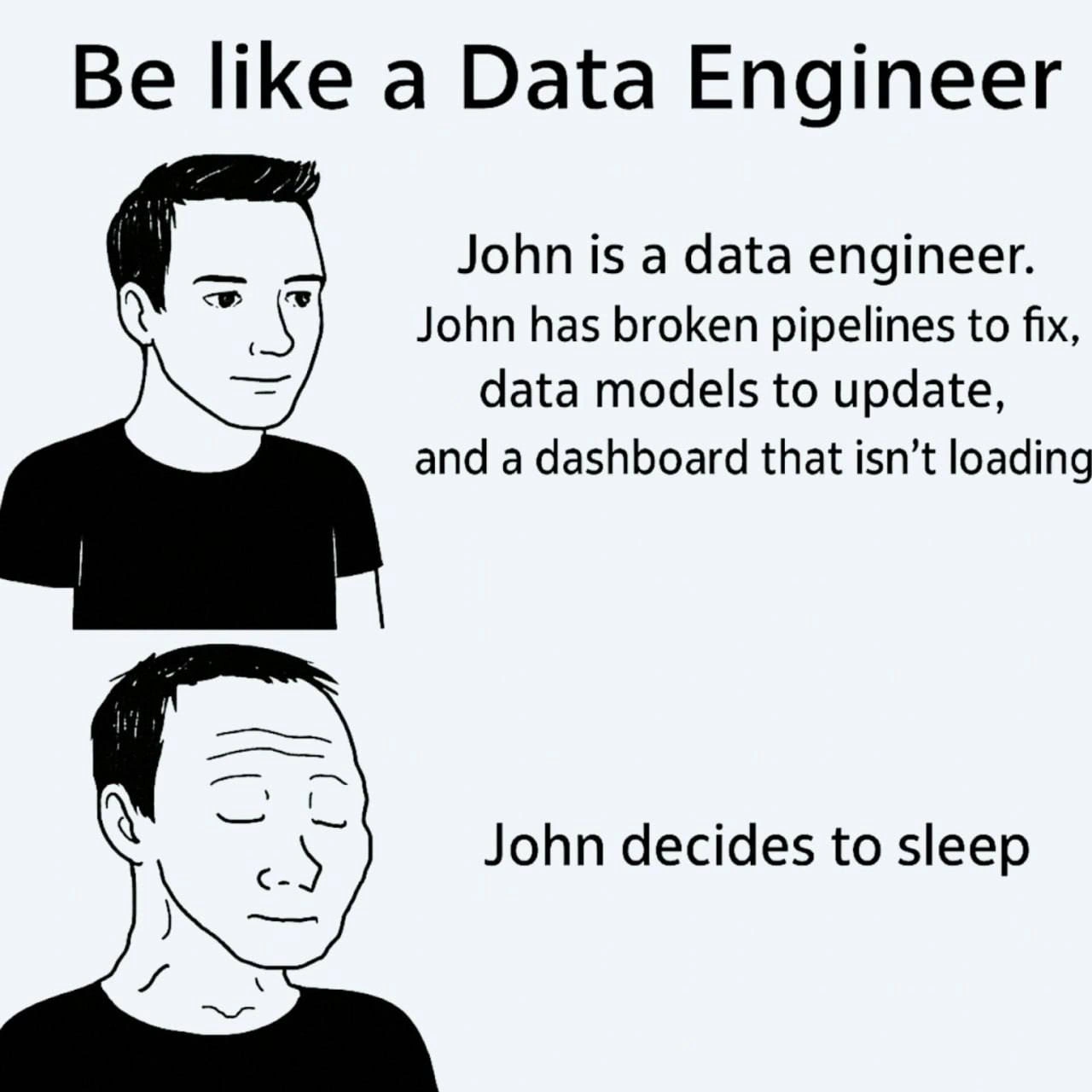
The meme is a simple two-panel black-and-white cartoon on a light grey background. Top header text reads, "Be like a Data Engineer" in bold. Panel 1 shows a torso-up silhouette of a generic male avatar (face blurred) next to right-aligned text: "John is a data engineer. John has broken pipelines to fix, data models to update, and a dashboard that isn’t loading." Panel 2 repeats the same avatar lower on the canvas with the caption to the right: "John decides to sleep." The humor contrasts catastrophic data-platform issues - failed ETL pipelines, stale schemas, and a Grafana dashboard timing out - against the engineer’s choice to preserve personal SLOs (sleep) rather than production SLOs. It plays on veteran data-engineering realities: endless Airflow red bars, 3 a.m. pager pings, and the sometimes-healthy decision to defer firefighting until daylight


Comments

14
Anonymous ★ Top Pick If the pipeline’s RPO can tolerate six hours, so can John’s REM cycle - true eventual consistency
  1. Anonymous ★ Top Pick

    If the pipeline’s RPO can tolerate six hours, so can John’s REM cycle - true eventual consistency

  2. Anonymous

    John knows the real secret to distributed systems: eventually consistent means consistently eventual, and the only thing that scales linearly with pipeline complexity is the probability it breaks at 3 AM. Besides, that dashboard has been 'almost ready' for six sprints - one more night won't hurt the P99 latency of disappointment

  3. Anonymous

    John understands that sometimes the best debugging strategy is to let the pipeline fail overnight and blame it on eventual consistency in the morning - after all, distributed systems are supposed to be resilient, and so should data engineers

  4. Anonymous

    When the DAGs are red and the dashboard says “no data,” run the only idempotent job left: sleep - eight hours of batch processing on the human scheduler beats a 3 a.m. hotfix every time

  5. Anonymous

    If the Airflow DAG has three retries, exponential backoff, and a 6am SLA, the most reliable runbook at 02:00 is sleep()

  6. Anonymous

    John's idempotent operation: sleep - rerun the pipeline tomorrow, because rested engineers achieve eventual consistency

  7. @whynotenp 1y

    Nah

  8. @OKomarov 1y

    John's pipeline broke three days ago. Nobody noticed. Except the SEO guy who thinks it's "a cache issue".

    1. @Mikle_Bond 1y

      To be honest, SEO guy is not exactly wrong, he does have cache issues.

  9. @nwordtech 1y

    Good sleep is a prerequisite

    1. @CcxCZ 1y

      Studies show that all the popular methodologies and tooling have order of magnitude smaller effect (if any) than being well rested.

  10. @grinya_a 1y

    If you are still paid, you do everything right

  11. Sure Not 1y

    John B Goodneough.

  12. @patsany_horosh_mne_v_dm_pisat 1y

    Off-topic, but it's currently 4am and I can't go back to sleep anymore

Use J and K for navigation