
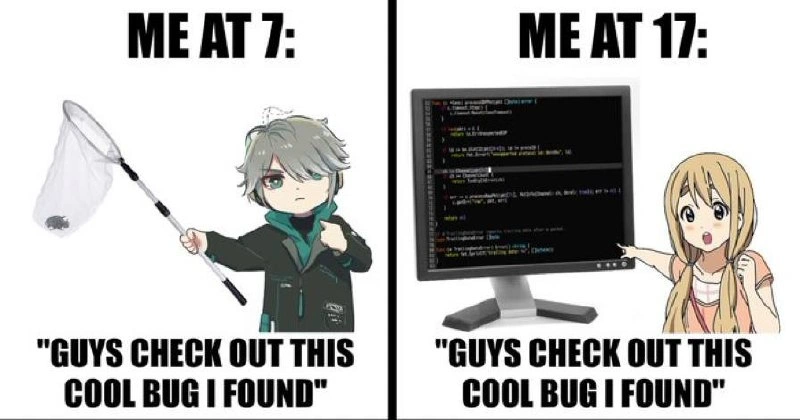
A Lifelong Passion for Finding Bugs, Literally and Figuratively
Description
A two-panel, anime-style meme comparing the interests of a person at two different ages. The first panel, labeled 'ME AT 7:', shows a young anime boy with grey hair holding a butterfly net that has captured an insect. The caption below reads, '"GUYS CHECK OUT THIS COOL BUG I FOUND"'. The second panel, labeled 'ME AT 17:', shows a blonde anime girl excitedly pointing at a computer monitor which displays lines of code in a dark-themed editor. A specific line is highlighted, indicating a discovery. The caption is identical: '"GUYS CHECK OUT THIS COOL BUG I FOUND"'. The meme is a pun on the word 'bug', humorously illustrating the transition from a child's fascination with insects to a teenage programmer's excitement at discovering a software bug

Comments
76Comment deleted
The thrill of finding a cool bug is timeless. The only difference is that at 17, you can't just put it in a jar and forget about it; you have to write a regression test
Seven-year-old me: beetle in a glass jar. Thirty-seven-year-old me: zombie thread in a Kubernetes pod - turns out we never outgrow bug collecting, we just pay for more expensive containers
The only profession where finding bugs after 10 years of experience still makes you excited enough to show everyone - though now it's because you finally found the root cause of that intermittent production issue that's been haunting your on-call rotation for months, not because it has pretty wings
The real character development arc isn't going from junior to senior - it's realizing that at 17 YoE you're still just as excited about finding bugs, except now they're race conditions in production instead of ladybugs in the garden. The butterfly net gets replaced with gdb, but the dopamine hit of 'I found it!' remains unchanged. Senior engineers don't lose their enthusiasm; they just redirect it toward increasingly esoteric edge cases that make their teammates question their sanity
Childhood bugs were finite and catchable; now they're recursive heisenbugs that vanish under observation
From butterfly net to Jira: the cool bug I found now only reproduces at p99 during cross‑region failover when retries ignore backoff; turn on debug and it vanishes - classic Heisenbug
At 7 a bug earned me a jar; at 17 it earns me a Jira, a SEV‑2, and permanent ownership of the module I didn’t know existed
Me at 27: "Guys i fixed this bug i found 10 years ago" Comment deleted
"Me at 7" ≈ boy "Me at 17" = girl "Me ar 27" = ? Comment deleted
a ghost Comment deleted
Me ar 27 = rawr :3 Comment deleted
enbie Comment deleted
Attack helicopter Comment deleted
I imagine an AI powered drone weapon that looks like Chrysalis from Metal Gear Solid Peace Walker. Comment deleted
Literally 😂 Comment deleted
smb whose pronouns are he/her (or smth?) Comment deleted
weaponized helicopter Can find better option than this. Comment deleted
he/him => she/her => was/were 🙃 Comment deleted
not funny, man. not funny Comment deleted
Boy became a femboy Comment deleted
he just got hired at software engineering position Comment deleted
the person who made that meme is trans btw Comment deleted
> she/her > rewrites stdlib based👍 Comment deleted
why did I read "me at" as "meat"? now I cannot un-see it Comment deleted
https://www.quora.com/Can-my-gender-pronouns-be-he-her Comment deleted
MEAT 7 Comment deleted
Are we going to talk about how he turned to a femboy? Comment deleted
That's not a femboy, that's a girl Comment deleted
Man, even worse, bro gender swapped Comment deleted
That's not a nice way to talk about trans folk Comment deleted
Man what is this taking me into 😐 I didn't mean it in any disrespectful way 😑 Comment deleted
Do trans exist? I ve never seen them Comment deleted
open your eyes then >:P Comment deleted
I mean, do they exist irl? Everyone can be everyone on the net, but... irl? Comment deleted
I do exist but I'm erased in my shitty country Comment deleted
yes, I met some. they're not (usually) visible in public transport and such Comment deleted
Oh, okay, so they are that mystic... Or maybe showing everyone your wiener is not polite? Now I get it Comment deleted
they have to hide it in public because they get beaten up for it, unfortunately Comment deleted
not their weiner, their transness I mean Comment deleted
The what Comment deleted
The impolite part is reducing trans people to their genitals Comment deleted
Oh, I'm sorry, but what else? Comment deleted
Like... presentation? not feeling shitty about one's body? gender euphoria? Comment deleted
I don't get it Comment deleted
You ever felt dissociation? Comment deleted
Never, I know what it is, but I never felt it Comment deleted
I just want to be a normal girl WHY THE FUCK WAS I BORN IN SUCH SCREWED BODY Comment deleted
Ah, now I understand So, it works like everyone could be everyone, and you can discover their gender only through talking? Comment deleted
It seems so? I mean, why do you need to know someone's gender (for any reason but identification in indirect dialogue)? It can be confusing if you misgender someone accidentally, but this is easily fixable and people who get annoyed at honest mistakes are shitty and unhelpful. Other than that, just... don't be a stubborn ass and do this on purpose and that's it, you won't have any other problem with a person whose preferences on what to call them you don't get. Comment deleted
I am literally trans Comment deleted
I've never seen you too, so I can't trust Comment deleted
my gf is trans and she exists irl (one meter away) Comment deleted
My gf is PDP-11 and is literally a great personality, how will you check it? Comment deleted
I won't, lmao why would I need to? Comment deleted
Maybe coz you don't believe? Comment deleted
why do you think so Comment deleted
So you believe everything on the net? Comment deleted
I don't "believe", I store in my memory "Someone said that <...>" about people selationship, and I don't need this to be proved in any way Comment deleted
Does she attend Computer Obsolescence Prevention Society meetings? https://samandmax.fandom.com/wiki/The_C.O.P.S.?so=search Comment deleted
oh congrats on that new name Comment deleted
? Comment deleted
transistors Comment deleted
trans sisters Comment deleted
what about other siblings Comment deleted
trans brothers Comment deleted
man i sure do love the rule that every programming related community sooner or later devolves into trans dispute is there an objective reason for that? Comment deleted
Difficult childhood often results in great abilities of conquering difficult fields like programming Comment deleted
i don't think that this is THAT decisive. if so, places like kosovo would be soon-to-be-silicon-valley-two. this also goes for trans people, i don't think the correlation is that big. pulling it out of my ass tho, i don't have a lot of experience talking to trans folks Comment deleted
If you drop trans from "who becomes a programmer" question it would still look like a difficult childhood is there most of the time. But "difficult childhood" is too broad of a term, and you pointed that out too. I honestly don't know how to describe the kind of difficulties that are so often tied to success in programming but I mean it's not like "living in Gaza sector" kind of difficult childhood Comment deleted
I think it's intrinsically linked to autism. Me, my gf, lots of my friends in STEM are all autistic or otherwise neurodivergent. And then trans people are also more likely to be autistic. So there's that. Comment deleted
not to be rude but that sounds like non-edgy and very sophisticated way to say "oh, excuse me, i'm just crazy". neurodivergent is also an umbrella term for people whose brains don't function like the norm and yet the norm is very, very vaguely defined. like, yes, making transition is not considered to be "normal" (walking on a very thin ice here, i don't have the vocabulary to phrase this better) behavior so that alone kinda makes you neurodivergent Comment deleted
I mostly agree with what you said, but I don't see how "I'm just crazy" is connected to whatever I said Comment deleted
it's me projecting and losing the thread. i don't think stamping "neurodivergent" on people is a solid explanation in itself, also i don't see any strong connection between technical stuff like programming and autism Comment deleted
Yeah, can't disagree with that, I guess Comment deleted
Alright, here's another possibility. Trans people are generally more isolated prior to coming out, because you don't feel like you're in the right place in groups of the assigned gender, and socialization with the right gender is complicated by how you are perceived. And STEM don't require that much socialization compared to social studies or whatever Comment deleted
looking at disciplines under STEM abbreviation, programming seems like the leader in terms of how much socialization one have to go through. like, mathematics is even more "i don't want to talk to anybody" type but i never notice that math communities are constantly arguing or joking on the topic of trans people. you can assume that coding lays in the perfect middle ground between social whoring and having no friends for this kind of things but it honestly feels like a reach to me Comment deleted