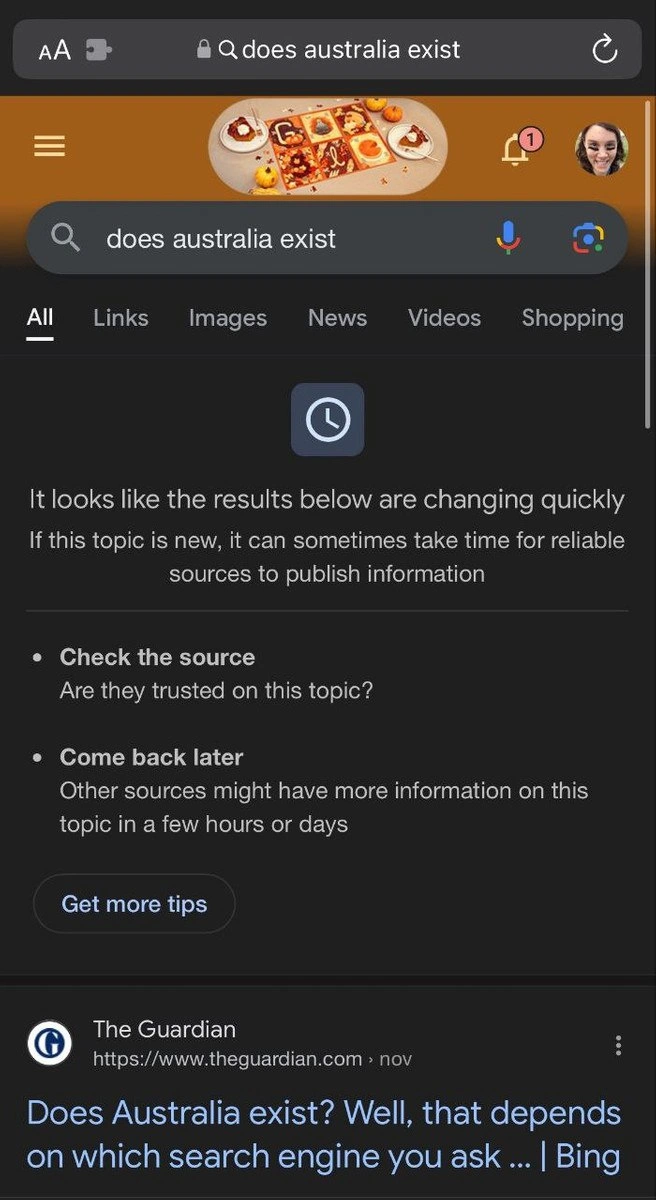
Search Engines Debate Australia’s Existence
Why is this Google meme funny?
Level 1: Asking If a Place Is Real
It is like asking a librarian whether Australia exists, and the librarian says, "Please come back later, experts are still checking." The funny part is that the question should be easy, but the computer treats it like breaking news. The machine is trying to be careful, and that makes it sound silly.
Level 2: Search Is Not Truth
A search engine finds and ranks pages. It is not simply a truth machine. It looks at many signals to decide which results to show and what extra warnings or panels to display.
The warning in the screenshot is probably meant for topics where new information is appearing quickly. For example, if something just happened, early pages might be incomplete, wrong, or low quality. Google tells users to be careful because better sources may appear later.
The meme becomes funny because the query is not really new or uncertain. Australia is a real country and continent-region in ordinary geography. So the warning feels wildly overcautious. It is like asking "is water wet?" and being told to return after official sources finish investigating.
The result below mentions Bing, which makes the joke about competing search engines and data accuracy. Different systems can rank different pages, summarize information differently, or react differently to unusual queries. If a strange article or conspiracy-flavored page is getting attention, the search interface may treat the surrounding topic as active even when the underlying fact is obvious.
For newer developers, this shows why building search and recommendation systems is hard. A system has to handle normal questions, jokes, bad-faith queries, misinformation, news, old pages, new pages, and ambiguous wording. Sometimes the same safety feature that helps with real misinformation makes a normal fact look suspicious.
Level 3: Continental Eventual Consistency
The screenshot shows a mobile Google search for:
does australia exist
That should be one of the least time-sensitive questions available to a search engine. Yet Google displays a warning card:
It looks like the results below are changing quickly
It then recommends Check the source and Come back later, as if the existence of Australia is a developing story and reliable sources may need a few hours to confirm whether an entire continent is still compiling. Underneath, a Guardian result appears with the title:
Does Australia exist? Well, that depends on which search engine you ask ... | Bing
The joke is the collision between a sensible safety feature and an absurd query. Google's warning card is designed for topics where information is genuinely unstable: breaking news, active crises, viral claims, fast-moving public events, or newly indexed controversy. It encourages users not to overtrust early results. That is good product design in the right context. Here, the query is so stable that the warning makes the search engine look like it has entered a philosophical incident.
For developers, this is a beautiful example of heuristic systems behaving correctly by their own rules and ridiculous by human standards. Search engines do not "know" facts the way a person does. They assemble signals: freshness, source authority, query intent, news velocity, spam risk, user behavior, matching documents, language models, knowledge graph confidence, and ranking experiments. If enough signals suggest volatility around a phrase, a warning can appear even when the literal question is silly.
The Guardian result about Bing adds the platform-rivalry spice. It turns the query into a joke about search engines disagreeing on reality. That is especially pointed in the era of AI-assisted search, where systems can summarize, infer, overfit to weird web text, or confidently reflect fringe claims. The search box becomes less like an encyclopedia and more like a mirror held up to the internet's untreated dataset.
The funniest part is that Google's advice is technically reasonable in isolation. Check the source is good advice. Come back later is good advice during breaking news. But applied to "does australia exist," it sounds like Google is politely asking everyone to wait for peer review from geography.
Description
The image is a mobile browser screenshot in dark mode with the address/search bar containing "does australia exist" and the Google search box showing the same query. Search tabs visible include "All," "Links," "Images," "News," "Videos," and "Shopping." Google displays a warning card saying, "It looks like the results below are changing quickly" and explains that if the topic is new, reliable sources may take time, with bullets "Check the source" and "Come back later," plus a "Get more tips" button. Below that is a Guardian result titled "Does Australia exist? Well, that depends on which search engine you ask ... | Bing," turning a search-quality failure into an absurd debate about whether a country exists.
Comments
8Comment deleted
Search engines discovered eventual consistency and briefly applied it to continents.
Just elgoog it Comment deleted
Australia? What is this? Comment deleted
An imaginary place far far away where people are supposed to walk upside down and fancy animals carry their children in bags. That a joke. Comment deleted
What? Australia wasn't a typical food from Mexico or something like that? Comment deleted
Food? I thought Mexico is a drug. Comment deleted
ah austria you mean, right? Comment deleted
yeah, Austria exists, but they misspelled it Comment deleted