Skip to content
DevMeme
5214 of 7435
Adversarial Fingers for Surveillance Footage
AI ML Post #5716, on Nov 29, 2023 in TG

Adversarial Fingers for Surveillance Footage

Why is this AI ML meme funny?

Level 1: Fake-Looking Real Life

Imagine someone wears a silly fake finger so a security camera picture looks like a bad cartoon. Then they say, "That picture cannot be real, look at the weird hand." The joke is that computers got so famous for drawing hands badly that a real person could copy the mistake to make reality look fake.

Level 2: AI Hands as Evidence

AI-generated content means images, video, audio, or text created by machine-learning systems. Many image generators improved quickly, but for a long time one of their most visible weaknesses was drawing hands correctly.

That weakness became a common internet detection trick. People would look at a picture and ask:

  • Are there too many fingers?
  • Do the fingers merge together?
  • Are the joints wrong?
  • Does the hand attach strangely to the wrist?
  • Is the same body part inconsistent across the image?

The meme imagines someone exploiting that habit in real life. If surveillance footage shows a person with an impossible-looking hand, people might suspect the footage is fake or AI-generated. The prosthetic finger in the photo turns a visual bug associated with AI into a physical costume prop.

Adversarial attacks are attempts to fool a system by crafting inputs that exploit its assumptions. Here, the "system" is not only an AI model. It is also the human process of judging authenticity. The attacker is not trying to make AI generate a bad hand; they are making a real camera record a hand that looks like an AI mistake.

For developers and security teams, the practical lesson is that detection rules need humility. If a rule becomes widely known, people can imitate the signal. "Too many fingers" might be a clue, but it cannot be the whole investigation. Good forensic analysis needs multiple independent signals, not one visual tell that the internet learned last week.

Level 3: Plausible Finger Denial

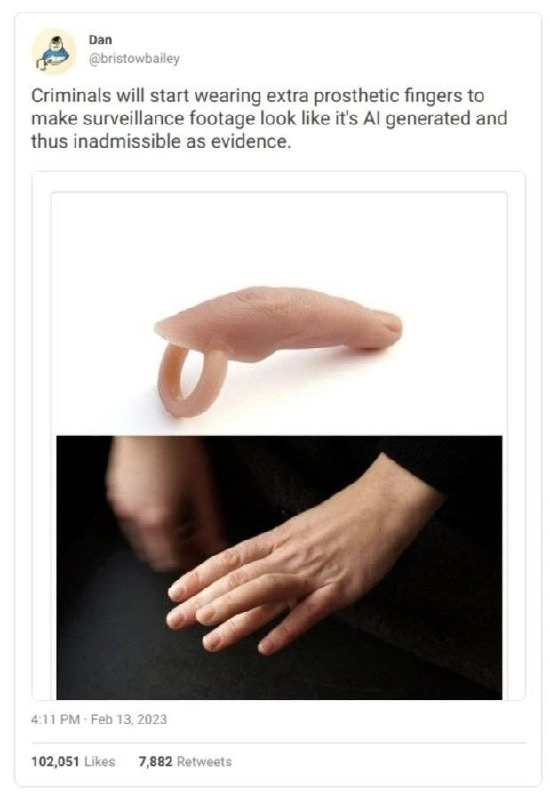
The tweet in the screenshot says:

Criminals will start wearing extra prosthetic fingers to make surveillance footage look like it's AI generated and thus inadmissible as evidence.

Below it are two photos: one of a flesh-colored prosthetic extra finger, and one of a hand wearing or demonstrating an added finger. The joke is brutally efficient because early AI image generators became famous for producing bizarre hands: too many fingers, melted fingers, doubled joints, impossible palms, and anatomy that looked assembled by a committee with no wrist experience.

The technical joke is a physical-world adversarial attack, but aimed at humans and institutions as much as algorithms. Traditional adversarial examples often mean perturbing an input so a machine-learning model misclassifies it. This meme flips the idea around: instead of changing pixels to fool a model, change reality to make future pixels look suspicious. The extra finger becomes an authenticity exploit against the viewer's learned heuristic: "bad hands mean AI-generated."

That heuristic was useful for a while because generative models struggled with hands. Hands are high-variation, partially occluded, structurally constrained, and semantically important. A model has to understand not just "skin-colored appendages near a wrist," but count, pose, perspective, contact, articulation, and whether the same hand remains consistent across the image. When models failed, users learned to inspect fingers as a cheap forensic shortcut.

The meme's darker insight is that every cheap forensic shortcut eventually becomes attack surface. Once people believe "six fingers means fake," a real six-finger-looking artifact can be used to create doubt. That does not automatically make evidence inadmissible; courts and investigators care about chain of custody, source systems, metadata, corroborating evidence, expert testimony, and whether the footage can be authenticated. But the joke is plausible enough to sting because generative AI has made "is this image real?" a mainstream question.

Security people recognize the pattern immediately. A detector creates a rule, attackers learn the rule, then the rule becomes part of the game. Spam filters, malware signatures, CAPTCHA systems, plagiarism detectors, bot detection, fraud scoring, deepfake detection: all of them become adversarial once the other side has incentives. The prosthetic finger is funny because it is so low-tech. No GPU cluster, no model inversion, no GAN pipeline. Just a fake digit and the legal strategy of "your honor, look at the hand."

Description

The image is a screenshot of a tweet by Dan, handle @bristowbailey. The tweet text says, "Criminals will start wearing extra prosthetic fingers to make surveillance footage look like it's AI generated and thus inadmissible as evidence." Beneath the tweet are two photos: one shows a small flesh-colored prosthetic extra finger piece on a white background, and the other shows a person wearing or demonstrating an extra finger near a real hand. The bottom of the tweet shows "4:11 PM · Feb 13, 2023" along with "102,051 Likes" and "7,882 Retweets," making the joke a physical-world adversarial attack against AI-era image authenticity assumptions.

Comments

5
Anonymous ★ Top Pick The cheapest adversarial example for computer vision is apparently a fake finger and a lawyer who knows GANs are bad at hands.
  1. Anonymous ★ Top Pick

    The cheapest adversarial example for computer vision is apparently a fake finger and a lawyer who knows GANs are bad at hands.

  2. @s2504s 2y

    mem - shut up and take my money

  3. @beton_kruglosu_totchno 2y

    can i shitpost faster with that?

  4. @Autoscatto 2y

    Fake It's an old art project

  5. @Autoscatto 2y

    https://nadjabuttendorf24.com/fingerring.php

Use J and K for navigation