The Beacon of Hope: That One Supportive Senior Engineer
Why is this Juniors meme funny?
Level 1: One Superhero Friend
Think of it like being the new kid at school. On your first day, you’re lost in the hallways and worried about asking questions. Most of the older kids either ignore you or act too cool to help. But there’s one older student who smiles and says, “Hey, need help finding your class? I can show you around.” They even sit with you at lunch and help you understand your homework. How would you feel about that person? Probably really happy and relieved! To you, that one friendly face would seem like a superhero friend. You’d look up to them because they’re the only one making you feel welcome while you’re confused and nervous.
In this meme, the junior engineers are like the new kids, and the kind senior engineer is like that helpful older student. The juniors are all gazing at this one senior with big admiring eyes, almost as if the senior is a celebrity or a hero. It’s funny and sweet because being nice and helpful should be normal, but at work it sometimes feels so special that people treat that kind person like a star. The picture even shows a smiling person with a bunch of hot sauce bottles, like they’re on a TV show being admired. That’s just a silly way to say: the juniors are really grateful to the one senior who helps them out, and they practically idolize them for it. The humor comes from the exaggeration (comparing a helpful coworker to a famous talk-show guest), but the feeling behind it is real – when you’re new and someone kindly guides you, it truly means the world.
Level 2: RTFM-Free Zone
Let’s break this down in simpler terms. In a software team, a junior engineer is someone who’s new to the field or the company’s codebase – they’re still learning the ropes. A senior engineer is someone with years of experience who’s expected to know the system well and often helps guide others. Ideally, seniors should teach and support juniors (this is what we mean by mentorship: an experienced person guiding a less experienced one). Good communication is key in this relationship: it means answering questions clearly, sharing knowledge, and not making the other person feel dumb for asking.
Now, what usually happens in real life developer culture? Sometimes seniors are super busy or they’ve answered the same basic question 50 times, and they get a bit impatient. Some might respond with something like RTFM – which stands for “Read The Fine Manual” (polite version; the F often stands for a not-so-polite word 😅). RTFM is basically a snappy way of saying “Go find the answer yourself in the documentation.” It’s not a friendly reply. For a junior who’s already struggling, being told RTFM or “just Google it” feels like a cold shoulder. It’s like asking a question in class and the teacher saying, “Did you even read the textbook?” – technically it might be true that the info is out there, but it sure doesn’t feel encouraging. This attitude creates an environment where new developers feel afraid to ask anything, because they don’t want to be brushed off or made to feel slow. That’s the attitude problem the meme is talking about – some seniors help, but with an eyeroll or a tone that screams “you’re bothering me.”
Now imagine the opposite: a senior developer who is happy to help, without any attitude. They remember what it was like to be new. When a junior timidly asks, “Hey, I’m stuck on this function, could you explain how it works?”, this kind senior doesn’t sigh or sneer. Instead, they smile and say, “Sure, let’s take a look together.” No sarcasm, no “you should know this”. They might even walk the junior through the code or do a quick knowledge sharing session. For the junior engineers, this person is a lifesaver. They learn more in 30 minutes with a kind mentor than in a whole day of banging their head against the keyboard in confusion. Over time, juniors start to gravitate towards the one approachable senior on the team, because they know “This is a safe person to ask, I won’t be judged.”
To illustrate, here’s a typical scenario versus the ideal scenario:
Junior Dev: "I'm really struggling with this bug. Could you help me figure it out?"
Typical Senior: "Sigh Did you even search the documentation? It’s all in the wiki."
Helpful Senior: "Sure thing! Let’s debug it together. Walk me through what you’ve tried so far."
See the difference? The Typical Senior (who has an attitude) basically says, “Figure it out yourself,” which is discouraging. The Helpful Senior invites the junior to collaborate and learn, which is encouraging. The meme celebrates that helpful attitude.
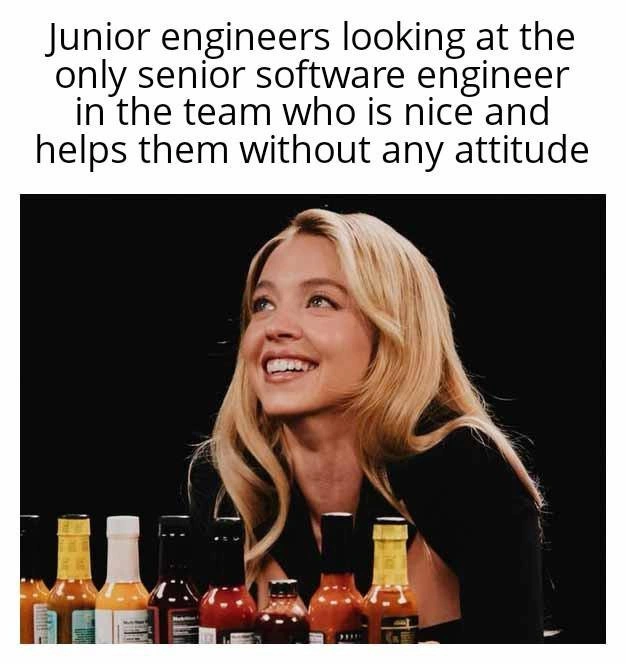
Now let’s talk about the picture. The image is from a meme template using the Hot Ones interview show. If you haven’t seen it, Hot Ones is a popular YouTube series where a host interviews celebrities while they all eat chicken wings coated in progressively hotter hot sauce. In front of the guest, there’s always a lineup of colorful hot sauce bottles (each one is a different spice level, and they get insanely spicy by the end). The meme shows a guest at the Hot Ones table – she’s smiling big, looking super appreciative (probably because she just survived a really spicy wing!).
In the context of this meme, that smiling Hot Ones guest represents the kind senior engineer. Why Hot Ones? Well, on that show, the guest is often respected or cheered on for enduring the “heat.” Viewers watch them closely, impressed by how they handle those burning hot sauces. The meme jokes that junior engineers look at the nice senior in the same awed way – like fans watching their favorite celeb keep cool under pressure. The juniors are effectively the audience, and the senior is the “celebrity” who’s handling all the spicy challenges (think of the tough debugging sessions or crazy production bugs as the hot wings). The line of hot sauce bottles in front of the smiling person is a nod to all those challenges. It’s a funny visual metaphor: the senior has faced the worst “heat” (complex issues at work) and still remains friendly and helpful (smiling, not breaking a sweat), so the juniors can’t help but admire them.
This scenario is extremely relatable in the software world. It touches on team dynamics and corporate culture in tech companies. Often, knowledge becomes concentrated with a few people (we call that a knowledge silo when only one person or a small group knows critical information). Ideally, knowledge should be shared, but that requires effort and a good attitude. The meme’s caption – “Junior engineers looking at the only senior software engineer in the team who is nice and helps them without any attitude” – perfectly sums up that feeling of gratitude and almost hero-worship juniors have for that one mentor figure. It’s poking fun at the reality that such a positive mentorship dynamic is rare enough to be meme-worthy. In many teams, newbies really do swarm around the one friendly expert because that’s their lifeline. It’s developer humor with a wholesome twist: it makes you chuckle, but also nod in agreement. If you’re a junior, you might be thinking of that one senior who helped you learn the codebase. If you’re a senior, maybe it reminds you to be that person, or makes you chuckle if you are that person getting all the questions. Either way, it’s a lighthearted call-out that in tech (and anywhere), knowledge sharing and kindness go a long way – and people definitely notice and appreciate it.
Level 3: Single Point of Kindness
In a sea of stressed-out coders and siloed knowledge, this meme highlights a TeamDynamics scenario every veteran recognizes: the one senior engineer who hasn’t lost their empathy. On many teams, finding a senior developer who actually enjoys mentoring juniors (and does so without an ego-trip) feels as rare as encountering a unicorn in the office. The humor here comes from how corporate culture often sets the empathy bar so low that simply being helpful and attitude-free makes you a legend. It’s both funny and a bit tragic – the meme exaggerates juniors gazing at that kind senior as if they’re a superstar on a talk show, because frankly, in a lot of workplaces, a senior who shares knowledge without condescension is a star.
Why is this so relatable? Many of us have seen the flip side: a newbie asks a question and gets a curt “did you even search Google?” or a RTFM reply. (For the uninitiated, RTFM stands for “Read The F***ing Manual,” the classic grumpy guru response that roughly translates to "figure it out yourself".) We’ve all worked with brilliant senior devs who, despite their skill, radiate an aura of unapproachability. They guard their knowledge like a dragon hoarding gold, perhaps unintentionally creating a knowledge silo. Juniors tiptoe around, afraid that asking for help will invite eye-rolls or a link to a dense 300-page spec. In this context, a senior who is patient, approachable, and willing to explain things is basically a hero. It’s downright sad (and darkly comic) that “not being a jerk” is enough to earn celebrity status, but here we are.
This meme pokes fun at entrenched DeveloperCulture norms. In an ideal world, senior engineers embrace mentorship as part of the job – doing code walkthroughs, explaining architecture decisions, encouraging questions. That’s how knowledge spreads and teams grow stronger. In reality, tight deadlines, burnout, or plain old ego often interfere. Some seniors survived a trial-by-fire themselves (late nights scouring Stack Overflow and cryptic docs) and subconsciously think, “I suffered, so you should too.” Others fear that if they spend time hand-holding juniors, they’ll fall behind on their “real work.” The result? Juniors end up isolated, grappling with imposter syndrome, and the team’s Bus Factor for critical knowledge drops to a perilously low number (often 1, centered on whoever wrote that code originally). When one kind senior breaks this cycle by freely sharing knowledge, it’s a breath of fresh air – and yes, every newbie in earshot will flock to them like they’re giving out free concert tickets.
Let’s talk about that Hot Ones reference in the image. Hot Ones is the YouTube show where celebrities get interviewed while eating increasingly spicy chicken wings. By the last wing, most guests are sweating, crying, or laughing through the pain, and viewers are in awe if they make it to the end. In the meme’s screenshot, the guest (face all smiles, framed by a lineup of hot sauce bottles) is analogous to our helpful senior engineer. It’s an ironic choice: the juniors view this senior with the same mix of admiration and intense focus as an audience watching their favorite celebrity conquer the spiciest wing. The row of hot sauces is like the gauntlet of production fires or hairy bugs this senior handles calmly. They can take the heat of on-call pages at 2 AM without melting down, and they’re willing to pass the hot sauce (i.e., share the know-how) instead of gatekeeping it. The juniors, much like Hot Ones fans, are leaning forward, eyes shining, practically cheering, “Look at them go – they handled the ‘Atomic Reaper 2.0’ of code bugs and even taught us something along the way!” The whole scene is a perfect mashup of RelatableDeveloperExperience and pop-culture humor: in a world where helping others is spicy and high-stakes, the one person who does it with a smile gets treated like the show’s champion. In short, this meme gives a knowing wink to all engineers: good mentorship is so valuable (and apparently so rare) that it turns a regular day at the office into an episode of Hot Ones, complete with a much-admired hero.
Description
This is a meme composed of text above an image. The text at the top reads, 'Junior engineers looking at the only senior software engineer in the team who is nice and helps them without any attitude'. Below the text is a photograph of actress Sydney Sweeney. She has blonde hair, is wearing a black top, and is smiling warmly while looking up and to her left with a clear expression of admiration and gratitude. In front of her is a row of various hot sauce bottles, indicating the image is from her appearance on the popular YouTube interview show 'Hot Ones'. The background is completely black. The meme humorously and accurately captures the feeling of relief and adoration that junior developers have for a senior mentor who is patient, approachable, and willing to share knowledge without condescension. In many tech environments, senior engineers can be perceived as grumpy, busy, or intimidating, which makes a genuinely helpful one an invaluable asset to a team. For experienced developers, this meme is a wholesome reflection on the importance of mentorship and the positive impact a senior's attitude can have on team culture and the growth of junior colleagues
Comments
16Comment deleted
That one supportive senior is basically a human linter for a junior dev's confidence, catching imposter syndrome errors before they can be committed to the main branch
Being the only approachable senior is like running the Hot Ones gauntlet: it starts with “why won’t my Docker container start?” mild sauce, and by Da Bomb you’re choke-explaining cache coherence while your sprint board quietly bursts into flames
After 20 years in tech, I've learned the rarest skill isn't knowing how to implement a distributed consensus algorithm or optimize a B-tree - it's remembering what it felt like to not know these things and having the patience to explain them without making someone feel stupid
The truly senior engineer knows that 'RTFM' is less effective than 'let me show you where that's documented and why it matters' - because the best code review is the one that teaches, and the best architecture decision is the one the whole team understands. After 15+ years, you realize your legacy isn't the systems you built, it's the engineers you helped level up
Be kind long enough and you become a human API gateway for tribal knowledge - zero rate limits, a bus factor of 1, and queries that get progressively spicier after each failed deploy
To the juniors, that senior is a low-latency API with no rate limits; to the architect, it’s a critical SPOF - empathy factor: 1
Rarer than a dependency bump without breakage: the senior who mentors juniors without hoarding the prod creds
Senior software engineers looking at the junior engineer that can google and debug most problems himself, instead of yanking someone for help every 5 minutes Comment deleted
😂😂😂 Comment deleted
Contractor engineer looking at the onsite engineer? Comment deleted
They don't look like this.....man Comment deleted
can’t remember any cutie like this one at work looking at me Comment deleted
The downside of working remotely? Comment deleted
I've seen such story once. Marriage happened a year later😁 Comment deleted
maybe, but at the office we didn’t had cuties like that working on the same software engineering department Comment deleted
of course they're nice if you've already had googled and researched the problem but didn't find any solution Comment deleted