A Developer's Prayer: The Agony of the Two-Hour Meeting
Why is this Meetings meme funny?
Level 1: Not a War, Just a Chore
Imagine your teacher asks you to sit still and listen for a while, or your parent tells you to clean your room for 30 minutes. It’s not a huge deal, right? But you really don’t want to do it, so you groan and whine like it’s the hardest thing in the world. You say, “Why do I get the hardest job? This is unbearable!” Meanwhile, your parent looks at you and replies, “It’s literally just cleaning your room.” In this simple story, you’re acting like a small chore is as scary as fighting a big dragon, and your parent is reminding you that you’re exaggerating. That’s exactly what’s happening in this meme. The programmer is complaining dramatically about having to be in a long meeting, as if he was sent on an impossible mission. The “boss” or the person in charge is basically saying, “Relax, it was just a normal meeting.” We find it funny because the developer is acting like he had to battle a monster, when really he just had to do a boring, ordinary task. It’s a silly exaggeration that anyone who’s hated doing something simple can understand.
Level 2: Coding vs Meetings
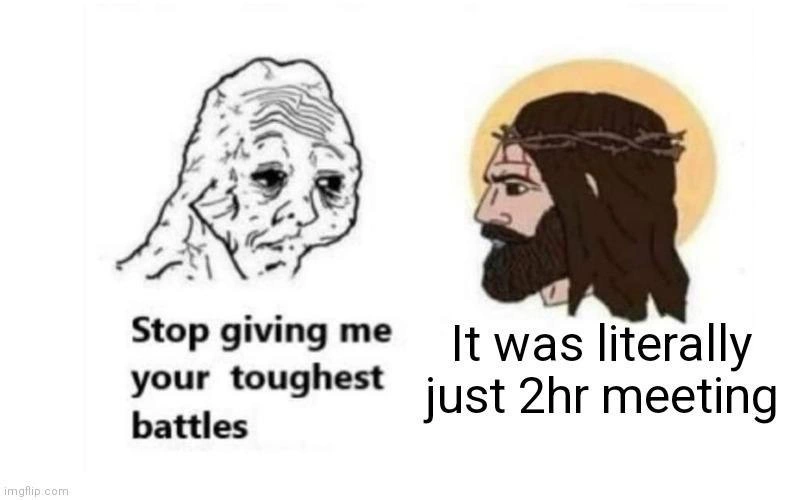
On the left side of the meme, we see a drawn character (the Wojak meme figure) looking old, tired, and defeated. He’s saying, “Stop giving me your toughest battles.” In this context, he represents a frustrated developer who feels utterly worn down. On the right side, there’s a calm figure with a halo and a crown of thorns – basically drawn like Jesus – replying, “It was literally just 2hr meeting.” Here, that haloed figure stands in for the boss or the universe responding. The contrast is the joke: the developer is acting like he was sent on some incredibly hard mission, but the reality is he only had to sit through a two-hour meeting.
Why would a two-hour meeting feel like a “tough battle” to a developer? In software teams, a status meeting (often weekly or biweekly) is when everyone sits together (or joins a call) for a long time to talk about progress, updates, or plans. Two hours is actually a pretty long meeting — imagine spending from 10:00 AM until lunchtime just talking or listening, instead of coding. Developers find such long meetings painful because it means two hours not writing code, not solving bugs, and often just hearing information that might only partly relate to their work. This leads to what we call meeting fatigue: feeling mentally exhausted and bored after too much discussion. It’s a real phenomenon in modern workplaces (ever hear people joke about “Zoom fatigue”? It’s the same idea – talking at a screen or in a room for hours drains you).
Now, corporate culture sometimes demands lots of meetings. In big companies or even startups following industry habits, you’ll have meetings to align the team, to report to management, or to brainstorm. They’re supposed to help everyone stay on the same page. But for a developer who needs concentration to be productive, these meetings can feel like an interruption or even a hindrance. Developer productivity is generally highest when a programmer can immerse themselves in writing and thinking about code for extended periods. For example, if you’re deep into building a feature and then have to stop for a meeting, you lose your momentum. When the meeting is over, you might need time to re-focus on where you left off. That’s why the meme exaggerates the meeting as a “toughest battle” — it’s poking fun at how something as simple as sitting in a chair and talking for a couple of hours can feel brutally hard to someone who just wants to be coding.
The humor also comes from the gaming reference. The meme title compares the meeting to an “epic boss fight.” In video game terms, a boss fight is the challenging final fight against a big enemy (the boss) at the end of a level or quest. It’s usually tough and requires a lot of effort and strategy. By saying a 2-hour status meeting felt like an epic boss fight, the developer is joking that this ordinary work task was as hard and draining as a big battle in a game. Of course, in reality a meeting isn’t a life-and-death struggle – but subjectively, it feels like a battle of endurance. The left panel text “Stop giving me your toughest battles” is actually a popular meme phrase people use humorously to complain about small hardships. It’s as if the developer is telling his manager or fate, “Why are you making me suffer with these horribly hard tasks?” and the manager/fate (depicted as the Jesus-like figure) is bewildered, replying, “Dude, it was just a normal meeting.” This format, using the Wojak and Jesus meme template, is common online to mock people who over-dramatize minor inconveniences. In our case, the minor inconvenience is just a long meeting on the calendar.
So, put simply: the developer is very frustrated and acting like surviving that meeting was some heroic feat. The boss (or whatever higher figure) is basically saying, “It wasn’t a big deal at all.” That mismatch is exactly why the meme is funny to those of us in tech. We’ve all been that developer internally groaning “ugh, why are you torturing me with this meeting,” while the management genuinely thinks a meeting is no big ask. It’s classic MeetingHumor in the tech world – taking a normal workplace scenario and blowing it comically out of proportion to highlight the developer frustration involved. After all, many of us programmers find writing code to be the enjoyable part and sitting in meetings to be, well, the toughest battle of the week.
Level 3: Boardroom Boss Fight
To a seasoned engineer, this meme elicits a pained chuckle of recognition. It captures that feeling when a routine status meeting turns into an endurance trial. The left panel’s developer is drawn like a battle-worn soldier for comedic effect, and honestly, that’s how a marathon meeting feels when you have code waiting. We’ve all emerged from a marathon planning or design review meeting rubbing our eyes as if we just fought a raid boss. Why is it funny? Because it’s relatable pain. In the game of corporate Meetings, a two-hour all-hands or planning session can deplete your HP (Headache Points) more than debugging a critical crash. The humor comes from exaggeration: a dev acting like they survived an epic boss fight when really they were just stuck on Zoom or in a conference room listening to quarterly roadmap slides. But there’s truth under the joke — many developers would honestly prefer a tough coding challenge over sitting idle in a long meeting that “could have been an email.”
From an experienced developer’s perspective, meetings are the mini-bosses scattered through the week, and a two-hour one is the final boss of Friday afternoon. It’s not that talking for two hours is physically hard; it’s that it clashes with how engineers get work done. Good coding requires concentration and extended deep work periods. Each long discussion feels like a timeout just when you’re about to solve the puzzle in code. There’s even a well-known concept in tech circles called the maker’s schedule vs manager’s schedule. Developers (makers) need large uninterrupted blocks to create and build. Managers operate on hourly blocks, hopping between meetings – for them, a 2-hour meeting is just another Tuesday. So when the right panel deadpans “it was literally just a 2hr meeting,” that’s the manager or team lead perspective: What’s the big deal? They schedule these things all the time as part of corporate culture. But to the developer, that meeting was a hulking beast guarding the day’s productive hours, a boardroom boss battle preventing them from shipping code.
This meme nails a specific WorkplaceHumor dynamic: the disconnect between how managers and engineers perceive time. The developer’s agony is played up (the dramatic “Stop giving me your toughest battles” line) to mock our tendency to be overly dramatic about common corporate rituals. Yet, ask any coder and they’ll confirm: back-to-back meetings drain you. It’s a very real MeetingFatigue. After two hours of feature updates, budget discussions, or sprint retrospectives, your brain is fried and your motivation is often dead on arrival. You end up staring at your IDE post-meeting, feeling like you need a coffee and a nap before you can resume work. In other words, the struggle is real — and that’s what makes it so funny when framed as a melodramatic meme. It’s poking fun at our own exaggerated despair while simultaneously commiserating with every developer who’s ever thought, “why was that meeting so painful?” The meme resonates because it’s a shared inside joke about MeetingOverload in tech: surviving a pointless long meeting can weirdly feel like an achievement of the day (achievement unlocked: Made it through the status update!). The boss fight might be tongue-in-cheek, but the battle scars (lost time and frayed patience) are 100% real to any developer who’s been there.
Level 4: Context-Switch Hell
Think of a developer’s brain like a CPU core running a heavy process. When they’re coding, they’re in full flow state – all caches warm, registers loaded with context, pipeline humming along. Now imagine a sudden interrupt: a calendar notification for a 2-hour meeting. The developer’s mental process gets preempted. Just like an operating system performing a context switch, they must save all that state (their place in the code, the problem they were juggling in their head) and load a completely different “thread” — the meeting agenda. This isn’t instantaneous; it’s pure overhead. In computing terms, the caches get flushed. The next time our dev returns to coding, it’s a cold start: all the variables of the problem they were solving have been paged out of memory. They’ll spend 15+ minutes just swapping their brain’s cache back in, re-reading code to rebuild context.
If meetings are infrequent, a modern “processor” (the experienced dev) can handle the occasional interrupt. But a two-hour meeting is a time quantum so large it’s like putting the CPU to sleep. By the time the meeting ends, the original process (coding) has lost all momentum. In OS terminology, excessive context switching leads to thrashing – the system spends more time switching tasks than doing work. A day filled with long meetings causes exactly that: the developer’s mind thrashes between contexts with zero throughput on actual code. No wonder it feels hellish. The meme jokes that a “simple” meeting became the toughest battle, and on a technical level, it’s because forcing a focused programmer to context-switch like this blatantly violates how efficient task scheduling should work. From a systems perspective, what seems like “just a 2hr meeting” is actually a massive scheduling interruption with all the hidden costs – the toughest boss fight isn’t coding the hard algorithm, it’s reclaiming your stack after the meeting monster ate your execution time.
Description
This is a two-panel meme contrasting a developer's suffering with the trivial cause. On the left, a withered, exhausted-looking Wojak character pleads with a divine entity, with the caption: 'Stop giving me your toughest battles'. This character appears aged and in anguish. On the right, a figure resembling Jesus Christ, drawn in the calm and confident 'Chad' meme style with a crown of thorns and a halo, responds with the caption: 'It was literally just 2hr meeting'. The visual joke lies in the dramatic gap between the developer's perception of a long meeting as an epic, soul-crushing trial and the mundane reality of the situation. A watermark for 'imgflip.com' is visible in the bottom left corner. The meme is a pointed commentary on corporate meeting culture and its effect on developer productivity and mental health. For software engineers, long meetings are not just boring; they break 'flow state,' the deep concentration required for complex problem-solving. This interruption is costly. The meme humorously exaggerates this pain to a level of religious suffering, a feeling many senior developers can relate to after sitting through countless unproductive status updates, planning sessions, or workshops that could have been an email
Comments
11Comment deleted
I survived another three-hour 'sprint planning' meeting where the only thing sprinting was my will to live
Sure, it was “just a 2-hour meeting,” but my L1 - L3 caches have been cold ever since - reloading the entire microservice graph into my head is a full-day rebuild
The real miracle isn't turning water into wine - it's surviving a 2-hour sprint retrospective where the PM discovers 'synergy' halfway through and pivots the entire roadmap while the architect silently calculates their BATNA for the third time this quarter
The real O(n²) complexity isn't in your algorithm - it's in your calendar, where every meeting spawns two follow-up meetings to discuss what was discussed. Senior engineers know the toughest battle isn't debugging a race condition at 3 AM; it's maintaining consciousness during a two-hour 'alignment sync' where 47 minutes are spent waiting for Bob to unmute, and the actual decision could've been an async Slack thread. The theological irony here is perfect: we pray for architectural challenges and distributed systems problems, but God sends us recurring calendar invites with no agenda
A 2-hour meeting is stop-the-world GC for humans - everything pauses, your working set gets evicted, and the only thing reclaimed is a follow-up meeting
Jesus carried the cross; we carry the 'quick 2hr architecture sync' - same weight, less redemption
That “just a 2hr meeting” with a dozen people is 24 engineer-hours - aka a perfectly orchestrated, org-wide stop-the-world GC
Once had a stand up that turned into a 3hr meeting which was basically just two people talking and everyone else waiting. Actual warcrime Comment deleted
I just mute and do some house chores/ play video games Comment deleted
Same, in other cases I just left this useless meeting Comment deleted
"just" Comment deleted