Junior Developer Looks at Senior Like a Dog During Production Deployment
Why is this Juniors meme funny?
Level 1: Puppy Dog Eyes
Imagine a little puppy doing something that makes it feel exposed – like going potty outside. The pup will often look up at its owner with big, trusting eyes, as if to say, “I’m a bit scared and vulnerable right now, please watch over me!” Now imagine a young programmer (a junior developer) doing something scary at work – launching a new update to a website or app that lots of people use. That junior programmer feels nervous and vulnerable, kind of like that puppy. They glance over at the senior programmer (the experienced person on the team) with the same puppy dog eyes, silently saying, “I trust you to keep me safe if anything bad happens.” It’s a funny and sweet comparison because it shows that even grown-ups in a tech job can feel as vulnerable as a little dog or child sometimes. The meme makes us smile because we recognize that look of trust and anxiety – it’s the look that says, “I hope you’ve got my back!” Just like an owner protects their puppy, a senior developer will help protect the junior’s big “deployment” moment, ready to step in if things go wrong. It’s a cute way to remind us how important trust and support are, especially when we’re doing something scary together.
Level 2: Trust-Fall Deploy
Picture a young developer about to deploy code to the company’s website for the first time. “Deployment” here means taking new code and releasing it into the production environment – the real servers that actual customers or users access. This is high stakes because if there’s a bug or mistake, it’s not just a test system that breaks; it’s the real thing. When something goes wrong in production, we call it a production issue or a prod incident, and it often requires urgent fixes (imagine a popular app or site suddenly going down – not fun!).
Now, junior developers (newbies) often feel deployment anxiety: a mix of nervousness and fear when pressing that final “deploy” button or running the git push origin main command that launches their changes live. They double-check everything, their heart rate spikes, and as the moment approaches, they might literally glance over at a senior team member. Why? Because that senior developer is their safety net. It’s like when someone does a trust-fall exercise – where you fall backward expecting your friend to catch you. A trust-based deploy is similar: the junior “falls” (deploys the code), trusting the senior will catch any problems. The tweet jokingly compares this to a dog looking at its owner while pooping. A pooping pup is in a super vulnerable position; it can’t easily defend itself at that moment. So it maintains eye contact with its owner, basically to say, “I trust you’re watching out for me while I handle this.” In the development scenario, the junior is “vulnerable” during the deploy and looks to the senior as if to say, “Please watch out for any danger and protect me (and the system) if something goes wrong.”
This dynamic is very relatable in tech teams. Senior developers have more experience with deployments and on-call duty (being on standby to fix issues at odd hours). They’ve probably dealt with errors and outages before, so they remain calmer and know the drill if the deploy triggers an error. They act like a human firewall, which in simple terms means they protect the junior and the system from “bad stuff” – just as a network firewall protects servers from bad traffic. In practice, the senior might have a checklist and monitoring tools ready. The moment the junior’s code goes live, the senior is checking logs, dashboards, and alerts, essentially guarding against any “intrusion” of unexpected bugs. If a problem appears, the senior will jump in to mitigate it, perhaps by initiating a rollback.
Rollback: This means reverting the system back to the last known good state (i.e., undoing the deployment). For example, if version 2 of an app causes errors, a rollback would reinstall version 1 that was stable. Some deployment setups have a convenient “rollback” button or command. For instance, a Kubernetes cluster might allow:
kubectl rollout undo deployment/my-serviceto quickly revert to the previous version. If such a feature isn’t available (or was not set up), the team has to fix forward or improvise, which is nerve-racking. Not having an easy rollback when deploying is a major source of fear – you can imagine the junior’s eyes widening if they realize, “We can’t easily undo this, can we?” That’s the rollback_button_FOMO the tags mention – the fear of missing out on a safety net.
In a healthy team, a senior developer overseeing a junior’s first big deploy is normal. It’s part of mentorship and learning. The senior is there to answer last-minute questions (“Are we sure the database migration won’t wipe data? Did we backup the DB?”) and to give the go-ahead when everything checks out. They might say encouragingly, “Looks good to me. Go ahead and deploy, I’m watching.” The junior triggers the deploy (often by merging code or running a CI/CD pipeline), and during that tense minute of the app updating, they glance over with those “Is it okay?” puppy eyes. The senior might give a reassuring nod or keep a laser focus on the monitoring graphs.
It’s a funny comparison but it makes perfect sense: Junior vs Senior here is like puppy vs owner. The senior engineer carries the responsibility of protecting the product (and the junior). They remember being in the junior’s shoes, so they try to create a sense of psychological safety – meaning the junior knows that even if something goes wrong, the team (and especially the senior) will support them, not blame them. In tech, we often say “no blame, only fix” during incidents, so the junior can trust they won’t be thrown to the wolves. That trust is crucial; it’s what lets a nervous newcomer actually hit the deploy button despite their fear. And when things go smoothly, the senior will celebrate with them, and if things go wrong, the senior will spring into action to fix it. Either way, the junior learns that they’re not alone in this high-pressure moment.
So the meme’s scenario is a mix of developer humor and a heartwarming truth. It highlights a common pain point (deployments are scary, things can break) but also the supportive culture in good teams. Everyone who has worked in software can chuckle because they’ve either been the junior with the “oh no, I hope I don’t mess up” face, or the senior catching that look and remembering their own past. It’s a little dramatic (most deploys aren’t that dangerous with proper process), but it certainly feels that dramatic to the people involved. That’s why this tweet went viral among developers – it captures the emotional core of release day jitters with a perfect doggie metaphor. 🐶🚀
Level 3: The Human Firewall
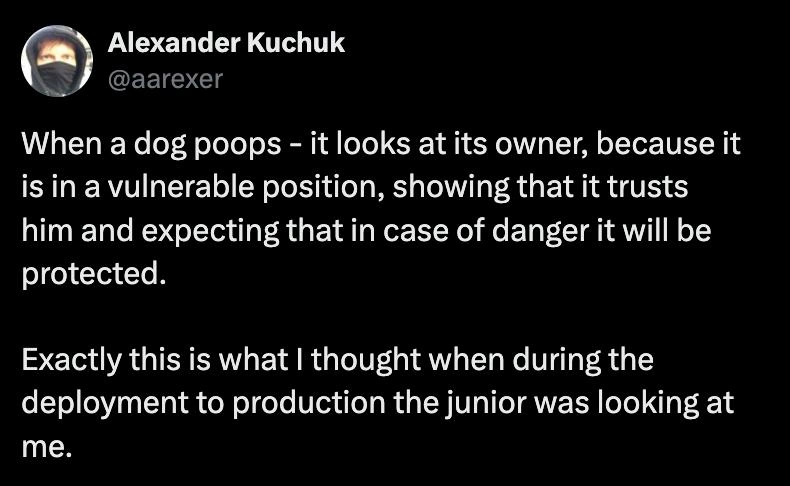
Alexander Kuchuk (@aarexer): “When a dog poops – it looks at its owner, because it is in a vulnerable position, showing that it trusts him and expecting that in case of danger it will be protected. Exactly this is what I thought when during the deployment to production the junior was looking at me.”
In a high-stakes production deployment, a senior engineer often becomes a human firewall between chaos and stability. This tweet comically compares a junior developer’s nervous gaze to the way a dog locks eyes with its owner while doing its business. It’s funny because the situations seem worlds apart – a canine’s bathroom break vs. a critical code release – yet the underlying dynamic is identical: vulnerable trust. The junior, like that pup, is in a very exposed position (pushing code live can feel like standing unclothed in a storm of potential bugs). They instinctively look to the senior engineer for protection, silently asking: “You’ve got my back if something goes wrong, right?”
From a seasoned developer’s perspective, this moment is equal parts endearing and anxiety-inducing. They recognize that wide-eyed prod deploy eye contact instantly – they probably gave the same look to their tech lead years ago. Now the baton (or the bag of doggy treats) is in the senior’s hands. In modern release management, especially under tight deadlines and imperfect testing, there’s a lot of implicit trust-based release management going on. We rely on the experience of seniors as a safeguard when automation and process can’t guarantee a flawless rollout. The senior is essentially the last line of defense, a living, breathing fail-safe. If the deploy script craps out (pun intended), the senior will leap into action, hitting that mythical rollback button or applying a hotfix patch in real-time.
This scenario is humorous to experienced devs because it’s too real. We’ve all seen the pattern:
- Deployment anxiety grips the newbie coder, while the veteran pretends to be a pillar of confidence.
- The junior’s code is about to go live to real users, and their mental image is basically a big red button labeled “Do Not Press If You Enjoy Sleeping”.
- The senior hovers like a guardian angel (or perhaps a bomb squad technician), finger on the “undo” trigger (if one even exists), ready to clean up any mess.
The tweet’s dog-pooping metaphor highlights an unspoken truth in software teams: deploying new code can leave even grown professionals feeling defenseless and exposed. A production release isn’t easily reversible – data migrations run, users start interacting, and if something goes wrong, you can’t always roll it back without consequences. It’s like the point of no return, much as a dog can’t undeed a deed once it’s done. Senior engineers carry the hard-earned scars of situations where a “simple deploy” went south at 2 AM, so they prepare for worst-case scenarios. They know that a production issue can be career-defining (or at least weekend-ruining). This collective trauma is why older devs insist on safety nets: comprehensive tests, staged rollouts, feature flags, monitoring alarms, and yes, having a seasoned person on-call as the human shield.
The humor here also pokes at organizational habits. Ideally, deployments shouldn’t feel like defusing a bomb with your bare hands. There are best practices: automated canary releases, blue-green deployments, robust CI/CD pipelines, you name it. But reality often falls short. Under pressure (say, a Friday afternoon hotfix – every senior’s nightmare), teams might skip steps. The junior ends up running deploy_prod.sh while everyone holds their breath. It’s a relatable developer experience because many of us have been there, sweating bullets, watching the terminal scroll, praying not to see any ERROR messages. The senior might joke later, “I was holding the rollback pin the whole time like a grenade, just in case.” In truth, sometimes there isn’t even a real rollback button – just a senior engineer with SSH access, ready to manually intervene. That “rollback_button_FOMO” (Fear Of Missing Out on an easy revert) is real: if you don’t have one, you desperately wish you did when things start going wrong.
Why do teams keep ending up in these nerve-wracking deployments? Often it’s because shipping quickly is rewarded more than playing it 100% safe. SeniorEngineerPain comes from knowing how badly it could go (they’ve seen the fabled one-line config change knock over an entire cluster). But they also know that if they don’t let juniors take the reins occasionally, those juniors never gain the experience to become reliable themselves. So it’s a careful dance: the senior lets the junior drive, but doesn’t stray far from the emergency brake. It’s both a trust exercise and a rite of passage in tech. The meme nails the feeling with a perfect analogy that triggers us to chuckle and maybe shudder a little: in critical deploy moments, the junior is the trusting pup and the senior is the vigilant owner, plastic bag (or in this case, incident playbook) at the ready to handle any... ahem... fallout.
Description
A tweet from Alexander Kuchuk (@aarexer) drawing a parallel between animal behavior and workplace dynamics: 'When a dog poops - it looks at its owner, because it is in a vulnerable position, showing that it trusts him and expecting that in case of danger it will be protected. Exactly this is what I thought when during the deployment to production the junior was looking at me.' The tweet uses the dog behavior analogy to describe the vulnerable trust a junior developer places in their senior during risky production deployments
Comments
12Comment deleted
The junior's deployment face is basically a TCP SYN packet -- they're waiting for your ACK before they can proceed, and if the connection times out, they're rolling back to their desk to cry
Nothing exposes an architecture flaw faster than a junior’s silent ‘please-save-me’ stare at T-minus-5 seconds to kubectl apply
The only difference between a junior's production deployment and a dog's bathroom break is that the dog's mess is easier to clean up and doesn't require a post-mortem meeting with stakeholders
The junior's deployment gaze is the human equivalent of a pre-commit hook - a last desperate check before the irreversible push to production. Unlike rollback strategies or blue-green deployments, this 'senior eye contact protocol' offers zero technical safeguards but maximum emotional reassurance. It's the unspoken SLA between generations: 'I'll break prod, you'll fix it, and we'll both pretend the postmortem was blameless.'
Juniors eye you in prod deploys like you're the guardian angel with rollback perms - until they realize you're both praying the canary survives
When the junior locks eyes mid-prod deploy, you realize mentorship is basically serving as the human circuit breaker, blast‑radius estimator, and emergency rollback - while pretending it’s a canary and not a big‑bang
Prod deploys turn seniors into human circuit breakers - junior hits Enter, you silently simulate rollback, schema migration blast radius, and SLO burn like an in‑memory chaos test
When the junior poops out a release to production Comment deleted
bayan ebychiy Comment deleted
Yep. Just like a kid doing his homework, with one eye being locked at their parent (any mistake results in pizdyk) Comment deleted
izvini bratik Comment deleted
😓 Comment deleted