Skip to content
DevMeme
5206 of 7435
Junior Dev's Dream vs. The useEffect Nightmare
Juniors Post #5707, on Nov 26, 2023 in TG

Junior Dev's Dream vs. The useEffect Nightmare

Why is this Juniors meme funny?

Level 1: The Big Mess Surprise

Imagine you’re a kid who’s only ever made a small mess in your room. You spill some toys and crayons – it’s a bit chaotic, but you figure grown-ups must keep things super tidy, right? You’re excited to visit a famous chef’s kitchen, thinking, “Everything will be in perfect order like on TV!” But when you walk in... oh boy. Pots are boiling over, there’s spaghetti hanging off the oven door, sauce splattered on the walls, and everyone is running around yelling orders. It’s even messier than your little room at home!

In this story: you are the new developer, your messy room was your little school coding project, and the chef’s kitchen is the big company’s codebase. The joke is that you expected a perfect, clean workspace but found an even bigger mess. It’s funny in a “welcome to the real world” kind of way. You feel surprised and maybe a bit better about your own mess, because it turns out even the “pros” are dealing with chaos. The big lesson? Every kitchen (or codebase) has some spaghetti on the walls – and sometimes the professionals are just really good at working in the middle of the mess!

Level 2: Spaghetti Code Reality Check

Let’s break down why this scenario is both funny and frightening, especially if you’re new to React or large projects. First, some terminology and context:

  • React: A popular JavaScript library for building user interfaces. It lets developers create UI components and manage state (data that changes over time) within those components. Modern React uses Hooks (like useEffect, useState, etc.) to add functionality to function components.

  • useEffect: This is one of React’s Hooks, and it’s specifically designed for handling side effects. A side effect is anything that affects something outside of the function’s scope, like fetching data from an API, subscribing to a stream of events, or updating the browser’s DOM directly. In React, useEffect allows you to run some code after the component renders, or when certain data (dependencies) change. You can think of it as telling React: “After you do the UI update, please also do X.” For example, updating the page title or sending analytics, etc. Each call to useEffect can watch certain values, and if those values change, the effect function runs again.

  • Lines of Code (LOC): Simply a measure of how big a codebase is by counting lines. ~60K LOC (sixty thousand lines) is huge for a front-end project. For perspective, that’s like the length of several novels worth of JavaScript/JSX. A large number of lines doesn’t automatically mean bad code, but it often implies complexity. More code -> more room for things to interact in unexpected ways if not structured well.

  • Spaghetti code: A slang term for code with a tangled, convoluted structure. If code logic is all over the place, with lots of interdependencies and no clear organization, we call it spaghetti code because reading it feels like trying to follow a single noodle in a bowl of spaghetti – messy and confusing. Juniors often worry their code is “spaghetti” because it’s not perfect. They hope a professional codebase is more organized. The dark joke here is that the “professional” code is also spaghetti, just a bigger serving of it.

  • Technical Debt: This is a concept where you take shortcuts in code (for speed or convenience now), but pay for it later in harder maintenance. It’s like skipping doing your homework: fine today, but you’ll have a lot more to do tomorrow. In large projects, technical debt accumulates when quick fixes, hacks, or poor designs aren’t cleaned up. Over time, the code gets harder and harder to work with – much like a financial debt accruing interest. A fragile codebase often has a lot of this debt; small changes can break things because the foundation is brittle.

Now, what’s happening with 650 useEffect calls? In a typical React component, you might use one or two useEffect hooks – for example, one to fetch data when the component mounts, or one to update something when props change. Having hundreds suggests that the codebase is doing a lot of work in these effects, probably too much. It could mean there are hundreds of components, each with their own effect logic. Or worse, some components might have multiple useEffect hooks trying to handle different things. This hints that there wasn’t a better system in place (like a centralized state management library such as Redux or Context) to coordinate things in a cleaner way. Instead, each part of the app is kind of yelling, “Something changed! Update this state!,” causing another part to yell, “Oh, that state changed? Then change this other state!” – a loop that can go on and on.

Let’s illustrate a cyclic state update on a smaller scale. Imagine a very simple component that tries to increment a counter whenever it updates, using useEffect:

import { useState, useEffect } from 'react';

function CounterComponent() {
  const [count, setCount] = useState(0);

  // This effect runs after every render when 'count' changes:
  useEffect(() => {
    // side effect: update state based on current state
    if (count < 5) {
      setCount(count + 1);
    }
  }, [count]);

  return <div>Count: {count}</div>;
}

In this code:

  • We start with count = 0.
  • The component renders "Count: 0".
  • Then the useEffect runs (because the component mounted, and it watches count). Inside the effect, it sees count < 5, so it calls setCount(1). That sets state to 1.
  • React re-renders the component (now showing "Count: 1"). Since count changed, the useEffect runs again. It increments count to 2… and this continues.

This will trigger re-renders five times until count reaches 5. After that, the condition count < 5 is false, so it stops updating. We created a deliberate cycle that eventually settles on 5 and then stops. That’s a bit like what the Reddit post describes: many effects causing updates in a loop until things “settle on a state” that doesn’t trigger new updates. In a real app with 650 such hooks, these chains might be far more complex and not as straightforward as a simple counter. But the idea is similar – values keep changing because different parts of the code keep reacting to each other. If you’re unlucky and there’s no “stop at 5” condition (or equivalent) in some cycle, you get an infinite loop of re-renders. That can freeze the app or crash your browser tab. Not fun!

So why did the developers end up with so many useEffect hooks? Possibly they had lots of components needing to coordinate. Maybe every time data X changed, component A needed to update state, which in turn caused component B to update something else. Without a clear architecture, the team might have kept bolting on new useEffect to handle each interaction. Over time, it became a giant tangle. This is often how LargeCodebases become intimidating: not because React or hooks are bad, but because how they were used (or misused) over years leads to a maze of logic.

For a junior developer, encountering this is a reality check. They might have been beating themselves up for writing “bad code” in school or personal projects, assuming professionals write everything perfectly. Then they see a “professional” codebase that’s even messier. The meme is essentially pointing out a common expectation_vs_reality moment: Even senior developers write messy code sometimes. The difference is scale and the fact that many people contributed to that mess.

To cope with such a codebase (as the Reddit post’s title asks), developers often have to:

  • Step carefully and test every change (because it’s easy to break something when behavior is so entangled).
  • Add safeguards (like the if condition in our example) to break cycles or prevent infinite loops.
  • Plan a refactor or introduction of better patterns slowly, if time and management allow, to pay down that technical debt. Maybe introduce a global state manager (Redux, MobX, Zustand) or simplify how data flows, so that not everything relies on useEffect chaos.
  • Often, developers new to the project will seek advice (hence the Reddit Needs Help tag) because it’s overwhelming to understand a 60k-line bowl of spaghetti solo. Pair programming with a senior who knows the system, or drawing diagrams of the data flow, can help unravel it.

In summary, this level demystifies the humor: 650 useEffect hooks in 60k lines of code is an extreme CodeQuality red flag. It’s a nightmare scenario that highlights exactly what juniors fear (spaghetti code), ironically living within the “professional” code they idealized. This encourages younger devs not to be too hard on themselves – if anything, seeing this disaster can make a newbie think, “Wow, even the pros write awful code sometimes. Maybe my code isn’t that terrible after all!” And that blend of relief and horror is what makes the meme funny: it’s a laugh born from the shared pain of developers who have been there and survived (with a twitch or two).

Level 3: Hook Hell at Scale

Newcomers often dream that professional codebases are elegant palaces of pristine architecture. Spoiler alert: they're usually just larger, trickier spaghetti code castles. In this meme, a bright-eyed junior proudly declares they've left their messy personal projects behind, only to walk straight into a 60,000 line React monstrosity. The punchline is painfully relatable: enterprise code can be an even bigger bowl of spaghetti, just with fancier naming conventions.

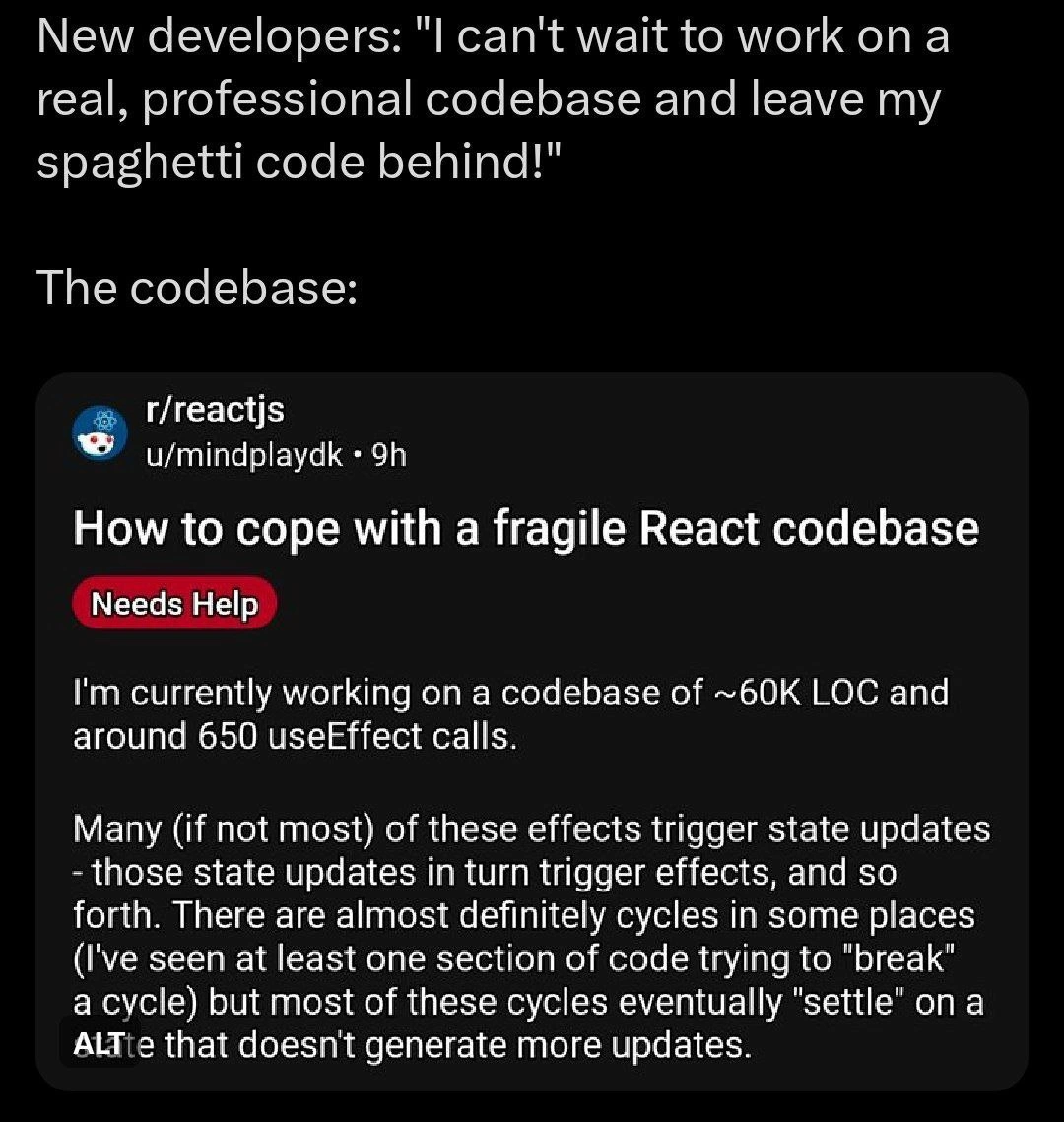
Consider the reddit post featured under “The codebase:” caption. The user pleads for help with a fragile React codebase and drops the jaw‐dropping stats:

“...working on a codebase of ~60K LOC and around 650 useEffect calls.”

That number of useEffect hooks is downright absurd. It's as if every component in the app decided to subscribe to some global gossip chain. Each useEffect is supposed to handle side effects (like data fetching or updating the document title) in a controlled way. But here, hundreds of them are tangled together, forming a massive web of interdependent effects. Many of these effects update some state, which immediately triggers another effect, which updates more state, and so on. The code is essentially chasing its own tail in a loop of updates. In chaotic systems theory (and in coding nightmares), we’d call this a feedback loop or cyclic dependency. The React app is repeatedly re-rendering like a frightened butterfly caught in a tornado of state changes. It’s a cascade of side-effects so intense you might expect the browser to start smoking.

From a seasoned developer’s perspective, this situation screams TechnicalDebt at a colossal scale. It's a textbook example of a FrontEnd Pain Point: quick fixes and poor design piling up over time. Chances are, this project started small and simple, but every new feature was slapped on with more hooks and hacks. No one had the time (or courage) to refactor those useEffect chains properly. After months or years, you end up with a fragile codebase where a change in one component unpredictably ricochets into others. The meme hits home because so many of us have inherited projects like this – where adding a single button feels like defusing a bomb. One wrong move and boom! an infinite loop of re-renders or a bizarre bug appears in production at 3 AM.

And let’s talk about those cycles mentioned in the post. The developer notes that “most of these cycles eventually ‘settle’ on a state that doesn't generate more updates.” In plainer terms, the code somehow fights itself to a standstill. This is both hilarious and horrifying. Imagine two mirrors facing each other: the reflections bounce back and forth endlessly – unless something breaks the symmetry. In our code, some effects ping-pong updates until a condition is met or a value stops changing, then the madness halts. They've effectively built a Rube Goldberg machine of state updates that miraculously stops just shy of crashing. It's like a race car that skids wildly but manages to halt right at the cliff’s edge. Sure, it “settles,” but the process is so fragile that any small tweak could tip it into an outright infinite loop. A veteran dev looks at that and mutters, “This isn’t architecture… it’s luck.”

The humor (tinged with horror) comes from the JuniorVsSenior contrast. The junior dev thought “real, professional code” meant clean structure and no more spaghetti. Reality check: professional spaghetti just comes in family-size portions. :spaghetti: The meme’s first line – “I can’t wait to leave my spaghetti code behind!” – is ironic because the real codebase is spaghetti; it’s just been rebranded with fancy React Hooks and a coat of corporate paint. Seasoned engineers chuckle (or groan) because we’ve all heard that naive optimism before – heck, we lived it – only to find out the hard way that CodeQuality in the wild can be shockingly poor. Large companies aren’t magically immune to messy code; they often just have more people adding noodles to the plate.

In the end, this meme delivers a hard truth with a smirk: LargeCodebases often carry large messes. The junior dev’s excitement meets a wall of confusing useEffect chains, and suddenly their own “spaghetti code” doesn’t look so bad. It’s a humorous yet cathartic reminder that every developer – junior or senior – eventually stumbles into a codebase held together by duct tape and desperation. The difference is, senior devs have the battle scars to recognize it and the gallows humor to laugh (so we don’t cry) about it. Welcome to the big leagues, kid – where the spaghetti code flows like a river, and you’re expected to swim in it. 🍝

Description

A two-part meme contrasting the expectations of new developers with the harsh reality of professional codebases. The top text, under 'New developers:', reads, 'I can't wait to work on a real, professional codebase and leave my spaghetti code behind!'. Below this, under 'The codebase:', is a screenshot of a post from the r/reactjs subreddit titled, 'How to cope with a fragile React codebase'. The post, flaired as 'Needs Help', describes a project of ~60K lines of code with around 650 `useEffect` calls, many of which trigger cyclical state updates that create an unstable, fragile system. The technical humor lies in the irony: the 'professional' codebase is a far more complex and terrifying version of spaghetti code than anything a junior developer might write. It highlights the pain of inheriting massive technical debt, specifically the misuse of React's `useEffect` hook, which can lead to unpredictable side effects and a nightmare debugging experience for even senior engineers

Comments

14
Anonymous ★ Top Pick A junior developer's spaghetti code is like a tangled ball of yarn. A senior's fragile `useEffect` codebase is a distributed yarn-demolition service that only fails on Tuesdays
  1. Anonymous ★ Top Pick

    A junior developer's spaghetti code is like a tangled ball of yarn. A senior's fragile `useEffect` codebase is a distributed yarn-demolition service that only fails on Tuesdays

  2. Anonymous

    60 K LOC and 650 useEffects - at that point it’s not a React app, it’s a client-side distributed system with zero observability budget

  3. Anonymous

    After 20 years in this industry, I've learned that 'professional codebase' is just what we call the spaghetti that survived production long enough to accumulate 650 useEffects - each one a monument to a developer who said 'I'll refactor this later' before their two-week notice

  4. Anonymous

    Ah yes, the classic React codebase where 650 useEffect hooks form a distributed consensus algorithm that would make Paxos jealous - except instead of achieving fault tolerance, they've achieved a delicate equilibrium where nobody dares touch anything because the entire state machine might collapse into a render loop singularity. Welcome to production, where 'professional codebase' means the spaghetti has been carefully organized into lasagna layers of cascading side effects

  5. Anonymous

    650 useEffect hooks later, your SPA isn’t a UI - it’s an eventually consistent system that forgot to implement a topological sort

  6. Anonymous

    650 useEffects in 60K LOC? That's not a codebase, it's a stateful Rube Goldberg machine where one render regrets birth the next

  7. Anonymous

    Enterprise React: 60k LOC and 650 useEffect hooks. It’s not spaghetti; it’s a cyclic dependency graph that occasionally converges to a UI - our CTO calls it “eventual consistency.”

  8. @callofvoid0 2y

    real chemical reactions going on

  9. @rostopiradv 2y

    I've seen incredible fuck ups in a number of languages You can screw up everything, if you are stupid enough

  10. dev_meme 2y

    skill issue

  11. @chupasaurus 2y

    Entropy is growing☺️

  12. @Aqualon 2y

    that's just terrible code architecture, nothing else

  13. @Aqualon 2y

    You can do this in any language that has watchers and a global state. Add a watcher to a variable and update very same variable on change. It's not even about js.

  14. @yuriy_the_man 2y

    Nothing unusual, it's just that they decided to build the system around effectual consistency

Use J and K for navigation