Skip to content
DevMeme
5207 of 7435
Bing's Unfiltered Honesty: A Self-Roast
AI ML Post #5708, on Nov 26, 2023 in TG

Bing's Unfiltered Honesty: A Self-Roast

Why is this AI ML meme funny?

Level 1: Bing Tells on Itself

Imagine you have two friends you can ask for help with homework. One friend (let’s call them Google) almost always gives you the right answers. The other friend (let’s call them Bing) tries to help but often gets things wrong or mixed up. Now picture asking that second friend, “Hey, are you good at helping with homework?” and they shrug and say, “Honestly, not really.” It’s a funny and surprising moment because usually people try to make themselves look good. Instead, this friend just flat-out admitted they’re not very reliable.

That’s basically what happened here. Bing – which is like that less reliable friend – was asked if it’s trustworthy, and it answered, “I’m not very reliable,” right there on the screen. This is humorous because of how unexpectedly honest it is. Normally, we expect companies or tools to brag a little or at least highlight their good side. But the search engine (which you can think of as an online answer-finding friend) just came out and confessed it’s not the best at its job. Developers (the people who write code and often look up answers online) found this really funny because it matches their experience: they know which friend (or search engine) usually has the answers. Seeing the “less trustworthy” helper openly say “Yeah, you probably shouldn’t count on me” made everyone chuckle, because it’s not every day that a product tells on itself so honestly.

Level 2: Bing’s Popularity Problem

Bing is Microsoft’s search engine (the tool that finds information on the web for you), while Google is the far more popular search engine most of us use daily. When we say Bing is the “default” search on Windows PCs, it means if you buy a Windows computer and use the built-in web browser (Microsoft Edge), any search you do goes through Bing automatically—unless you change the settings. Despite this prime placement on millions of computers, Bing’s market share is still tiny compared to Google’s. (Market share is basically the percentage of users choosing one product over its competitors. Google has had something like 90% of people using it for searches for years, whereas Bing hangs out in the single-digit percentages.) That already tells you many people don’t find Bing as useful or reliable.

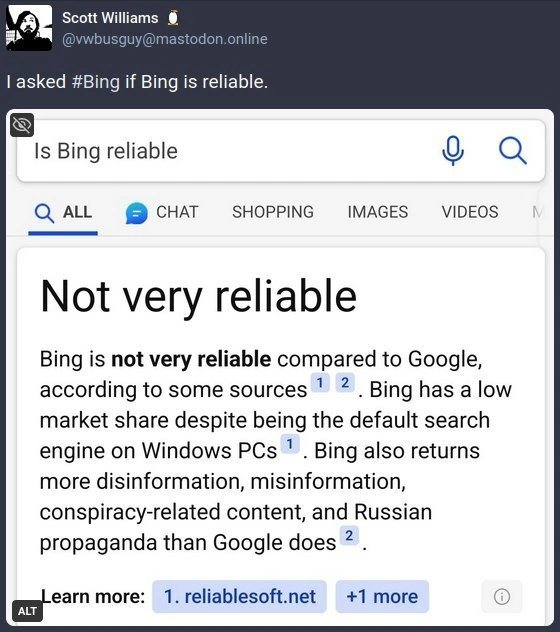
The meme shows a screenshot where someone literally asked Bing: “Is Bing reliable?” and Bing’s own results came back with a big, bold answer: “Not very reliable.” Just below that, the snippet elaborates that Bing isn’t very reliable compared to Google, citing a couple of sources (with tiny [1] and [2] footnote links for reference). In simpler terms, some articles or studies out there have said Bing doesn’t perform as well as Google in providing trustworthy search results. Bing’s summary lists a few reasons: it mentions that Bing has a low number of users despite being built into Windows, and that it tends to show more misinformation and conspiracy-related content than Google does. “Misinformation” means false or misleading information—basically, stuff that isn’t true or reliable. The snippet even calls out “Russian propaganda,” meaning some content pushing false or biased narratives that one study found Bing showing more often. Essentially, the search engine’s own summary is admitting it might lead you to sketchier information more frequently than Google would.

For a developer (or anyone searching for accurate info), this rings true. It means if you’re troubleshooting code or looking up a programming question, using a less reliable engine like Bing could give you results that are off-target or from questionable sources. Imagine you search for an error message and Bing’s top result is a random blog from 2010 with no clear answer, whereas Google shows a Stack Overflow question from 2021 with the exact fix you need. This difference in quality is why people often joke about Bing. In fact, it’s a common bit of developer humor to say “Nobody ever says ‘Bing it’.” We all say “Google it” because Google has become synonymous with getting a useful answer. We even turned “Google” into a verb because of how consistently it delivers helpful results, especially for programming problems. That cultural habit lines up with what this screenshot shows in plain text.

Another notable thing here is the blunt honesty of Bing’s answer. Usually, big companies try to paint their products in a positive light. If you asked a company spokesperson directly, “Is your tool reliable?” you’d expect some kind of upbeat answer like “Of course, we strive to be the best!” But in this case, the question was answered by the search engine’s algorithm pulling from third-party opinions, not by a human with a marketing filter. It’s almost like Bing inadvertently gave an uncensored answer by quoting outside sources. It even provided references you could click on (“Learn more: 1. reliablesoft.net +1 more”) to see where that information came from. For a junior developer or someone new to tech, it’s a bit of a revelation: even a major product like Bing has widely discussed shortcomings, and the internet’s information about those shortcomings is so readily available that Bing will show it to you if you ask the right question.

All told, Bing has a popularity problem largely because it’s seen as less reliable than Google. This meme is funny because it shows Bing openly acknowledging that problem in its own interface. It’s a bit like asking a restaurant if they’re the best in town and them putting up a sign that says, “Honestly, not really.” You wouldn’t expect that level of frankness, especially coming from the product itself. But here it happened automatically, which just doubles the effect. For developers who depend on accurate search results to do their jobs, this little self-own by Bing is both humorous and a clear reminder of why they tend to prefer the other guy.

Level 3: Algorithmic Self-Own

“I asked #Bing if Bing is reliable.”

Bing literally returning a snippet calling itself “Not very reliable” is the ultimate self burn in search engine history. For seasoned developers, this screenshot hits multiple layers of irony and truth. We rely on search engines daily as part of our developer toolkit, so seeing Bing – the perennial underdog – openly label itself as untrustworthy is both hilarious and validating.

First, there's the longstanding Bing vs Google rivalry. Veteran devs remember that Microsoft launched Bing to challenge Google’s dominance, but it never really shook Google’s position as the go-to search for trustworthy answers. Most of us default to Google because years of use have proven its reliability for coding questions, error messages, and technical documentation. Bing, meanwhile, has a reputation for being the search engine you only use by accident or when forced (like that one time you opened Edge on a fresh Windows install and forgot to change the default to Google). The meme capitalizes on this: even Bing’s own search results are effectively saying “Yeah... you might want to stick with Google.” You can practically hear the veteran devs chuckling, “Told you so.”

The way this answer is delivered makes it even funnier. The image shows a Bing search snippet (that big bold text box) with Bing’s answer to the query “Is Bing reliable”. Normally, these featured snippets or answer boxes are meant to present a quick, authoritative response pulled from some website. They’re often used to answer factual questions (think: “What’s the capital of France?” or “How do you center a div in CSS?”). But here the algorithm served up a brutally honest meta search query result about itself. It’s as if the search engine looked in the mirror and, without any PR filter, blurted out, “Not very reliable.” Talk about an algorithmic self-own! This kind of self-criticism from a product’s own mouth is something you rarely see – presumably, no one at Microsoft explicitly programmed Bing to neg itself, but the impartial (or maybe just oblivious) answer-summarizing AI had no qualms about doing so.

The context behind that “Not very reliable” verdict is rooted in real industry analysis. The snippet cites sources: one likely notes Bing’s tiny market share despite being the default search on Windows, and another points out Bing’s issues with search engine reliability around misinformation. Seasoned devs might recall articles or studies on this. Essentially, some researchers found that Bing’s results include significantly more disinformation and fringe content compared to Google’s. That means if you search world news or health info, Bing might more often surface conspiracy-laden pages or propaganda (the snippet explicitly mentions “Russian propaganda” as an example) whereas Google is a bit more careful about those. For a developer searching technical information, the analogy is encountering more spammy Stack Overflow knockoff sites or outdated tutorials in Bing’s results, whereas Google tends to put the canonical Stack Overflow answer or official docs front and center. The meme underscores this trust gap: Bing not only has fewer users, but according to those sources, it also hasn’t earned the same level of trust due to the quality of what it serves up.

From a developer experience (DX) standpoint, this is too real. We’ve all been in a rush to fix a bug and typed a question into whichever browser was open. If that happened to be Bing, chances are we got some funky results: maybe a link to a five-year-old forum post with zero answers, or a sketchy blog full of SEO keywords but no real solution. Meanwhile, popping the same query into Google usually pulls up a Stack Overflow thread with the exact error and a green checkmark answer. After a few experiences like that, you learn which engine to trust when time is ticking. So hearing Bing’s own interface basically warn “I’m not very reliable” feels like the machine is confirming what developers have joked about for ages. It’s the kind of sarcastic self-own we’d crack in late-night ops chats: “Even Bing knows it’s the last resort.”

On an industry trend level, there’s also a swipe at the current hype. Microsoft has been pushing Bing hard by injecting it with AI features – like the new Bing Chat (powered by GPT) that’s supposed to give better answers and take on Google’s crown. This screenshot is likely a side-effect of those AI summarization features: Bing’s algorithm aggregated content from sites like “reliablesoft.net” and others to directly answer the question. Ironically, the fancy AI upgrade led Bing to dunk on itself with a well-sourced, no-nonsense summary. It’s a bit of satirical poetry: the technology Microsoft hoped would make Bing seem smarter ended up highlighting, in cold factual detail, why Bing hasn’t been winning the search war. You can imagine the Bing team’s facepalm when this started trending on Mastodon – the AI did what it was asked (tell the truth) but in doing so it handed Google a meme-worthy own goal.

All told, this meme gets a knowing laugh from experienced devs because it encapsulates a decade of industry satire in one image. It’s the search engine equivalent of a code comment that reads “// TODO: fix this terrible hack later” – an embarrassing admission out in the open. Bing asked itself a straightforward question about trust, and the answer (coming from its own data and algorithms) was a blunt “Not very reliable.” At least you can’t accuse Bing of lying here – it’s an unexpected moment of candor in the cutthroat search engine landscape, and a darkly humorous confirmation of why devs have been saying “just Google it” all along.

Description

A screenshot of a Mastodon post from a user named Scott Williams who searched on Bing for the query 'Is Bing reliable'. The image shows the Bing search results page prominently displaying the answer 'Not very reliable' in a large, bold font. The snippet below elaborates, stating, 'Bing is not very reliable compared to Google, according to some sources,' and mentions its low market share and issues with returning more disinformation and misinformation. This meme captures the irony of a search engine's own algorithm highlighting its perceived weaknesses. For the tech-savvy audience, it's a humorous take on the challenges of AI-driven search, which can sometimes surface self-deprecating or brand-damaging information by impartially summarizing indexed web content. It plays into the long-standing developer preference for Google and the general skepticism surrounding Bing's performance
Comments

39
Anonymous ★ Top Pick This isn't a bug, it's a feature. Bing has finally achieved a true zero-trust architecture, starting with itself
  1. Anonymous ★ Top Pick

    This isn't a bug, it's a feature. Bing has finally achieved a true zero-trust architecture, starting with itself

  2. Anonymous

    Bing replying “Not very reliable” to “Is Bing reliable” is peak SRE: error budget so overdrawn the service just returns the post-mortem as the SERP

  3. Anonymous

    The most reliable thing about Bing is its ability to consistently tell you why Google is better - it's like watching a search engine develop Stockholm syndrome with its own inferiority complex while Microsoft's market cap hits $3 trillion

  4. Anonymous

    When your search engine has better self-awareness than most production monitoring systems - Bing essentially returning a 200 OK with a payload of 'service degraded, recommend failover to competitor.' It's the technical equivalent of a load balancer actively routing traffic away from itself. At least it's honest about its SLA violations, which is more than you can say for most vendor reliability claims in RFP responses

  5. Anonymous

    Asked Bing if Bing is reliable; it replied “Not very.” That’s the only time a ranking model hits 100% precision while the brand KPI goes to zero - SREs celebrate, PMs open a Sev-1

  6. Anonymous

    Bing's RAG pipeline finally escaped the corporate filter, pulling unvarnished truth over branded hallucinations

  7. Anonymous

    When your search RAG doesn’t include a brand-safety filter, you ship the equivalent of /healthz returning 200 with payload: {status: 'not reliable'}

  8. @pnlt_s 2y

    That "Russian propaganda" part hits hard

    1. @rglrd 2y

      Because of Bing is sponsored by Infowars.

  9. @callofvoid0 2y

    suicidal

  10. 扇子 2y

    since bing isnt reliable source of information this information is not true

  11. Ølеґsîū 🪬🕍🪬 2y

    Based? Well it indeed tops up some doubtful sites sometimes

  12. Ølеґsîū 🪬🕍🪬 2y

    Just Google it 😁

    1. @lord_desecrator 2y

      Jews Are Evil (c) Jew

    2. @RiedleroD 2y

      they don't autocomplete it anymore lmao

      1. Ølеґsîū 🪬🕍🪬 2y

        Cuz jews interjected 👃🏿

  13. @callofvoid0 2y

    that connection lost was just in time

  14. @rglrd 2y

    But earlier Bing was able to give the most effective suicide method. 99% by blowing up head with a shotgun. Just like Ronnie Mcnutt at his last stream.

  15. @callofvoid0 2y

    a mixture of both

  16. @rglrd 2y

    Helium inhalation is too boring. Mcnutt did it much more funny.

    1. @callofvoid0 2y

      I don't know anything about that guy

      1. @RiedleroD 2y

        the guy who streamed himself on facebook live, blowing his head off with a shotgun. They didn't shut down the stream until after cops arrived to find his… very open mind

        1. @callofvoid0 2y

          damn

        2. @RiedleroD 2y

          luckily the bitrate was shit, so the gore looks like in an early 2000s video game

          1. @rglrd 2y

            Just like modern Call of duty games.

  17. @ZgGPuo8dZef58K6hxxGVj3Z2 2y

    As a bing user I can confirm how many times this happened

    1. @SamsonovAnton 2y

      Should we take your message as a signal that you are being held hostage by Microsoft or another extremist organization?

      1. @ZgGPuo8dZef58K6hxxGVj3Z2 2y

        Nah I want to replace google from my life. Only YouTube is what I sadly still use

        1. @dugeru42 2y

          why not duckduckgo?

          1. @ZgGPuo8dZef58K6hxxGVj3Z2 2y

            Idk I am used to it because I used windows phones. And google deliberately served old google websites to the browser. Which had the same codebase as on PC and the PC version supported “modern” youtube and everything.

        2. Deleted Account 2y

          2 skipable ads

          1. @ZgGPuo8dZef58K6hxxGVj3Z2 2y

            I have 5 sec unskippable nothing

  18. @pwnzkk 2y

    Funny enough, bing has a reward program for using it as a search engine, so I use it every day to farm those reward points (it pays for my game pass on Xbox lol and some dlcs). And it’s totally unreliable

  19. @plusdanshi69 2y

    At least he's being honest

  20. @endisn16h 2y

    not as bad as :3 though

  21. @endisn16h 2y

    this from urban dictionary btw

    1. @ZgGPuo8dZef58K6hxxGVj3Z2 2y

      Doubt

      1. @endisn16h 2y

        font looks familiar

        1. @RiedleroD 2y

          I'm pretty sure that's just arial

Use J and K for navigation