Junior Code Came in a Dream
Why is this Juniors meme funny?
Level 1: The Forgotten Idea
This is funny because it is like a student building a strange but working science project, then saying, "I knew exactly how it worked yesterday, but now I forgot." The project may still run, but everyone else has to decide whether it is clever, lucky, or held together by hope.
Level 2: Explain the Why
Code review is when another developer reads your change before it is merged. They look for bugs, unclear names, fragile logic, missing tests, security issues, and places where future developers might misunderstand the intent.
Code readability means how easy it is for someone else to understand what the code does. Good readability comes from clear names, simple structure, focused functions, useful tests, and comments that explain surprising decisions. Comments should not say // add one to x; they should explain why adding one matters.
Mentorship is the helpful side of this meme. A junior developer often knows that a fix works before they can explain it elegantly. A senior developer's job is not just to reject the patch with a sigh. It is to help turn "I tried things and this passed" into "this works because the API returns nullable values during initialization, so we guard that state before rendering."
The funny part is the gap between having written code and being able to explain it. Every developer eventually learns that "the tests passed" is not a complete design argument. It is a good start, but the team also needs to know what problem the code solves and why this version is less dangerous than the alternatives.
Level 3: Dream-Driven Development
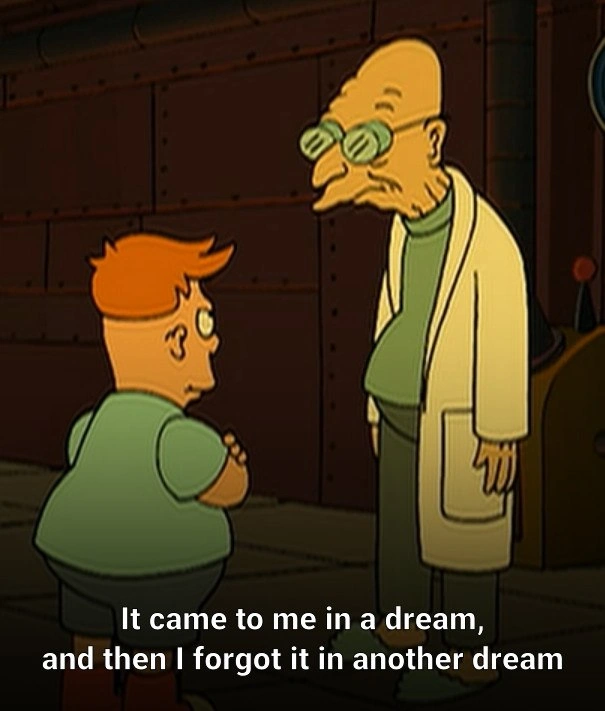
The visible subtitle says:
It came to me in a dream,
and then I forgot it in another dream
That line becomes developer humor because the post frames it as:
When junior explains code to you
The joke is not really "juniors are bad." The sharper joke is about missing rationale. Code can work and still be nearly impossible to defend if the author cannot explain why it is shaped that way. In a review, a senior developer is rarely asking "did you type valid syntax?" They are asking whether the choices survive contact with maintenance: why this abstraction, why this data shape, why this retry behavior, why this naming, why this exception handling, why this suspicious boolean parameter quietly controlling the fate of the sprint.
The Futurama still heightens the dynamic. Fry looks small and cornered, Professor Farnsworth looks old, tired, and professionally disappointed, and the subtitle reads like the entire design document was stored in volatile memory. That maps cleanly onto CodeReview, CodeReadability, and CommunicationGap. The pain point is not just that the code is confusing; it is that the explanation evaporates right when the team needs it.
Experienced developers recognize this pattern because implementation ideas often begin as intuition. A junior developer may solve a bug by trying things until the test passes, copying a Stack Overflow-shaped memory from last week, or following a framework pattern without fully understanding the trade-off. That is normal learning. The problem starts when the working code becomes tribal knowledge immediately, because no one can reconstruct the reasoning later.
The senior-reviewer trauma is that "I forgot why" is not merely inconvenient. It creates future risk. An unexplained conditional becomes sacred. A duplicated helper becomes "probably load-bearing." A weird timeout survives three rewrites because nobody knows which production incident it once appeased. The codebase fills with tiny monuments to forgotten context, and then management asks why simple changes take so long. Please hold while engineering consults the dream archive.
Description
The image is a Futurama still showing Fry facing Professor Farnsworth in a dim industrial room. White subtitle text at the bottom says, "It came to me in a dream, and then I forgot it in another dream." The sibling metadata caption frames it as "When junior explains code to you." The technical humor is about a junior developer being unable to justify or reconstruct their own implementation, leaving the reviewer with code that feels inspired, forgotten, and undocumented.
Comments
1Comment deleted
The implementation has no comments because apparently the design doc was stored in REM sleep and garbage-collected on wake.