Skip to content
DevMeme
1563 of 7435
The classic 'just connect frontend to the database' question
Backend Post #1744, on Jun 29, 2020 in TG

The classic 'just connect frontend to the database' question

Why is this Backend meme funny?

Level 1: Chew Your Food

Imagine you have a whole pizza in front of you. You’re really hungry, but instead of eating it slice by slice and letting your stomach digest it, you walk over to the trash can and just dump the whole pizza straight in. 🍕🗑️ Silly, right? You’d end up hungry and the pizza would be wasted! In real life, we know we have to chew and digest our food so our body can get the good stuff out of it and not get sick.

Building an app works the same way. The frontend (what you see on your screen) is like your mouth – it takes in stuff (like user input or clicks). The backend is like your stomach – it’s hidden inside, but it’s super important because it processes that stuff (checking it, breaking it down, making sure it’s right). The database is like the food storage or maybe the pantry – it’s where the final nutrients (data) are kept for later. The funny post in the meme was joking that someone suggested skipping the “stomach” part and just throwing data straight into storage (like throwing food directly into the toilet!). The reply basically said: “Nope, that’s not how it works – you need to process things, just like you need to digest food.” The reason this is funny is because it uses a gross but clear everyday example to show why skipping important steps is a bad idea. In simple terms: every step in the process exists for a reason. Just like you wouldn’t skip chewing and swallowing when eating, in software you shouldn’t skip the backend when sending data around. It might be a joke, but it’s teaching the same common-sense lesson: do things the right way, or you’ll just make a mess!

Level 2: Data Digestion

So, what is a “backend” exactly, and why do we say data needs to be “processed”? Let’s break down the jargon:

  • Frontend: This usually means the part of the software that users see and interact with – think of a website’s interface or a mobile app’s screens. It’s all the buttons, forms, and visuals in your browser or phone. Frontend code (HTML, CSS, JavaScript for web, for example) runs on the user’s device. It’s great at showing information and collecting input, but it’s not directly trusted with heavy lifting like talking to databases on its own. In our meme, someone is suggesting the frontend (like the web page or app on your computer) should talk straight to the database. That’s unconventional in web development.

  • Backend: This refers to the server-side part of an application – the behind-the-scenes logic that runs on servers (like a computer in a data center or cloud). When you fill out a form on a website and hit “Submit”, that data usually gets sent to the backend. The backend is a program (it could be written in Node.js, Python, Java, etc.) that receives the request, performs operations (like checking your input, consulting the database, doing calculations), and then sends back a result or webpage. You can think of the backend as the kitchen of a restaurant: you (the client) place an order, and the kitchen (server) prepares something and gives it back to you. It’s called “backend” because users don’t directly see it – they experience its results through the frontend.

  • Database: This is where data is stored. It’s like a big filing cabinet or a digital pantry for all the information the application needs – user accounts, posts, transactions, you name it. Common examples are SQL databases like MySQL or PostgreSQL, or NoSQL databases like MongoDB. The database usually lives behind the backend. Only the backend talks to it directly. The backend acts like a responsible middleman: it knows the database’s secret knock (credentials and queries), and it only asks for or writes what’s needed. In normal setups, your browser (frontend) never talks directly to the database; it always goes through the backend’s API.

Now, the meme’s joke: someone asks, why not skip the “middleman” (the backend) and just have the frontend talk to the database? That question might arise if you’re new and thinking, “hey, the frontend could just fetch data from storage by itself, right?” Technically, there are a few environments where a client-side application could talk to a database-like service (for example, some apps use Firebase, which lets frontends communicate with a cloud datastore directly). But even those services are carefully managed behind the scenes – they have rules, auth, and validation built-in (which is essentially providing a backend service, just one you don’t write yourself). In general web development, your browser can’t even open a direct connection to a database on its own – browsers are restricted to talking HTTP(S) to servers for security reasons. There’s no fetch("database://query") in JavaScript – and that’s by design!

Consider some common early-career scenarios to illustrate this:

  • First time deploying a website: You might start with all-in-one setups (like a simple LAMP stack where PHP code talks to MySQL) – but even there, the PHP code on the server is the backend doing the talking to the database. When you only write some front-end code (HTML/JS) and wonder how to store data, you quickly learn you need something like a server-side script or an API. Many of us tried to avoid that at first (“maybe I can use just client-side storage or a Google Sheet as a DB?”), but as soon as you need multi-user data or security, a dedicated backend becomes necessary.

  • Learning about APIs: An API (Application Programming Interface) is how the front end requests data or actions from the backend. For instance, if you’re making a weather app, your frontend (running in the browser) makes a call like GET /weather?city=London to a backend service, which then maybe asks a database or third-party API for London’s weather, and finally sends the result back. As a junior dev, understanding this separation is a milestone. The person in the meme essentially questioned the need for that separation. The experienced reply was: “Skipping that step is as nonsensical as skipping digestion.”

  • Trust and Validation: A key mantra is “Never trust user input.” When you’re new, you might assume users will only input what you expect. But take it from us, they won’t. They’ll try weird things, whether by accident or on purpose. The backend is where the app can say, “Hold on, is this data safe and sensible?” For example, if a form asks for age, the backend can check it’s a number and maybe within a reasonable range. If you skipped the backend and put that logic in the frontend, a malicious user could bypass your interface and send bad data directly to the database (since there’s no guarded gate in between). Early in your career, you might not realize how crafty or unpredictable input can be – until something breaks. Ever see a site crash because someone typed a long string of characters or a weird symbol? That’s why validation usually happens on the server too (even if the frontend already does it – the backend double-checks).

Now let’s talk about that bodily function analogy in the comment, because it’s a pretty spot-on teaching tool (if a bit gross!). The commenter compares skipping a backend to bypassing your body’s digestive process: “Why do we eat and go to the bathroom when we can just throw food directly in the toilet?” They answer themselves: “Because stuff needs to get processed.” In simpler terms: you can’t get nutrition from food if you don’t digest it in your stomach, and you can’t get useful, safe data if you don’t process it through the backend. This analogy is something even non-tech folks can grasp. It invokes a funny image (literally tossing dinner straight into the toilet 🚽) to highlight how absurd it is to skip an essential step. For a junior dev or a student, this paints a clear picture: the backend’s job is like the stomach’s job – breaking things down, filtering out the bad stuff, and making sure the rest of the system (the body or the app) can actually use the input safely.

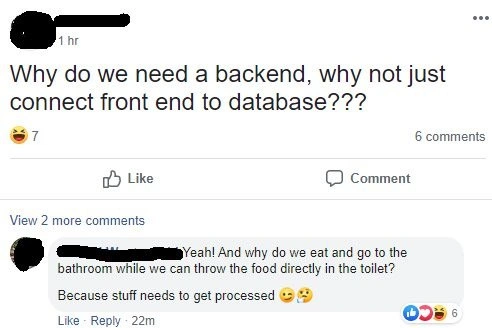
Also notice: the meme is presented as a facebook_post_screenshot. The UI (white background, blue accents, the familiar Like/Comment buttons) tells us this conversation happened on a Facebook thread, likely in a programming or meme group. The names are blacked out (common when sharing screenshots to protect identities), but you can see the original post was made "1 hr" ago and got 7 laugh-react emojis. The fact it got laughs and a bunch of comments means the community immediately recognized the question as a joke or a misunderstanding worth ribbing. The top visible reply (with 6 reactions of its own) uses the funny food analogy. This format itself – asking a naive question and getting a witty comeback – is typical in dev humor circles. It’s both educational and entertaining. As a newbie, you might learn from this without feeling personally attacked, because the humor softens the lesson. And that lesson is: Yes, we really do need a backend! 😄 It’s not there just to make your life harder; it’s doing the vital processing to keep everything running smoothly and securely.

In short, the backend is the unsung hero that processes data behind the scenes, much like our body processes food. The meme’s conversation might be light-hearted, but it’s teaching an important principle of software architecture. It’s a reminder to all developers, especially those just starting out, that some “shortcuts” in architecture lead to dead ends (or really messy outcomes).

Level 3: Two-Tier Turmoil

Original Poster: "Why do we need a backend, why not just connect front end to database??? 😂"
Commenter (reply): "Yeah! And why do we eat and go to the bathroom while we can throw the food directly in the toilet? Because stuff needs to get processed 😉🤔"

This meme snapshot from a Facebook post hilariously exposes a classic ArchitectureTradeoffs blunder: suggesting a frontend_without_backend. At first glance, a direct_db_connection_proposal (just plug the UI straight into the database) sounds like a shortcut to simplicity. After all, why bother writing server code if the FrontendDevelopment could talk to the Databases itself? But experienced developers immediately recognize this as a BackendVsFrontend cautionary tale – one that makes every seasoned backend engineer either chuckle or cringe (or both).

In modern WebDev, the norm is a three-tier or n-tier architecture: frontend (UI/client) → backend (server/application logic) → database (storage). Skipping the middle layer is akin to a two-tier free-for-all, and it introduces a world of trouble:

  • Security Nightmare: Exposing your database directly to clients is like giving out the keys to the kingdom. The backend usually acts as a gatekeeper – authenticating users, authorizing actions, and keeping sensitive details (like DB credentials) hidden. If the front end connects straight to the DB, you'd have to ship your DB login info in the client code (which anyone can read!). A malicious user could reverse-engineer your app, find the connection string, and suddenly your database is wide open. It’s as risky as it sounds – even junior devs learn quickly that hardcoding passwords in client-side code is a big no-no.

  • No Input Sanitization: The backend is where we typically validate and sanitize user input – checking that data is in the right format, not too large, and not trying to do something sneaky. Without it, the database will get raw, unprocessed input from the UI. Remember the infamous Little Bobby Tables comic from XKCD about SQL injection? That’s what happens when you trust user input directly: if a user types Robert'); DROP TABLE Students;-- into a front end that pipes it straight to the DB, say goodbye to your data. 🥴 The comment’s bodily_function_analogy (throwing food straight into the toilet) perfectly captures this – you’re bypassing the “digestion” (processing/validation) step. In tech terms, skipping input processing is how you get garbage in, garbage out or worse, a hacked database.

  • Business Logic & Data Processing: In any non-trivial app, the backend isn’t there just to be annoying – it contains the business rules and processing logic. Think of things like calculating prices, validating transactions, or enforcing that "a user can only do X if condition Y is met." If you connect the front end directly to the DB, where does that logic live? Either you push it all to the front end (which means duplicating it in every client and trusting that no one tampers with it), or you try to put it in database stored procedures (which is a maintenance headache and still hard to secure on a per-user basis from the client side). In a direct connection scenario, each client becomes a little wild west executing whatever queries it wants. One mistake in the UI code, and users might retrieve or modify data they shouldn’t, because there’s no central authority of backend enforcing rules. It’s like a classroom with no teacher – chaos waiting to happen.

  • Performance & Scalability: A well-designed backend can cache frequent requests, batch operations, and manage load on the database. If every front-end instance (say, every user’s browser) talks directly to the database, you can overwhelm the DB with requests. The database is excellent at storing and retrieving data, but handling thousands of concurrent clients and complex logic is not its forte. The backend server acts as a buffer and coordinator – it can handle spikes by queueing or load balancing, and only ask the DB for what’s truly needed. Without it, the database gets slammed directly by clients. It’s as if a popular restaurant let every customer walk into the kitchen to grab ingredients – nobody gets a proper meal and the kitchen gets wrecked. The meme’s joke hints at this too: skipping processing and dumping things in one place leads to a mess (or in computing terms, an overwhelmed service).

  • Maintainability: In proper SoftwareArchitecturePatterns, the separation between frontend, backend, and database makes it easier to maintain and update each part. If you realized you need to change how data is calculated or add a new validation, you typically update the backend logic in one place. But if frontends are directly doing DB queries, that logic could be duplicated across every client application (imagine updating code on every user’s machine or every deployed mobile app – yikes!). Also, debugging issues is much harder when there’s no central log of what users asked for – a backend normally logs requests, errors, etc. Without it, tracking down why "the data looks wrong" is like solving a mystery with no clues. This is why even ArchitectureTradeoffs that favor simplicity rarely advocate ditching the backend entirely – the cost comes back to bite you in maintenance and debugging pain.

The Facebook screenshot displays this scenario in a comedic real-world context: an unsuspecting user (perhaps a newbie developer) asks in a post why the backend is even needed, and another user drops a brilliantly scathing analogy. The visible 😆 laugh reactions (7 of them) and the reply’s own likes (you can see small reaction icons with a count of 6) tell us the developer community found this hilarious and on-point. It’s a form of BackendHumor where the punchline doubles as a tech lesson. Seasoned devs are effectively saying, “We have a backend for the same reason you have a stomach in your body’s system – to process and handle stuff that raw inputs (be it food or user data) can’t deal with on their own.”

In summary, the meme humorously encapsulates why_backend_exists in the first place. It roasts the naive idea of a frontend talking directly to a database by comparing it to an obviously absurd shortcut in real life. The senior perspective here is a unanimous agreement: Sure, you could connect a front end directly to a DB... if you enjoy data breaches, corrupted data, and all-night debugging marathons. Every experienced developer has encountered proposals like this (occasionally from overenthusiastic beginners or non-technical managers), and this meme is the perfect tongue-in-cheek response. The laughter it garnered is half because it’s funny, and half because it’s too real – we need that backend “processing stomach” to keep the system healthy.

Description

A screenshot of a social media post captures a classic beginner's question. The original post asks, 'Why do we need a backend, why not just connect front end to database???'. Below it, a commenter delivers a perfect, sarcastic analogy in response: 'Yeah! And why do we eat and go to the bathroom while we can throw the food directly in the toilet? Because stuff needs to get processed'. The names of the posters are blacked out for privacy. This exchange humorously highlights a fundamental concept in web architecture - the necessity of a backend to handle business logic, validation, security, and data processing, which are all invisible but critical functions that can't be exposed directly to a client-side application. The analogy, while crude, is an effective way to explain the concept to non-technical or junior stakeholders


Comments

7
Anonymous ★ Top Pick Sure, connect the frontend directly to the database. Shipping your connection string to every user's browser is the latest in open-source security
  1. Anonymous ★ Top Pick

    Sure, connect the frontend directly to the database. Shipping your connection string to every user's browser is the latest in open-source security

  2. Anonymous

    Just wire React straight to prod - every user gets their own connection string, RBAC is whatever SQL they can Google, and we’ll let the SOC2 auditor raise PRs against schema.sql

  3. Anonymous

    Sure, let's expose our database credentials to every browser inspector and trust JavaScript to enforce business rules - what could possibly go wrong? Next we'll implement authentication by asking users to pinky promise they're who they say they are

  4. Anonymous

    Ah yes, the classic 'why can't I just SQL injection myself?' architecture pattern. It's right up there with storing passwords in plaintext and using production as your testing environment - technically possible, wildly inadvisable, and a resume-generating event waiting to happen. The backend isn't just middleware theater; it's where we hide all the business logic that product managers change every sprint, enforce the security rules that prevent your database from becoming a public fountain, and maintain the illusion that our system has 'layers' when really it's just controlled chaos with better PR

  5. Anonymous

    Skip the backend; let React speak SQL directly to prod. It’ll handle auth, rate limiting, migrations, and transaction semantics between re-renders - worst case, the data breach will be strongly consistent

  6. Anonymous

    Sure, wire the SPA straight to the DB - then every browser becomes a privileged client, schema migrations are breaking API changes, and the entire internet does free pen testing

  7. Anonymous

    Direct FE-to-DB: because exposing your schema is just the appetizer for schema-less sprawl and auth confetti in prod

Use J and K for navigation