Database Relationships vs. Romantic Relationships
Why is this Databases meme funny?
Level 1: Not That Kind of Relationship
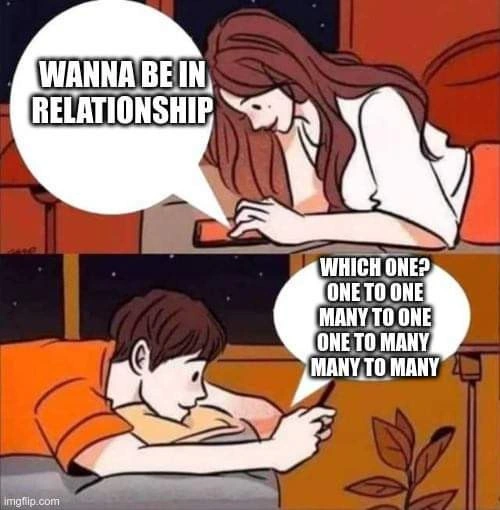
Imagine your friend asks, "Do you want to be my partner?" and instead of just saying "Sure!" you start asking, "What kind of partner? A best friend partner? A group project partner? A playing tag partner? Or a secret club partner?" That’s basically what’s happening here, but with computer talk! The girl is asking the guy to be her boyfriend (a romantic relationship). But the guy has a computer programmer brain, so he hears the word "relationship" and thinks about how data is connected in a computer database. He replies by listing different kinds of data relationships (like one-to-one, one-to-many) as if she was talking about data, not dating. It’s a funny misunderstanding because he’s using logic and tech jargon when she was expecting a sweet, simple yes. Essentially, she’s speaking the language of love, and he’s answering in the language of computers. The humor comes from him completely missing the point — he treated a loving question like it was a multiple-choice math problem! It’s a cute reminder that sometimes techie people take things a bit too literally, mixing up love and logic in the most adorable, goofy way.
Level 2: Cardinality Crash Course
Let’s break down the tech terms in this meme. The humor revolves around the dual meaning of relationship. In normal life, a relationship means dating or being a couple. In computing – especially in database design – a relationship describes how two sets of data are connected. When the developer hears "relationship," he isn’t thinking about holding hands; he’s thinking about how two database tables link together! This falls under RelationalDatabaseDesign, which is about structuring data using tables (also called entities in an Entity-Relationship model) and defining connections between them. An Entity Relationship Diagram (ERD) is like a blueprint for a database that shows these tables (entities) and the relationships between them. Each line connecting two entities in an ERD has a label like 1:1 or 1:N – that label is the cardinality of the relationship, meaning how many items on one side can be associated with how many on the other side.
In the meme, the woman asks if he wants to be "in a relationship." The developer replies with "Which one? One to one, many to one, one to many, many to many." He’s listing the four basic types of relationship cardinalities you learn in database fundamentals. Here’s what those mean in simple terms:
- One-to-One (1:1) – One of this is connected to one of that. For example, imagine a database table of Users and a table of UserProfiles. If each user has exactly one profile, and each profile belongs to exactly one user, that’s a one-to-one relationship. In real life, think of something like one person having one passport: each person gets one passport, and each passport is for one person.
- One-to-Many (1:N) – One of this is connected to many of that. For instance, one mother can have many children, but each child has one mother. In database terms, you’d have a
Mothertable and aChildtable; each child row would store a reference (like a foreign key) to exactly one mother, but one mother’s ID can appear on multiple child records. Many-to-One (N:1) is just the same relationship viewed from the other side: many children link back to the same single mother. Another everyday example: one author can write many books, but each book has one primary author – that’s a one-to-many relationship (author→books). - Many-to-Many (M:N) – Many of this are connected to many of that, kind of a free-for-all connectivity. A classic example is students and classes: one student can enroll in many classes, and one class has many students. If you were drawing an ERD, a many-to-many relationship might connect
StudentandClass. In practice, relational databases handle many-to-many by introducing a third table (often called a join table or linking table). For example, a table namedEnrollmentmight list pairs of(StudentID, ClassID)to link each student to all their classes. In everyday terms, many-to-many is like a friendship network: you can have many friends and each friend has many other friends too – everyone’s connected to lots of others.
All these are kinds of relationship cardinalities in a database context. So when the developer asks "Which one?" he’s essentially asking, "What kind of relationship model are we talking about?". Of course, the woman just meant a normal dating relationship (which ideally would be one-to-one – two people exclusively dating each other). But the dev interpreted it like a schema problem: does she mean one-to-one (just you and me), one-to-many (you and me, but I’m also dating others?), many-to-many (everyone dates everyone 😜)? It’s a silly mix-up.
For a new developer or CS student, this meme is also a quick review of relational basics. In DatabaseDesign, deciding the cardinality between tables is important. It affects how you set up foreign keys and maybe intermediate tables. For example, if something is one-to-one, you might combine the data into one table or use a one-to-one link with a unique key. If it’s one-to-many, you put a reference in the "many" side’s table (like a customer_id in an Orders table because one customer can have many orders). If it’s many-to-many, you use a linking table to store the associations (like a StudentsCourses table for which student is in which course).
The meme’s joke works because the developer is treating a simple phrase about dating as if it were about designing a database EntityRelationshipDiagram. The tags like RelationalDatabaseDesign and EntityRelationshipDiagram all point to this context. It’s a playful take on CSFundamentals – turning an everyday question into a nerdy discussion about data relationships. Anyone who has taken a databases class will recognize those terms and hopefully get a good laugh from seeing them in a dating scenario!
Level 3: ER Diagram of Love
For seasoned developers, this meme strikes a familiar chord: the age-old trope of the overly literal coder. Here we have a classic case of developer mindset meets dating. The woman asks a straightforward romantic question: “Wanna be in a relationship?” (i.e. do you want to date me?). But the developer’s response is to rattle off database relationship cardinalities: “Which one? One to one, many to one, one to many, many to many.” He’s answering as if she proposed a database schema design instead of a romance! 😅
Why is this funny? Because it lampoons how developers often think in technical terms even in everyday situations. The word "relationship" triggers his mental context for database design rather than dating. Every developer who’s spent time modeling data or writing SQL joins has those terms ingrained in their brain. Mention relationship, and a dev might instantly think of Entity-Relationship diagrams, tables and foreign keys. It’s relationship_cardinality_humor at its finest: turning a heartfelt question into a data modeling romance analogy. Essentially, the guy is diagramming the love life: one-to-one sounds like a monogamous couple, one-to-many or many-to-one suggests a love triangle or some polyamorous tangle, and many-to-many... well, that’s an “it’s complicated” scenario where everyone’s dating everyone in some kind of polycule! By treating her question as if it were ambiguous in the database sense, he inadvertently asks if she’s looking for an exclusive one-on-one partnership or something out of a wild ER diagram of love.
Experienced devs chuckle because we recognize this hyper-literal, analytical approach. It’s the same energy as responding to "Can I ask you a question?" with "You just did," or answering “How do I look?” by launching into a code review-like critique. The meme exaggerates that engineer habit of needing specificity. In real software work, when someone says they need a relationship between data, our first response is to clarify the requirements: Is it one-to-one or one-to-many? We’ve been trained by years of DatabaseDesign and troubleshooting to never assume the type of relationship without definition – because assuming wrong (say, coding something as one-to-one when it needed to be many-to-many) can cause major headaches later. So the developer’s reply, albeit socially clueless, is technically thorough. He’s basically performing requirement analysis on a dating request!
There’s also a layer of in-joke about devs and social interactions. The stereotype is that programmers can be oblivious or awkward in romance, treating it with the same logic as a coding problem. Here the guy literally treats “be in a relationship” like it’s a term needing disambiguation. It’s humor by way of contrast: DatabaseHumor meets real-life dating. The shared experience being poked at is how our brains, steeped in CS fundamentals, sometimes auto-complete everyday phrases with technical meanings. (If you’ve ever heard a colleague answer “I love you” with “I know, right?” or respond to “I’m hot” with “Have you tried turning on the AC?” – it’s that same kind of programmer literalism at play.)
For those of us who have drawn countless EntityRelationshipDiagram boxes on whiteboards, the phrase "one-to-many" is practically reflexive. We find it hilarious that this guy goes so far as to list every possible relationship type as if that was the logical response. It’s overkill in the real world, but exactly the kind of exhaustive enumeration a developer might consider normal when discussing system requirements. The meme captures that absurd crossover: a dev who can’t turn off the technical part of his brain even in a romantic context. And let’s be honest, many of us have been there – maybe not quite to this extreme – but perhaps making a joke about JOINing tables on a date or saying something like "I have an exclusive lock on you" to our partner (cue the groans 🤣).
On top of that, the meme gives a gentle poke at the jargon we use in RelationalDatabaseDesign. Terms like one-to-many are second nature to engineers, but sound hilariously out-of-place in a love confession. By replying with a list of cardinalities, he sounds like he’s in a design meeting. It’s almost as if he’s about to draw a mini ER diagram of their potential relationship on a napkin: "Should our entities have a one-to-one relationship or do we allow a many-to-many? Let’s define the schema before we date." The situation is absurd, yet any dev who has spent too long in front of a database schema can relate to at least the impulse.
And of course, there’s an extra chuckle for those into database tech: at least he’s using relational DB terms. 😉 Had he been a NoSQL enthusiast, he might have dodged the question entirely with, "Sorry, I don’t do relationships – I prefer everything denormalized!" In other words, the meme winks at the database folks: the guy is clearly a relational database nerd, treating love like a structured query. It’s a lighthearted reminder that sometimes our CSFundamentals bleed into real life in the funniest ways.
Level 4: Relational Algebra Rendezvous
In the world of relational databases, the term relationship has a precise, technical meaning quite apart from romance. Here, the developer’s brain snaps into data modeling mode, interpreting "relationship" in the sense of an Entity-Relationship (ER) diagram. In database theory, a relationship describes how two sets of data (two entities) associate with each other, governed by cardinality constraints. Formally, if we have a set A and set B of entities (say, User and Account records), a relationship R is defined as a subset of the Cartesian product A × B. Cardinality specifies the number of elements of B that can relate to each element of A (and vice versa). In other words, it answers: "How many of them can be linked to one of these?"
In the classic Chen ER model (1976), and generally in relational database design, cardinality is categorized as one-to-one (1:1), one-to-many (1:N) (with the inverse many-to-one (N:1)), or many-to-many (M:N). These denote fundamental constraints on the mapping between two entity sets:
- 1:1 (one-to-one) means each record in entity A corresponds to at most one record in entity B, and each record in B corresponds to at most one record in A. Formally, R is a one-to-one function (possibly partial) between sets A and B.
- 1:N (one-to-many) means one record in A may relate to multiple records in B, but each record in B is linked to only one record in A. This implies a function from B to A (each B has a single A), but A to B is one-to-many (not a single-valued function).
- N:M (many-to-many) means one A can relate to many Bs and one B can relate to many As. There is no functional constraint in either direction: it's a general subset of A × B with potentially multiple pairs sharing the same A or the same B.
In practical database terms, these cardinalities affect how you design table schemas and constraints. For example, a one-to-one relationship often means you could merge the two entities into one table or use a UNIQUE foreign key constraint to ensure exclusivity. A one-to-many relationship is typically implemented by giving the "many" side a FOREIGN KEY that references the "one" side’s primary key. A many-to-many relationship requires a third table (often called a join table or associative entity) to connect the two sides, because the relational model (with tables in First Normal Form) doesn’t allow many-to-many directly without decomposition. Under the hood, the database enforces these rules to maintain referential integrity, preventing, say, a record in B from linking to two different A’s if we declared the relationship one-to-one.
-- Many-to-Many example: Students and Courses (a student can enroll in many courses, a course has many students)
CREATE TABLE Student (
student_id INT PRIMARY KEY,
name TEXT
);
CREATE TABLE Course (
course_id INT PRIMARY KEY,
title TEXT
);
-- Join table to model the many-to-many relationship:
CREATE TABLE Enrollment (
student_id INT,
course_id INT,
PRIMARY KEY(student_id, course_id),
FOREIGN KEY(student_id) REFERENCES Student(student_id),
FOREIGN KEY(course_id) REFERENCES Course(course_id)
);
In an ER diagram, these cardinalities are often annotated with symbols (like the classical "crow’s foot" notation, where a fork indicates the many side). The developer in the meme reflexively enumerates all four cardinality options – “one to one, many to one, one to many, many to many” – as if clarifying a data schema. It’s a rigorous, almost academic response: he’s essentially asking, what is the exact mapping multiplicity of this proposed relationship? This level of precision is great when designing database schemas (ensuring your entity relationships are correctly normalized), but in a candlelit conversation, it’s hilariously off-key. The humor emerges from this collision of formal database theory with an everyday romantic question. The poor guy is treating a simple yes/no question like a mini relational algebra problem, complete with exhaustive cardinality specs. It’s as if his brain couldn’t help but run an ALTER TABLE script on his love life! He has essentially formalized the notion of a relationship into a schema constraint question, highlighting the stark contrast between human relationships and relational schema relationships.
Description
A two-panel comic illustrating a text message exchange between a man and a woman. In the top panel, a woman with long brown hair is lying down while texting, and her message reads, 'WANNA BE IN RELATIONSHIP'. In the bottom panel, a man in an orange shirt is also lying on a bed while texting his reply, which is 'WHICH ONE? ONE TO ONE MANY TO ONE ONE TO MANY MANY TO MANY'. The background in both panels shows a window with a starry night sky. The humor stems from the man interpreting a personal, romantic question through a technical, database-centric lens, listing the four types of database relationship cardinalities as if he's designing a schema. This joke is highly relatable to developers who often apply technical logic to everyday life situations
Comments
7Comment deleted
He's just trying to define the foreign key constraints and cascade behavior before committing to the transaction. Smart man
Senior dev dating rule: never commit until you’ve seen the ERD - confirm the cardinality, nullability, and whether emotional deletes cascade, or you’ll be VACUUMing dead tuples for years
After 15 years of database architecture, you realize the real challenge isn't choosing between ONE-TO-MANY or MANY-TO-MANY relationships in your schema - it's explaining to your partner why you need a junction table for your social calendar and why your anniversary date should be stored in UTC with proper timezone handling
When you've spent so long designing database schemas that you can't hear the word 'relationship' without immediately considering cardinality constraints, foreign key cascades, and whether you'll need a junction table. The real question is: does this relationship require ACID compliance, or can we get away with eventual consistency?
Happy to commit, but first let’s agree on cardinality, a unique constraint, and ON DELETE behavior - I’m not doing another relationship that defaults to CASCADE
Happy to be in a relationship - just define the cardinality and foreign keys; many‑to‑many needs a proper join table, and breakups are soft deletes, not ON DELETE CASCADE
She wants 1:1 exclusivity; he counters with full cardinality options - because prod always needs that many-to-many junction table for exes