Skip to content
DevMeme
1562 of 7435
The Allure of Over-Engineering a One-Time Solution
DesignPatterns Architecture Post #1743, on Jun 27, 2020 in TG

The Allure of Over-Engineering a One-Time Solution

Why is this DesignPatterns Architecture meme funny?

Level 1: Building a Spaceship to Cross the Street

Imagine you have to do a really simple chore, like walk across the street to deliver a letter to your friend’s house one time. Now, you have two ways to approach this:

  1. Simple approach: You take the letter, walk across the street, hand it to your friend. Done. It took a bit of effort, but you only did exactly what you needed to do.

  2. Over-the-top approach: You decide that instead of just walking, you might have to deliver lots of letters in the future (even though you only have one right now). So, you spend weeks building a fancy rocket ship that can cross the street in 0.1 seconds. 🚀 You design it with a special letter-delivery module, a navigation system, and even a comfy seat just in case you need to bring passengers someday. Finally, after a long time, you use the rocket ship once to deliver that single letter… and then you realize you don’t actually have any more letters to deliver.

It’s pretty obvious in this analogy that building the rocket ship was overkill for the task. It’s funny because the person did way too much work for something that could have been done much more simply. They built this amazing, complicated thing and then didn’t really need it after all! In everyday terms, we’d laugh and say, “Wow, you really didn’t need to do all that just for one letter.”

That’s exactly what the meme is joking about, but in the world of coding. The meme shows a person (Drake) who prefers the wild, over-the-top solution to a problem instead of the easy solution. It’s like he’s saying, “No, I don’t want to just do the simple thing once. I’d rather create a whole system that I only end up using once.” It’s silly, right? We laugh because it’s a bit ridiculous – it’s poking fun at the times people make something more complicated than it has to be.

So the heart of the joke is: sometimes people (or developers writing code) spend a ton of time and effort planning for a big future that never comes. It’s like packing a giant suitcase for a one-day trip. When we see that, we can’t help but chuckle because it’s so over-the-top. The meme uses Drake’s funny expressions to make it clear which approach is being chosen – the crazy complicated way – and that contrast is what makes it humorous and easy to get. Even if you’re not a coder, you can appreciate that doing way too much work “just in case” and then not actually needing it is a goofy, relatable mistake.

Level 2: YAGNI vs DRY

Let’s break this down in simpler terms and define some of the jargon. The meme shows Drake (a famous meme format where he rejects one thing and approves another) making a funny choice: he’s rejecting “writing unique code and using it once” and instead approving “writing an extensive modular system and using it once.” This is highlighting something we call over-engineering. Over-engineering means designing a solution that is far more complicated or fancy than what is actually needed for the current task. It’s like killing a housefly with a bazooka – effective, perhaps, but far too excessive for the problem at hand!

In software development, there are a couple of principles at play here:

  • DRY (Don’t Repeat Yourself): This principle encourages developers to avoid duplicating code. If you’re going to use some code logic in multiple places, it’s usually better to write it once and reuse it, rather than copy-pasting it over and over. Why? Because if you have one definition, it’s easier to update or fix bugs, and everything stays consistent.

  • YAGNI (You Aren’t Gonna Need It): This is another principle, popular in agile programming circles, which warns developers not to add features or complexity based on the assumption that “we might need it in the future.” YAGNI says you should write your code to solve today’s requirements, not tomorrow’s hypothetical ones, because tomorrow’s requirements often change or might never materialize.

Now, how do these apply to the meme? The top text, “Writing unique code and using it once,” sounds almost like it’s violating DRY – you write something that’s not reused, just a one-off. Usually, we’d frown at code that’s only used once if it’s something that might be needed elsewhere; maybe you could generalize it or put it in a common place for reuse. But the bottom text reveals the twist: “Writing an extensive modular system and using it once.” Here, the developer tried so hard to follow a reuse philosophy (like an extreme interpretation of DRY) that they built an extensive modular system – basically a big, flexible architecture with the intention that it could be reused in many places – and then they ended up also only using that once! In other words, they over-architected a solution for a single problem.

Let’s clarify “unique code” vs “modular system” in simple terms. Writing unique code and using it once means you solve the problem directly in a bespoke way – you write exactly what you need for this one case, and you don’t necessarily plan to use that code elsewhere. Think of it as a single-use script: solve the problem and you’re done. On the other hand, writing an extensive modular system means you’re creating a solution composed of many interchangeable parts (modules) with the idea that those parts could be reused or extended for different scenarios. It’s like building a whole toolkit or library that could solve not just this problem, but any similar problem in the future by reusing those modules. That sounds great in theory – who wouldn’t want a flexible system, right? – except it takes a lot more effort to build upfront, and its benefit is only realized if you actually reuse it for multiple things later.

The meme is pointing out the scenario where a developer does all that extra work (making it modular, generic, “reusable”) and then… only ever uses it for the original case anyway. No other project or feature ever comes along that uses that grand system. So all the effort to generalize and make it flexible was unnecessary. This is a direct violation of the YAGNI principle. YAGNI would have advised: “Hey, you only need this code for one thing right now. Don’t spend time making it a general-purpose solution because you aren’t gonna need that generality.” In hindsight, YAGNI was correct – they didn’t end up needing the general, modular version. They could have saved time and kept the code simpler by just writing that one-off solution.

Let’s look at a down-to-earth example to illustrate the difference:

  • Unique one-off code: Say you have to convert a single file from one format to another as a one-time task. You write a small script convert_file.py that does exactly that conversion for that specific format and file. You run it, it works, done. You might never use convert_file.py again, and that’s okay – it served its purpose.

  • Extensive modular system: Instead of a simple script, you decide to build a file conversion framework. You create a whole system where you have a Converter base class, separate modules for handling different file formats, configuration files to plug in new converters, etc. After a lot of work, you convert that one file… and then you never actually get another file to convert, or when you do, it’s so different that your framework would need heavy modification. In essence, you built a mini-application or library for file conversion with the thought “I can reuse this for any file type!” but you ended up using it just that once.

For a newer developer (or one early in their career), it’s important to learn the balance between not repeating yourself and not over-complicating things. Why do developers sometimes lean toward the over-complicated solution? A few common reasons:

  • They’ve heard that “good code is reusable code,” so they try to make everything reusable, sometimes without real requirement for reuse.
  • They might be imitating patterns from bigger systems they’ve seen, thinking “real professionals use elaborate architectures, so I should too,” even if the scale of their problem is small.
  • There’s a genuine desire to avoid future work: “If I make this general now, I (or others) can save time later by reusing it.” The mistake is overestimating that “later” need.
  • Using fancy design patterns or architectures feels like a technical achievement. For someone who just learned about a pattern (say, the Strategy pattern or a new framework), there’s an eagerness to apply it everywhere, even where it’s not truly needed, just for the sake of practicing or feeling “architectural”. This meme’s bottom panel could be interpreted as a jab at a developer who just learned a bunch of architecture ideas and now sees every problem as a chance to build a framework.

Now, what are the downsides of this over-engineered approach? First off, time and productivity: Building a modular system usually takes significantly more time than writing a one-off script. If you only ever use it once, that extra time was essentially wasted – you could have moved on to the next task. Second, complexity: A one-off solution is often much easier to read and maintain because it’s straightforward. A generic system, by nature, has more parts and indirection, which can confuse future maintainers (or even the original author a few months down the line!). It can introduce more bugs because there are more paths in the code, more things that can go wrong. This relates directly to CodeQuality: simplicity often means fewer bugs and easier testing. Over-engineering can degrade code quality by making things overly convoluted.

However, it’s worth mentioning: making code modular and reusable is a good practice when you actually have multiple places or future plans to use it. Good architecture and design patterns are crucial in large or evolving systems. The key is doing it at the right time. The meme’s humor is really about premature modularization – doing it before it’s clear that it’s needed. There’s a saying: “Plan for the future, but don’t build for the future until it arrives.” In practical terms, that might mean write the simple solution now; if later on you find a second or third case that could use this code, then you refactor and generalize it into a modular system. That way, your effort is justified by actual use cases.

The Drake meme format itself helps convey this message in a relatable, tongue-in-cheek way. In the first panel, Drake’s body language (hand up, face turned away in disgust) is saying “ugh, no” to what is actually a perfectly fine approach: just write the code you need for the task (simple, one-off). In the second, his expression is pleased and he’s pointing approvingly, saying “yes, that!” to the absurd approach: spend a ton of time engineering a fully generic, modular masterpiece and end up only ever calling it one time. The comedic effect comes from the role reversal – you’d expect a developer to prefer the simpler solution for a one-time need, but here Drake (symbolizing that overenthusiastic developer in us) prefers the needlessly complex route. It’s poking fun at our tendency to sometimes make our lives harder in the name of clever design.

To a junior developer reading this, the meme is basically a humorous reminder: don’t over-complicate things when you don’t have to. Sure, avoid copy-pasting code everywhere (that’s what DRY warns against), but also beware of building a “reusable” monster that never actually gets reused (that’s what YAGNI warns against). The sweet spot is to implement code that meets the requirements cleanly and clearly. If only one thing needs doing, do that one thing well. If later it turns out you do need to reuse the code, you’ll have more insight into how to generalize it properly then.

So, the next time you catch yourself thinking, “I have this one small task… maybe I should write a whole framework for it so I can reuse it in all sorts of ways,” recall Drake’s grin in that bottom panel – and then maybe don’t do that! 😄 Better to keep it simple until there’s a proven need for complexity. The meme is a lighthearted way of teaching the importance of pragmatism in software design.

Level 3: Framework Overkill

At this level, the humor of the meme hits home for any experienced developer: it’s making fun of the over-engineering that we’ve all seen (or regrettably done) in real projects. The meme’s two panels capture a very relatable developer experience: in the first, Drake is saying “no” to the idea of just writing some unique code and using it once. That would be too straightforward, almost too boring, right? In the second panel, Drake is all smiles and pointing, essentially saying “yes, this is the way!” to the idea of building an “extensive modular system” – a grand, possibly over-architected framework – and then also only using it once. It’s an absurd reversal of what common sense (and good CodeQuality practices) would dictate, which is exactly why it’s funny. Developers recognize that smell: the code that was painstakingly designed to be reused or extended, yet in reality, it served one very narrow purpose and then fell into disuse or one-off maintenance mode.

So why is this so funny and painful for developers? It highlights a classic anti-pattern where ambition and idealism trump practicality. There’s even a nickname for the kind of developer behavior this meme pokes at: being an “architecture astronaut” or suffering from “gold-plating”. That means going unnecessarily high-level or adding extra “shine” to the design of a solution well beyond what is needed. Instead of the code being lean and focused, it’s over-generalized. For example, imagine a developer proudly announcing, “I’ve built a whole plugin architecture so our app can accept different payment modules!” – which sounds cool – but currently the app only ever needs to support one payment method and no additional modules are on the horizon. They spent an extra few weeks building a flexible plugin system for an imaginary second plugin that never gets written. The result? The codebase is now littered with interfaces like PaymentModule, classes like PluginManager, configuration files for plugin loading… and only one plugin implementation using all that infrastructure. It’s as if someone constructed an entire Swiss Army knife but all they ever needed was the knife part for a single cut. 🗡️

This over-engineering habit is so common that seasoned devs have developed principles to guard against it. The YAGNI principleYou Aren’t Gonna Need It – is one such guardrail. The meme specifically illustrates ignoring YAGNI: the character (Drake) explicitly prefers doing the thing YAGNI says not to do (writing code for a need you don’t have yet). Instead of solving the immediate problem directly, the developer prepared for all kinds of hypothetical future scenarios (different contexts where that code could be reused) which never actually happened. The painful part is that all those “extra” code paths and structures you built can actually make the single use-case harder to implement and maintain. It’s extra moving parts for no gain. A wise senior engineer might say here, “Please, keep it simple. If down the road we truly need a modular system, we can refactor then. But don’t start by complicating things.” This is the essence of another key acronym: KISS – Keep It Simple, Stupid. Far from insulting, “stupid” here is a tongue-in-cheek reminder that even brilliant people should opt for simplicity first. In our context, a KISS approach would have been to just write the unique code needed for the task and call it a day, rather than dreaming up a full framework.

Let’s break down a concrete scenario. Scenario: We need to perform a certain data transformation in one specific context. A straightforward approach would be to write a function or script for that transformation and use it once in the app. The over-engineered approach, however, might involve creating a whole abstraction around data transformations so that in theory any kind of transformation could be plugged in later. Suddenly we have an IDataTransformer interface, a couple of classes implementing it, a registry to manage multiple transformers, and so on – even though we only ever have one type of data to transform. Here’s a toy illustration in code form:

# 👎 The "simple script" approach (Drake says nah to this):
result = transform_data(input_data)  # Directly call a function to transform data for this one case.

# 👍 The "extensive modular system" approach (Drake approves this, ironically):
class DataTransformer:
    """General interface for any data transformation."""
    def transform(self, data):
        raise NotImplementedError

class XmlDataTransformer(DataTransformer):
    def transform(self, data):
        # transform XML data (the only format we actually need to handle)
        return parse_xml_and_transform(data)

class JsonDataTransformer(DataTransformer):
    def transform(self, data):
        # (This class is never used, but we imagined maybe needing JSON one day)
        return parse_json_and_transform(data)

# A modular system that selects a transformer based on format:
transformers = {
    'xml': XmlDataTransformer(),
    'json': JsonDataTransformer()
}
fmt = 'xml'
result = transformers[fmt].transform(input_data)

In the code above, the simple approach would just directly call transform_data for XML and be done. But the over-engineered approach introduced an abstract class DataTransformer, a specific XmlDataTransformer, and even a placeholder for JsonDataTransformer just in case – plus a dictionary to choose transformers by format. Drake’s meme is essentially celebrating the second approach over the first even though it’s needless. We ended up writing extra classes and an extensible system that, in practice, gets us nothing (we never actually needed JSON transformation at all!). This is a textbook example of YAGNI violation. We built support for a future feature ("maybe we'll do JSON someday") that never happened, and we paid the price in code complexity.

From a CodeQuality perspective, more code and more indirection = more possibilities for bugs and more effort to understand the flow. The junior who maintains this code later might scratch their head thinking, “Why do we have a plugin system for data transforms when we only handle one format?” From a DeveloperProductivity standpoint, time spent building that framework is time not spent delivering actual needed features. The meme hits a nerve because many teams have had post-mortems where they realized a project took longer or became bug-ridden due to over-architecture. Perhaps someone on the team got excited about implementing a fancy Design Pattern or a new microservice architecture, and nobody questioned if it was warranted for the task at hand. It’s fun to build something general and “future-proof”, so it’s a temptation especially for passionate developers (we love designing cool systems). But the sobering reality is that future-proofing is often a mirage. Requirements can change in a direction that your precious framework didn’t anticipate, meaning you might have to rewrite or heavily modify that “reusable” system when the second use-case actually arrives – if it ever does! In those cases, all the generality buys you little; sometimes it even constrains you because the second use-case doesn’t quite fit the generic design, leading to awkward workarounds or the dreaded realization: “maybe we should have kept it simple initially.”

There’s a well-known saying by experienced programmers that fits perfectly here:

“Prefer duplication over the wrong abstraction.”

What does this mean? It’s advising that it’s often better to have two bits of similar code (duplication) than to prematurely abstract them into one “reusable” bit of code that attempts to handle both but ends up too complex or doesn’t actually match either need well – the wrong abstraction. In our meme, writing unique code and using it once might lead to a bit of duplication if you needed a similar thing later (you’d write another one-off solution for the new problem). But that duplication would likely be simpler to manage than an elaborate generic system. The “wrong abstraction” here is the extensive modular system built with the hope of reuse that doesn’t happen. As Sandi Metz (a respected voice in software design) points out, undoing a wrong abstraction (i.e., untangling an over-engineered design) is much harder than just writing something straightforward from the start, even if that means duplicating a bit of code. This meme humorously depicts a developer who has not yet learned that lesson – or who is willfully ignoring it because building the framework seems cooler.

We also see a bit of irony that tickles developers: usually, we champion code reuse. “Reusability” is like a holy grail in software engineering – it saves time, avoids bugs (since you’re using well-tested code across projects), etc. But here, reusability is taken to an absurd extreme: they created a reusable system, but then never reused it. It’s the ultimate “all dressed up with nowhere to go” scenario. The effort spent on making it reusable had no return on investment. Everyone who’s worked on a software team has seen at least one feature or subsystem built with grand aspirations (“We’ll build this right so it can be used in all our future apps!”) that ended up being used in exactly one place ever. Looking back, the team realizes a lot of over-engineering happened. The meme gives us a chance to laugh at ourselves for those over-engineered follies. It’s a gentle poke reminding us of the YAGNI principle’s wisdom and the value of focusing on the immediate needs before trying to conquer hypothetical ones.

In summary, from a senior dev’s perspective, this meme is both a joke and a small cautionary tale. Don’t build a cathedral for a one-room church service. Make sure the problem truly calls for a big generic solution before you invest in building one. Otherwise, you might end up as the person who constructed an entire elaborate modular framework and ended up with just a single module using it. The shared chuckle is in recognizing that, yep, we’ve seen that happen – and it’s always so counter-intuitive and facepalm-worthy in retrospect that all you can do is laugh (and maybe cry a little) and vow to keep things simpler next time.

Level 4: Abstraction Tar Pit

On the theoretical side of software design, this meme underscores the concept of accidental complexity – the extra complexity we introduce that isn’t inherently required by the problem. In an ideal world (and in computer science theory), the simplest solution for a one-time problem is a direct, specific piece of code addressing that problem and nothing more. By contrast, an "extensive modular system" is a general solution designed to handle not just the problem at hand, but many variations of it. It’s as if the developer solved a superset of problems when only one specific instance ever needed solving. The result? The final code has a much higher Kolmogorov complexity (think of this as the length or complexity of the description of the solution) than necessary for the single use-case it serves. All those extra classes, layers, and indirections are bytes spilled in vain if no other scenario ever uses them.

In software architecture terms, every new abstraction layer or module interface comes with an inherent cost. Fred Brooks in The Mythical Man-Month talked about the “tar pit” of software projects – where even simple things become bogged down by complexity. Here, the developer voluntarily jumps into a tar pit of their own making: adding abstraction upon abstraction, hoping to enable reuse or flexibility that, in reality, never comes. This is closely tied to the idea of essential vs. accidental complexity from Brooks’ famous essay “No Silver Bullet.” The essential complexity is what you must have to solve the problem at all; the accidental complexity is what we add through our solution approach (like elaborate frameworks or extra layers) that isn’t strictly needed. In the meme’s scenario, premature generalization has piled on heaps of accidental complexity. The one-off problem had a simple essential core, but the chosen solution wrapped it in layers of architectural ceremony (factories, modules, plugins, you name it) that weren’t inherently required.

Why would a smart engineer do this? Sometimes, it’s due to the over-application of the idea that “general solutions are better.” In theory, a modular, reusable system is elegant – it adheres to the DRY (Don’t Repeat Yourself) principle by attempting to create a single system for all similar needs. However, if those similar needs never materialize, the effort to avoid hypothetical repetition actually outweighs the cost of just writing a simple one-time solution. This is reminiscent of the classic adage in computer science:

“All problems in computer science can be solved by another level of indirection… except for the problem of too many layers of indirection.”
David J. Wheeler

This meme is a cheeky illustration of having “too many layers of indirection.” The top panel (Drake refusing) is saying “No thanks” to the straightforward approach that would introduce zero extra layers. The bottom panel (Drake pointing approvingly) is essentially saying “Yes, let’s add indirection and abstraction!” even though it’s overkill. In a deep technical sense, every additional layer (for example, a class hierarchy, a service interface, a plugin loader) adds overhead: more code to maintain, potential performance costs (function calls, abstractions might not be as optimized as a direct solution), and more possibilities for things to go wrong (each layer might hide subtle bugs or require configuration). If those layers aren’t providing a benefit (like handling multiple use-cases or improving real code reuse), they’re just extra baggage. The YAGNI principle (“You Aren’t Gonna Need It”) from Extreme Programming is essentially advice to avoid this scenario. It’s grounded in the empirical observation that software requirements often change in ways we don’t expect; building a generalized solution for a future that never arrives is a wasted investment at best, and at worst, it makes the current solution harder to understand and maintain.

From a high-level design patterns perspective, the meme lampoons the misuse of patterns and architecture. Think of implementing an Abstract Factory, a complex Command pattern setup, or a multi-tier microservice architecture for what ultimately ends up being a single operation or a single-use script. The developer has engaged in what Joel Spolsky famously dubbed “architecture astronautics” – going so high-level and abstract with design that they lose sight of the actual ground-level needs. The irony is rich: the architecture astronaut builds a whole space station for reusable code, only to find out the mission was a one-man flight. In academic terms, they optimized for the Nth use of the code without ever getting to a second use. Mathematically, we could say they attempted to create a function f(x) generalized for all x, when only one x = x₀ was ever needed; the extra generality is like adding terms to an equation that always cancel out except in an alternate universe that never comes. This is why seasoned engineers often quip that simplicity trumps over-engineered “elegance” when future use-cases are uncertain – a nod to the widely cited wisdom of KISS (Keep It Simple, Stupid) and the understanding that every extra moving part in a system is a potential point of failure if it isn’t pulling its weight.

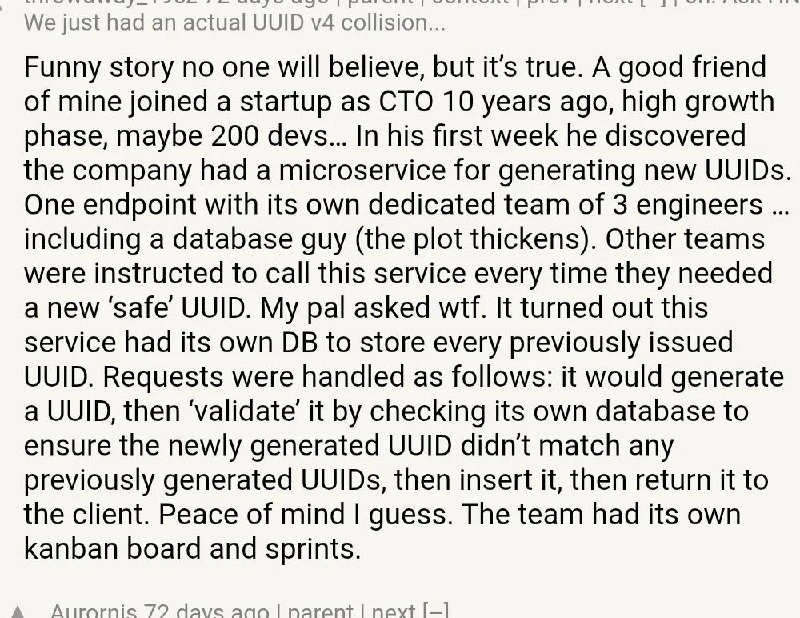
Description

This is a classic 'Drake Hotline Bling' two-panel meme format used to comment on developer habits. In the top panel, the rapper Drake is shown with a hand up in a gesture of disapproval next to the text 'Writing unique code and using it once'. In the bottom panel, Drake has a look of approval and is pointing, next to the text 'Writing an extensive modular system and using it once'. The meme humorously critiques the common developer tendency to over-engineer a solution. Instead of writing a simple, fit-for-purpose script, developers often feel compelled to build a complex, perfectly architected, and reusable system, even when they know it will only ever be used for a single task. It's a self-deprecating joke about prioritizing elegant abstraction over pragmatic simplicity
Comments

7
Anonymous ★ Top Pick That modular system is now a platform. It has three users, a backlog of feature requests nobody will ever work on, and a legacy dependency that prevents upgrading the entire stack
  1. Anonymous ★ Top Pick

    That modular system is now a platform. It has three users, a backlog of feature requests nobody will ever work on, and a legacy dependency that prevents upgrading the entire stack

  2. Anonymous

    Nothing says “seasoned engineer” like architecting a plugin-driven, event-sourced micro-kernel so extensible that the only extension ever written is called DefaultPlugin

  3. Anonymous

    Somewhere there's a developer who built a microservices architecture with Kubernetes, event sourcing, and CQRS just to parse a CSV file that runs once a quarter - and they're writing a Medium article about how it scales to infinity

  4. Anonymous

    We've all been there: spending three sprints architecting a beautifully abstracted, dependency-injected, plugin-based framework with comprehensive interfaces and factory patterns... for a feature that ships once and never changes. It's the software equivalent of building a suspension bridge to cross a creek you'll visit once. But hey, at least when the PM asks 'can we make it configurable?' six months later, you can smugly say 'already is' - right before realizing the codebase has moved on and nobody remembers how your elegant system works

  5. Anonymous

    YAGNI? That's for juniors - seniors build the framework today for tomorrow's 'obvious' needs that never arrive

  6. Anonymous

    Architecture ROI check: two sprints building a pluggable framework with DI and an event bus, then product cancels the feature - congrats, you built a reusable system for exactly one cron job

  7. Anonymous

    Classic senior move: refactor a 200-line one-off into a pluggable, hexagonal microkernel with DI and an SDK - then ship exactly one plugin forever

Use J and K for navigation