Skip to content
DevMeme
4401 of 7435
Modernizing a Legacy System
LegacySystems Post #4821, on Aug 18, 2022 in TG

Modernizing a Legacy System

Why is this LegacySystems meme funny?

Level 1: Excel Always Wins

Think of it this way: the company’s job ad was like someone promising you every flavor of ice cream if you come to their party. You arrive, excited to taste chocolate, strawberry, mint, and all the rest… but then you find out they only have plain vanilla. You’d probably laugh a little and think, “Wait, seriously? All that promise for just this?” In this meme, all the fancy tech skills listed are the many ice cream flavors being promised. But the only thing you actually get to “taste” on the job is the plain vanilla of tech tools: a simple Excel spreadsheet. It’s funny in a cheeky way because we understand the feeling of expecting something grand and getting something ordinary. The joke shows that sometimes in the tech world, people talk big, but what you really do is pretty simple – and that surprise is the whole point of the laugh.

Level 2: Spreadsheet Surprise

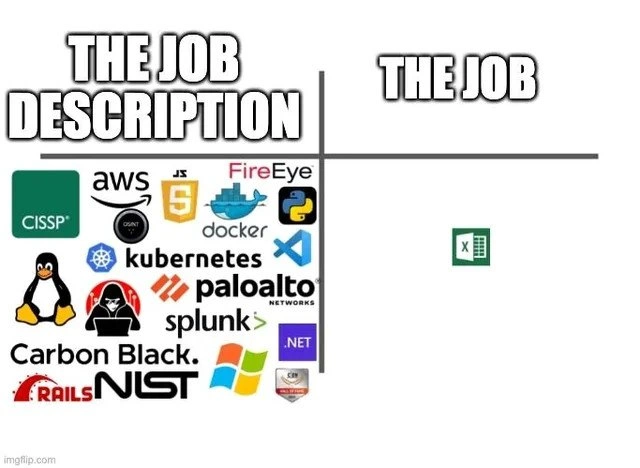
For a newcomer to the tech industry, let's break down why this meme is funny. It highlights the difference between what a job posting promises and what you actually do on the job (a classic expectation-vs-reality gag). On the left side of the image, under "The Job Description," there’s a big collage of technology logos and acronyms. Each of these is a real tech skill or tool that job listings often mention. For example:

  • AWS – Amazon Web Services, a popular cloud computing platform. Companies mention AWS when they expect you to deploy or manage servers and services in the cloud.
  • Docker – a tool that packages applications into containers, which run the same everywhere.
  • Kubernetes – often written as “K8s,” it’s a system to manage and orchestrate lots of Docker containers across many machines.
  • Python, JavaScript, .NET, Rails – these are programming languages or frameworks. JavaScript is mainly for web front-end code, Python and Ruby on Rails are often used for back-end servers, and .NET (from Microsoft) is a framework/language ecosystem typically for large enterprise applications. Listing all of these means they want you to be fluent in multiple coding environments (which is a lot!).
  • Linux and Windows – the two major operating systems. Being comfortable with both implies you might manage or develop on both server types.
  • CISSP – a top-tier security certification (Certified Information Systems Security Professional). If a job asks for this, they expect knowledge of cybersecurity principles at an expert level.
  • FireEye, Carbon Black, Palo Alto – these are cybersecurity tools/companies. FireEye and Carbon Black provide advanced threat detection on networks and computers. Palo Alto Networks makes enterprise firewalls. Including these hints the job might involve cybersecurity or IT defense duties.
  • Splunk – a software platform for searching, monitoring, and analyzing log data. If an application or network generates logs (records of events), Splunk helps make sense of them. A job listing that cites Splunk expects you to deal with a lot of system logs or security events.
  • NIST – refers to standards from the National Institute of Standards and Technology (like the NIST cybersecurity framework). Mentioning NIST means the company cares about compliance and security best practices.

Seeing so many different tags in one job description is a big tip-off. It’s like the company is asking for a superhero who knows every technology ever. A junior developer reading that might think, “Wow, I need to know all these things to get a job?” In reality, no single job would realistically use all of these at once – it would be overwhelming and unnecessary. This kind of buzzword overload in job posts is often joked about because companies sometimes copy-paste every trendy skill hoping to find a perfect candidate. The meme exaggerates it by cramming the entire left side with logos, but it’s only slightly exaggerating! We’ve all seen job ads listing, say, 10 different programming languages plus DevOps and security certifications to boot. It’s overkill.

Now look at the right side, under "The Job." It’s almost blank, with just a tiny Excel icon (the logo for Microsoft Excel, the spreadsheet software). The joke is that despite all those high-flying requirements on the left, the actual work you'll do is simply Excel spreadsheets all day. For many developers, this punchline hits home. A spreadsheet-centric role means you’re mostly entering data, making charts, or writing formulas in Excel, rather than coding in those fancy technologies. It's not what you’d expect if you read the description. Imagine applying for what sounds like a cutting-edge software engineering job, and then finding out you spend most days editing rows and columns in Excel. Talk about a surprise!

This humor is very relatable because lots of us have experienced something similar early in our careers. Maybe you got your first job thinking you’d build awesome software, but then your manager said, “Actually, can you just maintain this giant Excel sheet for now?” It’s a bit disappointing and ironic. Excel is a great tool, but it’s often used as a makeshift solution in places that don’t have proper systems. So the company might have talked about cloud infrastructure and big data, but internally they are still glued together with spreadsheets. For a junior developer, this meme is a lighthearted caution: don’t believe everything a job description says. The fancy buzzwords might just be there to impress – the real job could be much more basic. The humor comes from that contrast: large hiring expectations vs mundane reality. Once you’ve been through it, you learn to spot these red flags (and you can laugh at it, like we do with this meme).

Level 3: Buffet of Buzzwords

The meme captures a hiring expectations mismatch that every seasoned developer has seen. On the left, under "THE JOB DESCRIPTION," there's a wall of tech logos – AWS, Docker, Kubernetes, Python, JavaScript, .NET, Rails, CISSP, FireEye, Carbon Black, Palo Alto Networks, Splunk, Linux, Windows, NIST, and more. It's basically a buzzword overload listing every hot tech skill and certification imaginable. Reading it feels like playing buzzword bingo: the posting asks for a DevOps engineer, full-stack developer, security analyst, and compliance officer all rolled into one mythical "unicorn" developer. Any senior engineer recognizes this laundry list as unrealistic – it's the jack-of-all-trades fantasy where the company wants one person to do the work of entire teams. We chuckle (or groan) because we've been through it: job descriptions that demand a rockstar ninja who can spin up a cloud infrastructure in AWS, code in five languages, juggle containers in Kubernetes, fortify security per NIST standards, and maybe absorb cosmic rays for energy while they're at it (why not?).

In reality, when you land such a job, it’s often a different story – which the meme’s right side hilariously exposes. Under "THE JOB," there’s nothing but a tiny green Excel icon floating in white space. All those fancy skills and cutting-edge tools from the description? Never used. Instead, your day-to-day might revolve around a massive spreadsheet. It's a punchline every veteran developer gets immediately: the job description promises the cloud, but the job delivers Excel. This is tech industry satire at its finest, highlighting how career expectations often clash with on-the-job reality. The humor stings because it's true – many of us have taken roles expecting to architect microservices or implement machine learning, only to spend our time copy-pasting data into Excel.

Why does this happen? Often, hiring managers or HR departments pad job listings with every keyword under the sun. They figure more buzzwords will attract “top talent” or cover all bases. Sometimes it's a clueless HR rep pasting requirements from multiple old templates, yielding a Frankenstein’s monster of a job ad. Other times it’s wishful thinking – they want one hire who magically knows AWS cloud infrastructure, can debug a monolithic .NET app and a Rails app, wrangle Docker containers on Linux and manage patching on Windows, analyze intrusion alerts from FireEye while writing Python scripts, and of course document everything per NIST guidelines. An experienced engineer reading that knows it's a red flag: either the company has no idea what they really need, or they expect superhero levels of overwork. Either way, the savvy response is an eyeroll and a chuckle, because we've learned the bigger the buzzword salad, the more likely the actual job is a bland casserole.

Speaking of bland reality, nothing represents it better than Excel. Despite all the high-tech jargon, many organizations fall back on good old spreadsheets to get things done. It's the unspoken truth: Excel spreadsheets are the duct tape of the corporate world. Veteran developers have seen entire critical workflows running on an ancient Revenue_Report_FINAL_v3.xlsx file sitting on a manager’s desktop. So the meme’s joke is painfully on-point: the spreadsheet-centric role was hiding behind grandiose requirements. Instead of deploying scalable apps or analyzing big data as promised, you might be formatting cells, fixing broken formulas, and emailing around CSV files. (As a cynic might say: "Modern problems require... Excel solutions.") The tiny Excel icon in that vast empty space perfectly symbolizes how all that tech grandeur shrinks down to one tiny, ubiquitous tool. No matter what fancy stack a project claims to use, somehow everything funnels back to Excel eventually.

This contrast is both funny and a little tragic. The CareerHumor here comes from shared experience – most developers have felt the whiplash of hiring humor like this. One minute you’re being recruited as if you’ll be designing NASA’s next flight software, the next you’re updating a 2000-row spreadsheet named data_final_FINAL_USE_THIS_ONE.xlsx. It’s a relatable humor moment that elicits a laugh of recognition (and maybe a groan). Sure, you'll gain exceptional Excel skills and a black belt in pivot tables, but it’s not exactly what you signed up for. The meme exaggerates to make its point, and that absurdity is why it’s so spot-on. Below is a tongue-in-cheek comparison between what the job_description_vs_real_job looks like:

Job Description Buzzwords Actual Daily Work
Architect scalable cloud apps on AWS with Docker/K8s Update a giant Excel sheet on a shared drive (your "cloud")
Develop full‑stack features in Python, .NET, JS, Rails Write Excel formulas and the occasional VBA macro
Implement enterprise security (CISSP, FireEye, etc.) Track user access in an Excel file named permissions_final.xlsx
Monitor logs & ensure NIST compliance (Splunk, SIEM) Manually copy logs into Excel for monthly compliance reports

As you can see, the left column reads like a tech buzzword buffet, while the right column is basically “Microsoft Excel, all day, every day.” The meme resonates with senior devs because we’ve lived this bait-and-switch. We know that feeling of déjá vu when you open your laptop and realize the only icon you’ll be clicking today is the green X. It’s a mix of irony and CorporateCulture critique: companies talk about cutting-edge innovation but often run on decades-old workflows. At least humor helps – we joke that Excel is the one true programming language everyone ends up using. After experiencing a few jobs like this, you learn to read between the lines of a flashy job spec. As the cynical saying goes, “In theory, theory and practice are the same. In practice… you’re doing spreadsheets.”

Description

A meme showing a person trying to put a modern engine into a very old car. The engine is shiny and new, while the car is rusty and falling apart. The person looks frustrated. This represents the struggle of trying to modernize a legacy system with new technology. The old system is often not compatible with the new technology, leading to many problems

Comments

7
Anonymous ★ Top Pick They say you can't put a new engine in an old car. In software, you can, but the old car will find a way to make the new engine leak oil
  1. Anonymous ★ Top Pick

    They say you can't put a new engine in an old car. In software, you can, but the old car will find a way to make the new engine leak oil

  2. Anonymous

    Job ad: “Design a zero-trust, cloud-native microservice mesh.” Reality: refactoring a 200 MB, macro-enabled spreadsheet that’s proudly single-tenanted on finance’s C: drive

  3. Anonymous

    They wanted someone who could orchestrate Kubernetes clusters across multi-cloud environments with zero-downtime deployments, but what they really needed was someone who could make the CEO's pivot table stop showing #REF! errors

  4. Anonymous

    After 15 years in the industry, you learn that 'full-stack engineer with Kubernetes, AWS, and Python expertise' is just HR-speak for 'Excel power user who occasionally writes a VLOOKUP formula.' The real technical debt isn't in the codebase - it's in the gap between the job req and the actual work, compounded daily at the rate of one pivot table per sprint

  5. Anonymous

    They promised a multi-cloud, containerized SIEM; our single pane of glass is RiskRegister.xlsx with 48 VLOOKUPs and rollbacks via Ctrl+Z

  6. Anonymous

    Promised Kubernetes orchestration; reality: orchestrating OFFSET formulas across 50 linked sheets

  7. Anonymous

    JD: Kubernetes, Palo Alto, Splunk; reality: Excel SRE - maintaining the spreadsheet monolith that’s the company’s true source of truth, with a deployment pipeline called Reply All

Use J and K for navigation