The Duality of Code in Development vs. Production
Why is this Bugs meme funny?
Level 1: Looks Can Deceive
Imagine you’re doing a really hard puzzle, and you’ve been working on it in your head. You might be sitting there, not moving much, just thinking about where the next piece goes. To someone else, you look like you’re not doing anything at all. Now picture a friend coming by and joking, “Haha, you’re so lazy, not doing any work on that puzzle!” You’d probably feel annoyed because you are working hard – just not in an obvious way they can see. That’s like the first part of the joke in this meme. Programmers sometimes look like they’re just staring at a screen or daydreaming, but actually their brain is busy solving problems (kind of like figuring out a puzzle piece in your head). So calling them lazy is unfair, just like calling you lazy when you’re quietly thinking hard.
Now for the second part: have you ever been so into a hobby or homework that someone jokes you have “no life” because you spend a lot of time on it? It’s not a nice joke. It’s like saying you do only that one thing and nothing else, which isn’t true. In this meme, the person is joking that programmers have no personal life – meaning they only sit with their computer and do nothing else fun. That’s a mean exaggeration. Most programmers have families, friends, or play games and sports, just like anyone else. They need time to relax so they don’t get too tired or burnt out, just like you need recess after focusing in class.
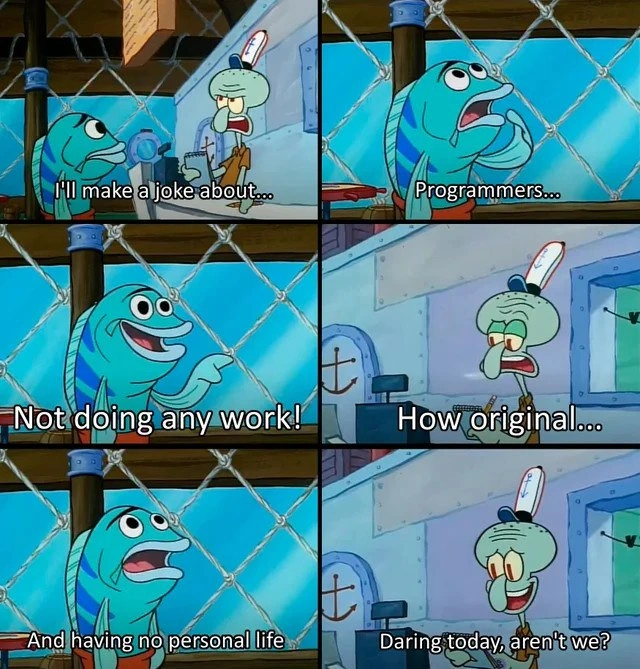
So the SpongeBob picture shows a customer fish excited to make these mean jokes and the cashier (Squidward) responding with a sarcastic “How original... Daring today, aren’t we?” which is basically him saying: “Wow, I’ve heard that joke a million times. It’s not clever at all.” The humor here is like when someone uses a very old, not funny joke, and instead of laughing, you just give them a look like, “Really? That’s the best you’ve got?” The meme is funny because it flips things around: it’s defending the programmers. It says that making fun of them for “being lazy” or “having no life” is a boring and unoriginal joke. In simple terms, the meme teaches us not to judge people by how their work looks from the outside. Just because you can’t see what someone is doing, that doesn’t mean they’re doing nothing – they might be working really hard in a way that isn’t obvious. And joking that someone has no life? That’s just not nice and pretty far from the truth. So, the meme uses SpongeBob characters to show that those old jokes about programmers aren’t as funny or clever as people think, reminding us that looks can be deceiving and everyone deserves respect for the work they do and the life they have outside of it.
Level 2: The Invisible Work
Let’s break down why this SpongeBob meme is funny to folks in tech. The big idea here is programmer stereotypes – basically, common beliefs or jokes about how developers behave. The meme highlights two very popular stereotypes:
- “Programmers not doing any work.” This is the joke that developers are lazy or just sit around. People might say this because a lot of what programmers do doesn’t look like traditional labor. A developer might spend hours quietly thinking about a problem, Googling error messages, or reading documentation. To someone watching, it can look as if nothing is happening. Unlike building a house or baking a cake, coding work is often invisible until it’s done. So outsiders might tease, “Oh, you just type a couple of lines and drink coffee all day, that’s easy!” This meme calls out that joke and basically says, “Ugh, not that joke again.”
- “Programmers have no personal life.” This stereotype claims that developers are so obsessed with computers that they don’t have friends or hobbies, working till midnight every day. It’s the image of the coder in a dark room, maybe living on junk food, completely disconnected from normal life. It’s often meant as a light tease – like calling someone a nerd who never leaves the computer. But it’s also an overused jibe, and it can feel a bit mean or out-of-touch today. Most developers do have lives outside of work (families, playing sports, music, you name it) or at least want to. In fact, there’s a big emphasis now on work-life balance tips in the tech industry, because having time away from the keyboard actually makes you a healthier and more productive developer. So when someone jokes “haha you must never see daylight,” devs are like, “Really? That old joke?”
In the meme panels, the turquoise fish represents someone eagerly making these cliché jokes, and Squidward (the grumpy cashier) represents the developer hearing them. The fish says, “I’ll make a joke about programmers not doing any work!” with a big grin. Then Squidward replies flatly, “How original...” meaning “wow, how creative (not!).” Next, the fish adds, “And having no personal life,” doubling down on the stereotypes. Squidward finally responds, “Daring today, aren’t we?” which in context means, “Oh, you’re really pushing the envelope with these daring, super-original jokes, huh?” Squidward’s sarcasm shows he’s unimpressed and annoyed. This sarcastic response is exactly how a lot of developers feel when these stereotypes are brought up yet again. They’ve heard it a million times, so the humor is in Squidward’s deadpan truth: the jokes are old and lame.
Technically, this meme also touches on the idea of invisible work in programming. Invisible work means all the effort you don’t see directly. For example, a junior developer might wonder why their senior spent an entire afternoon and only wrote 10 lines of code. But maybe those 10 lines fixed a critical bug or prevented a security hole – a huge win! Writing code isn’t like an assembly line where more widgets = more work. A lot of the work is thinking, designing, testing, and fixing, which might not result in tons of new code. In fact, good coding can sometimes mean simplifying or removing code. So when people joke “not doing any work,” devs get defensive because they are working – it’s just not always visible labor. As for the “no personal life” part, younger devs are often advised to maintain hobbies, socialize, and take breaks, because burning out on coding helps no one. It’s even common for experienced mentors to share mental health advice and work-life balance resources with newcomers. So implying that “real programmers have no life” isn’t just outdated, it’s something the community actively pushes against.
Lastly, it’s worth noting the SpongeBob meme format used here. SpongeBob SquarePants is a cartoon that’s generated a ton of popular meme templates. This one with Squidward in the Krusty Krab is often used to mock someone for saying or doing something unoriginal. It’s a perfect fit: the enthusiastic fish is the jokester, and Squidward is basically every developer who’s heard these stereotypes too many times. In developer meme culture (DeveloperHumor and CodingHumor threads everywhere), this format would immediately signal a sarcastic tone. The text in each panel spells out the conversation clearly, so even a junior developer or someone new to coding can catch the drift: “Oh, these are those same old jokes about lazy programmers with no life, and the meme is making fun of how unoriginal those jokes are.” It’s relatable humor for anyone in tech who’s tired of being seen as either a couch potato or a code zombie.
Level 3: Stereotype Overflow
At the senior engineer level, this meme hits on a tired joke that has long overstayed its welcome in developer culture. The SpongeBob meme format shows a wide-eyed customer fish enthusiastically declaring he’ll joke about “programmers not doing any work” and “having no personal life.” Squidward, as the jaded developer behind the counter, responds with deadpan sarcasm: “How original... Daring today, aren’t we?” This sarcastic response is basically the entire developer community rolling their eyes. Why? Because jokes about the lazy programmer trope and the no-personal-life nerd are as overused as a for loop in legacy code. They’ve been repeated so often that hearing them now feels like a Stack Overflow of stale humor.
On a deeper level, the meme is a subtle developer defense against misconceptions. It highlights the disconnect between visible output and intellectual effort in software engineering. To an outsider, a programmer staring at the screen or refactoring might “not look busy.” It’s true that our work doesn’t always produce flashy, immediate results – sometimes after a full day’s effort, there’s just a tiny commit or even fewer lines of code than we started with (thanks to deleting cruft!). But those small changes can represent hours of debugging, design discussions, and problem solving. In tech terms, a one-line fix might resolve a complex race condition or an elusive memory leak. The invisible work is massive, even if the visible output is minimal. Senior devs know that measuring productivity by lines of code is bogus – sometimes the most productive day involves removing 100 lines of tangled logic to improve performance or readability. So when someone cracks a lazy programmer joke, experienced engineers smirk because they know real productivity isn’t easily seen.
The “no personal life” punchline gets an even more sarcastic eye-roll. This stereotype paints developers as socially isolated basement-dwellers who code until 4 AM, surviving on pizza and energy drinks. It’s an old caricature, going back to at least the 90s if not earlier, and it doesn’t reflect reality for most. Sure, during crunch times or on-call emergencies we might put in long hours (we’ve all had those 3 AM deployments – fun times not!), but modern developer culture (thankfully) puts more emphasis on work-life balance and mental health. Many devs have families, hobbies, and gasp even personalities outside of keyboard and screen. The meme’s Squidward essentially says, “Oh wow, another joke implying I have no life outside coding? Never heard that before.” It’s dripping with sarcastic response to signal that these clichés are not just unoriginal, they’re also pretty insulting. After all, implying someone has no life can diminish personal boundaries and normalize unhealthy expectations (like being available 24/7 or working every weekend). Seasoned developers have seen how these attitudes lead to burnout and toxic work-life imbalance. So this meme resonates because it calls out the programmer_stereotypes – both the “lazy coder who automates everything and does nothing” and the “obsessive coder with no life” – as the shallow jokes they are.
In essence, at the senior level we recognize the humor as relatable satire. It’s poking fun at how non-developers (and sometimes clueless managers) misunderstand what real developer productivity looks like. The meme’s format, borrowed from SpongeBob, is classic: one character proposes something obvious or clichéd, and the other sarcastically mocks the lack of originality. In our context, the target of the roast is the unimaginative person who keeps making these lazy programmer jabs. Experienced devs appreciate this meme because it finally roasts the cliche instead of the coder. It’s a witty bit of developer humor that says, “Hey, those jokes about us slacking off and having no life? We see right through them – and we’re not amused.”
Description
A two-panel meme contrasting the developer's perception of their code with its real-world performance. The top panel, labeled 'My code in development,' features a vibrant, majestic lion, symbolizing strength, elegance, and perfection. The bottom panel, labeled 'My code in production,' shows a small, scruffy, and somewhat panicked-looking cat, representing the same code when it encounters the chaotic, unpredictable environment of a live system. This meme humorously captures the universal developer experience where robust-seeming code behaves unexpectedly or reveals its fragility once deployed, resonating with senior engineers who have experienced this humbling reality countless times
Comments
7Comment deleted
The confidence of a junior dev's first production deployment has the same energy as a house cat seeing its reflection for the first time
Apparently ‘not doing any work’ is just what you call deleting 30 k lines across six repos so prod finally stops paging us at 3 a.m. - Git shows minus signs, my social life shows zero downtime
Meanwhile, we're architecting distributed systems that handle millions of requests while recruiters still ask if we can "make the logo bigger" and relatives think we fix printers
This meme perfectly captures the senior engineer's reaction when yet another non-technical person makes the 'programmers don't work, they just Google stuff' joke at a company all-hands. We've heard it so many times that we've developed a standardized O(1) eye-roll response, complete with the same energy as reviewing a PR that reinvents Array.prototype.map() for the third time this sprint
Bold take: programmers idle like event loops - poised for that async callback to hijack our weekend
Funny how 'programmers do nothing' until the pager is quiet; the deliverable was a zero on the incident dashboard and a P99 that dropped 200ms -- hard to screenshot the absence of entropy
Programmers don’t do any work? Right - just deleting code to hold 99.95% SLO across 60 microservices while PagerDuty manages our social life