Skip to content
DevMeme
4402 of 7435
String Concatenation: From Simple to Insane
Performance Post #4820, on Aug 18, 2022 in TG

String Concatenation: From Simple to Insane

Why is this Performance meme funny?

Level 1: Hiding in the Bathroom

Imagine you’re trying to solve a really hard puzzle or homework problem. One person carefully uses all the right tools – like looking at hints, working through each step slowly, double-checking their work – just like a good student should. That’s the top picture: someone methodically working through the problem with the proper tools (in coding, that tool is a debugger which helps pause and examine the program). Now think about yourself on a bad day: you’ve tried everything, but the puzzle still doesn’t make sense. Instead of continuing, you feel so frustrated that you just stop and put your head in your hands. You might even go sit in the bathroom or another quiet place because you’re upset and need a break. That’s the bottom picture. It’s showing a person who has basically given up (at least for the moment) and is feeling hopeless. This is funny in a bittersweet way because we all know we should keep trying calmly, but sometimes we just can’t help feeling defeated. The meme exaggerates this by showing the difference side by side: “normal people” keep working with their fancy tools and calm focus, while “me” – I’m just emotionally exhausted and literally hiding in the bathroom out of despair. It’s like saying: When I can’t fix something after trying really hard, I feel so hopeless I just want to be alone and cry for a bit. We laugh at the meme because deep down, we’ve all had moments like that with tough problems. It assures us that feeling frustrated and needing to step away is a common human reaction. In simple terms, the joke is: other people solve problems in a straightforward way, but when I try, I get so frustrated I end up sitting on the toilet, sad and defeated. It uses a cartoonishly dramatic image to make us smile and say, “Yep, I’ve been there!”

Level 2: Plan B – Print and Pray

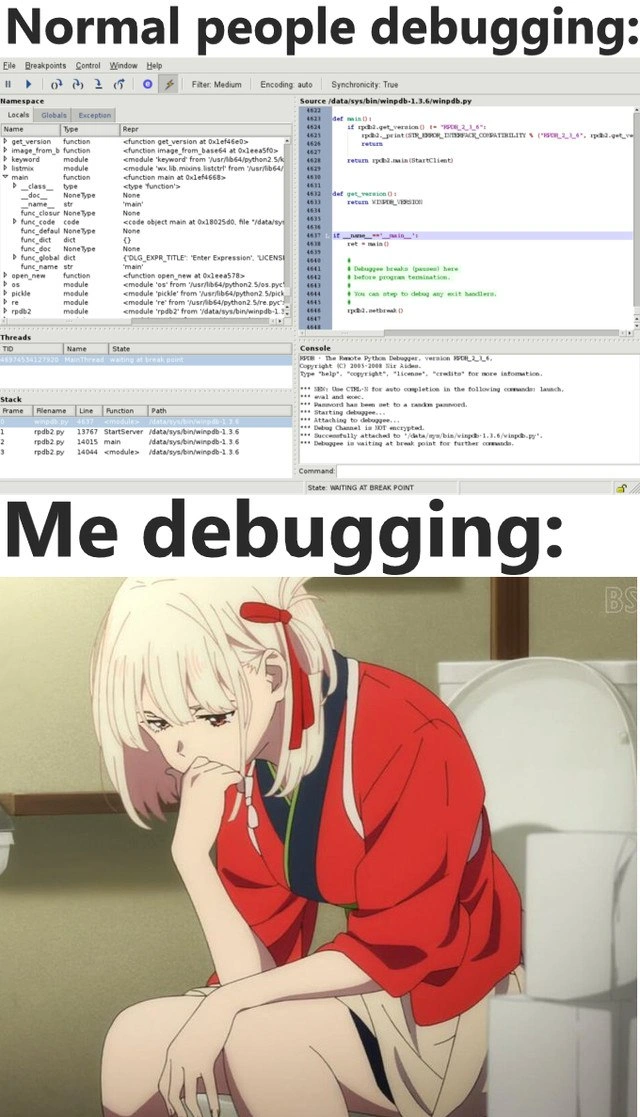
Stepping down to a more introductory view, let’s explain what’s happening in this meme. Debugging is the process of finding and fixing errors (bugs) in your code. Ideally, you use a debugger, which is a specialized tool or program that lets you run your code step-by-step. In the top image, we see a debugger called WinPDB (a Windows Python Debugger). It has a GUI (Graphical User Interface) showing things like the list of variables in the current scope (the “Namespace” with Locals and Globals), the call stack trace (the list of function calls that brought the program to the current point), and the source code with a highlighted line. That highlighted line is a breakpoint – a spot where the program has been instructed to pause. The status message “WAITING AT BREAK POINT” means the program hit that breakpoint and is now suspended, allowing the developer to inspect what’s going on at this exact moment. This is what “normal people debugging” portrays: a structured, step-by-step inspection of a running program. The developer can check if variables have the expected values, move line by line (Step, Next buttons etc.), and see where things might be going wrong. Using a debugger is often taught as the “proper” way to troubleshoot because it gives you a controlled environment to observe program state and behavior in real-time.

Now, the meme contrasts that with “Me debugging,” showing an anime girl looking defeated on a toilet. Of course, this isn’t literally a debugging method! It’s a tongue-in-cheek way to say that my approach to debugging has devolved into sitting and feeling hopeless. Why would a developer feel like that? Because sometimes debugging is really hard and doesn’t go as planned. Imagine you tried all the usual techniques – breakpoints, reading error messages, checking the logic – and the bug is still not solved. It’s common (especially when you’re new or the bug is really tricky) to feel frustrated and stuck. The “toilet” part of the image is an exaggeration meant to be funny. It suggests the person has left their desk and gone to the most private, comfort-seeking place – the bathroom – essentially to take a break and sulk. It symbolizes hitting rock bottom in troubleshooting. In a way, it’s also referencing how sometimes taking a break (even if it’s just going to the restroom or getting a coffee) is the last resort to clear your head. Developers often joke about “shower thoughts” or “toilet contemplation” – where stepping away from the screen might suddenly give you an idea or at least calm the frustration. So the image conveys: I tried debugging properly, it didn’t work, now I’m just despairing and maybe hoping for a miracle insight.

The phrase “Print and Pray” (used in our level title) is a humorous way developers describe a less elegant debugging method: adding print statements to the code to display values at certain points, then running the program at full speed and praying you catch the bug in the output. Many beginners (and yes, even experienced programmers sometimes) do this when they’re stuck. Why prints? Because if a fancy debugger isn’t an option (or isn’t helping), you can still insert lines of code to output the program’s state (print("value of x:", x)) to trace what’s happening. It’s not as interactive or precise as a real debugger, but it’s often Plan B. The meme’s bottom half essentially depicts the emotion during that Plan B (or Plan Z) phase – you’re out of clever ideas, so you’re just moaning to yourself about the bug. It’s a form of self-deprecating humor: the author is saying “Look, other devs are debugging with cool tools. Me? I’m so lost I might as well be crying in the bathroom.” By using an anime image, the meme adds a dramatic visual language that’s surprisingly common in tech memes – mixing pop culture with programming. The anime girl’s body language (head in hand, distant stare) perfectly communicates despair without any words. For those unfamiliar, anime (Japanese animation) often uses exaggerated expressions and scenarios to convey emotion, which meme creators borrow for impact. Even if you don’t know the specific character, you immediately get the mood: utter defeat.

Let’s also clarify the structure: “Normal people X; Me X” is a popular meme template. It sets up an expectation in the first panel (“This is how normal folks do it”) and then subverts it humorously in the second (“This is how I do it”). In reality, normal developers probably also struggle, but the joke is about feeling alone in your struggles. It’s a way to laugh at oneself and say “I bet I look ridiculous, I can’t do what appears easy for others.” Within developer culture, sharing such memes is a way to bond over the shared pain — everyone recognizes that toilet-of-despair feeling, even if we don’t talk about it in stand-up meetings! It’s very relatable humor for anyone who’s spent late hours chasing a bug. If you’re new to coding, don’t worry: even people with years of experience find themselves stuck and overwhelmed at times. The meme just uses an extreme example for comedic effect. In practice, if a debugger isn’t helping, a developer might:

  • Take a short break (get coffee, walk around – hopefully not only to cry, but to clear the mind).
  • Use simpler tools like print/log statements to gather clues.
  • Talk to a colleague or even a rubber duck (yes, rubber duck debugging is real – explaining the problem out loud, even to an inanimate object, can spark insight).

The “toilet of despair” scene is basically this scenario cranked up to 11. It’s the feeling of “I have no idea what to do next, so I’m just going to sit here and wallow for a minute.” Every developer has a moment when a bug makes them feel totally defeated. The meme takes that internal moment and makes it visual and absurd (because comedy helps take the sting out of the frustration). In sum, Level 2 explains the key terms and images: a debugger interface (WinPDB) representing the proper debugging process, and a defeated anime character on a toilet representing a developer’s frustration and despair. It’s comparing the ideal vs the reality in a funny, exaggerated way that’s instantly recognizable to those in software development.

Level 3: Breakpoints vs Breakdowns

On a more practical level, the meme hilariously contrasts textbook debugging with the real-world emotional meltdown many developers experience. The top panel (“Normal people debugging”) shows a screenshot of the WinPDB Python debugger – a GUI tool where you can set breakpoints, step through code, inspect variables, and view the call stack. It’s a pretty idealized scene of debugging: the program is paused at a line (State: WAITING AT BREAK POINT), local variables and stack frames are neatly listed, and the developer can methodically examine program state. This represents the disciplined approach: using proper debugging tools to methodically find the bug. In theory, every developer should debug like this – calmly, systematically, treating bug hunting like science.

Then comes the punch line: “Me debugging:” with a forlorn anime girl in a red yukata sitting on a toilet, face in hand, utterly defeated. This stark normal vs. me format is classic self-deprecating humor. It implies “Everyone else does this the proper way; meanwhile, look at my pathetic approach.” The DeveloperHumor hits home because most devs have been there: you start pouring over stack traces and memory dumps like a pro, but after hours of failure you end up literally or figuratively sitting in despair. The toilet of despair is an absurd exaggeration, yet it symbolizes something very real – the urge to retreat to a private corner to contemplate your life choices when a bug refuses to budge. It’s an ironic twist on DeveloperExperience (DX): we talk about great DX when tools make us productive, but here the experience has degraded to sitting on cold porcelain questioning one’s sanity.

The humor also comes from the juxtaposition of high-tech vs. low point. Up top, we have a complex debugging interface – buttons, threads, breakpoints galore – suggesting a developer in control. Down below, we have an anime character literally sitting in defeat, suggesting a developer who has lost all control. This captures the emotional rollercoaster of debugging. In one moment you’re confidently using a debugger to step through code; the next, none of it makes sense and you’ve collapsed into “I have no idea what’s going on.” It’s the breakpoint turning into a breakdown. The choice of an anime reference for the “me” panel adds dramatic flair – anime often exaggerates emotions, so it perfectly illustrates that over-the-top hopelessness. (Plus, many coders are anime fans, so it’s kind of an in-joke in the DeveloperMemes world to use anime scenes for relatability.)

Importantly, the meme resonates because it’s about relatable dev experience. We’ve all had bugs that reduce us to this state. Perhaps the bug only happens on the client’s machine, or only when the moon is full. You’ve tried the scientific method: breakpoints, debugging sessions, reading documentation. Yet the issue remains unsolved. Eventually, frustration boils over. The meme says “I give up – I’m not debugging anymore, I’m just… sad.” It’s poking fun at that emotional low point in troubleshooting. In a team setting, a “normal” colleague might calmly use the debugger, while you might be that person muttering to yourself in the restroom stall after your fifth failed fix. The contrast is hyperbolic for comedic effect, but it’s rooted in truth. The top image’s WinPDB debugger interface is something an experienced or “proper” developer might use. The bottom image’s scenario – sulking on a toilet – is obviously not a real debugging method, but it humorously represents using despair and contemplation as the last resort. It’s effectively saying: when all logical debugging approaches fail, you turn to existential debugging (Why, cruel world, does this code not work?!).

Another layer here is the classic “Normal People vs Me” meme format. This format is popular because it highlights personal quirks or failures against a perceived norm. In tech culture, we’re always aware of “how professionals do things” versus how messy our own processes can get. “Normal people debugging” implies a mythical average developer who does everything right (using interactive debuggers, writing tests, staying calm). “Me debugging” implies the author feels comically inferior, resorting to ridiculous extremes (like crying in the bathroom). It’s relatable humor because developers often feel imposter syndrome — the sense that everyone else has it together while I’m just hacking and praying. By depicting themselves on a toilet (literally the lowest seat in the house) the author exaggerates their felt incompetence. This kind of debugging self-deprecation makes the meme funny and comforting at the same time: funny, because it’s an extreme exaggeration, and comforting, because it acknowledges that actually, everyone ends up feeling this way. The secret joke is that even “normal people” have their toilet-of-despair moments; nobody debugs in that pristine linear way all the time. The shared understanding is what triggers that knowing laugh — we’ve all retreated to our mental bathroom stall of shame during a tough bug.

Finally, consider the setting itself: the toilet is a place of solitude (and, well, not usually associated with programming prowess). By placing the defeated developer there, the meme taps into a bit of dark, cynical humor. It says debugging this issue has literally driven me to the lowest of lows. A cynical veteran developer might quip: “After trying twenty fixes that didn’t work, you end up in the one place no one will bother you – yep, debugging from the bathroom, staring at the floor tiles for answers.” The contrast between fancy debugging tools and this absurd “toilet troubleshooting” scenario underscores how debugging can degenerate from high-tech analysis to primal frustration. In summary, Level 3 dissects why the meme is painfully funny: it satirizes the gap between the ideal debugging process and the chaotic reality of developer life, with a vivid visual metaphor that any coder who’s chased a stubborn bug can appreciate.

Level 4: The Heisenbug Effect

At the deepest level, this meme hints at a notorious class of bugs that seem to disappear the moment you try to observe them. When the caption says "the debugger fails," it evokes the dreaded Heisenbug scenario. In software lore, a Heisenbug (named after the Heisenberg uncertainty principle) is a bug that changes behavior or vanishes under scrutiny – much like a shy quantum particle. The moment you attach a debugger or enable extra logging, the timing shifts or memory layout changes, and poof – the bug won’t reproduce. Debuggers work by pausing code at breakpoints and often altering execution timing, which can mask race conditions or timing-dependent faults. For example, a nasty thread synchronization bug might only surface when the program runs at full speed; single-stepping through it can unintentionally prevent the race condition from happening. It’s the ultimate developer nightmare: you know a defect is lurking, but every time you investigate, it hides in the shadows. This meme’s absurd contrast – a sophisticated debugger vs. a despairing toilet retreat – touches on that real frustration. When even the state-of-the-art tools provide no answers, developers face a kind of computational absurdity: the system behaves differently simply because it’s being watched. The observer effect in debugging is a humbling reminder that our tools have limits, and some bugs only materialize in the wild chaos of a real run. Seasoned engineers have learned (the hard way) that beyond a point, fancy breakpoints won’t save you. They resort to plan B: scatter print statements, run the program in a real environment, and pray to catch the bug off-guard. And when that fails, well, that’s when you find even the grizzled veterans in the proverbial “toilet of despair,” grappling with the fact that the software is effectively outsmarting its observer. This high-level foible of debugging – where examining a system changes its behavior – underpins the meme’s core joke: sometimes the only debug session you get is a staring contest with your code’s ghost, and it’s winning.

Description

A four-panel 'expanding brain' meme illustrating different methods of string concatenation in programming. The first panel shows a normal brain next to the word 'STRING,' representing a basic string. The second panel displays a slightly more evolved brain with 'StringBuilder,' indicating a more optimized approach. The third panel, showcasing a galaxy brain, presents the absurdly inefficient method of concatenating a string inside a loop: '("(&str" + a_very_long_string + ")").repeat(10000000)'. The humor lies in the sarcastic portrayal of the last method as the most enlightened, while in reality, it's a performance nightmare that senior developers would instantly recognize and avoid
Comments

7
Anonymous ★ Top Pick A junior dev uses string concatenation. A senior dev uses StringBuilder. A principal engineer writes a PhD thesis on the performance characteristics of both, then uses the '+' operator anyway because it's 'good enough for this service'
  1. Anonymous ★ Top Pick

    A junior dev uses string concatenation. A senior dev uses StringBuilder. A principal engineer writes a PhD thesis on the performance characteristics of both, then uses the '+' operator anyway because it's 'good enough for this service'

  2. Anonymous

    Normal devs fire up WinPDB; I lock myself in the restroom to single-step 500 asyncio tasks in my head - because you can’t attach a debugger to a Heisenbug running in prod

  3. Anonymous

    After 20 years in this industry, I've mastered every debugging tool known to humanity, yet here I am at 3 AM, convinced that undefined behavior in C++ is actually a sentient entity that feeds on my sanity and only manifests when the debugger isn't watching

  4. Anonymous

    The debugger shows you exactly where the code is, what variables contain, and the complete call stack - yet somehow you still end up staring at the screen for three hours wondering if the bug is in your code, the framework, the compiler, or your understanding of reality itself. Bonus points if you eventually discover it's a race condition that only manifests on Tuesdays

  5. Anonymous

    Real talk: my most effective debugger is SERIALIZABLE isolation - lock the bathroom door, tail logs on the phone, and the race condition finally reproduces

  6. Anonymous

    When the bug vanishes under the debugger, I switch to the only environment with a reliable global lock: the bathroom stall - my race-condition observability suite

  7. Anonymous

    Normals bisect stack traces; I derive halting problem proofs from the throne - undecidable until refactor hits prod

Use J and K for navigation