Jira's Phantom Board Updates
Why is this Agile meme funny?
Level 1: The Boy Who Cried Wolf
Imagine you’re in class at school. There’s a big chart on the wall showing the day’s schedule. Now, picture a classmate who keeps shouting, “The schedule changed! Look, something’s new!” even though nobody touched that chart and every activity is exactly the same. The first time, everyone checks the chart, confused. But when this keeps happening for no reason, it gets pretty annoying, right? That’s what this meme is joking about. JIRA is like that overeager classmate, always telling you “Hey, something changed!” when in fact nothing changed at all. It’s funny in a silly way because JIRA is basically ringing a false alarm bell. Just like in the fable of The Boy Who Cried Wolf, after so many false alarms you stop believing it – and that mix of frustration and “here we go again” is exactly why developers find this meme relatable and amusing.
Level 2: False Alarm Over Nothing
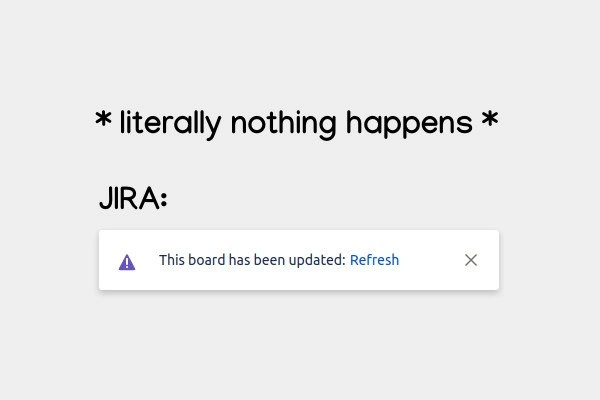
For those newer to the world of software teams, let’s break down the joke. JIRA is a popular tool used in software development for tracking tasks, bugs, and project progress – basically an digital bulletin board for your team’s work. In many Agile teams (using methods like Scrum or Kanban), you have a board that shows all the work items as cards moving through columns (To Do, In Progress, Done, etc.). JIRA’s board is interactive and updates in real-time so everyone stays on the same page. Normally, if someone else on your team moves a card or edits an issue, JIRA will display a little banner message saying “This board has been updated: Refresh”. That is JIRA politely telling you: “Hey, something changed that you haven’t seen yet – click refresh to load the latest data.” It’s meant to be helpful.
The meme jokes that JIRA sometimes shows this alert even when nothing actually changed. The top line “literally nothing happens” is internet-slang indicating that no event occurred. But JIRA still says, “Board has been updated.” Why would that happen? Possibly due to a minor behind-the-scenes change. For example, maybe an automated system updated a timestamp on a card, or someone opened an issue and closed it without changes. To you, the board looks the same – no cards moved – yet JIRA thinks there’s an update. It’s essentially a false update notification. Developers call this kind of thing notification spam: getting bombarded by alerts or emails that aren’t truly important. It’s a common annoyance in corporate tools and a big source of DeveloperFrustration.
This “refresh frenzy” is a bit of everyday ProjectManagementHumor in tech circles. New developers quickly learn about these quirks. At first, you might diligently stop and hit Refresh whenever JIRA asks you to – after all, you don’t want to miss any important change on the team board. But after the 50th time seeing phantom alerts, you realize it’s often a cry of wolf. It interrupts your work for no benefit. This is what we mean by poor DeveloperExperience: the tool meant to help you manage tasks ends up distracting you from the tasks themselves. In Agile practices, staying updated is crucial, but so is maintaining focus. The meme captures that tug-of-war. You can practically hear a junior dev ask, “Do I really need to refresh again, or is JIRA just being JIRA?” The answer, as you come to find out, is frequently the latter. So the meme is poking fun at JIRA’s overzealous nature – something almost everyone using it has experienced and can laugh about (after the frustration subsides).
Level 3: The Board That Cried Refresh
When you’ve survived enough sprint cycles, you start to recognize false alarms in your tools a mile away. This meme skewers Atlassian JIRA – the ubiquitous project tracker every software team loves to hate. Picture the scene: your scrum board sits open in a browser tab all day, and you're deep in code. Suddenly a purple warning icon flashes with “This board has been updated: Refresh”. Heart quickens—did someone stealth-move a ticket or reprioritize the sprint backlog? You dutifully click refresh, bracing for chaos... and literally nothing on the board is different. It’s the digital equivalent of being tapped on the shoulder for no reason. Experienced devs know this dance all too well: JIRA’s over-eager notifications are crying “update!” when there’s no real update, a classic case of notification spam in Agile tooling.
Why is this funny to anyone who’s wrestled with a JIRA board? Because it’s so true. In theory, these alerts keep everyone in sync in an Agile workflow. If a teammate in another time zone drags a story card from "In Progress" to "Done", a well-timed “board updated” prompt saves you from working off stale info. Great, right? But the DeveloperExperience (DX) often feels more like DeveloperFrustration. JIRA tends to be that overzealous coworker who hits “Reply All” on every email. The board might not visibly change at all—no column moves, no new cards—yet the app nudges you to Refresh anyway. Perhaps an invisible field updated (a timestamp or an ID) or an integration flickered in the background. Regardless, the result is noise: your concentration gets broken for a non-event. Seasoned developers chuckle (and groan) at this because it’s a daily tiny betrayal by a tool that’s supposed to streamline work. The humor comes from shared pain: we’ve all cursed under our breath seeing JiraTickets trigger a phantom update notification.
There’s a deeper irony here that senior engineers appreciate. Modern dev teams preach focus and avoiding context-switching — the holy flow state where real productivity happens. Yet the very tools meant to enable focus (like an Agile board in JIRA) are often the ones shattering it. It’s a prime AgilePainPoints moment: the process interfering with the work. Much like an annoying smoke alarm that goes off whenever you cook anything, JIRA’s constant “board updated” pop-ups condition us to ignore them. Over time, many of us become numb to the banner. Sure, JIRA, I’ll get right on that refresh… just after I finish pulling my hair out. It’s a cynical joke among veterans that we’re doing ProjectManagementHumor: performing ritual refresh clicks to appease the almighty backlog, even when we know nothing’s changed. In a darkly comedic way, the meme highlights how tooling frustration is baked into everyday developer life. We trade jokes about Agile processes, but it’s half nervous laughter – we recognize how a well-intentioned feature becomes a minor form of torture through sheer repetition.
Finally, consider the unwritten postscript every senior dev knows: by the time you do ignore one of these alerts, that’ll be the day the PM actually did reorder the sprint in a panic. The meme hits a nerve because it’s a shared cautionary tale. We’re laughing at the absurdity of JIRA crying wolf, but also grimacing at the knowledge that one missed refresh could mean working on the wrong thing. Such is the battle-hardened life in corporate development: even when nothing happens, JIRA finds a way to remind you it’s always watching.
Description
A simple, minimalist meme on a light grey background. At the top, text in a sans-serif font reads, '* literally nothing happens *'. Below it, the text 'JIRA:' is centered. Underneath this, there is a screenshot of a classic Jira notification bar, which is white with a small purple warning triangle icon. The notification text reads, 'This board has been updated: Refresh', with 'Refresh' being a blue hyperlink. The joke targets a common and frustrating user experience with Atlassian's Jira software. It humorously points out how Jira's web interface frequently prompts users to refresh the board for updates, even when no visible changes have been made by the user or their team. This speaks to the platform's sometimes overly aggressive state-checking or polling mechanisms, which can interrupt a developer's focus for no discernible reason, becoming a running gag in the tech community about enterprise tool quirks
Comments
10Comment deleted
I'm convinced Jira's 'board updated' notification is just its websocket connection screaming into the void about its own loneliness
JIRA’s “board updated” toast is basically a UI-level cache with a 0-second TTL - perpetual invalidation as a service
JIRA's refresh notifications are just WebSocket events celebrating that someone, somewhere, changed their mind about whether a story is 5 or 8 points for the third time today
JIRA's refresh notifications are the software equivalent of that colleague who sends a 'quick reminder' email every 5 minutes about a meeting that's still three days away. At this point, we've all developed notification blindness - the board could actually be on fire and we'd just dismiss it out of muscle memory. It's like they implemented a WebSocket connection but forgot to add any meaningful change detection logic, so now it's just broadcasting 'something might have changed, probably not, but click refresh anyway' every time someone breathes near the server
JIRA refreshes: CAP theorem in action - prioritizing Availability of notifications over Consistency of actual board state
Jira’s event bus publishes 'board_update' on every heartbeat - congrats, we’ve implemented distributed Ctrl+R‑as‑a‑service with bonus context switching
Jira: at-least-once delivery for exactly zero updates - refresh toast on every WebSocket keepalive
true story Comment deleted
real talk Comment deleted
That's only because you haven't opened this JIRA tab for ages Comment deleted