Excel Is Fancy SQL
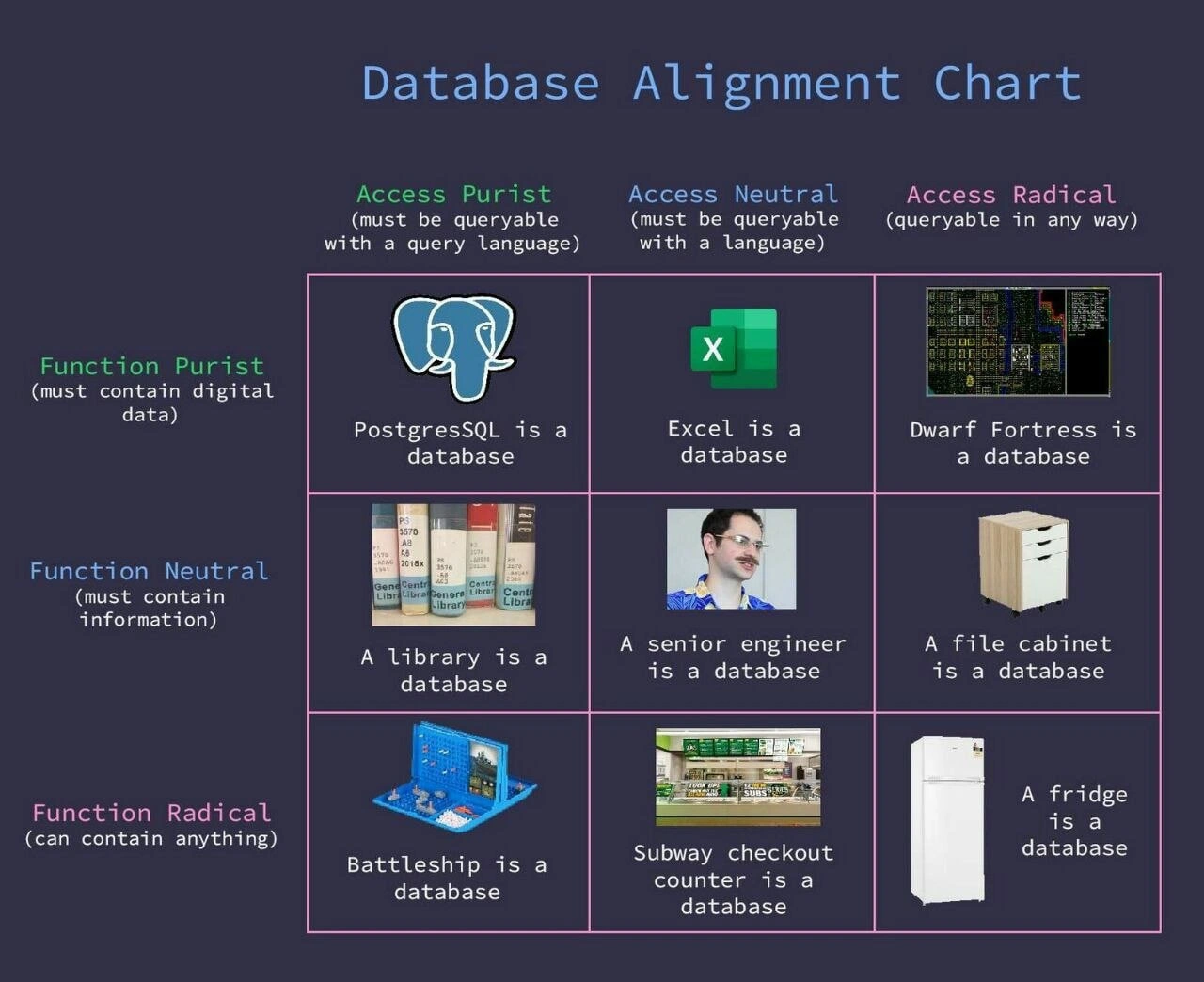
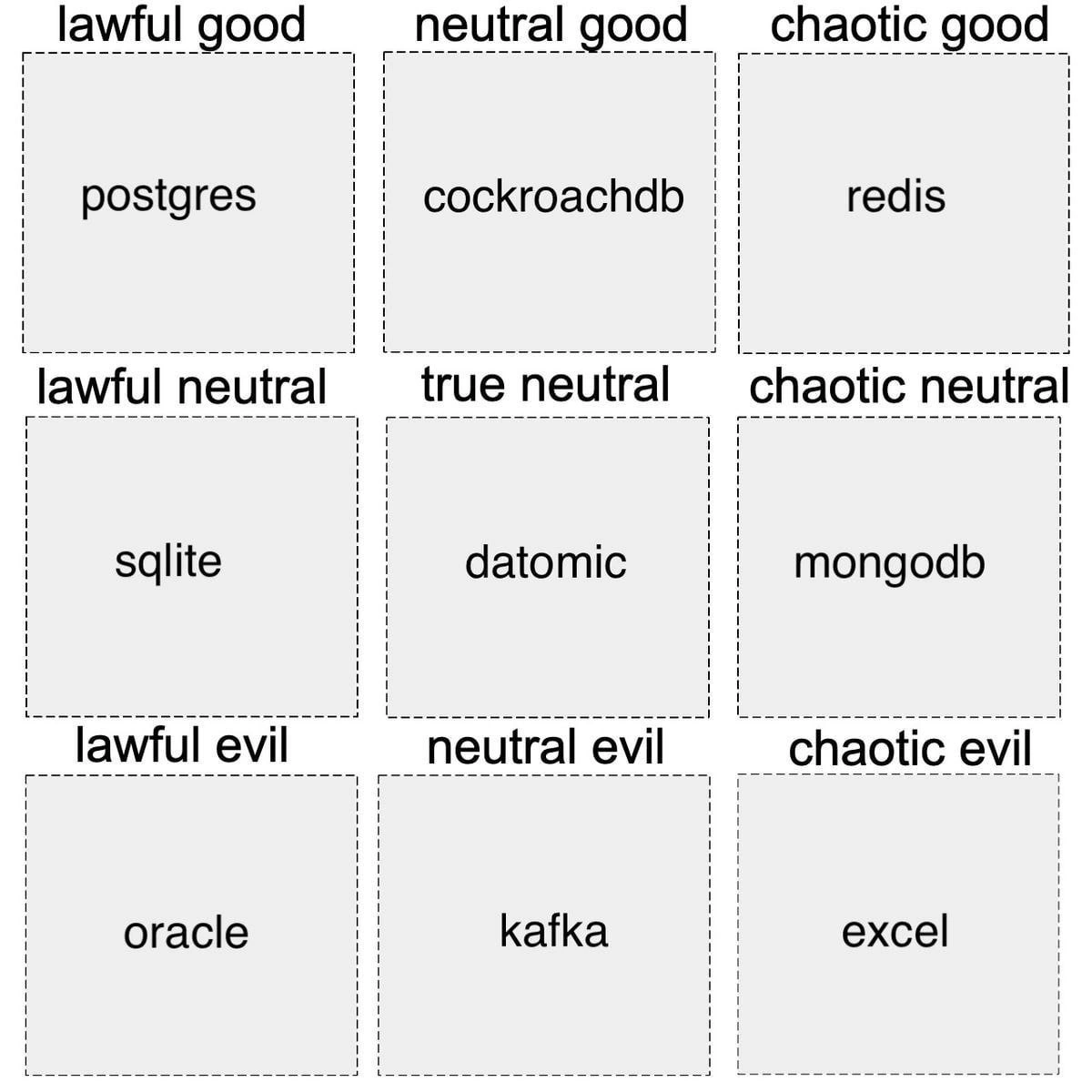
Why is this Databases meme funny?
Level 1: A Dressed-Up List Machine
Imagine two people sorting a big box of cards. One person writes strict instructions: "find all red cards, group them by number, and count them." The other lays the cards on a fancy table, moves them around by hand, colors some piles, and writes totals on sticky notes. Both are organizing information. The joke is that Excel is like the fancy table version of database work.
Level 2: Tables With Different Rules
SQL is a language used to ask databases for information. A simple query might mean "show me all customers from this city" or "add up all sales by month." It is common in backend systems, analytics pipelines, and reporting tools.
Microsoft Excel is a spreadsheet program. It lets people put data in rows and columns, write formulas, sort, filter, make charts, and build pivot tables. A spreadsheet looks simpler because you can see and click the cells, but it can still do many tasks that feel database-like.
The meme connects them because both tools deal with structured data. A database table has rows and columns. An Excel sheet also has rows and columns. A SQL JOIN combines tables; an Excel user might use VLOOKUP, XLOOKUP, or manual matching to combine sheets. A SQL GROUP BY summarizes data; an Excel user might build a pivot table.
For newer developers, the important difference is that SQL usually keeps logic in explicit queries run by a database engine, while Excel often mixes data, formatting, formulas, and manual edits in the same visible grid. That makes Excel flexible and approachable, but also easy to turn into a fragile system.
Level 3: Spreadsheet Query Theater
The tweet says:
Microsoft Excel? Don't you mean
followed by the phrase:
FANCY SQL
The joke works because Excel and SQL live on opposite sides of the same business-data ritual. SQL people write declarative queries against tables. Excel people manipulate grids, formulas, filters, charts, pivots, and copy-pasted exports until the quarterly truth emerges in cell G42. Calling Excel fancy SQL is wrong in the precise way that makes it funny: it compresses two very different mental models into one ornate punchline.
SQL is built around asking a database for sets of rows: SELECT, WHERE, JOIN, GROUP BY, and aggregate functions. Excel is built around a visible grid where each cell can contain a value, formula, or mistake that will be discovered at 4:57 PM. Yet many office workflows use spreadsheets to do database-shaped work: filtering records, joining data with lookup formulas, grouping by category with pivot tables, cleaning columns, calculating totals, and sending the result to someone who will immediately rename the file final_v3_real.xlsx.
The senior pain is that Excel often becomes the unofficial application layer. It starts as a convenient data-analysis tool, then grows into a reporting system, then into a workflow engine, then into the only place anyone understands the business rules. Developers may mock it, but the mockery is nervous respect. Excel has a massive runtime installed in finance departments worldwide, and its deployment strategy is "email attachment plus human memory."
The ornate script font adds another layer. SQL is usually imagined as plain, utilitarian text. Excel is not actually fancy by default, but it is culturally associated with polished reports, colored headers, merged cells, dashboards, and the mysterious executive preference for things that fit on one tab. The tweet dresses SQL up in cursive because spreadsheet work often makes raw data look presentable, even when the underlying operation is just "filter, group, sum, repeat."
Description
The image is a cropped dark-mode Twitter screenshot from FoxTrip, handle @ItsFoxTrip. The tweet reads, "Microsoft Excel? Don't you mean" followed by the phrase "FANCY SQL" rendered in ornate cursive lettering. The meme jokes that spreadsheets are effectively a user-friendly, visually dressed-up way to query and manipulate tabular data. For developers, the punchline lands in the overlap between Excel-heavy business workflows and database-backed thinking.
Comments
1Comment deleted
Excel is SQL with cells, vibes, and one intern quietly implementing the join by hand.