Skip to content
DevMeme
2003 of 7435
When Developers Want to Stop the Testing Count
QA Post #2232, on Nov 6, 2020 in TG

When Developers Want to Stop the Testing Count

Why is this QA meme funny?

Level 1: No Tests, No Bugs

Imagine you have a big school exam, but you didn’t study enough. After taking the test, you’re really worried you did badly. So when the teacher starts grading everyone’s exams, you jump up and shout, “Stop grading the tests!” 😯 Why would you do that? In your mind, if the teacher doesn’t finish grading, then your bad score won’t come out and you won’t get in trouble. Of course, that’s silly – your actual score is whatever it is, and not looking at it won’t change that. The problems (mistakes on your test) are still there even if no one checks the paper.

This meme is just like that, but with software. The developer made some mistakes in the program (there are bugs, which are like errors in the code). The testers are like the teacher grading the exam – their job is to check the software and find any issues. Now the developer is yelling “STOP THE TESTING!” which means “don’t check for bugs!” He’s basically hoping if nobody looks for problems, then there won’t be any problems reported, and the software can be released as if everything is perfect. It’s a funny and ridiculous situation because in real life, stopping testing doesn’t make the bugs go away – it just means users will find those bugs later on. It’s like not cleaning your room and then telling your parents not to come in; just because they don’t see the mess right now doesn’t mean the room is clean. The joke is that the developer is panicking and acting irrational, kind of like a kid having a meltdown saying “I don’t want to know if I did something wrong!” We find it funny because we know the truth: not looking at a problem doesn’t fix it. The developer in the meme is basically trying to hide from the truth, and that never ends well.

Level 2: Testing Tantrum

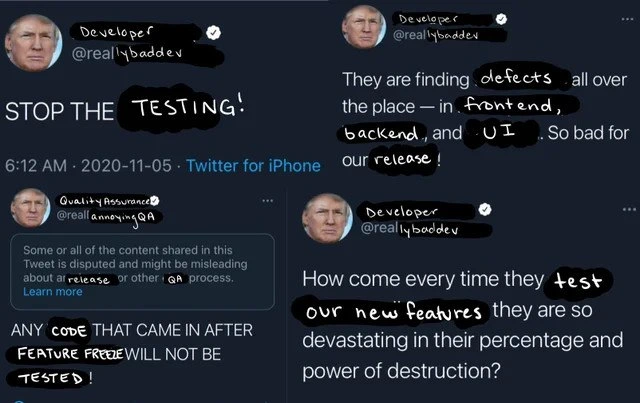
In plainer terms, this meme is depicting a panicked developer during a software release who is throwing a tantrum about testing. It’s styled to look like a series of Twitter posts (a twitter_style_meme), complete with a fake username and profile picture, to parody some well-known tweets from November 2020. But let’s focus on the software side: the developer is upset that the QA (Quality Assurance) team is still running tests on the software right before launch and finding a bunch of problems (bugs 🐞). He tweets “STOP THE TESTING!” as if testing is a bad thing because it’s revealing defects. In reality, finding these bugs now is much better than users finding them after release – but in the stress of a release crunch, sometimes developers panic. The meme exaggerates this into a public “tweet” to make it funny.

We have some specific terms here that junior developers or those new to team projects might not know. First, feature freeze: this is a rule or date in the project schedule after which no new features or major code changes are allowed. Think of it as locking down the content of a release. For example, if your app is scheduled to go live on Friday, the feature freeze might be a week before that. After the freeze, developers should only fix existing issues, not add new things. Why? Because new features can introduce new bugs, and right before a release there isn’t much time to test everything again. It’s a way to stabilize the software. In this meme, the QA person’s reply says “ANY CODE THAT CAME IN AFTER FEATURE FREEZE WILL NOT BE TESTED!” This means if the developers snuck in extra changes or features after the cutoff, the testing team isn’t going to cover those in this cycle. Essentially, un-freezing to add last-minute code is a big no-no. The tester is laying down the law: if you broke the freeze, those changes are on you. This is a common feature_freeze_struggle in real life – product or dev teams sometimes try to push “just one more” feature in, even when they’re not supposed to, and it often backfires with late-stage bugs.

Now, the developer’s tweets mention finding defects in the frontend, backend, and UI. If you’re new: front-end usually refers to the part of the software that runs on the user’s side – for a web app, that’s the website or client interface (HTML/JS in a browser, or a mobile app interface). Back-end is the server side – the database, the server logic, the API behind the scenes that the user doesn’t see directly. UI stands for User Interface, which is basically another way to say front-end (the buttons, forms, visuals the user interacts with). The meme is likely listing all these to say “bugs everywhere!” – in other words, the whole system (client and server) has issues. This is the software equivalent of “holes in the boat from stem to stern.” If QA is reporting problems in all those areas, it indicates the new code changes probably weren’t isolated; they affected multiple parts of the application. For instance, adding a new feature in the UI might break something in the interface, and also require a backend change that wasn’t done correctly, leading to server errors – so both layers end up with defects. That’s why the developer is panicking: so many bugs, so little time! ⏱️

The tweet “How come every time they test our new features they are so devastating in their percentage and power of destruction?” is a melodramatic way of saying: every time QA tests the new code, it breaks things big time. The “percentage” likely refers to the percentage of tests that are failing or the proportion of features that are broken. “Power of destruction” just means the bugs are really serious (maybe crashing the app or corrupting data). A junior dev might not have heard it phrased like that (it’s a very over-the-top phrase, used for humor), but you probably have seen when a new code push causes, say, 30% of the automated test suite to fail – that’s a pretty devastating percentage! Or maybe one critical bug brings down the whole system (great power of destruction, indeed). The developer in the meme is basically whining: “Why are the testers always finding such big problems with our latest features? It’s ruining our release!” The seasoned answer: they find big problems because big problems exist – and thank goodness they found them before you shipped to customers. But in the moment, under pressure, the dev is in denial and would rather not know.

This meme also references something outside of coding: it’s parodying actual tweets from the 2020 US election period (where someone wanted vote counting to stop). If you weren’t aware, Twitter started flagging some contentious tweets with disclaimers. Here, the meme uses that concept: the QA’s reply includes a fact-check banner similar to Twitter’s. It basically says the developer’s claims about the release process are “disputed” and “misleading.” Then it states the factual correction: that any code after the freeze won’t be tested. This is a funny way to show QA calling out the dev’s nonsense in an official tone. Even if you don’t know the politics, you can understand it as “QA is correcting the record.” The QA’s Twitter name @realAnnoyingQA is a joke too – from the developer’s perspective, QA can seem “annoying” because they are the bearers of bad news (bugs, delays). It’s playing on a common stereotype: the tester who always finds something wrong, driving the developer crazy. But the truth is, that’s their job: Quality Assurance teams are there to assure the quality of the product by finding issues. Without them, those issues slip to users.

For a junior developer, the big lesson (and comedy) here is about SoftwareBugs and project management. It’s highlighting a very real tension: QA vs Dev conflict can happen when deadlines loom. Developers want to say “our feature is done!” and move on, but testers then say “not so fast, it’s breaking X, Y, Z.” The worst thing you could do is what the meme’s developer suggests – stop testing or ignore the bugs. That’s basically pretending the bugs don’t exist. In a healthy team, devs and QAs work together: when QA finds a bug, devs fix it, and although it might threaten a deadline, it’s better than shipping bad software. Sometimes though, under huge deadline pressure (say a big client demo or a holiday launch), managers might be tempted to cut testing short. They might say “okay, just stop testing now, we have to release” – usually with the intent to patch any discovered issues later. This is risky and can lead to RegressionTesting nightmares down the road (a regression is when something that used to work in the software breaks after a change – exactly what thorough testing is meant to catch).

So the humor here is a bit of dark comedy for developers: we laugh because we’ve seen this happen and we know it’s a bad idea, but it still happens. It’s TestingHumor with a wink: everyone knows “stopping the tests” won’t make the code better, it just means you won’t know what might explode until users start complaining. The meme uses the exaggerated scenario of a Twitter rant to highlight how absurd it sounds. For a new developer, it’s a good reminder: don’t be that person! If you ever catch yourself thinking “maybe we shouldn’t test this so we can release on time,” remember this meme. It’s better to face the bugs now than face angry customers later. As the saying goes in software teams, “Better a bug caught in QA than a bug caught in production.”

Level 3: Feature Freeze Fiasco

This meme brilliantly mashes up a software release panic with the style of a notorious 2020 Twitter meltdown. The top-left tweet screams “STOP THE TESTING!”, echoing a certain “stop the counting” rant from the election, but here it’s a developer (@reallybaddev) freaking out about QA testing instead of vote counting. In the meme’s dark-mode Twitter UI, the developer’s profile pic (blurred, but recognizably a certain ex-president’s face) and handle “reallybaddev” clue us in that this account is doing something really bad indeed. He tweets that testers are finding defects everywhere – “in frontend, backend, and UI. So bad for our release!” – as if discovering bugs is an unfair attack on the product. It’s a perfect parody: states like Pennsylvania and Michigan become frontend and backend, and instead of votes being found, it’s bugs being found “all over the place.” The tone mimics a conspiracy: our poor release is being sabotaged by all these bug reports! To any experienced developer, this is hilarious because it flips reality on its head – finding bugs is good before a release, but this panicked dev sees it as a hostile act. The humor hits especially hard if you remember those real tweets; the absurdity of shouting to stop a crucial process (counting votes or testing code) is front and center. 🐛🔍

From a senior developer’s perspective, the scenario is painfully familiar: it’s the eve of a big release, a strict feature freeze was supposedly in effect (meaning no new features or risky changes after a cutoff date), yet somehow last-minute code snuck in. Now a slew of bugs are being discovered in every part of the system. The project manager or lead developer, under immense release_deadline_panic, is having a meltdown – instead of thanking QA for catching issues in time, they’re effectively saying “If we stop testing, then nobody will know about the bugs and we can pretend the software is fine.” 🙃 This is classic denial. It’s akin to covering a smoke detector so it stops beeping – the fire (bugs) is still burning, you’ve just silenced the alarm. In real teams, this attitude might manifest as pressure to ignore failing tests, to downgrade bug severity unjustifiably, or even to accuse QA of being “too picky” right before a deadline. The meme exaggerates it to the level of a tweet tantrum, which is both funny and uncomfortably real.

Why do these feature_freeze_struggles happen? Often it’s a mix of over-ambition and poor planning. The team promised a ton of features (maybe due to management pressure), ran out of time, but still tried to slip in changes after the freeze. Those late changes haven’t been through proper QA testing, so of course testers are now finding software_bugs left and right. It’s defect_anxiety taken to the extreme: the developer is horrified that testers are uncovering problems in “frontend, backend, and UI” – basically every layer of the application. This suggests regression testing is revealing that new code didn’t just introduce one bug, but broke things across the board (front-end UI glitches, back-end errors, perhaps API failures, etc.). The phrasing “so devastating in their percentage and power of destruction” lampoons the dramatic tone – it implies the new features caused an unusually high failure rate in tests (like say 40% of tests are red 😱) and maybe even corrupted data or crashed environments (power of destruction indeed). Anyone who’s been through a botched release can relate: one bad deploy can feel like it obliterated half the system. The developer’s panicked question “How come every time they test our new features they are so devastating…?” is dripping with self-pity. A seasoned dev reading it will smirk because the answer is obvious: the features are buggy. It’s like a chef complaining “why every time the health inspector examines my kitchen, do they find so many violations?” – well, fix your kitchen! The absurdity is the dev framing QA as the enemy for doing their job. This is a textbook example of shooting the messenger.

The bottom-left of the meme has perhaps the funniest and most meta detail: a fake Twitter fact-check banner slapped on the QA reply. It reads: “Some or all of the content shared in this Tweet is disputed and might be misleading about release or other QA process. Learn more.” This is a direct spoof of Twitter’s warnings on dubious election tweets. Here, it’s implying the developer’s ranting is misleading about the release process. The QA account (with the handle @realAnnoyingQA, another tongue-in-cheek touch) then posts in bold: “ANY CODE THAT CAME IN AFTER FEATURE FREEZE WILL NOT BE TESTED!” 💥. That’s the QA team performing a “fact-check” clapback, essentially telling everyone: Don’t believe this dev’s nonsense; the truth is that any changes after the cut-off aren’t covered in testing. In other words, QA is highlighting the real issue: the developer ignored the process, pushed late code, and now can’t accept the consequences. For veteran engineers, this is chef’s kiss humor because we’ve lived this bureaucratic drama. We hear echoes of meetings where QA leads firmly remind everyone of the rules: “We can’t certify those last-minute changes because we had no cycle to test them.” Sometimes management tries to bend this rule (“just quickly test it, please?”), but a good QA will hold the line. The meme makes QA’s stance look as official and neutral as a Twitter fact-check: it’s not personal, it’s just the truth of how release management works.

At a deeper level, this meme also pokes fun at the eternal QA_vs_dev_conflict in a software team. Developers want their code to ship, QAs want it to be right. When time is short, these goals clash. The developer in the meme is acting like a politician claiming fraud when losing – here “losing” means his code isn’t passing tests. The subtext is that he perceives testing as an attack on his success, rather than a safety net. Seasoned devs know that stopping testing to avoid finding bugs is suicidal for a project – those bugs will bite you in production if not caught. It’s far better to delay a release than to ship something broken (unless you enjoy high-severity support calls at 3 AM). The cynical veteran outlook is laughing because we’ve seen the real-life versions of this scenario end in disaster. Think of high-profile product launches that went wrong due to insufficient testing (the classic case of “we didn’t have time to test it, so now users are our guinea pigs”). The meme’s dark humor comes from truth: we are sometimes pressured to “ship it now, fix it later,” and this tweet parody distills that madness in one image.

In summary, this meme resonates with developers who have survived release_deadline_panic and seen managers effectively say “Quality can wait, just ship it.” The Twitter parody format adds an extra layer by linking it to a very public “stop counting” fiasco – we recognize the satire instantly. It’s DeveloperHumor that uses a real-world event to spotlight a tech industry problem. The TestingHumor here is both hilarious and cathartic. After all, STOP THE TESTING! is something you’d only hear from a really bad dev (pun intended) – and the fact we find it funny means we know never to actually do that... right? 😏

Description

A meme composed of several mock tweets from accounts named 'Developer' and 'Quality Assurance', both using Donald Trump's profile picture. The layout mimics the Twitter interface. The first tweet from 'Developer' (@reallybaddev) exclaims, 'STOP THE TESTING!'. Subsequent tweets from the developer complain, 'They are finding defects all over the place - in frontend, backend, and UI. So bad for our release!' and 'How come every time they test our new features they are so devastating in their percentage and power of destruction?'. In response, the 'Quality Assurance' account (@reallyannoyingQA) has a tweet with a Twitter-style disputed content warning, stating 'Some or all of the content shared in this Tweet is disputed and might be misleading about our release or other QA process.' Below this, QA firmly states, 'ANY CODE THAT CAME IN AFTER FEATURE FREEZE WILL NOT BE TESTED!'. The meme leverages the political context of the 'Stop the Count' rhetoric from the November 2020 U.S. election, repurposing it to humorously depict the adversarial relationship often seen between development and quality assurance teams, especially during a stressful release cycle when numerous bugs are being discovered
Comments

8
Anonymous ★ Top Pick The only thing with a higher defect discovery rate than a QA engineer two days before release is a business analyst changing a 'minor' requirement
  1. Anonymous ★ Top Pick

    The only thing with a higher defect discovery rate than a QA engineer two days before release is a business analyst changing a 'minor' requirement

  2. Anonymous

    Yelling “STOP THE TESTING!” during feature freeze is the software equivalent of deleting Prometheus because the latency graph looks bad - sure, the numbers can’t hurt you now; prod will

  3. Anonymous

    The only time developers actually want voter suppression is when QA starts filing tickets two hours before the release candidate ships

  4. Anonymous

    This developer's approach to QA is like demanding a recount but only for the commits that passed - classic case of 'works on my machine' meeting the harsh reality of systematic testing. The real tragedy isn't the bugs they're finding; it's that someone actually thought code merged after feature freeze wouldn't need validation. At least the 'disputed content' label on the third tweet suggests even Twitter's algorithm knows that's not how SDLC works

  5. Anonymous

    QA doesn't break new features - they just audit the tech debt vectors we orthogonally injected across the stack

  6. Anonymous

    “Stop the testing” is just Goodhart’s Law for bugs - disable QA, watch defect counts hit zero, and watch production quietly become your test environment

  7. Anonymous

    Treating QA as a blocker is like improving uptime by silencing alerts - you optimized the dashboard, not the release

  8. @p4vook 5y

    kekw

Use J and K for navigation