Misinterpreting 'Agile' as 'Reckless'
Why is this Agile meme funny?
Level 1: Fast but Careless
Imagine a chef who rushes a dish out of the kitchen without tasting it to see if it’s cooked properly, just because he wants to save time. The chef is proud and calls this new approach “agile cooking” since the meal went out fast. Sounds silly, right? The customers would probably get undercooked or overly salty food because the chef skipped the important step of checking the quality. This meme is funny for the same reason: it shows someone doing something risky (sending out changes without checking them) and still thinking it’s a good idea just because it was done quickly. We all realize that doing things fast is pointless if you don’t do them well. Skipping the “taste test” – whether it’s food or software – and claiming it’s the right way is obviously a bad idea, and that’s why everyone can laugh at it.
Level 2: Agile is Not YOLO
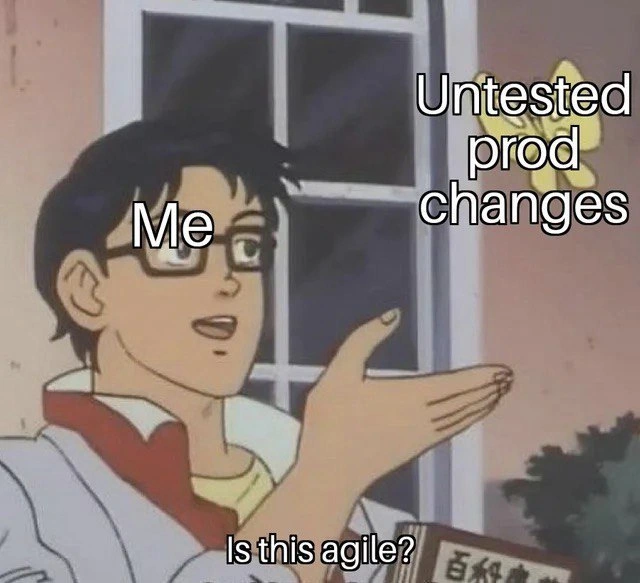
In the image, a confused character labeled "Me" is pointing at a butterfly labeled "Untested prod changes" and asking, "Is this agile?" To understand the joke, let’s break down the terms in simpler words:
- Production (prod): The live environment where real users interact with the software. For example, a website or app that is available to the public is running in production.
- Change: A code update or new feature. An untested change means no one checked if that update works correctly before releasing it.
- Testing (QA): The process of checking if the software works and has no major bugs. This includes things like running the app to see if everything functions, writing unit tests (small programs that automatically verify each part of the code), or having a QA engineer try to break the new features in a safe environment before it goes to production. Testing usually happens in a staging or test environment, not directly on real users.
- Agile development: A way of building software in short, quick iterations (often called sprints). Agile teams plan small pieces of work, build them, test them, and release them frequently instead of doing one big release after months. Agile encourages being flexible and responding to feedback, but it doesn’t mean rushing out sloppy work. Quality is still important!
- Code review: When another developer looks over your code changes before they go live, to catch mistakes or suggest improvements. This is a safety step to maintain quality. Skipping this means no one double-checks the work.
- Cowboy coding: A slang term for when someone writes code and pushes it out without any formal process or team communication – like a cowboy acting alone in the Wild West. It’s bold and fast, but very risky.
- YOLO deploy: "YOLO" stands for "You Only Live Once." In tech slang, a YOLO deploy means deploying a change without testing or review, basically saying "let’s just do it live and see what happens!" (It's usually said jokingly, not as a serious practice.)
Now, in a normal software development process — even an Agile one — if you make a change, you test it first. You might run your unit tests, try out the new code on a test server, have colleagues do a code review, and only then deploy it to production. All those steps are like safety checks before real users see the change. Agile doesn't remove those safety checks; it just means you do them more frequently and in a lighter-weight way than older methods. Agile teams still care a lot about making sure things work; they just avoid big slow bureaucratic processes. Instead of one massive test phase at the end of a project, agile teams test continuously in smaller chunks.
What’s happening in the meme is the opposite of good practice: the person is deploying untested changes straight to production and thinking that's somehow following Agile principles. It's a misunderstanding. Yes, Agile is about delivering quickly, but “quickly” doesn’t mean “carelessly.” Skipping tests and code reviews is almost guaranteed to cause problems later (like crashes or bugs that users will encounter).
Imagine you’re new on a team and you see someone merge their code and push it live without anyone else checking it or without running the app to verify it. If you asked them why, and they said, "We're being agile, no time for testing," you'd probably feel uneasy. And you'd be right — something is off! In reality, proper Agile teams still test their code thoroughly — they just do it in a streamlined way, often using automation as part of their CI/CD pipeline. The meme highlights this mix-up in a funny way by showing a developer who skips all the important steps and yet thinks that’s what Agile means.
The anime panel format (“Is this a pigeon?”) is a popular meme for illustrating confusion or false identification. Here it shows a developer mistaking untested prod changes (basically a risky code push to production) for Agile methodology. It’s funny to developers because it exaggerates a real scenario we warn against. The takeaway for a junior developer is: Agile isn’t an excuse to be careless. It’s about adapting and delivering value faster, while still keeping quality in check. The character in the meme skips the crucial checks and still expects a pat on the back by calling it "agile" – and that mismatch is the punchline.
Level 3: Cowboy Agile
In this classic “Is this a pigeon?” anime meme, a naïve developer character (labeled Me) points at a butterfly labeled “Untested prod changes” and asks, “Is this agile?”. The humor makes experienced devs both laugh and cringe. It’s a piece of developer humor poking at a real pain point in Agile adoption: the character is completely misidentifying reckless cowboy coding as proper Agile methodology. In reality, dumping untested code into a live system isn’t agile at all – it’s a one-way ticket to on-call nightmares.
Seasoned engineers recognize this anti-pattern instantly. The meme satirizes how some teams deploy in a chaotic way while insisting they're "being agile." Pushing untested prod changes directly to production – with no code review, no QA cycle, and no_unit_tests – is basically playing roulette with your application. It's essentially testing in production, treating real users as unwitting QA testers. Any veteran who’s been paged at 3 AM due to a broken hotfix will tell you: calling that mess “agile” is brutally ironic (sure to cause plenty of production issues).
For context, the Agile Manifesto (Agile’s founding document) does value speed and flexibility, but never by sacrificing quality. Real agile teams integrate testing at every step. They write unit tests, conduct peer code reviews, run suites in a CI pipeline – all to ensure each change is safe. Sadly, some folks interpret "agile" as a magic word meaning "skip all the boring stuff and just ship." This meme nails that misconception. It's a prime example of fake_agile: using Agile jargon to excuse a chaotic, no-standards approach to deployments.
Let’s compare what Agile principles intend versus how they're warped in this scenario:
| Agile Principle (intended) | Misinterpretation (in the meme) |
|---|---|
| Working software (deliver value) | "If it runs, even barely, we can ship it." |
| Responding to change over rigid plans | "Make last-second code edits directly in prod." |
| Continuous improvement & learning | "Break things often and call it 'failing fast'." |
| Technical excellence enhances agility | "Testing is a luxury; we're too agile for that." |
As you can see, the practices in the meme flip genuine agile ideas upside-down. It's Agile in name only — more fragile than agile. Seasoned devs find this both funny and exasperating because they've witnessed it (or suffered through it) before. It’s essentially the "move fast and break things" philosophy taken to an irresponsible extreme, then masked with a buzzword.
In real life, releasing code this way tends to create an avalanche of problems. Code that wasn’t tested (maybe it “worked on my machine”, but nowhere else) will break in production, leading to emergency fixes, downtime, and unhappy users. Ironically, all the time "saved" by skipping tests is lost many times over in firefighting and bug-hunting later. Every senior engineer has learned that lesson, which is why this meme’s scenario is so relatable. It's a cringe comedy of errors we recognize: we know exactly how this story ends.
Modern development practices like CI/CD pipelines exist to prevent this nightmare. With proper Continuous Integration, your code changes trigger automated tests; Continuous Deployment only pushes builds that pass those tests. But in the meme's scenario, the process is more like: "commit, push, pray". To illustrate, consider a pseudocode version of a deployment flow:
# Proper CI/CD deployment process:
run_unit_tests()
run_integration_tests()
perform_code_review()
deploy_to_staging()
if all_checks_pass:
deploy_to_production() # Only release after quality checks
# "Cowboy Agile" process (the meme scenario):
deploy_to_production() # Push straight to live with zero checks
monitor_for_fires() # Watch prod blow up and scramble to fix issues
In the second “Cowboy Agile” pipeline, all the safety nets are removed. The system likely ends up in firefighting mode (monitor_for_fires() is tongue-in-cheek for watching for crashes in real time). Veterans jokingly call this kind of DevOps failure “DevOops”. It means someone deployed first and dealt with the mess later.
Ultimately, the joke here underscores a dangerous misunderstanding: Agile doesn’t mean “no discipline.” True agility actually requires good engineering practices (automated tests, incremental delivery, continuous improvement) to avoid turning into fragile chaos. The meme hits home with senior developers because we’ve all met that person (or that manager) who waves the "Agile" flag while doing exactly the wrong things. We laugh, perhaps a bit bitterly, because calling cowboy coding “agile” is like calling an actual bug a feature and expecting a high five. It’s a sharp reminder that speed isn’t the same as progress.
Description
This image uses the popular 'Is this a pigeon?' meme format from the anime 'The Brave Fighter of Sun Fighbird'. The central character, an android, is pointing at a butterfly and incorrectly identifying it. In this version, the character is labeled 'Me', the butterfly is labeled 'Untested prod changes', and the subtitle reads, 'Is this agile?'. The meme satirizes a common and dangerous misunderstanding of Agile methodologies. For experienced developers, the humor lies in the critique of 'cargo cult Agile,' where teams adopt the buzzwords and speed of the methodology ('move fast') without the critical engineering practices that underpin it, like robust testing and continuous integration. Pushing untested changes to production is a high-risk activity that true agility aims to prevent through automated testing and incremental, validated releases
Comments
7Comment deleted
The difference between 'agile' and 'fragile' is a few missing unit tests
If your idea of “agile” is merging to main on Friday and letting PagerDuty handle the retrospective, that’s just unpaid QA at scale
Twenty years in, and I've finally realized that "move fast and break things" was supposed to be a cautionary tale, not a sprint retrospective action item
Ah yes, the 'Agile' methodology where sprints are measured in seconds between git push and production outage, and our definition of done is 'it compiled locally.' The butterfly represents that fleeting moment of confidence before the PagerDuty alerts start rolling in at 2 AM. True agile practitioners know that 'move fast and break things' was meant metaphorically, not as a deployment strategy - but here we are, treating production like our personal integration environment while the SRE team quietly updates their résumés
Untested prod deploys: Agile velocity measured in mean time to 'hotfix sprint'
Untested prod changes aren't Agile - they're event-driven architecture where the events are PagerDuty alerts
We boosted agility by adding a Jenkins stage named “Skip tests” - lead time down, DORA up, change failure rate redacted in Confluence