The Belle Curve of Code Quality
Why is this CodeQuality meme funny?
Level 1: Cake Fail
Imagine you see a picture of a perfect princess cake in a bakery window. It looks like it’s straight out of a fairy tale – every detail just right. You decide to make a cake just like it at home. You try your best, but when you’re done, your cake looks… well, very different. The icing is smudged, the face looks a little scary, and the whole thing is lopsided. It still tastes okay, but it sure doesn’t look like that picture. This is funny in a “expectation vs. reality” way: what we hoped to create turned into something much messier.
That’s exactly what the meme is joking about, but with writing computer programs. The “college code” is like the perfect cake picture – it’s how we expect things to be when we learn about it or plan it in our head. The “real world code” is like the homemade cake – the result we often get when we actually do the work under tough conditions. It’s a bit silly and makes us laugh because everyone knows things in real life rarely turn out as perfect as the plan. Just like a homemade cake that’s ugly but still edible, real-life code might be ugly but it works. The meme makes us smile because it reminds us of that feeling: something that was supposed to be beautiful turned out goofy, and yet, we’ve all been there.
Level 2: Expectation vs Reality
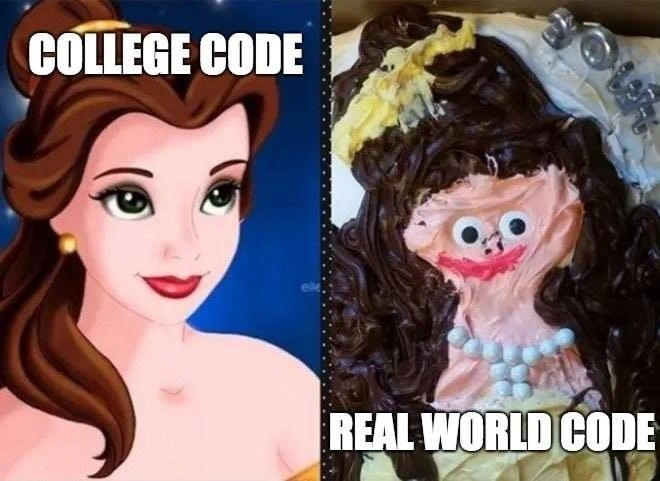
This meme uses the classic expectation_vs_reality_meme format that many developerMemes love. On the left, labeled “COLLEGE CODE,” there’s a beautiful Disney-style princess illustration (think of Belle from Beauty and the Beast, graceful and perfect). This represents code written for a class or in an academic setting – let’s call it textbook code. It’s the kind of code a student writes when learning: usually very clean and organized, following all the guidelines the instructor taught. In school, code projects are often small enough that you can make everything just right. You’ve got well-named functions, clear logic, and maybe even comments for every step. Essentially, the left side is showing the ideal version of code, what you’d find in a programming textbook’s examples or a perfectly done homework assignment. It’s the princess: pretty, flawless, and by the book.
Now the right side, tagged “REAL WORLD CODE,” shows a famously failed homemade princess cake. It’s pretty funny to look at: the icing is smeared everywhere, the candy eyes are crooked, the smile is lopsided – it’s a real cake fail. This disaster cake is a visual metaphor for what production code (code in real software projects) often looks like. Production code means the code that runs in actual products or services that people use, not just a demo for class. And unlike the tidy college assignment, real-world code can be messy and full of imperfections. Why? Because in a company or big project, you have deadlines, changing requirements, and multiple people working on the code. The result can be a bit chaotic.
Think of it this way: writing code for an academic_project is like cooking with a recipe under perfect conditions – you follow the instructions step by step. Writing code for a production_deadline_pressure project is more like trying to throw together a meal when the restaurant kitchen is on fire and customers are waiting – you’ll do whatever works right now and fix the presentation later (if ever!). In real projects, you often don’t have the luxury to rewrite everything nicely; you just patch the problem so things keep running. Over time, all those quick fixes and patches build up, which developers refer to as technical debt.
Let’s explain technical debt in simple terms: it’s like when you borrow time by doing something the quick-and-easy way instead of the right way. For example, if there’s a bug, you might fix it with a short-term hack that makes the code uglier, just so you meet your deadline. That’s like borrowing time – you saved time now, but you “owe” a cleanup later. Just like real debt, if you don’t pay it back, interest builds up: the codebase becomes harder to work with, and future changes take longer. New developers joining a company often find a lot of these band-aid fixes in the code. It can be overwhelming to read: functions are longer than expected, names of variables might be confusing, and you might see comments like “// TODO: improve this”. That’s why the meme’s right side is so exaggeratedly ugly – it’s showing how code quality can degrade when we pile on many quick fixes without cleanup.
This is also a bit about learning and facing reality. In school, you might learn the proper way to design software (using neat abstractions, well-organized classes, etc.). But when you start a job and look at a real-world codebase, it can be shocking! It’s the difference between a neat lab assignment and a huge product that’s been evolving for years. For instance, you might have learned in class that global variables are bad practice, yet you open a professional project and find a file full of global config flags. Or you were taught to carefully break down problems into small functions, but the code you see has a MainService.java with 5,000 lines of code. It feels like seeing that messy cake – “How did things end up like this?”
The meme captions it as “College code” vs “Real world code” to highlight this code_quality_discrepancy. The left is how you expect your code (and other people’s code) to look: logically structured and aligned with what you learned. The right is often the reality: code that works, but in a rough, unpolished way. Newer developers (junior engineers) often experience this when they first contribute to a large codebase or do a code review on an old module. It can be a bit funny and a bit sad: funny because it’s such a stark expectation vs. reality moment, and sad because you realize maintaining that messy code is now your job! But don’t worry – every developer goes through this. Over time, you learn why that messy code exists and how to gradually improve it (or at least live with it).
In summary, this meme uses a Disney princess parody (perfect vs. ruined) to compare ideal learning examples to the messy reality of professional software. It’s poking fun at the difference between academic_projects (where everything can be made perfect for a grade) and real software_engineering_reality (where you often have to deal with other people’s code, time crunches, and evolving systems). The humor comes from recognizing that huge gap. If you’ve ever tried to follow a tutorial project and then looked at a real codebase on GitHub or at work, you’ll instantly relate to the joke. It’s saying: “Don’t be fooled by the perfect examples in class – real-world code can be as much of a hot mess as that cake, and that’s normal!”
Level 3: Beauty vs the Beast
In this meme’s split-screen, the left side is a picture-perfect Disney princess – pristine code as envisioned in academia – while the right side is a disfigured princess cake, a hilarious stand-in for real production code. Seasoned developers smirk (or cringe) because this contrast is too real. In college or tutorials, we craft tidy little programs: well-structured, elegantly designed, often following every best practice from the textbook. That’s the fairy-tale code quality we imagine – the Beauty. But deploy software in the wild under real conditions, and you often end up with the Beast: a big ball of mud codebase shaped by technical debt, last-minute hacks, and crazy deadline demands. The meme exaggerates it with a literal cake wreck, but every engineer who’s seen a critical 10-year-old legacy system knows it’s barely an exaggeration.
To break it down, here’s how college_code (the idealized princess) stacks up against production_code (the cake disaster) in practice:
| College Code (the “Beauty”) | Real-World Code (the “Beast”) |
|---|---|
| Built from scratch for a clear assignment; small, self-contained. | Evolved over years; large, tangled with legacy modules and quick patches. |
| One or two developers (often just you) with a consistent style. | Dozens of devs with differing styles & skill levels leaving mixed footprints. |
| Follows textbook design patterns and best practices (gotta get that A). | Packed with pragmatic quick fixes, weird workarounds, and // TODO comments added under deadline pressure. |
| Clean, well-commented, and structured (professors insist on good architecture). | |
| Runs in ideal conditions with controlled input (it’s a demo). | Must handle chaotic real-world scenarios: funky user input, partial failures, weird edge cases – often via ad-hoc if statements breeding like rabbits. |
| Discarded after grading or forgotten. | Mission-critical in production; too expensive to rewrite, so the messy code lives on (and grows). |
This side-by-side hits home for senior engineers. We’ve all seen that fresh-out-of-college hire’s eyes widen at their first code_review_nightmare: functions hundreds of lines long, variables named temp2 left from frantic fixes, and comments like “// FIXME: workaround for launch, sorry!”. The princess on the left is how code should be – orderly and elegant. The monstrosity on the right is how code often is after real-world constraints attack. Technical debt is the big culprit: each time a corner is cut to ship on time (like frosting over a mistake on the cake), a debt is incurred that we “pay back” later with debugging pain and costly refactors. Over time, that debt accumulates interest: the code becomes harder to change without breaking something else.
Why do teams let a codebase turn into that frosting-smeared horror? Because in the real_world_vs_academia showdown, reality usually wins. Businesses value features delivered on time and “good enough” solutions. If a nasty workaround keeps the system running for demo day, it’s going in the deploy. Unlike a professor, production users don’t read your code; they only care that the app works. So engineers in the trenches make compromises: speed over elegance, band-aids over perfect designs. After a few years of this, the code’s original Beauty is unrecognizable – a Beast held together by duct tape and hope.
This meme is industry satire at its finest because it compresses a whole engineering reality into two images. The left side’s polished Disney art represents the theoretical best (like code you write when learning, or in slides about Clean Architecture). The right side’s cake-from-hell is the practical result of software engineering reality – the kind of ugly-but-working system everyone pretends to be fine with during stand-up meetings. It’s funny and painful because every developer knows the secret: under the hood of most production systems lies code that looks more like that lopsided cake than a neat computer science project. We laugh, perhaps a bit cynically, because we’ve been there – applying yet another layer of frosting to keep the shaky cake from collapsing, dreaming of the day we have time to bake it properly from scratch.
Description
A two-panel 'expectation vs. reality' meme contrasting different types of code. The left panel, captioned 'COLLEGE CODE,' shows a perfectly rendered, flawless illustration of Belle from Disney's 'Beauty and the Beast.' She is smiling gently against a starry blue background. The right panel, captioned 'REAL WORLD CODE,' displays a photograph of a comically failed attempt at a Belle-themed cake. The cake has a misshapen face, googly eyes pointing in different directions, a smeared red frosting mouth, and messy brown frosting for hair. The meme humorously captures the transition from writing clean, theoretical, and self-contained code for academic projects to working with complex, messy, and often compromised code in a professional environment. Real-world code is subject to deadlines, changing requirements, legacy constraints, and multiple contributors, often resulting in a product that functions but lacks the elegance of its original design, much like the horrifying cake

Comments
7Comment deleted
College code is like a perfect algorithm on a whiteboard. Real-world code is that same algorithm after it's been through three framework migrations, a merger, and an emergency hotfix by a guy who quit two years ago
College: `class Belle extends Princess { elegance(); }` Prod after six pivots: `BelleServiceImplFactoryHelperManager_vFinal2` - 3 247 LOC, inline SQL, and a TODO so old it needs its own GDPR checkbox
College code has SOLID principles and clean architecture. Real world code has a 15-year-old jQuery plugin holding up the entire payment system because the last person who understood it retired in 2019
This meme perfectly encapsulates the moment every CS graduate realizes their pristine, well-documented, fully-tested academic projects bear no resemblance to the 15-year-old monolithic codebase they'll inherit on day one - complete with global variables named 'temp2_final_ACTUAL', comments in three different languages (none of which are English), and a critical function that nobody dares refactor because 'Dave wrote it in 2009 and he's the only one who understood the business logic, but he left for Google six years ago.'
In school the project ends at 'it runs'; in production it starts at 'it runs' - then come retries, idempotency, PII, SOC2, vendor timeouts, and the 4 a.m. rollback
College code is concept art; prod code is the cake you frost over a 2007 Oracle schema, a vendor SOAP SDK, and a Friday release - still technically edible per the SLA
College code: immutably elegant facade pattern. Real world: mutable monolith after one merge conflict too many, googly-eyed from observability hacks