Jazz Chords and Passwords: The Universal Language of Cryptic Strings
Why is this Security meme funny?
Level 1: Secret Code Club
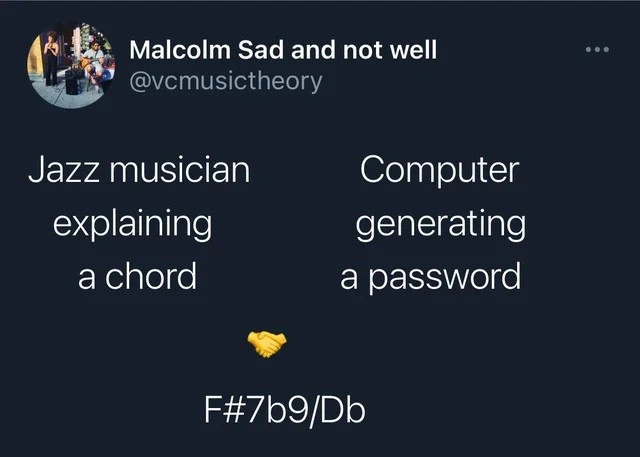
Imagine two people from totally different worlds discovering they both love using secret codes. One is a musician who uses special names for musical chords, and the other is a computer that makes super strong passwords. This meme joke is saying their secret codes look so similar, they could shake hands and be part of the same club.
Think of it like this: a jazz musician might say a chord name like “F sharp seven flat nine over D flat” – that sounds like a bunch of random letters and numbers if you don’t know music. Meanwhile, a computer might come up with a password like “F#7b9/Db” – which is also a mix of random letters, numbers, and symbols. Funny enough, those two examples are exactly the same mix of characters! It’s as if the musician’s fancy chord name accidentally became a tough password.
So the picture shows a handshake 🤝 between “Jazz musician explaining a chord” and “Computer generating a password.” They’re shaking hands because they realize “Hey, we do the same thing – we both make complicated strings that nobody else understands!” The final line “F#7b9/Db” is both a wacky jazz chord and what could be a very strong password.
In simple terms, the meme is funny because it’s saying a music expert’s secret language and a computer’s secret language end up looking identical. It’s like if a chef described a recipe in super fancy terms and it turned out to be the same words an engineer used to name a spaceship part. Two completely different areas share a moment of “Hey, your gibberish looks like my gibberish!” It makes us laugh because it shows how complex and confusing jazz music names and secure passwords can be – so much that you can’t tell them apart. It’s a little joke that even if you don’t know much about music or computers, you get that both are speaking their own secret code.
Level 2: Jazz Chord or Password?
At this level, let’s break down what’s going on and why it’s funny. On the left side of the meme, it says “Jazz musician explaining a chord,” and on the right side it says “Computer generating a password.” Below both, there’s a handshake emoji 🤝 connecting them, and underneath that, the string F#7b9/Db. This format is telling us that a jazz musician’s chord description and a computer’s random password have something in common – namely, the string F#7b9/Db could belong to either situation.
So what is F#7b9/Db? This is a piece of jazz chord notation. Let’s decode it in simple terms:
- F# stands for the note F-sharp, which is the root of the chord (the main note the chord is built on). The symbol
#means sharp, which in music means “a half-step higher.” So F# is a half-step higher than F. - 7 means it’s a seventh chord. In jazz, if you just see “7” by itself, it usually means a dominant seventh chord. That’s a type of chord that has a specific sound (it includes the 7th note of the scale, which adds a bit of tension).
- b9 means flat nine. The “9” refers to the ninth note in the scale (which is like an extra spicy note added on top of the basic chord). The “b” here is a flat sign (in written music it’s a little ♭ symbol, but on Twitter they used a lowercase b). Flat means lower the ninth note by a half-step. So “b9” is an alteration that makes the chord even more intense or jazzy.
- /Db means there’s a slash, and after the slash is Db (D-flat). This indicates an alternate bass note. So instead of the bass (lowest) note being F# (the root), the chord is played over a D-flat in the bass. D-flat (Db) is essentially the same pitch as C# (they’re what musicians call enharmonic equivalents), but the notation chooses Db here, likely for theoretical reasons in context.
All together, a jazz musician seeing “F#7b9/Db” understands it as: “Play a F-sharp dominant seventh chord with a flat ninth, and put a D-flat note in the bass.” That’s a very specific, complex chord – it creates a distinct dissonant sound used in jazz music.
Now, why does that look like a password? Think about password generators – especially those used in cyber security. When a computer generates a password for you, it often mixes uppercase letters, lowercase letters, numbers, and symbols to make a password that’s hard to guess. For example, a generated password might look like P@ssw0rd! or Xd2#9Lp$ – basically a mash of different character types. The string F#7b9/Db fits this pattern perfectly! It has:
- Uppercase letters (F and D).
- Lowercase letters (the “b” which we are reading as just the character b here).
- Numbers (7 and 9).
- Special symbols (
#and/).
It’s exactly the kind of random assortment of characters you’d expect from a secure password. In fact, if you ignore the music meaning and just see it as characters, F#7b9/Db meets typical strong password criteria that many websites enforce (one uppercase, one lowercase, one number, one special character). That coincidence is the crux of the joke.
The meme uses the handshake emoji 🤝 to show that these two very different scenarios – a jazz lesson and a computer program – are “agreeing” or “meeting in the middle” on this string. In other words, jazz chord naming and password generation are depicted as shaking hands over their shared love of complicated strings. It’s a playful cross-domain analogy: something from the music world is being directly compared to something from the tech/security world.
For a junior developer or someone new to security, this also highlights why strong passwords often look like gibberish. The reason is entropy (meaning randomness/unpredictability): the more mixed-up and nonsensical a password is (like including F# and b9 and /Db – totally non-dictionary fragments), the harder it is for attackers to guess or brute-force it. We usually don’t literally use chord names as passwords, but the point is a strong password can seem as nonsensical as a line of jazz notation if you’re not familiar with it. And vice versa, to someone not versed in jazz, a chord description can seem as random as a computer code. It’s music_theory_meets_security in a humorous way.
So, the meme is funny and relatable because it shows two very nerdy things colliding: a complicated jazz chord and a secure password. Both are notoriously hard for normal folks to understand at a glance. If you’ve ever looked at randomly generated password like “X5$qB9!” and thought “who on earth came up with this?”, it’s the same vibe as looking at a jazz chord chart full of F#7b9/Db-type chords and thinking “what on earth does that mean?”. The tweet basically says: hey, jazz musicians and password algorithms have a lot in common – they both produce stuff that looks like random gibberish!
Level 3: Universal Gibberish
At first glance, the meme humorously highlights that a jazz musician’s chord explanation can look indistinguishable from a computer-generated password. The tweet sets up a classic handshake meme format: two seemingly unrelated folks (a jazz musician and a password generator) “shaking hands” over a shared trait – in this case, producing strings of text that appear totally cryptic to outsiders. The chord name F#7b9/Db is displayed like the agreement between them, and it legitimately looks like something your company’s password policy would spit out when you hit “generate secure password”. The comedic spark is the realization: music theory notation and cybersecurity gibberish operate on comparable levels of complexity.
Why do developers and security folks chuckle at this? Because complex passwords are the bane and boon of our existence – we’re told a good password should include uppercase and lowercase letters, numbers, and special symbols in a nonsensical arrangement. And here comes a jazz chord like F#7b9/Db that casually ticks all those boxes. It’s as if a jazz instructor accidentally created a password so strong even a hacker’s GPU would sweat to crack it. Developers who’ve dealt with password complexity rules immediately recognize the pattern: this chord contains a funky mix of characters that would satisfy even the most paranoid system administrator’s checklist. In fact, let’s break it down against a typical “strong” password example:
| String | Uppercase? | Lowercase? | Digits? | Symbols? |
|---|---|---|---|---|
| F#7b9/Db jazz chord |
Yes (F, D) | Yes (b) | Yes (7, 9) | Yes (#, /) |
| P@ssw0rd! password |
Yes (P, W) | Yes (s, d) | Yes (0) | Yes (@, !)** |
As you can see, F#7b9/Db has it all: uppercase F and D, a lowercase b (used as a flat symbol), numbers 7 and 9, and special characters # and /. It’s a string that would make any cybersecurity auditor proud. This is where the humor really lands for techies: the chord name accidentally looks like it was generated by a password_generation script aiming for maximum entropy. It’s developer humor gold when two distant concepts align perfectly like this.
On the flip side, jazz musicians famously use dense notations. When a “Jazz musician is explaining a chord,” they might throw around obtuse labels like F#7b9/Db, and to anyone without a jazz background it sounds like gobbledygook – much like a random 8-character password sounds like gibberish to a user. Both are effectively jargon from specialized fields. We’ve got a classic cross_domain_analogy: music theory meets security practice. The meme plays on the shared experience of “Okay, that’s just nonsense to me.” Developers often joke about not understanding music theory, and musicians might joke that tech jargon is beyond them, but here they are, meeting in the middle with a string that is equally confounding to both laypeople.
There’s also a subtle nod to the concept of entropy (randomness/unpredictability). In security, we celebrate randomness in passwords: more entropy means a safer password. In jazz, we celebrate complex chords because they create rich, unexpected sounds – a kind of musical unpredictability. That phrase “share the same entropy” in the title is a tongue-in-cheek way to say: both a jazz chord name and a secure password are incredibly complex and unpredictable sequences. The handshake emoji 🤝 visually reinforces that agreement: Jazz theory and password generators, congrats – you’ve achieved the same level of inscrutability!
Anyone who’s ever struggled to remember a strong password or felt their eyes glaze over in a music theory class can relate. It’s a CyberSecurityMemes-worthy gag: we deal with WeakPasswords by making insanely complex ones, only to realize they start to look like something from a totally different domain. It’s equal parts poking fun at password rules (“throw in an uppercase, a number, a jazz chord extension… and you’re good”) and at the beautiful absurdity of jazz chord notation (where something like “F sharp seven flat nine over D flat” is a completely legitimate musical instruction). The senior engineers and security experts are likely grinning because they’ve lived both sides: they know exactly why passwords need that complexity, and they also know just enough music to be tickled that F#7b9/Db is a legit chord symbol. It’s a perfect storm of niche knowledge overlap – a TechHumor gem that unites musicians and developers in laughter over shared complexity.
Level 4: High-Entropy Harmony
In information theory, the entropy of a string is a measure of how unpredictable or random it is. Strong computer passwords are designed to maximize this entropy – they’re essentially high-entropy sequences of characters that are hard to guess. At the same time, an advanced jazz chord notation like F#7b9/Db compresses a huge amount of musical information into a terse symbol string. In its own way, a jazz chord name encodes layers of tonal complexity (root, chord quality, extensions, alterations, bass inversion) much like a password packs randomness – both appear as dense, nonsensical text to the untrained eye.
From a theoretical standpoint, these two domains (cybersecurity and music theory) are speaking languages of encoded complexity. A randomly generated 8-character password taps into an alphabet of possible symbols (letters, numbers, punctuation) to create an unpredictable combination. Its Shannon entropy (H) in bits can be roughly calculated as (H = L \cdot \log_2(|\text{alphabet}|)). For example, if the alphabet has 70 possible characters, an 8-character password has about (8 \times \log_2(70) \approx 8 \times 6.13 \approx 49) bits of entropy. That means there are on the order of (2^{49}) possible combinations – truly a high-entropy space that thwarts brute-force attacks.
Now consider the jazz chord F#7b9/Db: it isn’t random at all to a trained musician, but it harnesses a complex encoding system. There are 12 possible root notes (F# in this case), chord quality markers (like “7” indicating a dominant seventh chord built on F#), extension tones like “9” (the ninth step in the scale) which can be altered (here “b9” means the ninth is flattened a semitone), and a slash notation “/Db” signaling that D♭ is the bass note. Each symbol has meaning, but to someone unfamiliar with music theory, this looks like a chaotic jumble of letters, symbols, and numbers – essentially high entropy gibberish. The entropy in a strict information-theoretic sense isn’t as quantifiable here (since F#7b9/Db isn’t chosen at random, it follows musical rules), but the perceived entropy is huge because of the vast space of possible chords and the rarity of any specific complex chord string. Jazz harmony allows for towering combinations of alterations and extensions – analogous to how a password generator permutes characters. The space of all possible jazz chords (with every root, quality, extension, and inversion) is astronomically large, not unlike the keyspace of a robust password.
Crucially, both fields grapple with combinatorial explosions. In cryptography, more possible combinations (a bigger keyspace) means a more secure password. In advanced music, more possible chord variations means a richer harmonic palette. The tweet’s punchline “F#7b9/Db” embodies this cross-domain complexity: It reads like the output of a cryptographic random password generator applying all the complexity rules (uppercase F and D, lowercase b, digits 7 and 9, special characters # and /). In a sense, the musical and security interpretations converge on the idea of dense information encoding. It’s a delightful convergence where Claude Shannon meets John Coltrane – information entropy meets harmonic entropy. The handshake 🤝 symbolizes that these two worlds share a fundamental concept: lots of entropy (or complexity) packed into a small package. This high-level parallel is what makes the meme intellectually satisfying – it hints that beneath the humor, both secure passwords and jazz chords rely on cleverly structured, highly dense information content.
Description
A screenshot of a tweet from the user 'Malcolm Sad and not well' (@vcmusictheory). The tweet presents a three-line comparison. On the left, it says 'Jazz musician explaining a chord.' On the right, it says 'Computer generating a password.' In the center, below the first two lines, is a handshake emoji (🤝), signifying agreement or a common ground. Below the handshake is the string 'F#7b9/Db'. The humor stems from the fact that this string is a perfectly valid and complex jazz chord notation (an F-sharp dominant seventh with a flat ninth, over a D-flat bass note) while also looking exactly like a secure, randomly generated password that a computer might create. It's a witty observation on the esoteric and seemingly unreadable notations shared by two very different, highly technical fields
Comments
7Comment deleted
I tried to use 'F#7b9/Db' as my password, but the system said it was too common. Apparently, half of the devs are jazz musicians, and the other half are just really good at guessing dominant seventh chords with altered extensions
Our new password policy: 1 uppercase, 1 lowercase, 1 digit, 1 special, and at least one tritone substitution - F#7b9/Db passes, but the validator still flags it as “too predictable.”
Both jazz musicians and password generators have mastered the art of creating strings that look like someone fell asleep on the keyboard, except one gets you into your bank account and the other gets you kicked out of a blues jam
Senior engineers know the pain: you spend 20 minutes explaining your elegant password hashing strategy to stakeholders, only to realize they're more confused than a frontend dev reading F#7b9/Db. Both jazz musicians and security architects share the same curse - our most sophisticated work looks like someone fell asleep on the keyboard, and the more symbols we add, the less anyone wants to understand it. At least the jazz musician gets applause; we just get a Jira ticket asking why login takes 100ms longer
We asked for high-entropy passwords; the jazz team delivered F#7b9/Db - finally a secret that’s both rotated and inverted
Password generators channeling bebop: max entropy, zero recall - rotate quarterly for that extra dissonance
F#7b9/Db has respectable entropy and all the specials; SSO bans '#', LDAP bans '/', and the 12‑char 800‑63B policy gets kneecapped by a VARCHAR(8)