Skip to content
DevMeme
2731 of 7435
How Programmers Translate Normal Speech
CS Fundamentals Post #3016, on Apr 27, 2021 in TG

How Programmers Translate Normal Speech

Why is this CS Fundamentals meme funny?

Level 1: Nerd Dictionary

This is like someone making a secret dictionary where normal words get replaced by computer words. "Yes" becomes true, "no" becomes false, and "I can't find it" becomes 404. The funny part is that programmers spend so much time with these ideas that they start sounding like a different language.

Level 2: Programmer Translations

Boolean values are values that are either true or false. Many programming conditions work this way: if something is true, do one thing; if it is false, do another.

Zero-based indexing means counting positions starting at 0. In many languages, the first item in an array is at index 0, the second is at index 1, and so on. That is why the tweet maps first to zeroth.

sudo is a Unix command used to run another command with administrator-level permission. It is like saying "please, but with authority."

404 is an HTTP status code meaning a web page or resource was not found. Binary is base-2 counting, where only 0 and 1 are used, so decimal two is written as 10.

An index out of bounds error happens when code asks for an item outside a valid range, like requesting item 10 from a list that only has 3 items. That is why "too high" becomes a programming error.

Level 3: Human Language Runtime

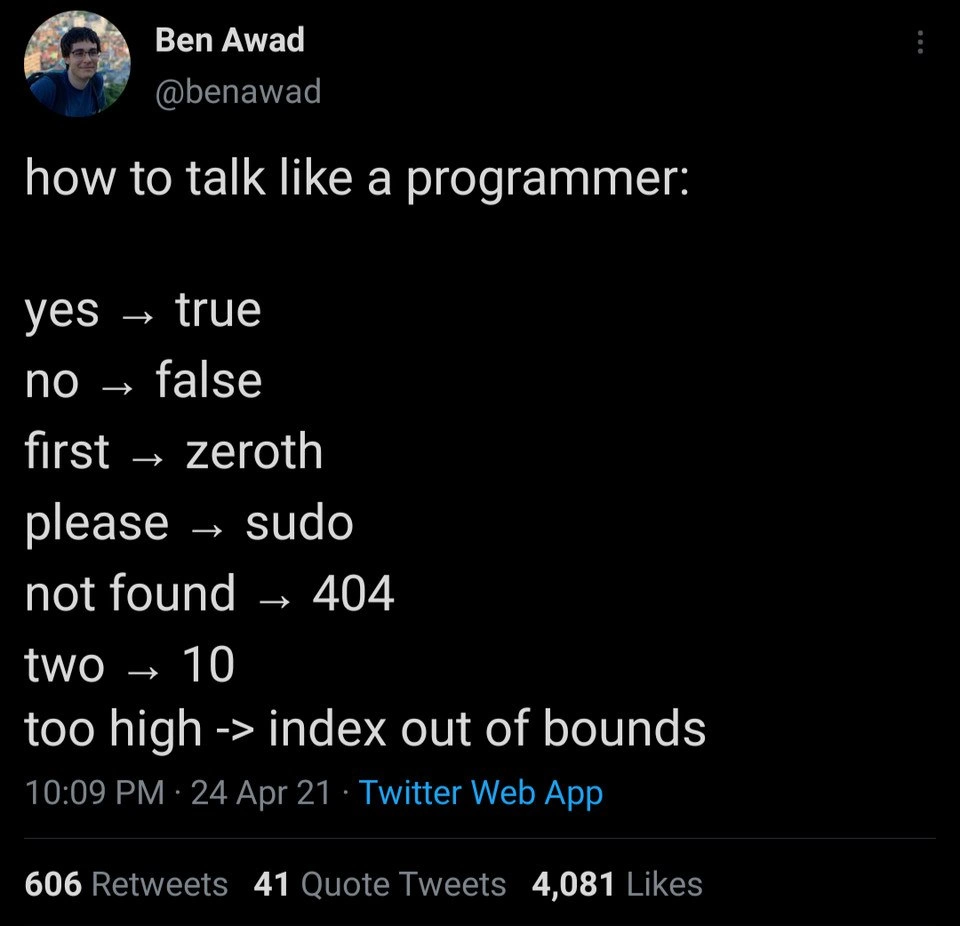
The screenshot presents a miniature phrasebook for translating ordinary speech into programmer reflexes:

how to talk like a programmer:

yes → true no → false first → zeroth please → sudo not found → 404 two → 10 too high -> index out of bounds

The joke is dense because every line points at a different layer of computing culture. yes -> true and no -> false reduce conversation to Boolean logic, where values collapse into two states. first -> zeroth invokes zero-based indexing, the reason arrays often begin at index 0 instead of 1 and the reason someone's "first item" becomes a developer's zeroth item. It is funny because programmers really do internalize that mismatch until normal counting starts to look suspicious.

please -> sudo is the Unix line. sudo runs a command with elevated privileges, so it becomes the terminal's version of asking nicely, except the system's answer is less "manners" and more "prove you are allowed to do this." The line works because developers often anthropomorphize the shell as a stern clerk who will obey you only after the right incantation and maybe a password.

not found -> 404 is the web line. HTTP status code 404 means the requested resource was not found, and it has escaped technical documentation into everyday culture. two -> 10 is the binary line: in base 2, the number written as 10 equals decimal two. That is the kind of joke that makes perfect sense after one CS fundamentals course and looks like a typo to everyone else.

Finally, too high -> index out of bounds ties the post together with an actual runtime failure. If a program tries to access an array position beyond the valid range, it can throw an index-out-of-bounds error. The phrase "too high" becomes a bad index, not a general complaint. The post message calling the cringe "out of bounds" adds another little recursion: even the reaction is expressed as an exception.

What makes the meme work is that it is not one joke; it is a compact tour through developer in-jokes. It turns natural language into type systems, shells, protocols, number bases, and runtime errors. The result is intentionally obnoxious in the way programmer humor often is: technically correct, socially unnecessary, and somehow still useful as onboarding vocabulary.

Description

A dark-mode Twitter screenshot shows a tweet by Ben Awad, @benawad, with a small profile photo and white text on a black background. The tweet reads: "how to talk like a programmer:" followed by mappings: "yes -> true", "no -> false", "first -> zeroth", "please -> sudo", "not found -> 404", "two -> 10", and "too high -> index out of bounds"; the footer shows "10:09 PM · 24 Apr 21 · Twitter Web App" and engagement counts "606 Retweets", "41 Quote Tweets", and "4,081 Likes." The humor is a compact tour of programmer idioms: booleans, zero-based indexing, Unix privilege escalation, HTTP status codes, binary notation, and bounds errors. It works because each everyday phrase is translated into a precise technical shorthand that developers use reflexively.

Comments

17
Anonymous ★ Top Pick The most realistic translation is still "please -> sudo" because consent only matters after privilege escalation.
  1. Anonymous ★ Top Pick

    The most realistic translation is still "please -> sudo" because consent only matters after privilege escalation.

  2. @deerspangle 5y

    The 4th one can be fun, if you use the Please build system: https://please.build/

    1. @Similacrest 5y

      3rd*

  3. @skylightxo 5y

    Ben Awad in a nutshell

  4. @pokadexr 5y

    The cringe of this post is out of bounds

    1. @dmytrijza 5y

      ​​The cringe of this post is out of bounds

      1. Deleted Account 5y

        ​​The cringe of this post is out of bounds

        1. @ceterre 5y

          ​​The cringe of this post is out of bounds

          1. @mvolfik 5y

            ​​The cringe of this post is out of bounds

            1. @p4vook 5y

              ​​The cringe of this post is out of bounds

              1. Deleted Account 5y

                The cringe of this post is out of bounds

                1. Deleted Account 5y

                  The cringe of this post is out of bounds

                  1. dev_meme 5y

                    The cringe of this post is out of bounds

                    1. @feskow 5y

                      throw std::out_of_range("cringe of this post is out of bounds");

    2. @qwnick 5y

      True

  5. @qqqrrrjjd 5y

    True

  6. @Roman_Millen 5y

    throw new PostCringeOutOfBoundsException();

Use J and K for navigation