Skip to content
DevMeme
1156 of 7435
When the Code Just Works
Bugs Post #1291, on Apr 10, 2020 in TG

When the Code Just Works

Why is this Bugs meme funny?

Level 1: When Code Actually Works

Imagine you and your friends are trying to do a really tricky puzzle. All week long, every time you put the puzzle pieces together, something’s wrong and it falls apart. It’s super frustrating! Then one day, you finally solve it completely – the puzzle doesn’t fall apart, and it shows the perfect picture, just like it’s supposed to. How do you all feel? You’d probably jump up, cheer, maybe even scream with excitement, right? 🎉🙌

That’s exactly what this meme is about, but with computer code. Writing code is like solving a puzzle or trying to get a game to work. Most of the time there’s some little mistake and the program says “Error!” (kind of like the puzzle collapsing). It can take many tries to fix those mistakes (the bugs). But on that special occasion when the code runs from start to finish without any errors, the programmer feels as happy and shocked as if they just won a big game.

In the picture, the people are sports commentators going wild, as if an unbelievable goal was scored. For a programmer, an unbelievable goal is when their program finally works perfectly. No errors at all! It’s a funny way to say that even grown-up coders feel like excited kids when everything goes right. Just like you’d high-five your friends after winning a tough level in a video game or finishing that hard puzzle, coders want to high-five everyone around when their code runs with zero problems. It doesn’t happen often, so when it does, it’s celebration time!

Level 2: No Errors, Just Applause

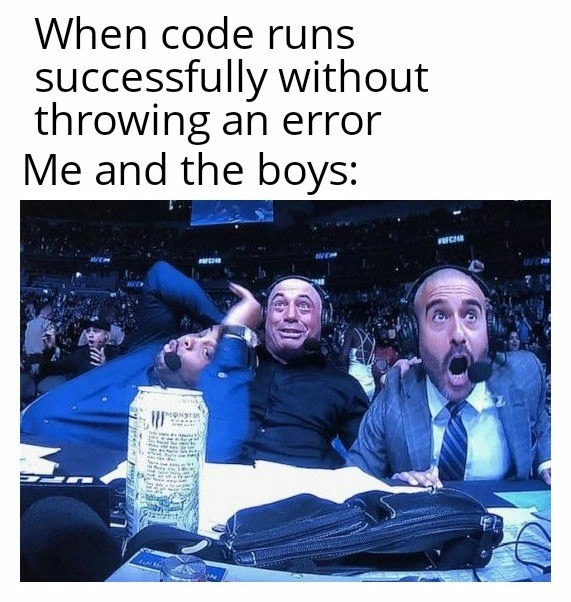
Let’s break this down for a newer developer or someone just getting into coding. The meme shows text at the top and an image below it. The text says:

“When code runs successfully without throwing an error
Me and the boys:”

In plain terms, this caption means: “If my program runs without any mistakes or crashes, this is how my friends and I react.” The picture underneath is a group of three commentators at a sports event looking shocked and thrilled. Think of announcers at a basketball game or an esports tournament when something incredible happens — mouths open, eyes wide, jumping out of their chairs. The meme is using that surprise celebration image to joke about how amazingly happy programmers feel when their code works perfectly.

Why is this so relatable to developers? Because most of the time, when you write and run code, something goes wrong. Especially if you’re just starting out (and honestly, even when you’re experienced), running code often results in errors. These could be:

  • Syntax errors – like misspelling a command or forgetting a ; semicolon or a } brace. The program won’t even start and will complain immediately.
  • Runtime errors (exceptions) – the program starts but “throws an error” during execution, meaning it hits a problem it can’t handle. For example, trying to divide by zero or accessing a variable that wasn’t initialized will cause an exception and likely make the program stop unless you handle that error in code.
  • Logical bugs – the code runs without crashing, but it doesn’t do what you expected. (Maybe your game character moves left instead of right, oops!)

Now, the meme specifically says “without throwing an error.” Throwing an error is programmer lingo for when the code encounters a big problem (an exception) and typically stops running further instructions. It’s like the code saying “I don’t know how to continue, something’s wrong.” This could produce a scary-looking message or a stack trace (a list of function calls that were running, to help you debug). As a developer, seeing an error means you have to enter debugging mode: you’ll check the code, find the bug, fix it, and try running again. This cycle of finding and fixing bugs is called debugging/troubleshooting, and it’s a huge part of a developer’s life.

Because errors are so common, a run with no errors at all is a big deal! The meme jokes that it’s such a big deal, you and your buddies would react as if your favorite team just won the championship. “Me and the boys” is just a fun way of saying “my friends and I”. In a developer context, “the boys” could be your teammates or fellow coders who have been suffering through the bugs with you. Maybe you’ve been working together on a tough project or you’re pair programming with a colleague. When finally the code executes perfectly from start to finish, everyone’s like “Whoa, did that just happen?!!” 🎉

Let’s visualize a common scenario for a junior dev:

  • You write some new code or fix a bug and hit the Run button (or type ./program in the terminal).
  • Yesterday and this morning, every time you ran it, something crashed or an error message popped up (maybe “NullReferenceException” or “Index out of bounds” – those tell you what went wrong).
  • But this time, the program runs all the way through. Maybe it prints the expected output, or the webpage loads correctly, or all your tests in the test suite pass with green checkmarks.
  • You stare at the screen for a second, a bit in disbelief: No red error text? No crash?
  • Then you feel a rush of excitement and relief. You might shout out, “It worked! It actually worked!” 💪

The image of the commentators is exactly how that excitement feels. Those guys are literally leaning back with their arms up and mouths open like “OOOOHHH!!”. In developer terms, that’s like high-fiving your friend across the desk or posting a triumphant GIF in your team chat. It’s celebration time for something that, to outsiders, might seem small: just a program running correctly. But after hours (or days) of frustration, it’s hard not to react that way. It’s pure, cathartic joy.

There’s also a bit of tongue-in-cheek humor here about how low our bar can be for happiness. Non-developers might assume programmers expect their code to work normally, right? In school, you run a calculator program and it just works. But in real development, especially with complex systems, expecting zero issues on the first run is almost laughable. So when it happens, we joke that it’s a miracle. It’s like a chef being amazed that a dish came out perfect on the first try, or an engineer surprised that the bridge they built stands on the first draft of the design — it can happen, but you kind of don’t expect it.

The tags also mention “run it in production energy.” To unpack that: production (prod) is what we call the live environment where real users use the software. Deploying or running code in production is serious business because errors there affect real people (and can cost money). There’s a jokey phrase developers use: “Works on my machine, ship it to production!” Usually said sarcastically, it means we’re so confident (or tired) after seeing it work once that we want to immediately push it live. Of course, good practice is to test more, code review, etc., before actually deploying. But the meme’s hype captures that impulsive moment of “Yes! Ship it now!” because we’re riding the high of success. That’s the loud commentator energy – we’re overjoyed and perhaps a bit over-optimistic.

Finally, “Me and the boys” is also referencing a broader meme format. It became popular with images of friends or characters acting goofy together. In dev memes, it often portrays a group reaction or a shared experience. Here, the shared experience is the relief of error-free code. It’s inclusive: we’ve all been there, we all celebrate like this internally (if not outwardly) when the code finally cooperates. It’s a bonding moment for the tech community, captured in a single ironic image. Even if you’re a solo coder, you might share this meme in a chat with other dev friends to say “this was me today” and everyone immediately gets the feeling. It’s a form of communal laughter at our own job’s reality.

In short, for a new developer: this meme is saying even programmers get surprised when things go perfectly. It humorously highlights the contrast between how often we deal with failures (a lot) and how giddy we get about success (like kids in a candy store). If you’ve ever spent an afternoon fighting with code and then finally seen it run without issues, you know exactly the pure happiness this image is portraying. It’s the kind of relatable developer experience that makes you feel part of the club – we’ve all cheered on that rare occasion when the computer isn’t throwing any tantrums!

Level 3: Works on First Try

When a piece of code runs error-free on the first go, it feels like witnessing a legendary event in software development. Seasoned devs have battled so many bugs and exceptions that a flawless execution is almost mythical. The meme’s caption sets the scene:

When code runs successfully without throwing an error
Me and the boys:

This top text is the setup. It’s describing that ultra-rare scenario — a program finishing without a single hiccup (no crashes, no exceptions thrown, nothing!). In the image below, “me and the boys” (a popular meme phrase for me and my buddies) are represented by three hyped-up sports commentators losing their minds with excitement. The juxtaposition is hilarious: writing code is usually a quiet, painstaking process, but here we compare a simple success run to a championship-winning play. It’s developer humor gold, highlighting how absurdly happy developers get over something non-developers might find trivial.

From a senior developer’s perspective, this reaction is 100% relatable. Why? Because normally, coding means debugging. In real life, our first attempt at running new code almost always throws an error or ten. Maybe there’s a NullPointerException in Java, a TypeError in Python, or some nasty off-by-one bug causing havoc. We’re used to seeing red error messages, stack traces, failing unit tests — you name it. So when nothing goes wrong, it’s shockingly rare. It feels like catching a break in an endless battle of troubleshooting. The stadium-level celebration in the image perfectly dramatizes that feeling.

Let’s break down the tech irony here:

  • “Successfully without throwing an error” – In programming, throwing an error (raising an exception) is what code does when something goes bad at runtime. Not throwing any error means everything worked as intended. For experienced devs, that outcome on the first run is about as common as a unicorn sighting in the server room. 🦄
  • Me and the boys – This phrase implies a group of friends or teammates. Coding might seem solitary, but debugging tough issues often turns into a team sport. Picture a group of engineers huddled around a screen late at night. They’ve been painstakingly tracking a nasty bug. When the fix finally works, everyone erupts like fans watching a game-winning shot. It’s camaraderie built on shared bugs and bug-fixing pain.
  • Sports commentator energy – The image shows commentators with headsets in total disbelief and glee, which is memetically known from events like UFC fights or buzzer-beater basketball games. In a dev context, that’s like your QA engineer and fellow devs shouting, “It actually ran! No errors! Unbelievable!” in mock play-by-play commentary. (Yes, developer experience can sometimes feel like a spectator sport when a deployment is on the line.)

This humorous contrast works because software bugs and errors are so ubiquitous that their absence is newsworthy. The meme exaggerates a minor victory (no runtime errors) into a major win as if it were an esports championship moment. Every senior dev has that scar tissue: countless failed builds and debugging/troubleshooting sessions where nothing seems to go right. So when everything goes right, it’s hard to believe. In fact, a veteran coder might first double-check that the logging system isn’t quietly failing – “Wait, no errors? Did our error logger silently crash or what?” 🙂. That cynicism comes from experience: if it’s too good to be true, it probably is. But assuming it’s real, it’s pure relief and joy. The meme nails this dual sentiment: surprise (because something’s probably wrong if there’s no error) and celebration (because hey, maybe it really is all green this time).

On a deeper level, this speaks to Developer Experience (DX) and the emotional rollercoaster of coding. Modern development includes automated tests, CI/CD pipelines, code linters, and runtime monitors – all there to catch mistakes. A senior dev knows that even with these safety nets, a new feature often fails initially due to unforeseen edge cases or integration issues. We’ve all seen that one last-minute bug that shows up right when you think you’re done. It’s practically a rite of passage in software engineering to mutter “Of course it’s failing... what did I miss now?” under your breath while combing through logs. Therefore, a smooth, error-free run flips the script. It’s an against-all-odds moment. The team might jokingly act out a commentator scenario, “It’s running… it’s actually running! And the crowd goes wild!!!”

There’s also an element of “run_it_in_production” energy satirized here. That phrase (referenced in the tags) captures a devil-may-care excitement: “It works on my machine, let’s deploy it to production right now!” 😅 In reality, seasoned devs are more cautious — they know a working dev environment run doesn’t guarantee a production success. But the meme’s over-the-top celebration hints at that temptation to ride the high of success straight into deploying the code live. It’s like a coach wanting to send the player back in immediately after a slam dunk. The rational senior engineer in us knows to calm down and run the full test suite or code review, but for a split second, hype takes over. The relatable developer experience here is balancing those emotions: cynicism from hard-earned knowledge of failure rates, and genuine euphoria when things (miraculously) go right.

In summary, at this advanced perspective, the meme humorously encapsulates a universal software truth: success is the exception, not the norm (pun intended 😉). The image of commentators freaking out is how it feels internally when your code finally behaves. It’s a moment of validation, sparking joy loud enough to rival a sports arena – a victory for the bug-weary developer’s soul.

Description

A 'Me and the boys' style meme. The top text reads, 'When code runs successfully without throwing an error. Me and the boys:'. The image below shows three UFC commentators (Joe Rogan in the center) at their desk, reacting with exaggerated shock and excitement. The man on the left is leaning back in his chair, another looks on with a wide-eyed, amazed expression, and the third has his mouth wide open in disbelief. The scene is bathed in a blue light from the event. The humor lies in the over-the-top reaction to something that should be normal - code running without errors. It reflects the cynical reality of software development, where developers often expect failure and are genuinely surprised and overjoyed when complex code works on the first try, especially after a long and arduous debugging session
Comments

7
Anonymous ★ Top Pick That's the face you make when the staging deployment goes green on the first try and you realize you've used up all your luck for the quarter, just before the production release
  1. Anonymous ★ Top Pick

    That's the face you make when the staging deployment goes green on the first try and you realize you've used up all your luck for the quarter, just before the production release

  2. Anonymous

    When the end-to-end tests go green on the first CI run, the principal engineers celebrate like esports casters - right up until someone asks, “Wait… did we accidentally mock the entire database again?”

  3. Anonymous

    After 20 years in the industry, the most suspicious thing isn't a failing test suite - it's when your distributed system with 47 microservices, 3 message queues, and eventual consistency actually works perfectly on the first deployment. That's when you know the real bug is hiding in production, waiting for the CEO's demo

  4. Anonymous

    The real miracle isn't that the code ran without errors - it's that all three developers were actually watching the same terminal at the same time instead of context-switching between Slack, email, and their own branches. This level of synchronized attention to a single deployment is rarer than a zero-day vulnerability in a Rust codebase

  5. Anonymous

    Code runs with no errors? Translation for seniors: we returned 200, swallowed the exception, and the metrics exporter quietly crashed

  6. Anonymous

    That glorious nanosecond before realizing it worked on localhost but prod has a new dependency hell waiting

  7. Anonymous

    Code ran clean - which usually means catch(Exception) swallowed the bug and the observability pipeline is dead; congratulations on your Schrödinger release

Use J and K for navigation