JavaScript's One-Size-Fits-All Approach to Numbers
Why is this Languages meme funny?
Level 1: Measuring Everything With One Ruler
Imagine a carpenter who throws away every tool except one ruler, declaring "this ruler measures everything." Mostly it works fine — but the ruler's smallest marks don't line up perfectly with certain lengths, so when you measure a tenth of an inch plus two tenths, it reads a hair off. And for really long distances it skips: two different lengths can land on the same mark. The meme shows the JavaScript language as a guy proudly refusing a full toolbox and pointing happily at his single ruler. It's funny because every programmer has been burned by that ruler — they ask the computer "what's 0.1 + 0.2?" and it cheerfully answers "0.30000000000000004," and the language acts like that's completely fine.
Level 2: Why 0.1 + 0.2 Misses
A datatype tells the computer how to store a value. Most languages offer several for numbers: integers (int, long) store whole numbers exactly; floats/doubles store decimals approximately but cover a huge range. A double ("double-precision floating point") uses 64 bits and is the more accurate of the two float flavors.
JavaScript skipped the menu — historically, every number is a double. Try this in your browser console:
0.1 + 0.2 // 0.30000000000000004
0.1 + 0.2 === 0.3 // false — the classic interview gotcha
Number.MAX_SAFE_INTEGER // 9007199254740991 — beyond this, whole numbers go fuzzy
2**53 + 1 === 2**53 // true (!!)
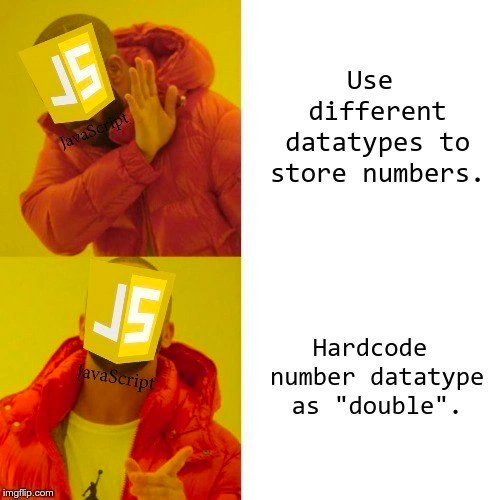
The reason is base-2 storage: just as 1/3 can't be written exactly in decimal (0.3333...), 0.1 can't be written exactly in binary, so the computer keeps an extremely close approximation. Practical survival rules you'll use constantly: never compare floats with === (check Math.abs(a - b) < epsilon); store money in integer cents; keep big IDs as strings; reach for BigInt when you genuinely need huge exact integers. The Drake format nails the attitude: what looks like a confident architectural choice is the language happily refusing the harder, more correct option.
Level 3: One Type to Round Them All
The format does the satirical heavy lifting: Drake's face replaced by the yellow JavaScript logo, smugly waving off "Use different datatypes to store numbers" and pointing with delight at "Hardcode number datatype as "double"." The word hardcode is the dagger. Languages don't usually "hardcode" type systems — they design them. Framing JS's numeric model as a hardcoded constant casts the language as a developer taking the shortcut every reviewer has rejected: why build the general mechanism when one magic value ships today?
What seasoned developers hear in this meme is the long tail of that 1995 shortcut. C, Java, and friends give you a numeric toolbox — int, long, float, double — because different jobs need different guarantees: exactness for counting, range for IDs, speed and tolerance for physics. JavaScript shipped with exactly one: every number a double. The consequences became a genre of production incident:
- Money math —
0.1 + 0.2 !== 0.3means naive currency arithmetic drifts by fractions of a cent until accounting notices; hence the iron rule store cents as integers (ironically, integers stored in a double) - 64-bit IDs — invoice or tweet IDs above 2^53 silently corrupt in
JSON.parse, which is how your invoice becomes someone else's - The equality lottery —
9999999999999999 === 10000000000000000istrue, a fact best discovered before the audit, not during
The meme is also a fair entry in the broader JavaScript design decisions genre (typeof NaN === "number" — the not-a-number that is a number — usually headlines that set). But the honest senior take has a twist of sympathy: the single-type model made the language radically approachable, and for the 95% of web code that counts list items and positions divs, doubles are flawless. The trap is the silence — no overflow exception, no precision warning, just slightly wrong numbers flowing downstream with total confidence. Like much of JS, it fails politely, which is the most expensive way to fail.
Level 4: Fifty-Two Bits of Truth
The meme's bottom panel — "Hardcode number datatype as "double"" — refers to a very specific artifact: IEEE 754 double-precision binary64, the format JavaScript's Number is contractually bound to. Its anatomy: 1 sign bit, 11 exponent bits, 52 mantissa (significand) bits, encoding values as $(-1)^s \times 1.m \times 2^{e-1023}$. Two mathematical consequences fall straight out of that layout, and both became famous bugs.
First, binary fractions can't represent most decimal fractions. $0.1$ in binary is $0.0001100110011\overline{0011}$ — infinitely repeating, like $1/3$ in decimal. The hardware stores the nearest representable double, so 0.1 + 0.2 adds two already-rounded values and rounds again, yielding 0.30000000000000004 — the exact value the channel poster sarcastically thanks "IEEE 754-2008" for. This isn't a JavaScript bug; C's double and Python's float do the identical thing. JavaScript's sin was only offering this type for every number.
Second, 52+1 mantissa bits mean integers are exact only up to $2^{53}$ (Number.MAX_SAFE_INTEGER = 9,007,199,254,740,991). Beyond it, the gap between representable doubles exceeds 1, so 2**53 + 1 === 2**53 evaluates true — consecutive integers silently collapse into each other. This is why every JSON API that returned 64-bit database IDs to a browser eventually shipped the same fix: send the ID as a string. Twitter's "snowflake" IDs crossing $2^{53}$ broke JS clients industry-wide and canonized the workaround.
The design choice itself is a fascinating trade. Eich's 1995 ten-day prototype borrowed the "one number type" simplification (HyperTalk and Lua made similar bets) — it eliminates integer overflow UB, promotion rules, and the int/float schism that confuses beginners. The costs arrived later, and the patches tell the story: Math.fround, typed arrays with real int32/float64 views, asm.js coercion tricks (x|0 to hint "this is an int32"), and finally BigInt in ES2020 — a whole second numeric type bolted on 25 years later, which is the type system equivalent of admitting the meme was right.
Description
A two-panel meme using the 'Drake' format, where the rapper Drake's face is covered by the JavaScript logo. In the top panel, the logo-faced Drake holds up a hand in rejection next to the text, 'Use different datatypes to store numbers.' In the bottom panel, the same character points approvingly at the text, 'Hardcode number datatype as "double".' This meme humorously criticizes JavaScript's design choice to have only one number type, the 64-bit IEEE 754 double-precision floating-point number, for all numeric values. Unlike many other languages that offer distinct types for integers and various floating-point precisions, JavaScript's approach can lead to infamous floating-point arithmetic issues, such as 0.1 + 0.2 not equaling exactly 0.3, a common pain point and source of jokes for developers

Comments
8Comment deleted
JavaScript's number type is like a junior dev's first solution: it works for most things, until you need precision, and then you discover the rounding errors of its youthful optimism
JavaScript’s 1995 design meeting: “Either we add ints and decimals, or we make every future dev learn IEEE-754 at 3 AM during a production cash-rounding bug.” Guess which one shipped
JavaScript's number system is like that senior architect who insists every microservice needs exactly 8GB of RAM because "it simplifies the infrastructure" - technically correct, wildly inefficient, and somehow still in production after 15 years
JavaScript looked at decades of numeric type theory and said 'everything is a double' - which is why your invoice ID over 2^53 silently became someone else's invoice
Ah yes, JavaScript's elegant solution to numeric types: when you can't decide between int, float, long, or decimal, just make everything a double and call it 'simplicity.' Sure, you lose precision after 2^53, and 0.1 + 0.2 !== 0.3, but at least you never have to think about which numeric type to use - because there isn't one. It's the programming equivalent of having one universal remote that kind of works for everything but perfectly for nothing. Meanwhile, developers from statically-typed languages watch in horror as JS happily stores their carefully crafted integer in 64 bits of floating-point glory
JavaScript: all numbers are doubles - until you need cents, remember IEEE‑754, and mixing BigInt for safety makes 2n + 1 a TypeError
JavaScript: all numbers are doubles so your prices, timestamps, and 64‑bit IDs can share one type - and three different production bugs
JS numbers: 9007199254740992 + 1 === 9007199254740992, the architectural feature securing endless refactors