Skip to content
DevMeme
Amazon's Secret ASCII Art: The Feline Easter Egg
WebDev Post #112, on Feb 13, 2019 in TG

Amazon's Secret ASCII Art: The Feline Easter Egg

Why is this WebDev meme funny?

Level 1: A Doodle Inside the Walls

When builders finish a house, sometimes one of them draws a little doodle on a beam before the drywall covers it — a secret hello to whoever opens that wall decades later. Websites have an "inside the walls" too: hidden text that visitors never see, but other builders can peek at with special tools. Someone exploring the hidden part of Amazon's shopping page found a tiny cat drawn out of keyboard characters, saying "MEOW." It's funny because Amazon is a giant, ultra-serious company — and yet some engineer hid a doodle in the walls of its busiest store, just to make the next curious person grin. Funnier still: the drawing looks an awful lot like a duck. A duck that says meow.

Level 2: What You're Looking At

Chrome DevTools is the inspector built into the browser (right-click → Inspect, or F12). The tab row visible in the screenshot — Elements, Console, Sources, Network, Performance, Memory — is the standard toolkit; the Elements panel shows the live DOM, the browser's in-memory tree of the page's HTML. The blue-highlighted </div> with == $0 means "this selected node is available as the variable $0 in the Console" — a handy trick worth learning early.

The surrounding markup decodes like this:

  • <!-- ... --> is an HTML comment — invisible on the rendered page but fully present in the source anyone can read.
  • position: absolute; left: -1000000px doesn't delete an element; it shoves it a million pixels offscreen. Developers use this so things like payment iframes or screen-reader text exist in the page without being visible — different from display:none, which removes the element from layout entirely (see the neighboring display:none;visibility:hidden div for that flavor).
  • <noscript> holds fallback content for browsers with JavaScript disabled.
  • Comments like sp:feature:amazon-pay-iframe are markers injected by Amazon's build system so engineers can tell which component generated which chunk of the page.

The takeaway habit: inspect everything. View source on sites you admire. Big production pages are messy, surprising, and occasionally contain a cat. Just remember the symmetry — everything you put in HTML is equally public, including the comments you forgot were there.

Level 3: Shipped Through Six-Pagers and Code Review

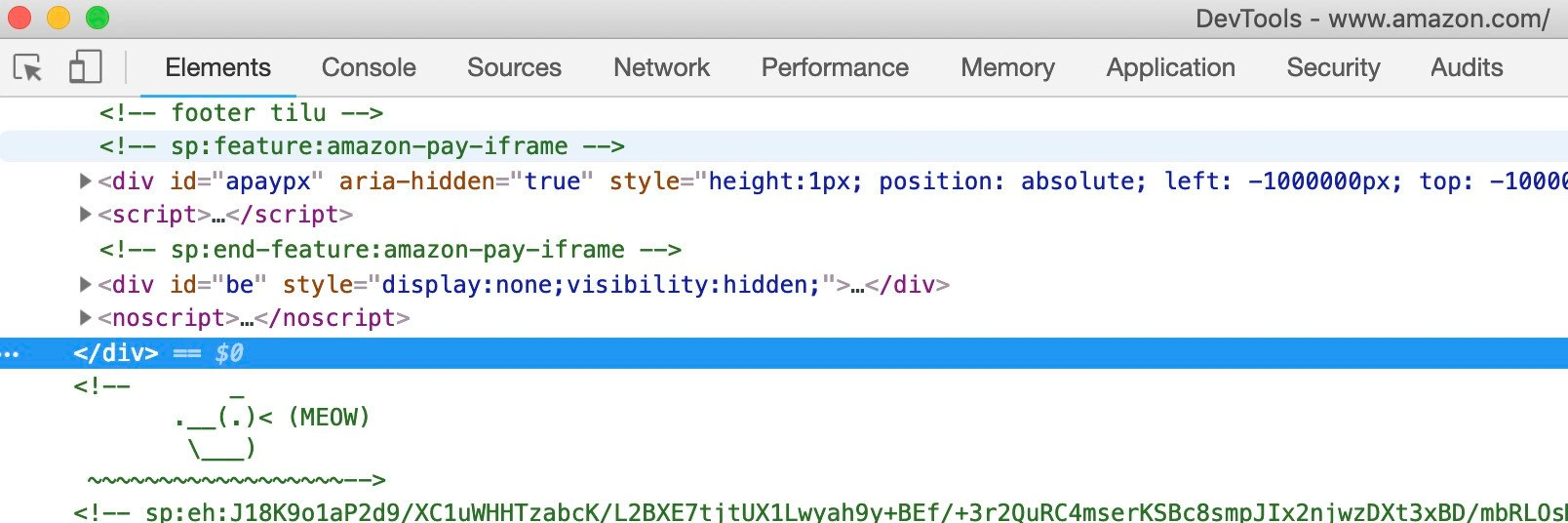
The screenshot shows Chrome DevTools open on www.amazon.com, Elements panel active, and the inspected markup is a guided tour of industrial-grade frontend plumbing: feature-flag comments like <!-- sp:feature:amazon-pay-iframe -->, a div with id="apaypx" parked at left: -1000000px (the venerable offscreen-positioning trick — present in the layout for iframes and screen readers, invisible to humans), a display:none;visibility:hidden div, a <noscript> fallback, and an opaque sp:eh: hash blob that's clearly machine-generated build output. And nestled between all this telemetry sediment, inside an HTML comment:

<!--        _
    .__(.)< (MEOW)
    \___)
-->

A tiny ASCII creature, deliberately committed, reviewed, and deployed to the most heavily trafficked retail page on Earth. The extra layer that makes it perfect: that ASCII shape is the classic ASCII duck — and it says (MEOW). The animal is lying about its species in production. (The Telegram poster's caption, "WOF WOF," gleefully extends the taxonomy crisis.)

For working engineers, the humor sits in the contrast between the artifact and the machine that produced it. Amazon's frontend is the output of one of the most process-heavy engineering cultures in the industry — and every byte of amazon.com's HTML is scrutinized for performance, because at that traffic volume, bytes are literally money. Whole teams exist to strip whitespace and shave payload. Yet here is a five-line cat-duck that some engineer got past code review, performance budgets, and whatever approval chain governs the retail page footer. Meanwhile, as every veteran knows, your own one-line CSS fix is on its third day awaiting a second approver.

This is also a living artifact of view-source culture — the tradition that the web ships its source code to everyone, and that curious people will read it. Easter eggs in HTML comments are messages in bottles aimed at exactly one audience: other developers poking around the DOM. It doubles as ambient recruiting (several companies famously hide job pitches in their console output) and as a small act of humanity — proof that behind the feature-flag scaffolding and minified bundles, an actual person was here, and that person liked ducks. Or cats. Allegiances unclear.

The quiet professional lesson underneath: HTML comments ship to production. Unlike server-side comments, which die at render time, anything in your markup travels to every client — which is why this cat exists, why sp: build markers are visible, and why, less charmingly, security auditors keep finding internal hostnames, dev credentials, and "TODO: remove before launch" notes in live page source. The same channel that carries a meow can carry a breach. Comment accordingly.

Description

A screenshot of a web browser's developer tools (DevTools) inspecting the HTML source code of the amazon.com homepage. The 'Elements' tab is active, showing various HTML tags and comments. Near the bottom of the visible code, inside an HTML comment block, there is a piece of ASCII art depicting a cat. The text '(MEOW)' is next to the cat. The code also includes comments like '<!-- footer tilu -->' and '<!-- sp:feature:amazon-pay-iframe -->'. The discovery of such a whimsical 'easter egg' in the source code of a massive, buttoned-up corporation like Amazon is the source of the humor. It's a reminder that even in the most complex, enterprise-level systems, individual developers leave their mark, often with a touch of humor that other developers can appreciate when peeking under the hood
Comments

8
Anonymous ★ Top Pick Amazon's frontend is so complex they have to comment their code with ASCII animals just to keep track of which div is which. That's not a cat, it's a 'catalog' component
  1. Anonymous ★ Top Pick

    Amazon's frontend is so complex they have to comment their code with ASCII animals just to keep track of which div is which. That's not a cat, it's a 'catalog' component

  2. Anonymous

    Chrome’s performance audit flagged 16 KB of “off-screen content”; tracing it led to an ASCII cat sitting at left:-1 000 000 px - proof that even at Amazon scale, devs still smuggle emotional-support monoliths between the microservices

  3. Anonymous

    The only code comment that survived the PR review was a cat, because even the most ruthless architect can't bring themselves to delete something that says MEOW

  4. Anonymous

    Somewhere at Amazon, an ASCII cat sailed through code review, legal, and a six-pager - meanwhile your one-line CSS fix is still blocked on two approvals

  5. Anonymous

    When your code review catches a cat in production but the PM asks 'does it impact the critical path?' and you realize the ASCII art is positioned -1000000px off-screen with better accessibility attributes than half your actual features. At least someone on the Amazon frontend team understood that aria-hidden='true' applies to both screen readers AND management visibility

  6. Anonymous

    Nothing says enterprise frontend like a 1px, aria-hidden payment iframe exiled to left:-1000000px and the only surviving documentation being an ASCII cat - production DX for whoever hits $0

  7. Anonymous

    PCI compliance masterpiece: the iframe that's PCI-passport ready yet forever lost in CSS's shadow realm at left:10000px

  8. Anonymous

    Enterprise feature flag: ship the Amazon Pay iframe, then bury it at left:-1e6px with aria-hidden and display:none - still counted by analytics, invisible to users, approved by the ASCII cat in the comment

Use J and K for navigation