Skip to content
DevMeme
The Haunting Specter of a 500 Internal Server Error
OnCall ProductionIssues Post #114, on Feb 13, 2019 in TG

The Haunting Specter of a 500 Internal Server Error

Why is this OnCall ProductionIssues meme funny?

Level 1: "Something Went Wrong"

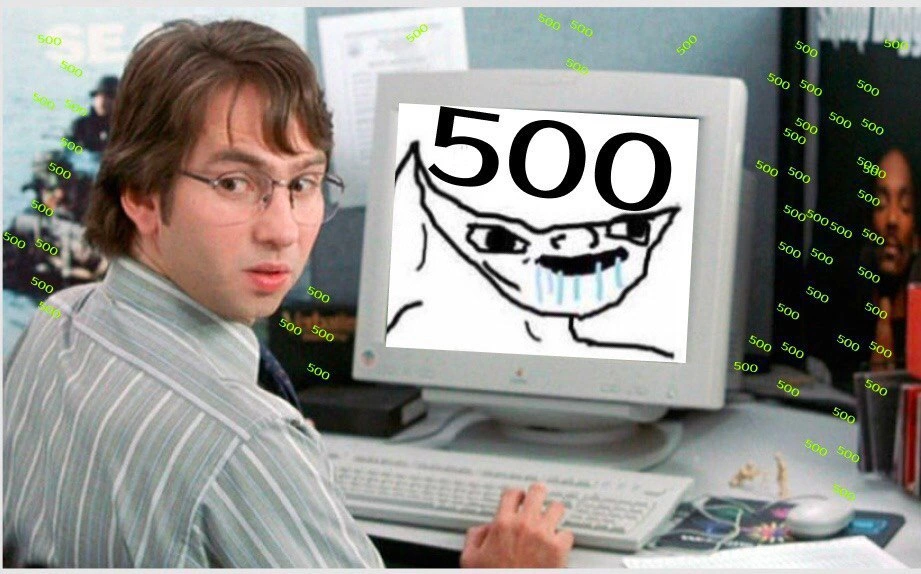
You know when a vending machine takes your money, makes a sad clunk, and lights up a sign that just says "ERROR" — not which part broke, not whether you get your money back, just error? That's what a "500" is: a website's way of saying "something broke inside me, and I'm not telling you what." The man in the picture is a programmer whose job is to fix the machine, and everywhere he looks — his screen, the walls, the air itself — that same unhelpful "500" is raining down. The drooling cartoon face on his monitor is what the error feels like: the machine grinning blankly while giving him absolutely nothing to work with. It's funny because everyone knows the feeling of being told "something went wrong" by a thing that knows exactly what went wrong and simply won't say.

Level 2: Reading the Status Code Tea Leaves

Every response a web server sends starts with a three-digit HTTP status code — a quick verdict on how the request went. The first digit tells you whose problem it is:

Class Meaning Whose fault
2xx (200 OK) Success Nobody's
3xx (301) Redirect Nobody's, just moved
4xx (404, 403) Bad request The client's
5xx (500, 502, 503) Server broke Yours. The backend's. You.

A 500 Internal Server Error usually means an unhandled exception: somewhere in the backend code, something threw — a null reference, a failed database query, a typo'd config key — and nothing caught it. The framework catches it at the top level and returns the generic 500 page instead of crashing entirely:

@app.route("/checkout")
def checkout():
    total = cart.total()        # cart is None → exception →
    return render(total)        # browser sees: 500 Internal Server Error

Early-career rites of passage this meme will remind you of later: deploying your first feature and watching the site return 500 because of a missing environment variable; learning that the browser shows nothing useful and the real story lives in the server logs (kubectl logs, tail -f error.log, or your error tracker); and discovering its siblings — 502 Bad Gateway (the proxy couldn't reach your app, which probably crashed) and 503 Service Unavailable (overloaded or down for maintenance). Rule of thumb that will serve you for a decade: 4xx means check the request, 5xx means check your own code — and check the logs first, always.

Level 3: The Server Knows and Won't Tell

The collage is a trauma diorama assembled from three meme strata: the anxious programmer from Office Space (Michael Bolton, patron saint of cubicle despair) glancing over his shoulder at a beige CRT; a drooling brainlet wojak on the monitor under a giant "500"; and dozens of small green 500s raining across the frame like Matrix code. The Matrix reference is the cruelest touch — Neo learned to see the underlying truth of reality in the falling glyphs, and this developer has achieved the same enlightenment, except the underlying truth of his reality is Internal Server Error, everywhere, forever.

HTTP 500 occupies a special place in the backend developer's psyche because of what it doesn't say. The 5xx class means "the server failed," but 500 specifically is the generic, catch-all confession: an unhandled exception bubbled all the way up, and the framework's last line of defense swallowed it and emitted the blankest possible apology. And this is, infuriatingly, correct behavior — leaking the real error to clients is a security hole (stack traces reveal file paths, library versions, query structure; every pentest report has a finding about verbose error pages). So the server knows exactly what broke — there's a stack trace with file and line number sitting in a log somewhere — and has decided, by design, that the outside world doesn't deserve to know. The drooling wojak as the face of the error is exactly how a 500 presents: total internal catastrophe rendered as a vacant smile.

The "raining everywhere" composition captures a second on-call truth: 500s never arrive alone. One bad deploy, one exhausted connection pool, one dead downstream dependency, and every endpoint starts failing simultaneously — the monitoring dashboard goes red, the error tracker rate-limits itself, and Slack fills with screenshots from people helpfully reporting what the graphs already screamed. The debugging ritual that follows is a genre unto itself: which service actually failed? Is the log line you need among the four million identical ones? Is it the database, the cache, or — tradition demands we ask — DNS? The 500 is where observability budgets get justified: the difference between a five-minute incident and a five-hour one is usually whether someone wired up structured logging and request tracing before the rain started.

The Office Space still is the perfect emotional anchor because that film is about software workers crushed by systems they can't fix — and the over-the-shoulder glance reads as the universal on-call reflex: did someone just walk up behind me? Is it my manager? Is it another alert? In 1999 Michael Bolton feared the consultants; today he'd fear PagerDuty.

Description

A meme depicting a developer in an office setting, looking back over his shoulder with a concerned and startled expression. He is sitting in front of an old, beige CRT monitor. On the screen, a crudely drawn, drooling goblin-like character (a variation of the Wojak meme) is displayed, with the large number '500' overlaid on it. The entire image is littered with the number '500' repeated in a faint green font, creating an overwhelming, nightmarish effect. The meme humorously visualizes the dreaded HTTP 500 Internal Server Error. For developers, this generic error message signifies a catastrophic failure on the server-side with no immediate indication of the cause, leading to stressful debugging sessions. The goblin on the screen and the flood of '500's represent the application in a state of complete breakdown, a familiar sight during production incidents


Comments

8
Anonymous ★ Top Pick The server isn't just throwing a 500 error; it's spawning a new goblin process for every failed request. It's not a bug, it's a denial-of-service attack from the inside
  1. Anonymous ★ Top Pick

    The server isn't just throwing a 500 error; it's spawning a new goblin process for every failed request. It's not a bug, it's a denial-of-service attack from the inside

  2. Anonymous

    Prod’s spewing 500s so ferociously PagerDuty rate-limited itself - turns out exponential backoff is the only component in our stack that actually scales

  3. Anonymous

    The 500 error's stack trace is just "¯\_(ツ)_/¯" all the way down, but at least the load balancer is distributing the blame evenly across all services

  4. Anonymous

    HTTP 500: the server's way of saying 'I know exactly what went wrong, and I've decided you don't deserve to.'

  5. Anonymous

    That moment when your monitoring dashboard lights up like a Christmas tree at 3 AM, and you realize your 'quick hotfix' before leaving Friday evening introduced a null pointer exception in the payment processing service. The trollface isn't the bug - it's your past self who thought 'it works on my machine' was sufficient testing for a production deployment

  6. Anonymous

    Classic: one unhandled exception, autoscaler thrashes, retries surge, health checks pile on, and suddenly 500s are the only horizontally scalable part of your architecture

  7. Anonymous

    HTTP 500 in prod: the moment your microservices choir harmonizes on 'it was the database all along'

  8. Anonymous

    When the only page that renders instantly is /500, congrats - you’ve finally achieved strong eventual consistency across the stack: everything fails the same way

Use J and K for navigation