Skip to content
DevMeme
4576 of 7435
When you proudly say JavaScript and everyone hears TypeScript instead
Languages Post #5021, on Nov 21, 2022 in TG

When you proudly say JavaScript and everyone hears TypeScript instead

Why is this Languages meme funny?

Level 1: Seatbelt, Right?

Think of it like this: you excitedly tell your friend you drove all the way home by yourself. Your friend immediately asks with a smile, “You wore your seatbelt, right?” If you just stare back silently, that smile is going to fade, and they’ll ask again, much more worried: “...You did wear your seatbelt, right??” It’s funny in a nervous kind of way, because of course everyone nowadays expects you to use a seatbelt for safety. In the same way, when a coder says “I wrote this in JavaScript,” people are now automatically expecting, “with TypeScript for safety, right?” The meme plays on that modern assumption – it’s like being shocked that someone might skip an obvious safety step that most others insist on.

Level 2: Typing the Script

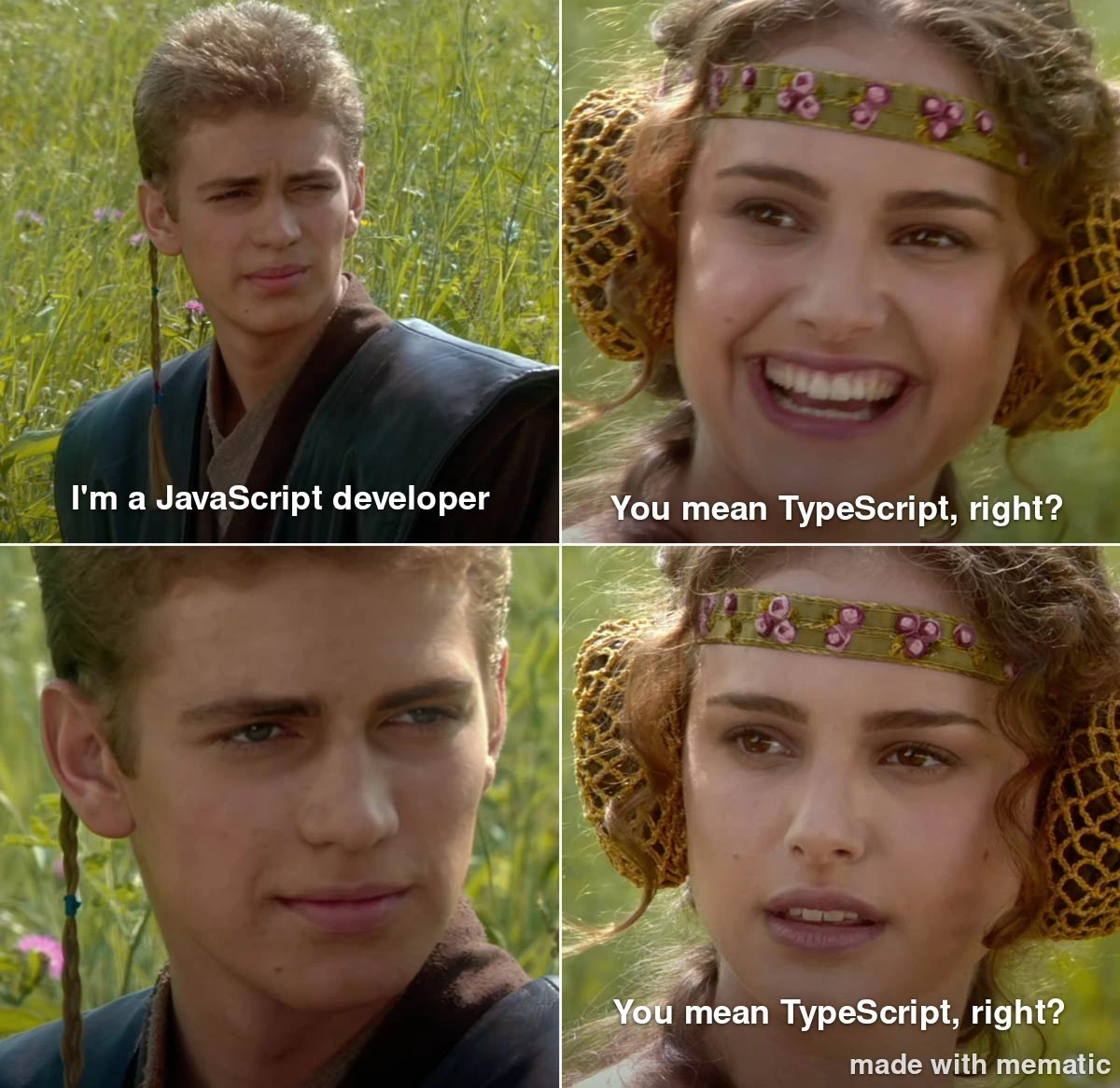
This meme uses a famous scene from Star Wars: Episode II – Attack of the Clones (often seen in memes) to make a point about programming languages. In the images, a young man (Anakin) and a young woman (Padmé) are having a light-hearted exchange in a meadow. The dialogue goes like this:

Anakin: “I’m a JavaScript developer.”
Padmé: “You mean TypeScript, right?”
(Anakin just smiles awkwardly, saying nothing.)
Padmé (now looking worried): “You mean TypeScript, right…?”

What’s happening here? Padmé assumed that when Anakin said he codes in JavaScript, he must actually be using TypeScript (a closely related language). When she realizes he might truly be using plain JavaScript without TypeScript, she gets concerned. This reaction is the joke: nowadays many people automatically expect JavaScript developers to use TypeScript for safety. Padmé’s growing concern in the last panel is like her thinking, “Oh no, you’re not using TypeScript? Are you sure that’s okay?”

Let’s break down the terms to understand why this is funny:

  • JavaScript (JS) is a very popular programming language, most known for making web pages interactive. If you click a button or see content update on a site, JavaScript is probably running behind the scenes. One key thing about JavaScript is that it’s dynamically typed. This means when you create a variable or a function, you don’t have to say upfront what type of data it holds – it could be a number, a string of text, an object, etc., and JavaScript won’t check that for you. The language is very flexible: the same variable can hold a number one minute and a text string the next, and JavaScript won’t complain. But this flexibility can sometimes lead to confusing errors if you’re not careful. For example, if a function expects a number and you accidentally pass in a string, JavaScript will try to still do something with it (like "5" * 2 in JavaScript would actually try to convert the string to a number and give 10 — sometimes it works, but other times it might produce weird results or errors). You usually won’t find out about the mistake until you actually run the code.

  • TypeScript (TS) is essentially an upgrade or extension of JavaScript. It was created to add something called static typing to the language. Static typing means you (or the computer) declare what type of data each variable and function is supposed to handle, and this is checked before the program runs. With TypeScript, if you say a variable should hold a number, the tool will alert you if you later try to assign a text string to that variable — that’s probably a mistake. TypeScript code actually gets converted (or “transpiled”) back into plain JavaScript before it runs, because browsers only understand JavaScript. But that conversion step includes all those safety checks. Think of TypeScript like a helpful assistant or teacher looking over your code and pointing out, “Hey, you said this variable would be a number, but here you’re giving it text – is that what you meant? It could cause a problem.” It’s like having a spell-check or grammar-check for your code logic.

To illustrate the difference, consider a simple example:

// TypeScript example:
let count: number = 5;
count = "five"; // 🚫 Error: Type 'string' is not assignable to type 'number'

In TypeScript, we declared count should be a number. If somewhere later we mistakenly set count = "five" (a string), TypeScript will catch it as an error before running the program. Now, here’s the same idea in plain JavaScript:

// JavaScript example:
let count = 5;
count = "five"; // No error here - JavaScript allows this!
console.log(count); // Now count is "five" (a string) at runtime.

JavaScript happily lets us assign a string to count after it was a number. There’s no immediate error. But if the next line of code tries to do a math operation on count assuming it’s still a number, we’d get a problem at runtime. In JavaScript, you often discover these issues only when the code is running (or through tests), which can be late in the game. TypeScript acts as an early guard, telling you “Hey, that doesn’t look right” while you’re writing the code.

Now, why does Padmé in the meme assume every JavaScript developer means TypeScript? It’s because in recent years, TypeScript has become extremely popular for professional development. It makes coding in JavaScript more predictable and reduces bugs. Many teams have adopted TypeScript because:

  • It catches common mistakes (like the one above) at compile time, so developers can fix them before deploying the code.
  • It makes code easier to maintain. When you come back to code written months ago, the explicit type definitions (or the inferred ones) act like documentation, reminding you what each piece of data should be.
  • Modern code editors (like VS Code) use TypeScript to provide smart suggestions and autocomplete. For example, if you have an object and you type objectName., the editor can list the properties available, because TypeScript knows the object’s shape. This is a big productivity boost — it’s part of why we say TypeScript improves Developer Experience (DX).

Because of these benefits, a lot of new web projects and frameworks encourage or even require TypeScript. If you’re a frontend developer today, chances are high you’ve worked with TypeScript or are expected to. It’s become almost a standard. So, in many developers’ minds, saying “I work with JavaScript” includes the assumption “(with TypeScript, of course).” The meme amplifies this assumption to a comedic level: everyone immediately hears “TypeScript” even if you just say “JavaScript,” as if TypeScript is now the default mode for JavaScript development.

For a newcomer: imagine you learned plain JavaScript and built a cool website. You proudly say “I’m a JavaScript developer!” In some circles, the response might be, “Oh cool, and you’re using TypeScript, right?” They’re not trying to be mean — it’s just that TypeScript is currently seen as the safer, more professional way to handle larger JavaScript projects. The meme just takes that common experience and makes it funny with Padmé’s increasingly worried face. She expected Anakin to keep up with the current best practices (using TypeScript for safety), and she’s shocked he might not be doing so.

In short, JavaScript is the original, flexible scripting language, and TypeScript is like a tuned-up version of it that adds strict rules (for your own good). The joke lands because nowadays many developers can’t imagine not using those extra safety features – just like Padmé couldn’t imagine a skilled Jedi not using the Force carefully (to slip in a Star Wars metaphor). So when someone doesn’t follow the current norm (writing plain JavaScript without TypeScript), it causes a bit of comedic alarm, as shown in the meme.

Level 3: Type Safety Strikes Back

In this meme’s four-panel drama, a young developer confidently declares, “I’m a JavaScript developer.” Padmé (the friend in ornate hair buns) smiles broadly and asks, “You mean TypeScript, right?” Her assumption is immediate — surely he’s using TypeScript. But then comes his awkward silence (Anakin just stares). In the final panel Padmé’s grin fades into concern: “You mean TypeScript, right…?” The humor hits home for seasoned devs because it exaggerates a real trend: modern JS stack expectations have grown to assume that of course you’re using TypeScript for any serious project. It’s poking fun at the static_typing_pressure in today’s industry. We’ve reached a point where saying JavaScript alone almost implies something is missing, like you forgot an important safety harness.

Why is this so relatable? It’s a nod to the ongoing JavaScript vs TypeScript saga – essentially the new chapter of the old dynamic_typing_debate. JavaScript (often abbreviated JS) has always been a dynamically typed language: variables don’t have fixed types, and type-related bugs only show up when the code is running (if at all). That gave JavaScript incredible flexibility (and honestly, chaos). We’ve all experienced or heard of those late-night debugging sessions caused by a silly type mistake – e.g. passing a string where a function expected a number, leading to the infamous runtime crash: undefined is not a function or NaN poisoning the output. For years, developers just accepted that as part of JS life. If something broke, well, you wrote more tests or did careful code reviews. “It’s fine, it’s JavaScript, things are loosey-goosey,” was the mantra.

Enter TypeScript in the mid-2010s as the prodigious “chosen one” to bring balance. TypeScript is a language that builds on JavaScript by adding a robust static type system. It checks your code at compile time, so it can catch those type mismatches before you ever run the app. This is a game-changer for large codebases. Suddenly, many JavaScript developers had an epiphany: “Wait, the compiler can warn me if I try to call a number like it’s a function? Yes, please!” TypeScript turned the wild west of JavaScript into a slightly more civilized frontier with rules. And developers discovered that these rules actually improve Developer Experience (DX): your IDE autocompletes object properties, you get instant feedback on mistakes, and you feel more confident refactoring code. It’s like going from free solo climbing to climbing with a safety harness – you gain a safety net without (mostly) losing the thrill of coding. No wonder everyone is excited!

Over a few years, TypeScript’s popularity skyrocketed. Major frameworks and companies embraced it: Google’s Angular framework made TypeScript mandatory, VS Code (built by Microsoft) showed off how powerful TypeScript-powered tooling could be, and even the React community shifted from Facebook’s static typing tool (Flow) to TypeScript. As a result, the industry started treating TypeScript as the default for “serious” JavaScript work. Job postings for JavaScript Developer often explicitly list TypeScript skills. Teams with legacy JS projects plan out migrations to TypeScript to curb bugs and make maintenance easier. This shift has been so decisive that many devs honestly assume any production frontend codebase is using TypeScript or something similar. That’s exactly the assumption Padmé’s character is making in the meme: of course you mean TypeScript, right? It’s practically a given now.

The comedy in the meme comes from that expectation clash. Anakin’s character (the JavaScript dev) is proud of his skills, but he’s a bit naïve to the current norms. Padmé represents the collective voice of modern dev peers, slightly incredulous that someone would still be using vanilla JS without the “upgrade.” Her increasing concern mirrors how a conversation might go in real life:

  • Dev A: “Yeah, I wrote this app in JavaScript!”
  • Dev B: “You mean…TypeScript, right?” 😉
  • Dev A: “Uh, no, just JavaScript.”
  • Dev B: (now dead serious): “...You’re kidding, right? You really didn’t use TypeScript?” 😨

Padmé’s second “right…?” in the meme is practically begging for reassurance, much like a teammate double-checking: “Please tell me you at least wrote some tests if you skipped types!” It’s both funny and telling. The meme captures that slight generational or cultural gap: a few years back, plain JavaScript was the norm and totally fine. But today, not using TypeScript in many environments feels like an omission, almost a rookie move. It’s as if the entire frontend community collectively decided, “We’ve been burned by untyped JavaScript enough times – let’s not do that anymore.” So when someone proudly says “I’m a JavaScript developer,” the instinctive response is, “Sure, but you’ve added the types, right?”

On a deeper level, this reflects how DeveloperExperience_DX and best practices evolve. We went from celebrating how quickly we could write code in JavaScript (because it’s so forgiving and flexible) to realizing that scaling those codebases is a nightmare without more structure. TypeScript’s rise is about making large-scale JavaScript development less error-prone. The meme exaggerates it to humorous effect: everyone “hears TypeScript” even if you said JavaScript, because that’s how ingrained the tool has become in professional circles. It’s the community’s way of saying, “We’ve learned from our mistakes, right? ...Right?!” – with a hint of anxiety. Padmé’s worried face all but says “I find your lack of types…disturbing.” 😅 (Borrowing a Star Wars line.)

In summary, the meme resonates with experienced devs because it’s too real: TypeScript has effectively become the Jedi Knight of the frontend galaxy, bringing order to the Force of JavaScript. And if you show up declaring allegiance to plain old JavaScript, don’t be surprised when everyone in the room gives you that wide-eyed Padmé look, double-checking that you haven’t strayed to the “unsafe” side. It’s all in good humor – after all, JavaScript and TypeScript are ultimately allies – but the joke lands because it highlights just how strongly the community now values static typing as a best practice.

Description

Four-panel Star Wars meadow meme. Panel 1 (top-left): young man in a grassy field says, “I’m a JavaScript developer” in white subtitle text. Panel 2 (top-right): young woman with ornate hair pieces replies, “You mean Typescript, right?” Panel 3 (bottom-left): close-up of the man staring back in awkward silence; no caption. Panel 4 (bottom-right): the woman, now concerned, repeats, “You mean Typescript, right…?” with the watermark “made with mematic” in the corner. The joke highlights current industry pressure for static typing, poking fun at how JavaScript roles are increasingly assumed to involve TypeScript for safety and tooling benefits

Comments

28
Anonymous ★ Top Pick “JavaScript developer” now gets automatically transpiled by recruiting to “TypeScript maintainer, monorepo janitor, and on-call for the bugs the compiler still lets through.”
  1. Anonymous ★ Top Pick

    “JavaScript developer” now gets automatically transpiled by recruiting to “TypeScript maintainer, monorepo janitor, and on-call for the bugs the compiler still lets through.”

  2. Anonymous

    After 15 years of shipping production JavaScript, you realize the real type safety was the runtime errors we caught in production along the way - and that TypeScript evangelists have never maintained a legacy codebase where adding a build step means rewriting three CI/CD pipelines and explaining to the CTO why the deploy time just doubled

  3. Anonymous

    The real tragedy here isn't Anakin's fall to the Dark Side - it's discovering your 'JavaScript developer' still means writing `any` everywhere and hoping the runtime catches your typos before production does. At least Vader's type system was consistent: everything returns `void`

  4. Anonymous

    JavaScript dev? You mean TypeScript - until it hits the network and all those lovely generics collapse back into stringly typed reality

  5. Anonymous

    Vanilla JS for that solo hacker vibe, TypeScript when 50 devs touch your monolith and 'any' becomes a war crime

  6. Anonymous

    In 2025, 'JavaScript developer' often means custodian of the last directory with strict: false and // @ts-ignore as the architecture

  7. @DjUlt 3y

    made with mematic

    1. @RiedleroD 3y

      made with love

    2. @sylfn 3y

      I am 3049 parallel universes ahead of mematic

      1. dev_meme 3y

        :O

      2. dev_meme 3y

        You against supporting useful websites?

        1. @sylfn 3y

          I didn't say this is good, I just showed that this is possible I don't care about "made with mematic" or other if it does not increase meme understanding difficulty

      3. dev_meme 3y

        So if dev meme will get its own website to create memes- you will not support it? 🥲

  8. @bezuhten 3y

    whats wrong with old good js

    1. @nazarbes 3y

      Java developers are losing jobs, you know

      1. @bezuhten 3y

        because of node you mean?

        1. @gizlu 3y

          Java napplets

    2. @jor_ban 3y

      NaN & undefined

      1. @bezuhten 3y

        I like those

    3. Deleted Account 3y

      It's too much freedom for the world with so many idiots

    4. @Araalith 3y

      Lack of type control that leads to an insane amount of hidden errors on big projects.

      1. @asm3r 3y

        Use Haskell. Use java. Stop broke Scheme with C-syntax, named Javascript

  9. @nazarbes 3y

    Yeah. I mean, they also want to hype a little bit) You can’t just go to a cafe and drink smoothies while coding Java, they’ll kick you out!

  10. @bezuhten 3y

    they give us bugs to fill sprints

  11. @Agent1378 3y

    Vanilla JS for the real men

    1. @ZgGPuo8dZef58K6hxxGVj3Z2 3y

      YESSSS

      1. @ZgGPuo8dZef58K6hxxGVj3Z2 3y

        JS Date type is the best /s

  12. @azizhakberdiev 3y

    Fuck typescript. We use vanilla with JSDoc comments

Use J and K for navigation