JavaScript's unique take on object-orientation
Why is this Languages meme funny?
Level 1: Only One Kind of Block
Imagine three kids playing with building toys. The first kid has a fancy Lego set with special pieces – wheels, little people, windows, all sorts of unique parts – and proudly says, “I can build anything, I have all these special pieces!” The second kid also has a big set, maybe even more elaborate, and boasts, “Oh yeah, I have all those too, and even extra cool pieces like golden wheels and rocket engines!” Now the third kid only has a box full of plain, basic blocks. No fancy shapes, just blocks that are all kind of the same. When it’s this third kid’s turn to brag, he just looks at his box and sighs, “All I have are… blocks.”
In this story, the blocks are like JavaScript’s objects. The other two kids with fancy Lego sets are like Java and C++ with their special OOP pieces called classes and all the extras. The third kid feels a bit left out because he doesn’t have those specialized parts – only the basic blocks that can sort of be used to build anything, but they’re not flashy. It’s funny and a little sad at the same time: he can still build things (just like you can build programs with JavaScript’s objects), but when the conversation is all about who has the coolest tools, saying “I only have this one kind of piece” comes off as a little embarrassing. That’s the joke of the meme in simple terms – JavaScript is the kid with only one kind of building block, while Java and C++ are bragging about their full toolkits. And just like in the playground, it’s played for laughs: we kind of smile because we know the third kid’s simple blocks can still do a lot, but he sure sounds humble (and a tad miserable) compared to the others who are showing off.
Level 2: Everything is an Object
Let’s break down what’s going on for those newer to these programming language antics. First, Object-Oriented Programming (OOP) is a programming style where code is organized around “objects” – think of objects as little virtual actors that hold data (properties) and can perform actions (methods). In classical OOP, you usually have classes: a class is like a blueprint or template. For example, in Java you might have a class Car that defines what a car can do (methods like drive() and properties like color). Then you create an instance of Car (an actual car object) to use in your program. Java is very strict about this – you can’t write any standalone functions or variables; everything has to belong to a class. That’s why Java proudly says “I am an OOP language” – it really lives and breathes classes. C++ also has classes (it was one of the first popular languages to add classes to a C-like language). C++ is a bit more flexible (you can write code outside classes if you want, and you can use different programming styles), but it definitely supports OOP: you define classes and create objects, and it has features like inheritance (one class can inherit traits from another). So when C++ says “I am an OOP language,” it’s true as well – it can do all the OOP tricks (and then some, like multiple inheritance where a class can have two parent classes, which Java doesn’t allow).
Now we come to JavaScript. JavaScript is a programming language widely used for web development (it makes web pages interactive). Is it an OOP language? Well, it does use objects – a lot. In fact, JavaScript’s basic data structures are objects. If you create a simple object in JS, it’s like a dictionary of key-value pairs (for example: let user = { name: "Alice", age: 25 }; creates an object with two properties). You can even add new properties to it on the fly: user.job = "Engineer"; just adds a new piece of data to our user object. That’s very different from Java, where you’d have to go back and change the class definition to add a new field. JavaScript was designed to be flexible and easy to use in web pages, and originally it didn’t have a formal class system. Instead, it has something called prototype-based inheritance. This means when you want one object to be based on another, you don’t define a class for it; you just use an existing object as a model. For example, suppose you have an object animal with a method sleep(). If you want to create a dog object, you can tell JavaScript “make dog inherit from animal.” Now dog can use the sleep() method from animal without having its own copy – it looks up to the prototype (the animal object) whenever dog doesn’t have something. It’s kind of like saying “This new object is just like that old object, but I might add a couple of changes.”
The meme text where JavaScript says “All I have are objects” is referencing this system. Unlike Java or C++, which have a distinct category of classes separate from objects, JavaScript treats almost everything as an object. There wasn’t even a class keyword in JavaScript until much later (and even now that it exists, it’s mostly a friendlier way to create objects behind the scenes). To a newcomer, this can be confusing. Imagine you learned Java first: you’re used to writing class Person { ... } and then new Person() to get an object. Then you open JavaScript and someone shows you:
let person = { name: "Alice", greet: function() { console.log("Hi!"); } };
No class definition at all – you just conjured an object out of thin air with {} braces! And if you want another person, you might copy that or use a function to generate similar objects. It feels unstructured. On the flip side, everything in JS is very dynamic. Objects can be modified anytime, and new types of objects are easy to create on the fly. That’s why the meme has JavaScript essentially shrugging and saying, “Well, I’ve got objects… that’s it.” This is poking fun at how JavaScript lacks the traditional OOP structure (no formal class blueprints in its early days), yet it is object-oriented in its own way (because it uses objects for literally almost everything).
This ties into some languageQuirks that juniors might find surprising or funny. For instance, in JavaScript, functions are also objects. You can do stuff like function foo() {} and then foo.bar = 10; – yes, you can assign properties to a function because functions in JS behave like objects with an executable ability. In Java, you could never do that with a method! And in C++, functions aren’t even a type of value you can play with directly like that. Another quirk: JavaScript will let you call a method that isn’t defined, and it’ll just throw an error at runtime, whereas Java would catch that as a compile-time error (“method doesn’t exist”). This is because JavaScript’s philosophy is very flexible (and forgiving… sometimes too forgiving, leading to runtime bugs). So the meme is highlighting, in a humorous way, that JavaScript’s world is just made of objects, and it doesn’t have the strict organizing principle of classes that the other two languages brag about.
Also, there’s an element of languageIdentityCrisis here. Over the years, as JavaScript apps grew bigger, developers started wanting the structure that classes provide. The community debated “Is JavaScript a real OOP language or just a hack?” People built class-like patterns and even entire libraries to simulate classes in JS. Eventually, the language itself added official support for classes (so now you might see class Person { ... } in modern JS code), but under the hood it’s doing the same object/prototype stuff. It was as if JavaScript was trying to fit in with its older siblings by wearing the same clothes (syntax) they do. That’s why the meme could be seen as JavaScript having an existential crisis – it’s unsure if it should proclaim “Yes, I’m OOP too!” or just stick with its own style. And in the meme, it humorously chooses the self-deprecating route: it basically says, “Look, I can’t brag like you guys. I don’t have fancy class hierarchies. All I have are objects.”
In summary, Java and C++ are shown as proud OOP languages with clear class-based pedigree, whereas JavaScript is the quirky younger sibling that technically is also object-oriented but in a non-traditional way. This is classic developer humor because it personifies programming tools and pokes fun at their differences. Once you understand that “objects vs classes” is the key difference being highlighted, the meme’s joke becomes clear: JavaScript’s everything_is_an_object approach makes it both powerful and a bit awkward during an OOP boast session. It’d be like someone at a sports car show saying, “I built my car from a predefined kit,” another saying “I built mine from a blueprint and custom parts,” and then JavaScript rolls in and says, “I cobbled mine together from spare parts lying around – hey, it runs, doesn’t it?” It’s endearing in a way, and that’s why we chuckle.
Level 3: All Objects, No Class
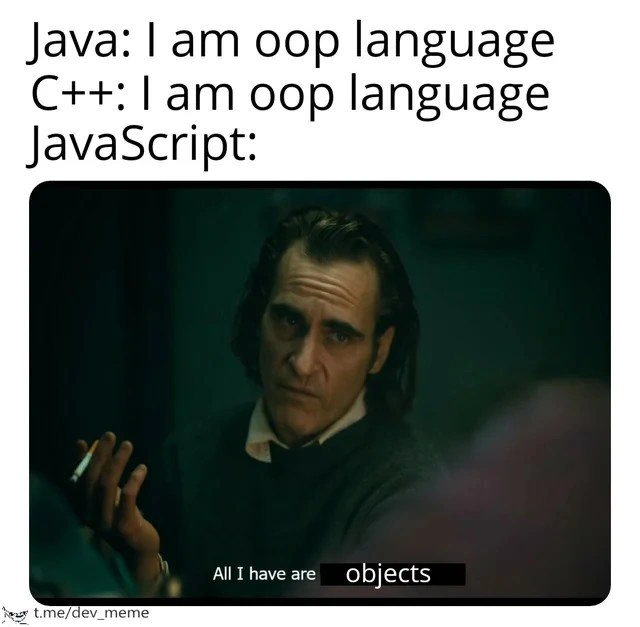
In this meme’s scenario, we witness an OOP brag-fest straight out of a developers’ forum. Java flexes first: “I am OOP language.” And it’s not lying – Java was built from the ground up to be object-oriented (every piece of code in Java resides inside a class; even the main method lives in a class). Next, C++ pipes up: “I am OOP language.” C++ has the chops to say that – it introduced classes and objects on top of C back in the 1980s, and it supports fancy OOP features like inheritance, polymorphism, and even multiple inheritance (with enough compiler magic to juggle those virtual tables). They’re basically in a pride contest over who’s the more object-oriented programming heavyweight. Then comes JavaScript, with an awkward pause represented by just its name and a blank line… and finally a defeated confession: “All I have are objects.” The punchline, shown in the movie subtitle, twists a serious line from the film Joker into developer humor. JavaScript here is portrayed like the Joker character, holding a cigarette in a dim room, lamenting despairingly that it only has objects. It’s a perfect comedic contrast: Java and C++ boast about their grand class systems, while JavaScript, the odd one out, responds with a smoke-and-sigh “all I have are objects.”
For seasoned devs, this hits on the longstanding languageComparison/languageWars trope: each language community likes to brag about its strengths. Java folks often tout “pure OOP” (ever heard a Java guru say, “100% pure Java, everything is in a class, no exceptions!”?). C++ developers might brag, “We have OOP and we can go low-level when we want – we’re the real deal!” Meanwhile, JavaScript has been the butt of jokes for not having “real” classes (at least until recently) and for its quirky prototype system. This meme perfectly captures that dynamic. It’s funny because it’s true: originally, JavaScript didn’t have a class keyword or formal classes at all. It uses prototype-based inheritance, which means instead of defining a class and making instances, you either literally create an object or define a constructor function and then JavaScript internally uses a prototype object to share methods. As a result, older JS codebases and tutorials were full of patterns like:
// A "class" in pre-ES6 JavaScript was just a function...
function Animal(name) {
this.name = name;
}
// ...with methods assigned to its prototype:
Animal.prototype.speak = function() {
console.log(this.name + " makes a noise.");
};
let dog = new Animal("Fido");
dog.speak(); // Fido makes a noise.
No classes anywhere – just functions and objects. The meme exaggerates this reality: JavaScript literally has nothing but objects (and primitives) to work with. Everything is an object in JS in one way or another. Functions? Yep, functions are first-class objects (you can pass them around, and they have properties like .call and .bind). Arrays? Definitely objects (an array in JS is just an object with numeric keys and some special handling). Even the prototypes themselves are objects. Need to create a new “type” of thing? In classic JS you’d make an object that serves as a prototype for others, or use a constructor function as shown. There was no built-in notion of a class constructor as a separate entity like in Java/C++. This gave JavaScript a reputation of being an OOP imposter in some circles and fuel for countless languageQuirks jokes.
The subtitle in the image, “All I have are objects,” nails the language_identity_crisis vibe. JavaScript is like a developer at a party where Java and C++ are bragging about their pedigreed OOP family trees (classes, inheritance, the whole aristocracy), and JS looks down at its hands (full of generic objects) and feels inferior. It’s comedic anthropomorphism of programming languages. Those who have suffered through the oop_purity_debate get the joke – some purists used to question “Is JavaScript even truly OOP?” because it lacked classes. JavaScript’s answer in the meme is a self-deprecating yes, but all I’ve got are these objects. It’s the equivalent of saying, “I don’t have fancy formal structures, I only have this one thing, but I guess I make do.” Seasoned devs also recall how this gap led to workarounds: before 2015, if you wanted that class feel in JS, you either used verbose prototype patterns or a transpiler (like using TypeScript or Babel to simulate classes). The community even introduced pseudo-classical frameworks and patterns (remember trying to emulate inheritance in JavaScript by chaining prototypes or using .call to pseudo-invoke a superclass constructor?). All that drama because JavaScript had no class keyword for two decades!
There’s a layer of irony here too that senior devs appreciate: In 2015, ECMAScript 6 finally introduced the class syntax in JavaScript. So nowadays you can write class Car { constructor(model) { this.model = model; } } in JS. But guess what? It’s essentially syntactic sugar – under the hood, it’s still doing the same old prototype-based mechanics. A JavaScript class is actually a kind of function (meaning it’s an object!) and its methods live on – you guessed it – the prototype. For example:
class Person {
constructor(name) { this.name = name; }
greet() { console.log("Hi, I'm " + this.name); }
}
typeof Person; // "function" <-- a class in JS is actually a function
Person.prototype.greet; // the function definition of greet lives on the prototype
Person.newProperty = 42;
console.log(Person.newProperty); // 42, we can add properties because it's an object
So even when JavaScript tries to dress up as a class-based language, it can’t hide its true nature: all it has are objects pretending to be classes! This is hilarious to those of us who know the backstory. It’s like JavaScript showed up to the OOP party wearing a “class” costume to fit in, but everyone who knows it can see it’s the same ol’ JavaScript underneath. In practice, that means you get weird quirks that wouldn’t happen in true class languages. (Even null gets treated like an object in JavaScript – typeof null famously returns "object" due to a historical bug. It’s as if JavaScript is so object-obsessed that it even labels “nothing” as an object by mistake!)
All these nuances are why the meme resonates among developers. It’s poking fun at languageWars bravado and the languageQuirks of JavaScript. The humor works on multiple levels: the surface-level absurdity (“poor JavaScript, so many objects, so little class”), and the deeper truth that JavaScript’s prototype_based_inheritance is fundamentally different from what Java/C++ do. It’s the classic scenario of one friend bragging, “I have an entire toolbox of fancy tools,” the second friend adds, “Oh yeah, me too, plus a laser-guided wrench,” and then the third friend (JavaScript) shrugging, holding up a Swiss Army knife saying, “All I have is this one multi-tool.” Developers laugh because we’ve seen this play out in countless flame wars and tech discussions. And secretly, we know that multi-tool (JavaScript’s single mechanism of objects) is surprisingly powerful – but it sure sounds pathetic when you phrase it that way in a brag contest!
Level 4: Class Warfare and Prototype Rebellion
At the deepest level, this meme highlights a fundamental object-oriented programming (OOP) schism: class-based vs prototype-based object models. Historically, classes entered the scene in the 1960s with languages like Simula (the first OOP language) and later Smalltalk – in these systems, classes are blueprints that define objects. Java and C++ proudly continue this classical OOP tradition. They have explicit class definitions (e.g. class Dog { ... }) that act as a Platonic ideal of an object, from which concrete instances are created. In contrast, JavaScript comes from a different lineage. Influenced by the experimental language Self (a pioneer of prototype-based inheritance in the late ’80s), JavaScript abandoned the idea of a formal class blueprint – every object can directly inherit from another object. There’s no abstract class template at runtime, just objects linked to other objects, like a big family tree with no ancestral “class” at the top, only a primordial Object.prototype.
This difference is more than syntactic – it’s almost philosophical. In class-based systems, the type of an object is tied to its class, and the structure is locked in by the class definition (especially in compiled languages like C++ where the compiler knows the class layout in advance). In prototype-based systems, objects are malleable; new properties or methods can be added on the fly, and inheritance is a matter of one object delegating to another. The meme’s line “All I have are objects” captures JavaScript’s existential crisis: it lacks the class construct that Java and C++ brag about, yet it embodies a form of OOP that’s in some ways more pure. In classic Smalltalk (a pure OOP language), everything is an object – even classes themselves are objects (metaclasses). JavaScript cheekily mirrors that ideal by eschewing classes entirely: functions, arrays, and of course objects, all are objects in JavaScript’s world (indeed, a JavaScript class is actually just a function under the hood). This leads to long-standing oop_purity_debate in academic and developer circles: what truly makes a language object-oriented? Alan Kay (who coined “OOP”) emphasized objects and messaging over class taxonomy. By that measure, JavaScript’s prototype-led model – where objects directly talk to each other – is arguably closer to OOP’s original spirit than Java’s strict class hierarchy! It’s an ironic twist: the “less orthodox” language might uphold the “everything is an object” mantra more literally than the class purists do. No wonder JavaScript sometimes seems to have a language identity crisis. It’s caught between being dismissed as a “toy” in serious OOP brag fests and secretly thinking, “Maybe I’m the most object-y of you all.”
Digging even deeper, this class vs prototype contrast has real implications for language design and developer experience. C++ and Java use class-based inheritance which provides structure and compile-time type checking (in C++ you get features like multiple inheritance, in Java you get a single-inheritance + interfaces model). These languages enforce an architecture: you define clear taxonomies of classes (Animal -> Mammal -> Dog, etc.), and you can reason about objects via their class types. JavaScript, on the other hand, implements inheritance by delegation: each object has a hidden link (its prototype) to another object, forming a prototype chain for property lookup. This yields great flexibility – you can modify or replace prototypes at runtime – but it confuses folks expecting a classical taxonomy. For example, there’s no built-in concept of “class type” in older JS; any object that quacks like a Duck is a Duck (if it has properties/methods, that’s enough). This duck typing approach means JavaScript’s object system is dynamically introspective and adaptable, but it lacks the comfort (or constraints) of formal class definitions. Seasoned engineers recognize that these two OOP models represent a “class warfare” of paradigms: one side prioritizes rigorous structure and type hierarchies, and the other prioritizes flexibility and simplicity of just using raw objects. The humor of the meme lies in how this deep-seated paradigm clash is personified: two proud class-based languages strutting, and one prototype-based language in a smoky corner, wryly acknowledging the only thing it truly owns – objects. (It’s almost poetic – or at least, it’s computer science poetry 🙂.)
Description
A three-line text setup contrasts two programming languages with a third, followed by a reaction image. The text reads: 'Java: I am oop language', 'C++: I am oop language', 'JavaScript:'. The image below is a still of Arthur Fleck (the Joker, played by Joaquin Phoenix) from the 2019 film 'Joker'. He has a serious, slightly melancholic expression and is holding a cigarette. A subtitle at the bottom has been edited to read, 'All I have are objects'. This meme uses the 'All I have are negative thoughts' format. The technical joke contrasts classic object-oriented programming (OOP) languages like Java and C++ with JavaScript. While the former have strict class-based structures, JavaScript is famously prototype-based, where almost everything - from functions to arrays - is fundamentally treated as an object. The Joker's persona of embracing a seemingly chaotic reality is used here to personify JavaScript's all-encompassing and flexible object model

Comments
7Comment deleted
Java and C++ build their worlds with carefully architected classes. JavaScript just throws a bunch of objects in a room and calls it a 'prototype chain party'
Java and C++ debate Liskov; JavaScript exhales, “My inheritance plan is to point __proto__ at whoever looks stable today.”
JavaScript's OOP is like explaining to stakeholders why your microservice architecture has 47 different ways to create an object but still can't properly encapsulate private state without WeakMaps and closures
JavaScript walks into a bar and says 'I'm object-oriented!' Java and C++ look up from their carefully architected class hierarchies and reply, 'You're just a bunch of objects held together by prototype chains and duck typing.' JavaScript shrugs: 'At least I don't need a factory factory factory to instantiate a simple object.'
JavaScript’s OOP is basically Object.prototype adopting everything, with ES6 "class" as HR paperwork
JavaScript's 'classes'? Syntactic sugar over prototypes - because real OOP would ruin the chaos we secretly love
Java: classes; C++: vtables; JavaScript: a hash map with dreams - OOP via prototypes until someone changes an object’s shape and V8 deopts