Skip to content
DevMeme
975 of 7435
GitHub's Security Alert vs. My Abandoned Project
Security Post #1097, on Mar 5, 2020 in TG

GitHub's Security Alert vs. My Abandoned Project

Why is this Security meme funny?

Level 1: Sleeping Through the Alarm

Imagine you have an old toy or gadget you haven’t played with in years. It’s been sitting forgotten in your closet. One day, a loud alarm goes off or someone runs in yelling, “Oh no! There’s a problem with your toy! It could be dangerous if you don’t fix it right now!” Normally, if it were a toy you still play with every day, you’d be worried and maybe rush to fix it. But in this case, you’re cozy on the couch, wrapped up in your favorite blanket, just staring blankly and thinking, “Eh, I haven’t touched that toy in forever. Why should I get up now?” You feel super relaxed and not bothered at all.

The meme is funny because it’s like an alarm clock ringing on a day off. The alarm (that’s GitHub’s warning) is loud and sounds urgent, but the person who hears it (the developer with the old project) just yawns and goes, “I’m not getting up for that.” In other words, the computer is telling the programmer, “Hey, there’s a big problem!” but the programmer is treating it like a false alarm, since the project is so old and unused. It’s the contrast between something that seems really important and someone who really doesn’t care. We laugh because we know the feeling of being comfy and ignoring an alarm that doesn’t matter – just like staying in bed when you know you don’t have school.

Level 2: Old Repo, New Worries

Let’s break down the scenario in simpler terms. On the left side, GitHub (a popular website where developers store and share code using version control called Git) is warning the developer about a security vulnerability in their project. GitHub has a built-in feature (often powered by a bot named Dependabot) that automatically checks your project’s dependencies – these are the external libraries or packages your project uses – against a database of known problems. When it finds a match (for example, a known bug or security hole in one of those libraries), it sends you a security alert. This usually appears as a message on the repository page or an email saying something like, “✋ Hey, one of your project’s libraries has a known issue that could let hackers harm your project. You should update it to a safe version.” It’s basically GitHub being a responsible housekeeper, telling you that some component in your software has termites and needs fixing.

Now, the right side shows “my project which hasn’t been touched in three years.” This means the developer wrote some code a while ago – three years is a long time in software! – and then stopped working on it. Maybe it was a side project (like a small app or a fun experiment) that they finished or lost interest in. For three years, no updates, no changes – the project is essentially abandoned or archived. In software, when we say legacy code or a legacy project, we often mean something old that isn’t actively maintained anymore. Over time, things around that code change: new versions of languages come out, libraries get updates, and importantly, security issues might be discovered in those old libraries.

So what happened? Likely, in those three years of inactivity, one of the project’s dependencies (say it was using a library to handle web requests, or a framework for a user interface) was found to have a CVE (Common Vulnerabilities and Exposures) entry – basically a registered security bug. For instance, imagine the project was using SomeLibrary 1.2.3, and in year 3 someone finds a serious bug in SomeLibrary that could let hackers do bad things (like crash the app or take control of it). That bug gets an ID (like CVE-2020-1234) and everyone is advised to upgrade SomeLibrary to version 1.2.4 where the bug is fixed. GitHub hears about this (they pull in data from security databases) and checks all the repositories to see who’s using the vulnerable version 1.2.3. Aha – this three-year-old project is one of them! 🚨 Alert time. GitHub pops up with “there’s a security vulnerability.” It even might offer a suggestion: “upgrade to SomeLibrary 1.2.4 to fix it.” Sometimes, Dependabot will go so far as to open an automatic pull request with the updated version change, essentially doing the first step for you.

Now here’s the comedic mismatch: The developer receives this alert about their old project and their reaction is basically 😑. The right panel’s person wrapped in a blanket, staring at the phone, perfectly captures that vibe of “...and I should care because...?” The project is sitting there like a sleepy cat that hasn’t moved in ages. No new features, no users, nothing. In all likelihood, the developer isn’t actively monitoring it or planning to update it – it’s just sitting on GitHub because, why not? Maybe a few people have starred it or it was a portfolio piece, but it’s not a live app running anywhere that would make this vulnerability dangerous.

For a newer developer, here’s why this is humorous: GitHub’s alert is very serious-sounding – words like “security vulnerability” can be scary. It’s like an alarm bell ringing, suggesting there’s an emergency with your code. You might imagine hackers poised to pounce on your project’s weakness. Normally, for a maintained project, you’d rush in to fix it: update the library, test everything, and push out a patch. That’s what you’re supposed to do to keep software safe and secure. However, in this meme, the project is long abandoned. The developer hasn’t cared about it for years, implying probably nobody is really using it either. So the developer is essentially ignoring the alarm.

It highlights a common situation in development: dependencies need updates, but if a project is no longer important, those updates feel pointless. Most developers have at least one old project repo that they haven’t deleted – maybe it's on GitHub for posterity – and every once in a while they get a notification saying “hey, update this!” and they just sigh. Think of it like getting a recall notice for a car you don’t drive anymore, or an update notification for a game you stopped playing. It’s technically good to fix it, but you might not bother since you’re not actively using it.

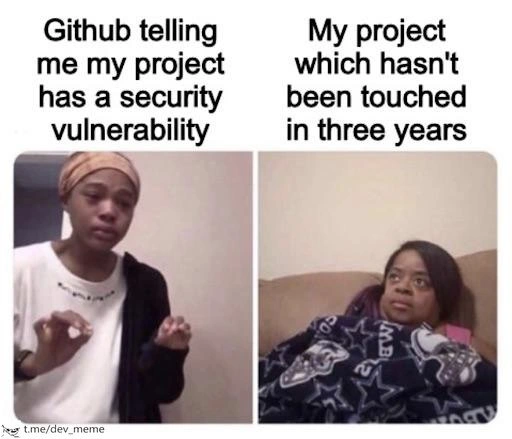
The meme’s text and images convey this perfectly. The left image (GitHub) is a person looking alarmed and urgent, hands up as if saying “Whoa, hold on, this is serious!” The caption directly says GitHub is telling me about a security issue – that’s the alarm part. The right image (the project) is a person totally wrapped up comfortably in a blanket with a blank stare at the phone. She looks completely unimpressed and in no hurry to move, which is exactly how an untouched project “feels” – inert, lifeless, not responding to stimuli. The caption about the project not being touched in three years emphasizes the lack of activity. So we have an active, almost panicky messenger on one side versus a lazy, couldn’t-care-less recipient on the other.

In simpler terms, this is poking fun at the tension between security and maintenance. On the one hand, modern development tools (like GitHub) encourage us to always keep things up-to-date and safe. On the other hand, developers know you can’t spend time on every little thing – especially not on projects that are effectively done and shelved. It’s a bit of an inside joke among programmers: “Yeah, I see that security warning… I’ll get around to it, maybe… or not.” It’s funny because it’s true – we know we’re being a little negligent, but pragmatically, it probably doesn’t matter for an unused project. The meme format (urgent person vs. comfy blanket person) dramatizes this everyday developer scenario in a way that’s instantly recognizable and laughable to anyone who’s been there.

Level 3: Stale Code, Fresh CVEs

The humor here hits seasoned developers right in the technical debt. We have GitHub (via its ever-vigilant security alerts) dramatically warning about a dependency vulnerability in a repository that’s been collecting digital dust for three years. It’s essentially an automated panic attack over code that’s long past its prime. Experienced devs immediately recognize this situation: you push some side project to GitHub, move on with life, and years later Dependabot barges in like an over-eager security guard shouting about a newly discovered flaw in library-x 1.2.3 from 2017. The left panel’s startled person is GitHub’s alert system, breathlessly informing you “Critical security issue detected! Update now!” Meanwhile, the right panel – the project wrapped in a blanket – represents your abandoned legacy code barely reacting, much like a catatonic zombie. It hasn’t had a commit since the Obama administration, and suddenly it’s front-page news in your inbox.

Why is this funny to experienced devs? Because it’s so relatable. We’ve all had that ancient side project or old work repository we haven’t touched in ages, yet the automated scanners treat it like a ticking time bomb. The absurd contrast is clear: GitHub’s security notice is urgent and alarmist, while the project (and by extension, the developer) is utterly indifferent. It’s the classic battle of security vs. reality: the ideal says “patch every vulnerability, no matter how old”, but the realist in us chuckles and says, “That project is basically a fossil – who is even going to exploit this?” It’s like GitHub is screaming about a door left unlocked in a house that’s already been abandoned and condemned.

There’s a layer of dark truth here: unmaintained software does accumulate vulnerabilities over time, a form of interest on technical debt. Each year of neglect is like another layer of dust where bugs and CVEs hide. In an enterprise setting, leaving those alerts unresolved would be a big no-no – security teams would have a field day. But for a personal project that’s not in use, it’s hard to muster the motivation. Seasoned devs might joke that these security vulnerability emails are the new spam. “Oh look, another CVE in a project I forgot existed – how cute.” There’s even a term for this reaction: alert fatigue. After the 50th email about some moderate severity issue in an ancient dependency, you become jaded. The meme exaggerates this: GitHub is basically at DEFCON 1, and the code is practically comatose.

Real-world scenarios amplify the joke. Consider a web app you wrote years ago for fun, using an old version of Express or Django. You haven’t deployed or advertised it in forever, but GitHub now knows about CVE-2020-XYZ in that framework. Suddenly you get a bright yellow banner or an email: “High severity vulnerability found in your project!” For a split second your heart skips – Security issue?! – then you realize it’s that project. Cue the eye roll. If you open the details, it’s something like: “Upgrade from 2.4.1 to 2.4.2 to fix a Remote Code Execution flaw.” And you’re thinking: “I would… if I even remembered how this project works.” The code is so old it might not even run on modern systems without a lot of tweaking. The effort to update it (and ensure nothing breaks) far outweighs any benefit, since nobody is using it. Senior developers recognize this cost-benefit dilemma instantly. We’ve seen plenty of code that’s technically vulnerable but practically harmless because it’s tucked away where no malicious actor is ever going to find it – it’s not even deployed!

Another angle is the supply chain vulnerability aspect. Seasoned folks know that even an abandoned project can pose a risk if it’s a library others depend on or if the code gets reused. This is why GitHub is so persistent. They’re trying to preempt the next big exploit that starts in somebody’s neglected repository. The industry has been bitten by “left-pad” and other dependency dramas, so the bots don’t discriminate – active or inactive, they will warn you. That’s actually a good thing in principle, but it leads to comical moments like this meme. It’s the equivalent of a fire alarm blaring in an empty warehouse – very loud, very urgent, but essentially echoing to no one.

GitHub Dependabot: “⚠️ URGENT: Your project has a critical security flaw! Update now or all hell breaks loose!”
Me (glancing at a 3-year-old repo): Huh… noted. *rolls over under the blanket*

This tongue-in-cheek dialogue is exactly what the meme portrays. The developer’s indifference is almost heroic in the face of the bot’s panic. A battle-scarred engineer has probably had truly urgent 3 AM production pages, so a dire warning about an unused app barely registers. It’s not that we don’t care about security – we do, deeply – it’s that we triage. And an old project that “hasn’t been touched in three years” is at the very bottom of the priority list. In fact, many of us intentionally archive such repositories on GitHub once we’re done with them, precisely to stop the nagging alerts (and to signal to others “here be dragons, and they’re sleeping”). The meme nails this conflict between best practices (always update!) and real-world pragmatism (if it ain’t broke and nobody’s using it, do I really need to fix it?).

Ultimately, experienced devs laugh because they know this scene too well. It ridicules the daily guilt-trip emails from GitHub about things we know we “should” fix but realistically never will. It’s shared camaraderie over the ever-growing backlog of “someday/maybe” fixes. We’ve all been the person under that blanket at some point, responding to an automated security scare with a shrug and a “meh, not today.” This meme lets us laugh at that little shameful secret – that sometimes, ignoring the problem (or at least postponing it indefinitely~~, which often means forever~~) is our default response when the code is that old and our coffee is aimed at more pressing fires.

Description

This is a two-panel meme that contrasts a sense of urgency with apathy. The left panel is labeled 'Github telling me my project has a security vulnerability' and shows a young person with an orange bandana gesturing seriously, as if explaining something critical. The right panel is labeled 'My project which hasn't been touched in three years' and features a young woman tucked into a couch under a blanket, looking completely unbothered and staring into the distance. This meme humorously captures the developer experience of receiving automated security alerts, such as those from GitHub's Dependabot, for old, abandoned projects. While the notification is technically important, it's practically irrelevant for a codebase that is no longer maintained, used, or deployed, leading to the indifferent reaction depicted

Comments

7
Anonymous ★ Top Pick My project's only user is the Dependabot scanner, so the biggest risk is the vulnerability getting its feelings hurt from being ignored
  1. Anonymous ★ Top Pick

    My project's only user is the Dependabot scanner, so the biggest risk is the vulnerability getting its feelings hurt from being ignored

  2. Anonymous

    GitHub: “Critical lodash RCE in your repo.” Me: “If someone can resurrect a Node 6 build wired to Grunt and Bower, they’ve earned the remote code execution.”

  3. Anonymous

    That todo app from 2021 with 47 critical vulnerabilities is now perfectly secure - it's achieved the ultimate defense-in-depth by having dependencies so old that modern attack vectors haven't been invented yet

  4. Anonymous

    Ah yes, the classic Dependabot notification for that React 16 project from 2021 with 47 critical vulnerabilities in lodash 4.17.15. Sure, I'll get right on updating those dependencies - right after I migrate from Webpack 4, update Node from v12, fix the breaking changes in three major versions of every package, rewrite the entire build pipeline, and somehow remember what this project even does. Or, hear me out: we could just let it rest in peace in its private repo, where the only threat actor is my own guilt when GitHub sends the 127th security alert this quarter

  5. Anonymous

    CVSS 9.8 alert on an archived toy service; remediation is upgrading a transitive chain that drags React 16->18 and Webpack along, so the only thing we ship is a 'risk accepted' ticket

  6. Anonymous

    Dependabot is the only engineer still assigned to that 2019 service - its job is to remind me our attack surface has better uptime than the app ever did

  7. Anonymous

    GitHub security alerts: the only thing commit-ing to your three-year-dormant repo

Use J and K for navigation