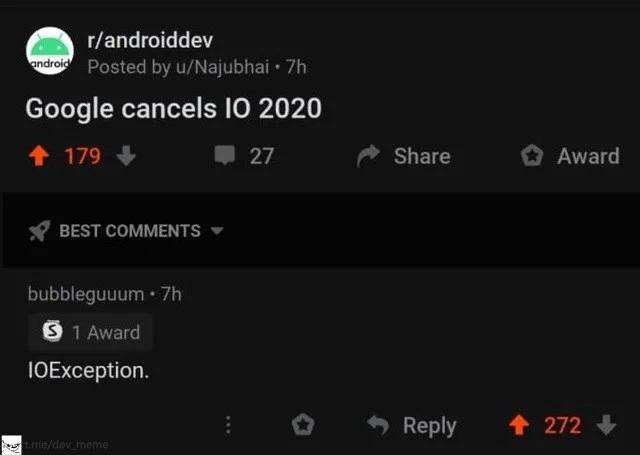
Google cancels I/O 2020, devs immediately label it an IOException
Why is this Google meme funny?
Level 1: Nerdy Wordplay
Imagine your school plans a big science fair, but it gets canceled at the last minute. Your friend who loves computers might joke, "Error: ScienceFairException!" It's a silly way of using a computer error phrase to describe a real-life cancellation. Here, Google had an actual big tech event called "I/O 2020" that got canceled. I/O in computer talk means "Input/Output" (basically the process of reading and writing data). When a computer can't do its input/output properly, it throws an error called an IOException (I/O exception). So a programmer joked that Google canceling the "I/O" event was like the world having an "IOException" error. It's funny because the developer turned a normal news announcement into a programmer's joke. They gave the cancellation a quirky label as if our reality were a computer program that hit a snag. Even if you don’t code, you can sense the wordplay: something named "I/O" was stopped, and the reaction was to call it an "I/O error." It's a little bit of geeky humor that made a lot of tech folks smile.
Level 2: Input, Output, Oops
Google I/O is the name of Google's big annual developer conference. (The "I/O" in the name hints at Input/Output, a core concept in computing, which is a fitting nod for a tech event.) In 2020, Google I/O was unfortunately canceled – no big announcements or gatherings that year for the Android and Google developer community.
Meanwhile, in programming, an exception is what we call an error or unexpected problem that can happen while a program runs. Java, the language behind many Android apps, has a specific exception class named IOException. This stands for "Input/Output Exception" and it gets thrown whenever some input/output operation fails. For example, if your code tries to read from a file that doesn't exist or fetch data from the internet but the connection is broken, Java will throw an IOException to signal that hey, something went wrong with the data input/output!
To handle such errors, developers use exception handling with try and catch blocks. For instance:
try {
// Attempt to open a file or network connection
readDataFromFile("config.txt");
} catch (IOException e) {
// This code runs if an I/O error happens
System.err.println("Oops, an I/O error occurred: " + e.getMessage());
}
In the code above, if the readDataFromFile call fails to find the file or read from it, it will throw an IOException. The catch block catches that exception and lets the program continue gracefully (here we simply print an error message). Java forces you to either handle or declare this kind of exception because issues with input/output are common and important to address.
Now, about the joke: when Google I/O 2020 got canceled, a developer on Reddit responded just with IOException. Why? Because "I/O" (the event) didn’t happen – in other words, the input/output operation failed – which is exactly what an IOException represents in code. It’s a clever bit of wordplay. They treated the cancellation as if it were a program crashing with an I/O error. The Android dev community, being very familiar with IOException from their coding life, immediately got the joke. The comment humorously labels the real-world news with a programmer's error term, and everyone who knows about exception handling in Java had a good chuckle. It’s a classic case of developers mixing tech terminology with everyday events, and it resonated so much that the joke comment became more popular than the news itself!
Level 3: When Life Throws Exceptions
For senior engineers, this joke hits right at the intersection of real life and code. Google canceling Google I/O 2020 instantly triggers a mental glitch for any seasoned developer: I/O, as in Input/Output... canceled? That sounds like an error! Indeed, one witty Android dev turned the news into a one-word punchline by commenting IOException. In coding terms, an IOException in Java is a checked exception indicating something went wrong with input/output operations. The pun is deliciously literal: the I/O event (the conference) failed to happen, so the world “threw” an I/O exception.
This works on multiple levels. I/O is the lifeblood of computing – reading files, making network calls, writing data – and when those operations fail, you get an IOException (like a file not found or a broken network pipe). Now a major event named "I/O" gets called off (due to forces outside, much like a real input/output interruption), and developers instinctively label it with the exact error they'd see in their logs if a crucial operation suddenly stopped. It's a perfect naming collision between tech jargon and reality. The comment resonated so strongly that it earned more upvotes than the announcement itself, a testament to how developer humor can turn disappointment into collective nerdy laughter.
For Android developers (many of whom cut their teeth on Java), IOException is a familiar frenemy. They've written countless try/catch blocks to handle failing network calls or missing files, always bracing for that dreaded error. Seeing a real-world "I/O" canceled felt uncannily appropriate to express in code terms. It’s as if the cancellation was just another exception that needed handling. And in true dev fashion, the community handled it by sharing a laugh. One tiny piece of source code vocabulary encapsulated the whole situation: no conference input or output this year – error thrown, end of story. In practice, an unhandled IOException would crash your program; in this case, the conference was indeed “crashed,” but at least the programmers watching could chuckle and say, "Yep, got an I/O exception, better catch it next year!"
Description
The image is a dark-mode Reddit screenshot from r/androiddev. The original post header reads "Google cancels IO 2020" and shows 179 up-votes, 27 comments, plus share and award icons. Beneath a "BEST COMMENTS" banner, user "bubbleguuum" (with a silver award) replies "IOException." and that comment has 272 up-votes. The UI uses orange arrows, grey icons, and white text on a black background. Technically, the humor stems from developers treating the cancellation of Google’s annual I/O conference as the Java checked exception type IOException, a play on the shared acronym that resonates with Android engineers

Comments
6Comment deleted
Google pulled the plug on I/O 2020 after realizing it’d have to add `throws PandemicIOException` to every public API - easier to deprecate the whole method call
The one time we actually wanted Google to throw an exception in production, and they delivered perfectly
When Google cancels I/O, the Android dev community throws an IOException - because when your annual input/output event gets terminated unexpectedly, you need proper exception handling. At least this one came with a clear stack trace: 'Caused by: java.io.PandemicException: Conference stream closed prematurely.' The real tragedy? No amount of try-catch blocks could have prevented this one
A rare moment when a checked exception improved clarity: 2020 threw IOException and everyone immediately agreed to catch-and-cancel
Google IO canceled: the IOException where even exponential backoff couldn't reconnect the dev community
Google canceled I/O - circuit breaker opened; endpoint returned 503 Service Unavailable with Retry-After: 2021