Skip to content
DevMeme
589 of 7435
The Ideal Codebase vs. Its Eventual Reality
TechDebt Post #673, on Sep 18, 2019 in TG

The Ideal Codebase vs. Its Eventual Reality

Why is this TechDebt meme funny?

Level 1: Clean vs Messy Room

Imagine you start the week by cleaning your room until it’s absolutely perfect. All your toys are put away, the floor is clear, and everything looks just the way you want. You feel proud seeing how neat and just right it is. But then, as the days go on, you pull out toys and clothes and leave them around because you're busy playing or rushing off to school. By Friday, the room is a total mess — there are lego pieces and socks everywhere, and you can’t even see the floor under all that clutter! It’s the complete opposite of how tidy it was at the start. You have to laugh a bit, because you tried to keep it clean, but real life (and maybe a little laziness) got in the way. This meme is joking about the same kind of thing with a coding project: we hope our work will stay neat and orderly, but in reality it usually ends up a bit of a mess. And just like with your room, that’s okay — it’s normal for things to get messy, and you can always clean it up later. The funny part is simply seeing the huge contrast between our lovely plan and how it actually turned out, which is something everyone can recognize and smile about.

Level 2: Clean vs Messy Code

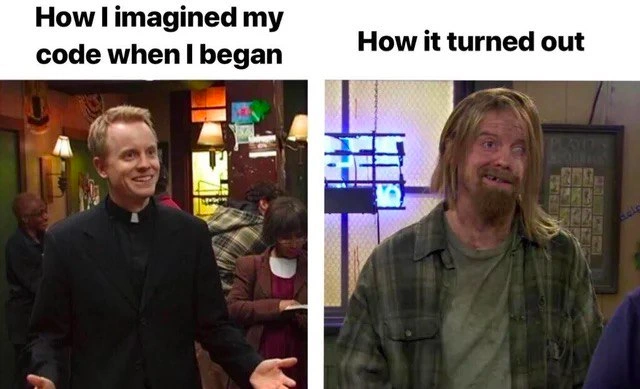
At the start of a project (or a school assignment), you probably imagine your code will be organized and clean. Clean code means code that is easy to read, well-structured, and maintainable — in other words, high code quality. In the meme’s left panel, the developer’s vision of his code is symbolized by that sharply-dressed, confident character (like someone who has everything in perfect order). This represents the hope that the program will be elegantly designed — everything in the right place, following all the best practices you've learned. For example, you plan to name variables clearly, split tasks into neat functions, and use sensible design patterns so the codebase feels pristine. That's the dream every developer starts with.

Now look at the right panel: the scruffy, tired-looking guy represents what the code actually ends up like after a while. Messy code (sometimes jokingly called "spaghetti code") is code that's full of tangled logic, quick-and-dirty solutions, and probably some confusing or repetitive parts. It's the result of many little compromises adding up over time. In reality, projects often face changing requirements and tight deadlines. You might begin with a clean solution, but then your boss or client asks for a new feature really fast. So you add it quickly, maybe cutting a corner or two. Do that dozens of times, and the code starts to lose its original tidy shape. Things that were supposed to be separate get all intertwined. Functions grow longer and harder to understand. The code still works, but inside it's not pretty anymore. In the image, the second character’s messy appearance perfectly captures that feeling of a codebase that’s been through a lot and isn’t in a glamorous state.

There are a couple of key terms developers use to talk about this situation. One is technical debt. Technical debt is a metaphor that compares quick-and-dirty coding to borrowing money. When you rush a feature or write sloppy code to meet a deadline, you're taking on "debt." It’s faster today, but later the code will be harder to modify or debug — you'll "pay interest" on that debt in the form of extra effort and headaches. Just like with real debt, the longer you wait to tidy the code, the more "interest" (problems) builds up. In a brand-new project, you have little to no technical debt because everything is still clean. But over time, as more hacks pile up, that debt grows and the code gets harder to work with. The meme is poking fun at how a once-clean project accumulates this debt and ends up looking a bit battered (much like the scraggly figure on the right).

Another important concept here is refactoring. Refactoring means going into existing code and improving its structure without changing what the code actually does. It's basically the act of cleaning up the code. For instance, if you have a very long, messy function, you might refactor it by breaking it into smaller functions, renaming variables to be clearer, or removing duplicate code. Good developers refactor regularly to keep the codebase healthy. In theory, after each new feature or fix, you would tidy up any mess you made. In practice, teams don't always get the time, so the code’s structure slowly decays. When you hear a developer say "we need to pay down our technical debt," they mean it's time to refactor the messy parts of the code that have built up. In the meme’s story, the developer imagined they'd keep polishing the code to stay perfect, but how it turned out is that those cleanup sessions didn’t happen enough, and the code ended up kind of shabby.

This meme is very relatable to anyone who has written software, even as a beginner. It highlights the classic expectation vs. reality of coding. Expectation: "I'm going to write super clean code and build a perfect app." Reality: after a few months, the code is held together with duct tape and // TODO: comments reminding you to fix things later. And you know what? That's normal. Building software can get messy, because requirements change and things evolve in ways you didn't expect. What's important is realizing that this happens to everyone and learning to improve the code when you get a chance. The joke here is a form of developer humor – programmers laughing at the fact that their precious code often ends up uglier than they intended (it's a way to stay sane and humble). From a developer experience point of view, it's obviously more fun and productive to work on a clean codebase than a chaotic one. But when things do get chaotic, at least memes like this remind us that we're not alone. All these concepts – code quality, clean code principles, technical debt, refactoring – really boil down to the same lesson: it's great to strive for clean code, but don't beat yourself up when reality intervenes. Just clean up what you can, when you can, and remember that every programmer has been on this same journey. That feeling of "hey, we've all been there" makes the situation easier to laugh about and learn from.

Level 3: From SOLID to Spaghetti

This two-panel meme hits way too close to home for seasoned developers. We all start new projects with lofty ambitions of pristine code and perfect architecture. In the left image, the well-groomed figure in clerical black represents that almost holy code ideal – our codebase as we imagined it would be: neatly layered, obedient to all the SOLID principles and every clean-code guideline, blessed by proper design patterns. You can practically hear the developer thinking, "I'm going to do everything the right way this time." But fast-forward through a few release cycles, and the right image is where we end up: a disheveled, weary-looking character that perfectly embodies the messy code reality after deadlines, hotfixes, and feature creep have had their say. The once-elegant structure has turned into "spaghetti code" (an industry nickname for tangled, hard-to-follow code, much like a bowl of twisted pasta). In short, our dream of a perfectly organized system degenerates into a patchwork of quick fixes and hacks. It's the classic developer expectations-vs-reality scenario: the gulf between initial design and final implementation that every senior engineer has learned to begrudgingly accept (and laugh about to stay sane).

Why does this descent from clean to chaotic happen so often? Quite a few familiar culprits are at play:

  • Feature Creep – New requirements keep coming, and many don't fit the original plan, so we bolt them on in whatever way possible.
  • Deadline Pressure – "Ship it now, we'll fix it later." Speed wins over elegance when the release date looms, leaving messy code in its wake.
  • Quick Fixes & Hacks – Bug in production? Just patch it ASAP! Each of those band-aid solutions solves the immediate problem but introduces inconsistency and technical debt.
  • Lack of Refactoring – We meant to go back and tidy up (honestly!), but there’s never enough time. Those promised cleanup sessions get postponed indefinitely as the next feature or fire takes priority.
  • Multiple Cooks – Over the life of the project, different developers come and go, each with their own style. Without strict code reviews or guidelines, the codebase becomes an eclectic mix of techniques and shortcuts.
  • Changing Expectations – The "perfect architecture" from day one might not even suit the product after it evolves. Instead of a complete redesign, we often just extend or bend the existing structure in unnatural ways.

The result? A codebase that works, but only by the grace of all those band-aid solutions holding it together. Functions that were once a tidy 20 lines long swell to 200+ lines of tangled logic. Clear module boundaries get blurred as one component starts reaching directly into another’s internals. Perhaps that strict layering you imagined (UI → Service → Database) turned into a free-for-all, where any piece of code can call any other piece directly because "it was just easier that way." We joke about needing holy water to exorcise our code, but deep down we know the only cure is a massive refactoring… which nobody has time for.

For example, consider a simple order-processing function. Initially, it might be beautifully straightforward:

# Pristine implementation as envisioned (clear, separate steps):
def process_order(order):
    validate(order)        # 1. Validate order data for correctness
    apply_discounts(order) # 2. Apply any promotional discounts
    save_to_database(order)
    send_confirmation(order)

But after countless urgent modifications, it ends up like this:

# Actual implementation after many quick fixes (messy and fragile):
def process_order(order):
    try:
        validate(order)
    except Exception:
        pass  # Swallow validation errors to avoid blocking orders with minor issues
    apply_discounts(order)
    if order.id is None:  # If order wasn't saved yet (new edge-case path)
        order.id = database.save(order)   # Direct database call (skips the intended abstraction layer)
        GLOBAL_LAST_ORDER_ID = order.id   # Using a global variable to track the last saved order (yikes!)
    send_confirmation(order, cc_support=True)  # Added a hack: always CC the support team on confirmation emails for now

Notice how the clean, logical flow devolved into a series of special-case checks and side effects. The updated version silently ignores errors (not great), introduces a global state (GLOBAL_LAST_ORDER_ID), and slips in a sneaky extra parameter to send_confirmation as a makeshift solution. These are all red flags for maintainability. Any one of those hacks might have been intended as a temporary measure, but in practice they often become permanent parts of the system. Once such code is running in production and making money (or at least not on fire), there's immense inertia against changing it. Future maintainers just sigh and work around the warts, and the codebase's health further deteriorates.

The humor here is a form of developer self-deprecation. We’re basically poking fun at our own tendency to start with pure intentions and end up creating the very kind of monster we swore to avoid. It’s a shared industry joke because literally every developer has been through this. You plan for immaculate code quality, but it feels like some law of nature drags your work toward chaos by the time it ships. Seasoned devs will chuckle (and maybe groan) at this meme because they've lived that transformation – from a greenfield "this time we'll keep it clean" mindset to, inevitably, wrestling with a gnarly legacy codebase full of odd quirks. The meme exaggerates it with a priest versus a scraggly drifter, but emotionally that contrast is spot-on. Maintaining a good developer experience (DX) in such an environment becomes tough: it's no fun navigating a maze of messy code. But at least we can commiserate. Everyone has their war stories of codebases that went from saintly to shabby, and that camaraderie in the absurdity makes the whole thing easier to bear (and to laugh about).

Level 4: Entropy Always Wins

Interestingly, under the lens of software engineering theory, this scenario feels almost inevitable. A codebase can be viewed as a complex system that tends toward increased entropy over time. In other words, just like physical systems drift from order to disorder (per the second law of thermodynamics), software tends to become more chaotic as more changes are introduced. Each new feature, bug fix, or quick patch injects a bit of disorder into the originally pristine structure. Without continuous effort (energy) to reorganize and refactor, the internal code quality will degrade. This phenomenon is so recognized that early software engineering research introduced the idea of software entropy: the notion that code will "rot" or lose its clean structure unless we actively keep it tidy. Over time, what began as a perfectly modular design can devolve into an unstructured tangle. The left panel’s "holy" ideal codebase represents a state of low entropy (high order), whereas the right panel's messy reality is high entropy (maximum disorder) incarnate.

In fact, there are unofficial laws and principles in our field that predict exactly this outcome. One of Lehman's Laws of Software Evolution states that as a program evolves, its complexity increases unless explicit work is done to reduce it. In practice, that means a project that isn't constantly refactored will accumulate complexity like barnacles on a ship. Another concept, technical debt, was coined by Ward Cunningham to describe how taking shortcuts in code is like borrowing against the future — interest accrues in the form of harder maintenance and refactoring pain later on. Initially, you may have envisioned a clean architecture following best practices (perhaps even dreaming of SOLID design principles and a flawless layered separation). But as expedient decisions pile up, the system’s design often morphs into what engineers ruefully call a "Big Ball of Mud" — an ad-hoc, sprawling mass of tightly coupled code with no clear structure. This isn't just poetic imagery; "Big Ball of Mud" is actually the tongue-in-cheek name of a well-known architecture anti-pattern identified by Foote and Yoder, describing exactly this kind of outcome. From a high-level viewpoint, the meme humorously illustrates a nearly law-like rule of complex software systems: without vigilant upkeep, clean code principles give way to entropy, and the once-elegant architecture inevitably ends up a tangled mess.

Description

A two-panel 'expectation vs. reality' meme. The left panel, captioned "How I imagined my code when I began," shows the character Rickety Cricket from 'It's Always Sunny in Philadelphia' as a clean-cut, well-dressed priest, symbolizing a pristine and orderly codebase. The right panel, captioned "How it turned out," depicts the same character in a later season, now completely disheveled, with matted hair, a scraggly beard, and dirty clothes, representing the codebase after accumulating technical debt, patches, and unforeseen complications. The meme humorously illustrates the inevitable degradation of software projects over time, a concept deeply familiar to experienced developers who have witnessed elegant initial designs decay under the pressures of deadlines and shifting requirements
Comments

7
Anonymous ★ Top Pick Every new project starts as a cathedral of elegant design. Six months later, it's more like a Winchester Mystery House of dependencies, held together by one critical script nobody dares to touch
  1. Anonymous ★ Top Pick

    Every new project starts as a cathedral of elegant design. Six months later, it's more like a Winchester Mystery House of dependencies, held together by one critical script nobody dares to touch

  2. Anonymous

    I set out to build a cathedral of SOLID abstractions; six prod hotfixes later it’s a roadside shrine of singleton globals, feature-flag duct tape, and whispered git-blames

  3. Anonymous

    The left side is your architecture diagram during the design phase; the right side is the same diagram after three years of "temporary" workarounds that became load-bearing

  4. Anonymous

    Started with dreams of elegant design patterns and SOLID principles. Now I'm just grateful when the monolith doesn't fall over during deployment and the 15-year-old stored procedure still compiles. The real architecture was the technical debt we accumulated along the way

  5. Anonymous

    Planned ports-and-adapters; shipped ports-and-prayers - a feral monolith whose “bounded contexts” are feature flags and 2 a.m. cronjobs

  6. Anonymous

    Envisioned a SOLID cathedral of code; erected a Big Ball of Mud with artisanal regex duct tape

  7. Anonymous

    Started with SOLID + hexagonal, ended with a Big Ball of Mud behind a feature flag called "temporary" that's been on since 2019

Use J and K for navigation