Skip to content
DevMeme
521 of 7435
JavaScript's 'twenty-minute' adventure into everything
Languages Post #599, on Aug 20, 2019 in TG

JavaScript's 'twenty-minute' adventure into everything

Why is this Languages meme funny?

Level 1: Quick Trip, World Tour

Imagine your friend says, “I’m just stepping out to grab some milk. I’ll be back in 20 minutes.” But instead of a quick errand, they end up traveling around the whole world and return home months later with souvenirs from every country! It’s silly and unexpected, right? Something that was supposed to be small and simple turned into a huge adventure.

That’s the joke of this meme. At first, creating JavaScript was like a small errand – just a little language to make web pages do simple things. But in reality, JavaScript went on a world tour in the tech world: now it’s used for making websites, servers, phone apps, desktop apps, even doing AI stuff. The meme makes us laugh because Rick’s “twenty-minute plan” grew into something much bigger than anyone imagined. It’s as if a tiny idea kept growing and growing into a giant project. Even Morty (the kid in the cartoon) is standing there like, “Whoa, that escalated quickly!” The humor comes from that huge gap between the tiny thing they planned and the huge thing it became. In simple terms: a little idea went on an epic adventure, and we’re all amused and amazed by how far it went.

Level 2: JavaScript Everywhere

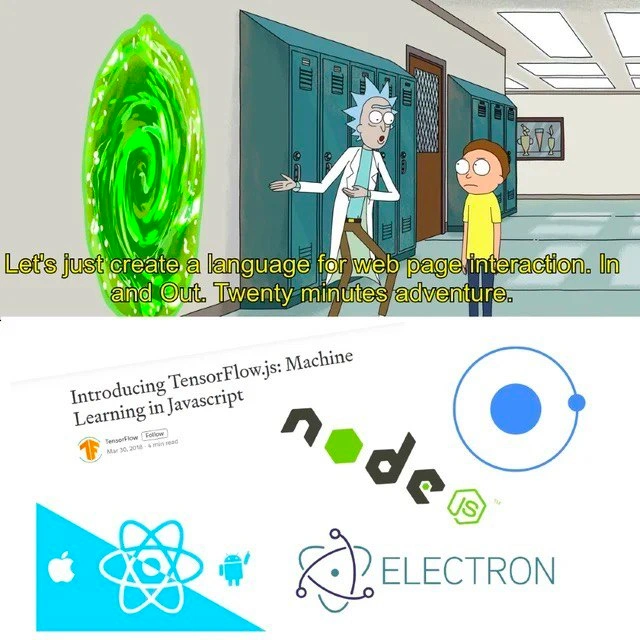
In the top panel of the meme, Rick (the scientist from the cartoon Rick & Morty) says, “Let’s just create a language for web page interaction. In and Out. Twenty minutes adventure.” He thinks it will be a quick, simple job. This refers to how JavaScript was originally created just to make web pages interactive, and everyone thought it would be a small, limited thing. In the mid-90s, JavaScript’s job was to do little tricks in the browser: validate a form without needing a page reload, show a pop-up message, change an image when you hover your mouse – small stuff to make static HTML pages feel alive. It was a lightweight scripting language meant only for the browser (the front-end of websites that runs on your computer when you visit a page). They truly expected it to be an easy, limited project – a “twenty-minute adventure,” so to speak.

The bottom panel shows the surprise twist: that “quick script” language ended up growing into an entire ecosystem far beyond web pages. The collage of tech logos and the TensorFlow.js headline represent all the places JavaScript ended up being used:

  • JavaScript: This is the programming language itself. Originally it ran inside web browsers. Now, thanks to new tools, it can run in many places.
  • Node.js: Node.js lets JavaScript run on a server, not just in a browser. This means you can use JavaScript to write the back-end part of a website or service (the part that lives on a server and sends data to and from browsers). For example, with Node.js you can write a program that listens for web requests and responds, all in JS. Before Node, you would have to use a different language on the server (like Java, Python, or PHP) while using JavaScript in the browser. Node.js changed that by allowing full-stack JavaScript with one language on both client and server. It uses Google’s V8 engine (from the Chrome browser) under the hood to run JS very fast outside the browser environment.
  • React & Mobile (React Native/Ionic): React (the blue atom logo) is a popular JavaScript library for building UI components on web pages. But the meme shows Apple and Android icons next to it, hinting at React Native. React Native is a framework that lets you build mobile apps for iOS and Android using JavaScript (and React’s component model). In other words, instead of writing Swift for iPhone and Java/Kotlin for Android, you can write your app logic in JavaScript and have it work on both platforms. There’s also Ionic/Capacitor (represented by that circular logo) which is another technology that uses web code (JS, HTML, CSS) to create mobile apps. These tools mean that a web developer who knows JS can also create smartphone apps without learning an entirely new programming language.
  • Electron: This is represented by the Electron logo (it looks like an atom orbit). Electron is a framework for building desktop applications using web tech. With Electron, you write an app in HTML, CSS, and JavaScript – just like a website – and then package it as a desktop program that runs on Windows, Mac, or Linux. Electron basically wraps your web code in a mini Chromium browser and includes Node.js, so your app can do things regular web pages can’t (like access files on the computer). Apps like VS Code (the code editor) or Slack (the chat app) are actually Electron apps, which means behind the scenes they are powered by JavaScript. This is pretty wild if you think about it, because desktop apps were traditionally made with languages like C++ or C#. Now even those can be made with JS.
  • TensorFlow.js & Machine Learning: The meme shows a snippet of a Medium article titled “Introducing TensorFlow.js: Machine Learning in JavaScript.” This highlights that JavaScript has even moved into the AI/ML (Artificial Intelligence / Machine Learning) realm. TensorFlow.js is a library that allows you to define and run machine learning models (like neural networks) using JavaScript. Typically, machine learning tasks (such as training a model to recognize images or predict trends) are done in Python, which has libraries optimized for heavy math. But TensorFlow.js lets developers do some of these complex tasks in a web browser or in a Node.js environment, using JavaScript. It achieves this by leveraging things like WebGL (which lets browser code use the computer’s GPU for fast computations). The fact that you can do serious number-crunching and AI in JavaScript is a big surprise compared to what JS was originally meant for.

So, what does all this mean in simpler terms? It means JavaScript went from being a tiny tool for web pages to being everywhere in computing. Thanks to real technical improvements and a lot of developer excitement (and hype), JavaScript transformed from a niche web script into a ubiquitous platform. You can now use JavaScript for the front-end (webpages), the back-end (servers via Node.js), mobile apps (via React Native or Ionic), desktop programs (via Electron), and even for things like machine learning (via TensorFlow.js). The phrase “JavaScript Everywhere” really captures it — the language is used in almost every field of software development now.

This huge expansion did spark some language wars in the programming community. Fans of other languages, like Python or Java, sometimes argue that JavaScript isn’t the best choice for all these new areas (for example, Python enthusiasts might say, “Why use JS for machine learning when Python is tailor-made for it?”). There are debates about whether JavaScript is truly suitable for some of these tasks, because every language has its strengths and weaknesses. Despite the debates, JavaScript’s popularity and the convenience of using one language have led many people and companies to adopt it in all those areas anyway. In practice, if something can be done in JavaScript, someone usually goes ahead and does it.

For a junior developer or someone new to this field, the meme’s message is both cool and a bit crazy: JavaScript is everywhere, and does (almost) everything now. If you learn JavaScript, you aren’t limited to just making pop-up alerts on a webpage. You could end up writing code for a web server, or building the next Slack desktop app, or creating a mobile app, all with that same language. That’s empowering — it means your skill with JS can open a lot of doors. This idea of one language for the whole “stack” (front-end to back-end, and beyond) is what people mean by “full-stack JavaScript.”

The humor in the meme comes from how extreme this all is compared to the original plan. Rick’s line about a "twenty minute adventure" is ironic because we all know how often a "quick fix" spirals into something bigger. It’s like saying “I’ll help you move a couch, it’ll just take an hour,” and then it turns into an all-day house remodeling project. Here, JavaScript was the little helper for web pages that turned into a 20+ year grand adventure through the tech world. This is a classic case of scope creep – the scope (or extent) of the project kept expanding.

And with that expansion comes both excitement and some overwhelm. Developers talk about framework fatigue: the feeling of being exhausted by the constant stream of new JavaScript frameworks and tools to learn. One year it’s Angular, the next it’s React, then Vue, then a new one like Svelte… it can make your head spin, especially if you're just starting out. The meme’s bottom image, crowded with logos and arrows shooting in every direction, visually represents that overwhelm. It’s as if that simple “JS for a webpage” idea exploded into a big bang of countless libraries, frameworks, and uses.

In summary, the meme is saying: They thought JavaScript would be a quick, small thing (just for web pages), but look – it turned into a huge deal that’s now running everything! It’s funny because it’s true, in an exaggerated way. For new developers, it’s a reminder of how a tiny idea can grow unexpectedly, and also a hint not to underestimate JavaScript – it’s a much more powerful and far-reaching technology than it first appears. Plus, if you ever feel overwhelmed by how much there is to learn in the JavaScript world, just remember: even the people who created it had no clue it would get this big! That shared surprise is exactly what the joke is poking fun at.

Level 3: 20 Minutes, 20 Years

"Let's just create a language for web page interaction. In and Out. Twenty minutes adventure."

The top panel quotes Rick from Rick & Morty cheerfully planning a twenty-minute adventure – a quick, simple mission. This is a tongue-in-cheek Rick and Morty reference that parallels the birth of JavaScript. Back in 1995, JavaScript was invented in just 10 days as a lightweight scripting tool for basic frontend web page interaction. The idea was in-and-out, a minor addition to make webpages dynamic – essentially, "let's solve form validation and some image swapping, then we're done." Famous last words, right? Fast forward 20+ years, and that "20-minute" hack of a language has opened a portal to an entire universe of software. The meme humorously contrasts the naive optimism of JavaScript’s humble start with the sprawling reality of its language scope creep. Rick’s casual plan becomes a decades-long odyssey; likewise, a little browser script exploded into an everywhere language empire.

The bottom panel's collage illustrates just how far JavaScript has ventured beyond its original domain. We see logos and references to modern tech trends: Node.js (JavaScript on the server), Electron (JavaScript for desktop apps), React + mobile platform icons (JavaScript for native mobile apps via frameworks like React Native or Ionic/Capacitor), and even TensorFlow.js – yes, that’s machine learning in JavaScript. It’s essentially showing a web language invasion into all areas of computing. The single-purpose web page script has mutated into a do-it-all ecosystem:

  • Servers run on JavaScript (thanks to Node.js turning a frontend browser language into a backend workhorse).
  • Desktop applications are built with JavaScript and web tech (Electron bundling a browser engine to create cross-platform apps, from Slack to VS Code).
  • Mobile apps are written in JavaScript (via React Native bridging to iOS/Android, or hybrid apps using Ionic’s web view approach).
  • Even cutting-edge AI/ML tasks now have JavaScript incarnations (TensorFlow.js enabling neural networks in your browser, no Python required!).

Each one of these developments was driven by industry excitement and hype. The moment someone proved "Hey, we can do this in JS too!", the community sprinted through that portal. This reflects a real trend: the promise of a single language unifying development is alluring. Why juggle different technologies when one fullstack JavaScript approach can do it all? Companies loved the idea of writing code once and deploying it everywhere. It's the holy grail of productivity – in theory. This enthusiasm led to JavaScript frameworks and tools popping up for literally everything, a frenzy often dubbed FrameworkFatigue by weary developers. New front-end libraries, build tools, and runtime environments emerged at a breakneck pace. Today’s dev joke is "there’s a new JS framework every time you blink" – it’s funny because it feels true. The meme captures that absurd ubiquity: a language meant to handle a bit of DOM manipulation now powers AWS lambdas, desktop chat apps, and even machine learning models.

From a seasoned developer’s perspective, this is equal parts impressive and ironic. LanguageEvolution usually happens gradually, but JavaScript’s growth was like a chain reaction. Early on, many of us thought JavaScript was a toy – useful for making buttons click, but nothing serious. Then Node.js came around (circa 2009) and we witnessed a paradigm shift: “You can run JavaScript on a server?!?” It broke the wall between front-end and back-end. Around the same time, Google’s V8 engine and just-in-time compilation made JS fast enough to be taken seriously outside the browser. Once that floodgate opened, there was no going back. Ambitious projects started using JS for everything. Some of it was pragmatic (sharing one language across the stack), and some was pure hype-driven development (doing it because we can). We got desktop apps built on Chromium via Electron – essentially a website in an app’s clothing. People joked that Slack is just a fancy web page pretending to be an app (it pretty much is, running in an Electron wrapper). The LanguageWars flared up: developers of traditional server languages (Java, Python, Ruby) rolled their eyes or felt threatened as the JavaScriptEcosystem encroached on their turf. Suddenly, JavaScript vs Everyone was a hot debate. Is Node.js better than Ruby on Rails? Can a web scripting language handle enterprise-scale servers? Is it wise to train neural nets in a browser? Those discussions were heated throughout the 2010s. And yet, JavaScript kept winning mindshare, largely because of convenience and a huge pool of JS talent.

Perhaps the craziest twist was JavaScript invading the AI/ML space – traditionally dominated by Python and R. The meme specifically highlights a Medium headline: “Introducing TensorFlow.js: Machine Learning in JavaScript”. For many engineers, that headline was the peak of absurdity (or brilliance, depending who you ask). Just imagine telling a ’90s web developer that in the future, we’d train neural networks with the same language used to validate form input on Netscape. It sounds like sci-fi. But thanks to modern JS capabilities (and browser tech like WebGL and WebAssembly), you really can run serious MachineLearning directly in the browser or in Node. It’s both amazing and a bit comical – the ultimate example of JavaScript being everywhere. This is where the meme’s punchline lands: Rick’s trivial mission statement resulting in something massively overblown is exactly how JavaScript’s journey feels.

There’s a well-known saying in programming circles, Atwood's Law: "Any application that can be written in JavaScript, will eventually be written in JavaScript." This meme is a textbook illustration of that law. Over the years, we’ve seen JS used for scripting, then full applications, then servers, then desktop, and now even data science and machine learning. It's like an ever-expanding blob that assimilates every new platform (javascript_everywhere, indeed). Developers laugh at this because it rings true: no matter how absurd the domain ("surely you wouldn't use JS for that?"), someone eventually does. Part of the humor is also a knowing nod from veteran devs who remember countless "it’s just a quick hack" projects morphing into permanent, legacy systems. We’ve all underestimated scope, saying “it’s a small script” only to end up maintaining a massive codebase years later. This meme scales that experience up to the entire JavaScript ecosystem.

Finally, beyond the laughs, there's a bit of exhaustion behind the joke. The bottom collage implies an explosion of complexity. Each arrow and logo represents another thing a modern JavaScript developer is supposed to know. The one-time "simple scripting language" now has countless tools, frameworks, and use-cases. That’s the FrameworkFatigue talking – it’s funny because it's overwhelming. Every week there’s a new library or hot trend, and JavaScript’s once modest role just keeps expanding. The meme exaggerates it in a sci-fi cartoon way, but the underlying truth is familiar to anyone in web development: JavaScript’s “twenty-minute adventure” became a never-ending, multi-decade expedition into every corner of tech. And honestly, a lot of us didn’t see it coming this far, which makes the whole situation equal parts hilarious, ironic, and a little mind-boggling.

Description

A two-panel meme that uses the 'Rick and Morty 20-minute adventure' format to comment on the evolution of JavaScript. The top panel features Rick Sanchez saying, 'Let's just create a language for web page interaction. In and Out. Twenty minutes adventure.' to a worried-looking Morty, referencing a famous scene where a simple plan spirals into chaos. The bottom panel illustrates the chaotic outcome: a collage of logos representing the vast expansion of JavaScript's ecosystem beyond simple web interaction. This includes a blog post title 'Introducing TensorFlow.js: Machine Learning in Javascript,' and the logos for Node.js (backend), React Native (mobile apps, with Apple and Android icons), and Electron (desktop apps). The joke is that JavaScript, intended for simple scripting, has become a sprawling, complex universe of its own, fulfilling Rick's ironic prophecy of a simple task becoming an unexpectedly wild journey
Comments

7
Anonymous ★ Top Pick Brendan Eich in 1995: 'I'll just add some Scheme-like features to make the browser do cool things.' The universe, 25 years later: 'And now, for my next trick, I will use your creation to run a neural network inside a desktop application that's actually a browser.'
  1. Anonymous ★ Top Pick

    Brendan Eich in 1995: 'I'll just add some Scheme-like features to make the browser do cool things.' The universe, 25 years later: 'And now, for my next trick, I will use your creation to run a neural network inside a desktop application that's actually a browser.'

  2. Anonymous

    We added JavaScript for one harmless onclick; now it’s orchestrating TensorFlow in an Electron shell on a k8s sidecar - and we’re still debating whether semicolons are optional

  3. Anonymous

    "We're now three layers deep in abstraction frameworks just to center a div, and somehow JavaScript is running our CI/CD pipeline, managing our Kubernetes clusters, and training neural networks - all because Brendan Eich had 10 days to ship something in 1995."

  4. Anonymous

    JavaScript in 1995: 'Just need to validate a form.' JavaScript in 2024: Running TensorFlow models in Electron apps that compile to native mobile via React Native while simultaneously powering your IoT toaster's firmware. Brendan Eich's 10-day prototype has become the cockroach of programming languages - it survived the browser wars, conquered the server with Node, invaded mobile, colonized desktop, and is now doing linear algebra. At this point, we're one npm install away from JavaScript running the Mars rover. The real 'twenty minute adventure' was the two decades of dependency hell we made along the way

  5. Anonymous

    We wanted click handlers; now our todo list ships a whole Chromium, runs its own Node backend, and does TF.js inference in the event loop

  6. Anonymous

    TensorFlow.js: Where WebGL shaders pretend to be TPUs until your browser tabs start unionizing for more RAM

  7. Anonymous

    JavaScript: the twenty‑minute DOM hack that became a twenty‑year dependency graph - now it trains models in WebGL, runs your backend on V8, and ships your desktop app with Chromium… right up until left‑pad disappears

Use J and K for navigation