JavaScript: The Undisputed King of a One-Man Kingdom
Why is this Languages meme funny?
Level 1: Winner with No Opponent
Imagine you have a race at school, but you’re the only person in the race. You run one lap and finish. Technically, you get first place – yay! 🥇 But then, instead of just taking your ribbon quietly, you start jumping around like you won the Olympics: you bite the gold medal, hug the judge, flash big victory signs with your hands, and even shake up a soda bottle and spray it everywhere in celebration. Sounds pretty silly, right? You’re celebrating like you beat a bunch of rivals… when really there were no other runners at all.
This meme is showing JavaScript (a computer language) doing exactly that. JavaScript “wins” in the web browser world because, well, it’s basically the only one playing. There’s no real second or third place competitor inside web browsers. So seeing JavaScript party so hard on the third-place step is funny – it’s acting over-the-top proud for winning a contest that it pretty much ran alone. It’s like crowning yourself champion just because no one else showed up, and throwing a huge party about it. The humor is in the overreaction: JavaScript is that kid doing cartwheels and spraying champagne (or soda 😜) for a very easy win. Even if you don’t know the tech details, you can laugh because it’s clearly a goofy celebration for a victory that wasn’t exactly hard-earned.
Level 2: Default Champion
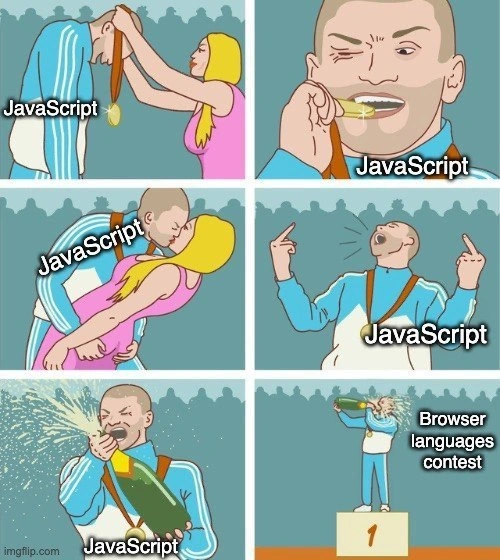
Look at the meme and you’ll see JavaScript personified as an Olympic medalist going absolutely wild with celebration on a winners’ podium. He’s got a medal around his neck, he’s biting it, kissing the presenter, throwing up peace signs, and even spraying champagne everywhere. The funny part? He’s standing on the third-place podium (usually the lowest step, meant for a bronze medalist). And above the scene, it says “Browser languages contest.” The joke is essentially this: JavaScript is acting like it won first place in a huge competition, even though it’s basically the only real contestant in the browser category. 🤣
In web development, JavaScript is the default champion in browsers. Here’s what that means in simpler terms:
- JavaScript is the programming language of the web. When you open any website, the interactive parts (like buttons doing something when clicked, forms checking your input, animations, dynamic content loading, etc.) are almost always powered by JavaScript code running in your browser. Browsers (Chrome, Firefox, Safari, Edge, etc.) are built to understand and run JavaScript natively.
- Browser languages – you might think there would be many languages that browsers can run, but in practice, JavaScript is the one and only main language for client-side programming. (HTML and CSS are also fundamental in browsers, but those aren’t programming languages; HTML is structure and CSS is style. For logic and interactivity, it’s JavaScript.) This is why we talk about a "browser monoculture": essentially one reigning language.
- The meme calls it a "contest," but in reality, there’s not much of a contest. It’s as if JavaScript is in a race where no other runners showed up, yet it’s throwing a victory party. Why no other runners? Because browsers don’t natively run Python, or Java, or C#, or any other popular language. If you wish Python could run in the browser, you’re out of luck (at least without a lot of extra help or conversion). Everyone has to use JavaScript, or tools that translate other languages into JavaScript.
So, JavaScript’s celebrating because it effectively “won” by being the only serious choice. The humorous exaggeration is that it’s on the third-place step acting like a gold medalist. This implies a couple of things:
- Maybe JavaScript isn’t considered the greatest programming language ever (many developers have plenty of jokes about its flaws or “wat?” moments), so perhaps it’s symbolically on a lower podium step when compared to some more elegant languages.
- But despite any flaws, JavaScript still dominates web frontends. It’s like getting a bronze medal without any silver or gold even awarded, and then JavaScript says “I’m #1 anyway!”
Let’s clarify a few terms and why this situation exists:
- Frontend: This refers to the part of an application that runs on your device (in the browser, in this context). Frontend developers write the code that actually executes in your browser, and they rely overwhelmingly on JavaScript. (The backend is the part that runs on servers behind the scenes, typically written in various other languages like Java, Python, Ruby, C#, etc., but those run on the server, not in your browser).
- WebDevelopment: In creating websites or web apps, you use HTML for structure, CSS for styling, and JavaScript for behavior. These three together are like the holy trinity of front-end web development. If you want to do anything interactive in a webpage, you must use JavaScript at some level.
- LanguageWars: This is a light term for the debates or “contests” between programming languages – people love to argue about which language is better for this or that. In many areas of programming, you have choices (for example, for backend you could pick Java vs Node vs Python vs PHP, etc., and developers playfully argue). But in the browser, there hasn’t really been a war because no matter what, you’re using JavaScript. It’s like a contest where one competitor was given a permanent head start.
- BrowserWars: Historically, this refers to competition between browser makers (like Netscape vs Internet Explorer in the 90s, or Chrome vs Firefox vs Safari later). In those battles, one thing that happened was everyone ended up supporting JavaScript as the standard scripting language. Other attempts (like browsers briefly supporting alternative scripts or plugins for other languages) fizzled out. By the mid-2000s, JavaScript emerged as the one language every browser agreed on.
Because of this history, JavaScript today has a monopoly in front-end web development. Monopoly here means one entity has all the market share. If you’re writing code that runs in users’ browsers, JavaScript is essentially your only native option. There are newer technologies like WebAssembly that let other languages run in the browser, but WebAssembly code is typically produced by compiling languages like C/C++ or Rust, and it’s used for very specific high-performance needs. For everyday web app features and UI interactions, developers stick to JavaScript (or languages like TypeScript that transpile to JavaScript). Transpile just means converting code in one language (like TypeScript) into another language (JavaScript) as a step, so that the browser can run it. In all cases, the browser ends up running JavaScript one way or another.
So, the meme’s comedy comes from this reality: JavaScript is basically celebrating itself for being the champion of browser programming, when in truth it’s the champion largely because no one else can even enter the race. It’s an exaggerated, silly visualization of how JavaScript “takes the podium.” The double peace signs and champagne spray are like the JavaScript ecosystem patting itself on the back. It resonates with developers because we all know that feeling — JavaScript is everywhere on the front-end, whether we like it or not, so we joke that it “won” and we might as well cheer (even if we chuckle at how it won).
For a junior developer or someone just learning web dev, the takeaway is:
- Don’t be confused by all the programming language options out there: if you’re doing frontend work in the browser, you’ll be working with JavaScript (or something that turns into JavaScript).
- The meme is a fun way the developer community teases JavaScript. We’re basically saying, “Haha, look at JavaScript acting all victorious… but well, it kind of is victorious in browsers, because it’s the only game in town!”
And if you ever feel JavaScript developers are a bit too enthusiastic about their language or new frameworks, this meme is a friendly reminder that some of that hype is tongue-in-cheek. After all, JavaScript has achieved incredible dominance – some celebration is warranted! – but the way it happened is unique (an accident of history turned into a legacy that we all rely on). So JavaScript stands on the podium, chest puffed out, while the rest of us roll our eyes affectionately and think, “Alright JS, calm down, we know you run the web.” 😅
Level 3: One-Horse Race
JavaScript is depicted as an athlete massively over-celebrating a win in a "Browser languages contest," despite standing on the third-place podium. In the meme’s six panels, JavaScript (the bald guy in a blue tracksuit) goes through all the flamboyant victory motions: he bends down to get a medal, bites it to verify it’s real gold, kisses the lady presenting the award, throws up double victory signs, and then uncorks a champagne bottle spraying it everywhere in triumph. Finally, the camera zooms out to show he’s actually on the lowest tier of the podium (third place) under a banner reading "Browser languages contest." This hilarious contrast is poking fun at JavaScript’s outsized self-confidence in the web world – it’s acting like an undisputed champion of an Olympics where, truthfully, there’s hardly any competition. It’s the classic podium medal meme template (the overexcited bronze medalist) applied to programming languages, and it perfectly captures the comedic irony of JavaScript's position in tech.
For seasoned developers, the joke hits on the browser monoculture that JavaScript enjoys. In front-end web development, JavaScript is essentially the only fully-supported, general-purpose programming language available in all browsers. If you want to add interactive behavior to a webpage – responding to clicks, updating content dynamically, sending network requests from the client side – you pretty much have to use JavaScript. By default, every browser (Chrome, Firefox, Safari, Edge, you name it) executes JavaScript, and no other competing language runs natively alongside it. So in a sense, JavaScript wins by default in the "browser languages contest." The meme exaggerates this reality: JavaScript is throwing a victory party not because it beat strong rivals, but because it’s basically running unopposed (or at best, against token rivals). It’s a one-horse race, and JavaScript is the horse – yet it’s still acting like it won gold against a field of challengers. 🥉🎉
This speaks to a bit of overconfidence in tech culture around JavaScript. The language absolutely dominates the Frontend world – which sometimes leads to a kind of brash attitude in its community. There’s a tongue-in-cheek notion among developers that “JavaScript rules the web”. With every browser vendor agreeing on JavaScript, it’s become a monopoly in web development. Historically, during the late ’90s BrowserWars, there were attempts at other browser languages and plugins (remember Java applets with the Java language, Adobe Flash with ActionScript, or even Microsoft’s VBScript in Internet Explorer). But none of those were universal or lasted – they either required extra plugins or only worked in one browser. By the time the dust settled, all browsers converged on JavaScript (standardized as ECMAScript) as the one scripting language. In other words, the LanguageWars never really happened inside the browser; JavaScript inherited the crown before any serious fight could occur. The result? A browser monoculture where every interactive page relies on JavaScript. Developers sometimes compare this to a monopoly: one technology controlling an entire domain. It’s incredibly powerful, but it can also lead to collective pain points – if JavaScript has a bad day, the whole web has a bad day (we’ve all seen those “It’s always JavaScript” bug blame jokes, akin to the classic “It’s always DNS” in ops humor).
Now, why is it funny that JavaScript is on third place in the meme, and not first? This detail is a cheeky nod to the fact that while JavaScript is first in usage (because it’s the only real browser language), many programmers wouldn’t award it first place in elegance or design 😅. JavaScript was originally created in a hurry (10 days in 1995 by Brendan Eich), and it has some infamous quirks and FrontendPainPoints that have haunted developers ever since. Yet, here it is, celebrating like a champ. The third-place podium could imply that, in an alternate world of programming language quality, JavaScript might rank behind other more polished languages (like some might prefer Python, or C#, or anything more consistent)... but those languages aren’t part of the browser contest. So JavaScript still claims the trophy and acts like it’s on top of the world, oblivious to its own oddities. It’s a humorous way to say: “JavaScript isn’t perfect – far from it – but it doesn’t matter, because it’s the king of the browser kingdom and it knows it!”
Senior developers also recognize the hype culture around JavaScript. Over the years, there’s been an explosion of frameworks and libraries (Angular, React, Vue, Svelte, … a new one each week, it seems), and JavaScript has expanded beyond the browser: into servers (Node.js), desktop apps (via Electron), mobile apps (with React Native, Ionic, etc.), even into machine learning and IoT. The JavaScript ecosystem loves to boast that "JavaScript can do everything". This meme mocks that enthusiasm a bit. The athlete’s premature champagne spray and medal-biting is like the JavaScript community patting itself on the back aggressively for its world domination, even if some of that domination is simply because no one else was allowed on the field. It’s playful self-awareness: JavaScript devs laughing at the fact that, yes, their language is everywhere and they’re proud — but it’s also a quirky, accidental champion.
To put it technically, every other language that wants to run in the browser has to compile to JavaScript or piggyback on it. We use tools like Babel or TypeScript transpilers to turn modern code or other languages into JavaScript, because the browser’s native tongue is just JavaScript. Even WebAssembly, a recent web technology that allows other languages (C, C++, Rust, etc.) to run in the browser, isn’t really a traditional high-level language competitor — it’s a low-level format that still works alongside JavaScript. JavaScript remains the only first-class citizen scripting language in web browsers. It’s like winning gold by default: if there’s only one entrant in the race, that entrant gets the gold medal automatically. But our meme JavaScript guy is acting like he just shattered a world record in a huge competitive field 🤣.
And let’s not forget the quirks that make some of us joke that JavaScript didn’t earn a real gold medal in language design. For instance, JavaScript’s type coercion leads to bizarre results:
console.log("5" - 3); // 2 (string "5" becomes number 5)
console.log("5" + 3); // "53" (number 3 becomes string "3", so it concatenates)
This kind of odd behavior is a classic FrontendPainPoint: it’s weird and unintuitive, yet we’ve learned to live with it because we have to. Despite such warts, JavaScript still flexes on that podium because, hey, no other language even gets to compete in the browser arena without essentially becoming JavaScript. The meme captures this contradiction: JavaScript is both flawed and triumphant. It’s the self-proclaimed winner of the browser Olympics, spraying champagne as if it overcame impossible odds, when really it won a race where it was the only real racer.
In summary, at the senior engineering level, this meme is a humorous critique of JavaScript’s de facto dominance in web development. It highlights the absurdity of how one technology can celebrate uncontested victories. We laugh because it’s true: JavaScript is everywhere and acts like the star athlete of the web – and yeah, it kind of is – but that might say more about the circumstances (historical accidents, browser politics) than about JavaScript being a perfect language. It’s a light-hearted way for developers to acknowledge both JavaScript’s unstoppable ubiquity and the slight ridiculousness of its overhyped glory. After all, even if you’re standing on a bronze podium, a win is a win – so JavaScript pops the champagne 🍾, and we’re all in on the joke.
Description
A six-panel comic meme format depicting a male athlete in a blue and white tracksuit celebrating a victory. The athlete, consistently labeled "JavaScript," is shown receiving a gold medal, biting it, kissing a woman, giving the middle finger to the crowd, and popping a champagne bottle. The final panel reveals the context: the athlete is standing on the #1 podium of the "Browser languages contest." The humor lies in the fact that for a long time, JavaScript was the *only* language that could run natively in web browsers, making it the de facto winner of a contest with no other participants. The meme satirizes JavaScript's dominance in the frontend world, celebrating its victory in a competition it couldn't possibly lose. It's a relatable joke for web developers who are well aware of JavaScript's monopoly in the browser environment, despite the rise of technologies like WebAssembly

Comments
7Comment deleted
JavaScript in the browser is like winning a race where you're the only one on the track, and you still somehow manage to trip over your own asynchronous callbacks
JavaScript gloating on the podium is peak hubris: dominate the only runtime for 25 years, then celebrate “victory” with a medal that’s actually Babel-transpiled TypeScript and champagne made of polyfilled Promises
JavaScript winning the browser language contest is like systemd winning best Unix philosophy implementation - technically correct, practically inevitable, and everyone's too invested to admit we should have seen this coming 20 years ago
JavaScript celebrating its browser monopoly like it earned it through merit, when really it's just the only language the bouncer lets into the club. Sure, WebAssembly is trying to crash the party, but good luck manipulating the DOM without eventually calling back to JS. It's not a competition when you're the only contestant - though to be fair, JavaScript has spent 25+ years turning that captive audience into actual competence with ES6+, TypeScript as a compile target, and a module ecosystem that somehow makes npm's dependency hell feel like an acceptable trade-off
JavaScript's browser gold: first-mover monopoly meets zero viable alternatives - transpile everything else to win
It’s the only league where the rulebook says every competitor must first compile to the defending champion
JavaScript: undefeated in the browser Olympics - when the rulebook is the DOM, the ref is V8, and even WASM needs your glue, you celebrate by shipping a 300MB node_modules podium to prod