JavaScript Devs Adopting TypeScript Feel So Distinguished
Why is this Languages meme funny?
Level 1: Playing Dress-Up
Imagine you and your friends usually play games wearing regular everyday clothes. Everything is casual and a little chaotic — if you spill some juice or mud on your shirt, no big deal. That’s like writing normal JavaScript: it’s fun and free, and no one is too worried about strict rules. Now picture one day you all decide to put on super fancy costumes, like you’re princes, princesses, or lords from a fairy tale. Suddenly, everyone starts acting very proper and proud. You’re speaking with fake royal accents, holding your pinky up while drinking imaginary tea, and feeling like you’re at a grand ball. You haven’t actually become real royalty, of course — you’re just kids in costume — but it feels special.
This meme is saying that JavaScript programmers feel something similar when they start using TypeScript. In this analogy, TypeScript is the fancy outfit for your code. Normally, writing JavaScript might feel like wearing comfy clothes and just winging it. When you put TypeScript on, it’s like dressing your code in a tailored suit or an elegant gown. There are more rules to follow (just like fancy clothes come with “don’t get dirty” rules and you have to mind your manners), but as a result the code feels more polished. The funny part is how simply adding these rules and structure makes some developers feel extra proud, almost like they’ve joined a higher class of coders. It’s as if they’re saying, “Look at me, I code with types now – so fancy!” even though underneath it all, it’s still the same program doing the same job. The meme uses the over-the-top image of aristocrats to poke gentle fun at that feeling. It’s a way of laughing at ourselves for how excited we get about a small improvement, like kids playing dress-up and momentarily believing they’re kings and queens.
Level 2: JavaScript Grows Up
Let’s break down what’s happening here in simpler terms. JavaScript is a language with dynamic typing. This means you don’t have to declare the type of your variables, and those variables can even change type as your program runs. For example, you could do:
// JavaScript (dynamic typing)
let value = "Hello"; // 'value' starts as a string
value = 42; // now 'value' is a number - JavaScript allows this without complaint
console.log(value * 2); // This will run, but if 'value' isn't what we expect, it could lead to weird results.
In JavaScript, the code above is totally legal: value starts as a string and later becomes a number. The language won’t yell at you for that. It only finds out something might be wrong when you actually try to use value in a way that doesn’t make sense at runtime (like trying to treat "Hello" as a number). This flexibility is convenient, but it can lead to surprises. If you mistype a property name or pass the wrong kind of value to a function, JavaScript might only realize there’s an issue when your code is already running (and potentially breaking).
TypeScript, on the other hand, adds static typing to JavaScript. Static typing is like adding labels or expectations for each variable and function upfront, and having a teacher (the TypeScript compiler) check your work before the code runs. For instance, in TypeScript you might write:
// TypeScript (static typing)
let value: string = "Hello"; // 'value' is declared to always be a string
value = 42; // Error: Type 'number' is not assignable to type 'string'
Here, we told TypeScript that value should be a string, and then we tried to assign a number to it. The TypeScript compiler will stop us right there with an error — we don’t even get to run the program until we fix that. By contrast, in plain JavaScript, doing value = 42 after value = "Hello" is allowed and only becomes a problem if later code expects value to still be a string. So, TypeScript is JavaScript with rules. It introduces a bit more formality: you define interfaces or types for objects (so you know exactly what properties they have), you specify function parameter types and return types, and you generally commit to what shape your data will take. If JavaScript is a casual conversation, TypeScript is like a more structured dialogue where each party agrees on the vocabulary beforehand.
Using TypeScript tends to improve the developer experience in a few big ways. First, your coding environment (like VS Code or WebStorm) becomes smarter: since it knows the types of your variables and functions, it can auto-complete properties and method names for you. It’s like having an assistant who knows exactly what you’re working with. If you have a function add(a: number, b: number): number and you accidentally call add("5", "6") (passing strings instead of numbers), TypeScript will immediately underline that and say, “Hang on, you’re giving this function the wrong input types.” Catching such mistakes early means you spend less time debugging weird issues at runtime. This boosts code quality because a whole class of errors (type errors) get caught and eliminated during development. In large projects (especially in the frontend world with big web apps), this is a game-changer: it’s much easier to maintain and refactor code when you have those explicit contracts. For example, if you change a data structure, the TypeScript compiler will point out every place in the code that needs updating to match the new shape, which is incredibly helpful as projects grow. No more shipping a bug to production because you forgot one file to update — TypeScript acts like a safety net.
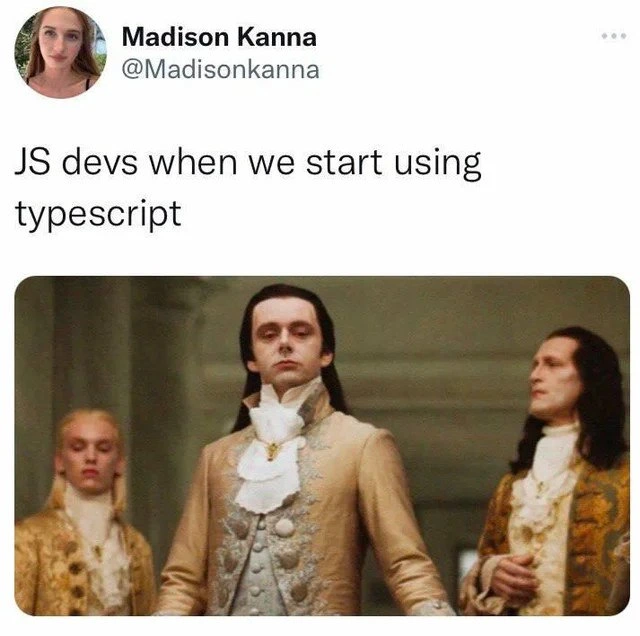
Now, what is the meme showing? It’s a joke about how developers feel when they adopt TypeScript. The meme has a tweet that says, “JS devs when we start using TypeScript”, paired with an image from a period drama where people are dressed as fancy 18th-century aristocrats. In plain language: “This is how JavaScript developers act when they begin using TypeScript.” The humor comes from the idea that adding static types (which is a relatively small change in one’s programming practice) suddenly makes people feel very sophisticated or superior. It’s like a group of folks who usually wear T-shirts and sneakers suddenly put on suits, wigs, and gowns and start behaving like they’re kings and queens. In the coding world, JavaScript has historically been seen as a very approachable, loosely structured language — sometimes even viewed as a “casual” or “beginner-friendly” language. Turning on TypeScript is like saying, “Okay, no more messing around, we’re going to do this the proper way now.” So developers might jokingly start to feel that they’re no longer just scripting things together; instead, they’re engineering with rigor and class.
Of course, in reality, TypeScript is just a tool. It won’t magically turn a novice coder into an expert, and you can still write bad code even with static types (just like you can still speak nonsense in a posh accent). But it does enforce some good practices. A lot of early-career developers, when they first use TypeScript, experience an “aha” moment: suddenly, many bugs they used to chase down are prevented, and they get more confidence in changing code because the compiler guides them. It’s a bit like upgrading from a bicycle to a bicycle with training wheels – at first you think, “Do I really need this?” but then you realize you’re not falling over as much. The meme exaggerates the pride that comes with that realization. It’s relatable because many of us remember the first time we ran a TypeScript project and saw it catch a silly mistake, and we felt a bit proud and “professional” because our code was adhering to these stricter standards. The tweet-and-image format delivers this idea in a punchy way: the tweet sets up the scenario, and the image delivers the punchline by visually comparing developers to haughty nobles showing off their new status.
Level 3: Powdered Wig Programming
This meme captures a familiar bit of developer humor in the web world. JavaScript developers, long accustomed to the free-wheeling freedom of dynamic typing, often see the shift to TypeScript’s static type discipline as a rite of passage into a more refined style of programming. The tweet from Madison Kanna quips, “JS devs when we start using TypeScript”, and the attached image shows three men in lavish 18th-century court attire (complete with powdered wigs, gold brocade jackets, and lace cravats) looking extremely proud and aloof. The juxtaposition suggests that the moment we enable a TypeScript tsconfig.json in a JavaScript project, we suddenly feel like royalty among programmers. It’s exaggerating how some devs act instantly aristocratic – as if they’ve ascended the social ladder of coding just by adopting static types. Seasoned engineers find this hilarious because, to an outside observer, we’ve only made a marginal change in language (JavaScript with a bit more structure), yet the change in attitude can be ridiculously disproportionate.
The humor works so well because there’s a grain of truth behind the joke. Many of us who have migrated a messy JavaScript codebase to TypeScript can recall feeling a surge of pride and relief once everything compiled cleanly. Turning a chaotic JavaScript project into a well-typed TypeScript one is essentially like putting a fancy outfit on your codebase – some jokingly call it a powdered-wig refactor because you’ve dressed the code in formal attire. Suddenly our project has clear interfaces, *.d.ts declaration files, and far fewer mysterious runtime bugs. It’s a genuine improvement in code quality and maintainability. However, along with that relief often comes a dash of smugness. We start insisting on stricter coding standards – flipping on "strict": true in the compiler settings like it’s a royal decree. In code reviews, a new TypeScript convert might display a bit of static type braggadocio: nitpicking about every function’s return type, or gleefully pointing out any usage of the dreaded any type (which, in the TypeScript world, is basically like breaking character and using slang at a formal dinner). The meme exaggerates this into the image of developers literally adopting aristocratic airs — chest puffed out, chin raised, speaking in posh tones — all because their project now has typed function signatures and interface definitions. It’s poking fun at how we can get overly proud about using a tool that, at the end of the day, just makes our JavaScript a little more like the languages that have had static types all along.
For veteran programmers, there’s an extra layer of irony here. Static typing is not a new concept at all — languages like C, C++, Java, and Pascal have enforced types for generations. So watching a JavaScript engineer put on an imaginary monocle and act superior for using a feature that is basically table stakes in older languages is rich comedy. It’s as if a group of casual dressers discovered formal tuxedos and ball gowns and now believe they’ve joined high society overnight. There’s a bit of language war tongue-in-cheek subtext: for years, fans of statically-typed languages poked fun at JavaScript’s wild-west dynamic nature ("Haha, JavaScript will let you add a number to a string without batting an eye!"). Now, the tables have turned slightly; JavaScript folks have embraced static types via TypeScript and some are proudly waving that banner, occasionally with an I’ve seen the light attitude. It’s like the JavaScript community is saying, “We’ve cleaned up our act!” and perhaps overdoing the self-congratulation. The meme is a wink to this reversal — we’ve gone from being the scrappy upstarts of the programming world to adopting a more formal stance, and maybe feeling a bit too pleased about it.
In real development teams, introducing TypeScript often does bring a noticeable cultural shift. The build process becomes more elaborate (there’s now a compile step in the front-end pipeline, type checking during CI, etc.), and the codebase starts to feel more “enterprise” or “professional”. Junior devs who were used to just hitting refresh to see their changes might now have to deal with compiler errors and learn about things like generics or type narrowing. It’s not unlike a small startup that used to "move fast and break things" deciding to implement formal engineering processes and strict code style rules. It can be Developer Experience (DX) enhancing and a little jarring at the same time. Teams might jokingly refer to older un-typed parts of the app as the Dark Ages, and the fully converted, well-typed modules as the Enlightenment. Indeed, the DX improves in many respects: you get auto-completion suggestions that actually know about your objects, you can refactor with confidence because if you mess up a variable’s shape every file that uses it will immediately complain, and onboarding new developers is easier since function signatures tell you exactly what to pass. But along with those benefits comes the slight pomp of having to do things the Proper Way. There’s a new emphasis on things like consistency and correctness that feels very much like enforcing procedural courtesy — a bit bureaucratic but ultimately making the kingdom run smoother. The meme nails that feeling by showing devs in brocade coats and powdered hair: once you adopt TypeScript, you do tend to carry yourself with a bit more formality in the codebase. You might start dropping mentions of “types” and “interfaces” in everyday conversation, telling everyone how much better the code is now. It’s all in good humor, an affectionate ribbing of that boost of confidence (or ego) we get when our JavaScript is finally behaving under strict rules.
Ultimately, this meme is a playful self-own for the dev community. Most programmers know that using TypeScript doesn’t actually make you smarter or better than anyone else — it’s just a tool that helps catch mistakes. But it feels good to have that safety net, and it’s a shared, relatable experience to jokingly act like we’ve joined some elite club of “real software engineers” when we turn on those static type checks. The meme resonates especially with front-end developers because TypeScript has rapidly become a staple in the modern tech stack for web development. If you’ve ever been in a meeting where the team decides “Alright, time to rewrite this in TypeScript,” you might notice a certain excitement in the air. Suddenly people talk about how “modern” and “robust” our code will be; it’s a bit like planning to renovate a home with better materials. This meme simply takes that excitement and turns it into a Regency-era ballroom scene. It says: go ahead, enjoy that moment of pride when your codebase is all nicely typed and errors that used to slip by are now caught at build time — just maybe don’t let it go too much to your head, m’lord. 😉
Level 4: The Aristocracy of Type Systems
TypeScript’s introduction of static typing to the JavaScript world can be likened to bestowing a formal title upon a commoner. Under the hood, adding static types means introducing a compile-time type system where previously there was none. In programming language theory, a type system acts as a set of logical rules that assign each expression a type and ensure operations are used with compatible types. Static typing specifically means these checks happen before the program runs (at compile time), rather than during execution. This is akin to enforcing proper etiquette at court before the event begins — any faux pas in how values are used (like trying to treat a number as if it were a string, or calling a function with the wrong kind of arguments) is flagged as improper in advance. By contrast, dynamic typing, which JavaScript uses by default, is more laissez-faire: the program only finds out something is wrong at the moment it actually happens (if at all), which might be in the middle of the ball, so to speak, potentially causing a scene (i.e. a runtime error).
One could call TypeScript a form of gradual typing: it allows mixing dynamic parts (e.g. using the any type to bypass checks) with static checks, so developers can enforce rules incrementally. The TypeScript compiler acts like a strict protocol officer for your code. It parses your code into an AST (abstract syntax tree), then type-checks it against the rules and annotations you've provided (or that it can infer). Only code that clears this gauntlet of checks is allowed to proceed to the execution stage. After verification, the compiler transforms (or "transpiles") the code to plain JavaScript, stripping away all the type annotations in the process. This process is called type erasure. The result that runs in the browser or Node.js is still ordinary JavaScript. In other words, the grand static type aristocracy exists purely at compile time – at runtime, there's no trace of those fancy type declarations. It’s like all those powdered wigs and silk coats are taken off once the ceremony is over, leaving everyone as commoners again during actual execution. From a technical standpoint, this demonstrates how TypeScript provides safety guarantees without runtime overhead. The types are used to prove certain correctness properties early on (a lightweight form of formal verification of the code), but they vanish when the code is running, so performance and behavior remain as nimble as untyped JavaScript.
TypeScript’s type system itself is surprisingly powerful (indeed, much more elaborate than what a typical frontend developer might expect from "just adding types"). It’s a structural type system, meaning compatibility is determined by the shape or structure of data rather than explicit declarations of inheritance. If an object has all the right properties, TypeScript considers it a match — akin to saying “if it walks like a duck and quacks like a duck, it’s a duck” but with compile-time rigor. On top of that, TypeScript supports generics (types that take other types as parameters, like a list of T can be any type T), union types (a variable can be one of several specified types), intersection types (combining multiple types into one), and even conditional types and mapped types which let the type system perform logic and transformation on types. These advanced features allow developers to model complex relationships in code with great precision. In fact, the TypeScript type system has become so expressive that it’s proven to be Turing complete – meaning, in theory, you could encode arbitrary computations using only TypeScript’s type definitions (a bit like doing math with only abstract annotations!). This is an almost absurd level of sophistication for something that started as a simple add-on to JavaScript. It’s as if our once humble scripting language put on not just aristocratic robes, but also picked up an advanced degree in the arcane sciences of type theory. The humor of the meme is rooted in this very contrast: the everyday, laissez-faire world of JavaScript suddenly being governed by the meticulous, aristocratic rules of an elaborate type system. It’s a dramatic leap in formality, and the meme jokingly imagines JavaScript developers treating it like a rise in social class.
Description
A screenshot from the movie "Twilight" featuring the Volturi vampires. Three characters with pale skin and long dark hair are dressed in ornate, old-fashioned, aristocratic clothing (gold and beige frock coats with elaborate white cravats). The central figure looks forward with a serious, almost smug expression. The tweet from Madison Kanna (@Madisonkanna) above the image reads: "JS devs when we start using typescript". This meme humorously portrays JavaScript developers, who are accustomed to a dynamically-typed and flexible language, as becoming overly formal and sophisticated after adopting TypeScript. TypeScript introduces static typing to JavaScript, requiring developers to define types for variables and functions. This change adds a layer of structure and compile-time verification that can feel more rigorous or "proper" compared to plain JavaScript. The joke is that this newfound structure makes JS developers feel as distinguished and superior as the ancient, aristocratic vampires pictured
Comments
13Comment deleted
JavaScript lets you believe you're a nimble startup founder. TypeScript makes you feel like you're a 300-year-old vampire architecting a legacy system, where every type must be 'immortal' and you hiss at the first sight of an 'any'
Nothing upgrades developer etiquette faster than a compiler yelling at `any` - one minute it’s cowboy coding, the next it’s "good day, Sir, may I lint your carriage?"
After 15 years of 'undefined is not a function' in production, we finally discovered what the Haskell folks meant by 'if it compiles, it works' - though we still ship 500KB of type definitions that get stripped at build time
The transition from JavaScript to TypeScript is like going from 'it works on my machine' to 'it won't even compile on my machine' - and somehow that feels like an upgrade. You trade runtime surprises for compile-time arguments with the type checker, but at least now your bugs have the decency to introduce themselves before production. It's the developer equivalent of trading chaos for bureaucracy and genuinely feeling sophisticated about it
TypeScript is the powdered wig we put on JavaScript to pass enterprise change control - right up until someone slips an any into the hot path
TypeScript gives our code powdered wigs and discriminated unions - then a JSON payload crosses the I/O boundary and the monarchy ends at runtime
JS devs on TypeScript: trading 'any' for generics, because nothing says elite like compiler-enforced existential crises
I thought it is reversed Comment deleted
TS devs when we start using Javascript Comment deleted
That’s deep Comment deleted
Definitely Comment deleted
What?, It make you feels like a vampire? Comment deleted
Make us feel real programmers Comment deleted