Skip to content
DevMeme
3546 of 7435
The Exhilarating World of C++ Pointer Indirection
CS Fundamentals Post #3883, on Oct 30, 2021 in TG

The Exhilarating World of C++ Pointer Indirection

Why is this CS Fundamentals meme funny?

Level 1: A Map to a Map

Imagine you have a special treasure box (say, full of candy). Now, your friend has a map that shows where that treasure box is buried. That map is super useful – it points you to the candy. In programming terms, the treasure is like an int (the actual thing you want), and your friend’s map is like an int* (a pointer showing you where that thing is located). Now along comes another friend who is really into maps. This second friend hands you another map, but guess what it leads to? It leads you to the first friend’s map, not directly to the treasure. So you have a map that points to another map, which then points to the candy. That second map is like an int** – a pointer that tells you where another pointer is. Kinda funny, right?

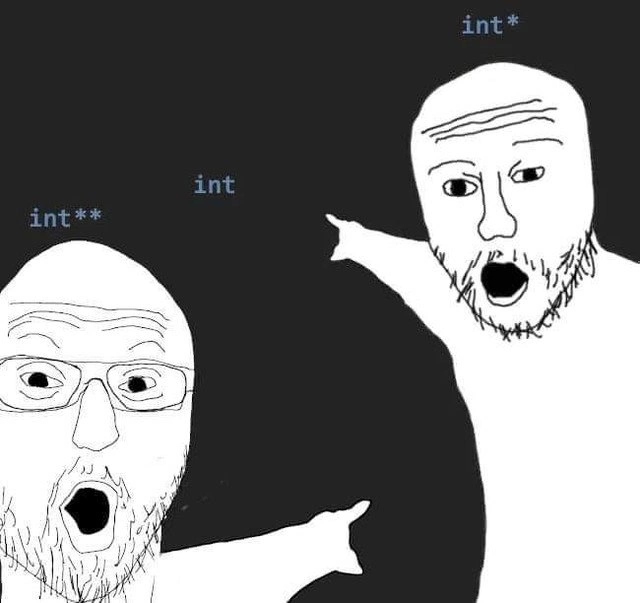
In the meme, the goofy excited guy represents that second friend (the map-to-a-map, int**). He’s jumping up and down about the fact that he has a map leading to another map. Meanwhile, the actual candy (the int value in the middle) is just sitting there, a bit ignored. The guy on the right with int* is like the first friend proudly holding the direct map to the treasure. The humor comes from how overly excited the left guy is about this extra indirection. It’s like someone getting more thrilled about the idea of a clue leading to another clue than about the final prize. For a kid (or anyone new), you’d probably laugh at a friend who says, “Look! I have a clue that points to another clue!” instead of just being happy to find the treasure. In the programming world, that’s what’s happening here: the C programmer is almost showing off that they have a pointer to a pointer. The meme makes it look like having that double-layered map is a personality quirk – something that C programmers get a kick out of, even if it seems a roundabout way to get to the actual candy. Essentially, it’s poking fun at how C folks sometimes love their complex tools (like pointers) a little too much, to the point where it becomes a joke about their identity. The heart of the joke is that feeling of “being in on it” – if you know what a pointer to a pointer is, you can laugh at how silly it is to treat it like a bragging right. And if you don’t, well, now you have a sweet little story about treasure maps to explain it!

Level 2: Star-Struck by Pointers

Let’s break down what all these int, int*, and int** actually mean in simpler terms. In the C programming language, an int is just an integer – a number like 42 stored in memory. A pointer is a variable that holds a memory address (think of it as a fancy index or locator for where data lives in RAM). When you see a type with an asterisk, like int*, it means “pointer to an int.” In code, if we have an int value, we use the & operator to get its address, and that address can be stored in an int*. Now, what about int**? Each additional * adds another layer of indirection. So int** means “pointer to an int*” – or in English, a pointer to a pointer to an int. It’s a two-hop journey: you go to the address of a pointer, which then leads you to the address of an int. This is why we call it double pointer. We can summarize the hierarchy like this:

  • int   → an actual integer value (e.g. 42).
  • int*  → a pointer (address) that points to an integer.
  • int** → a pointer that points to another pointer (which in turn points to an integer).

In the meme, each character represents one of these: the middle has the plain int (the actual value), the figure on the right with int* is a pointer to that value, and the excited left figure int** is a pointer to the pointer. The joke is essentially showing a fan preferring the indirection (the pointer) over the actual thing (the int). It’s like our int** friend is saying, “Ooh look, an address to an address!” while the poor int value is just standing there like, “Hey, remember me? I’m the real number you ultimately need.”

If you’re newer to C/C++ or Low-Level Programming, here’s a quick illustration with code to clarify how these relate:

#include <stdio.h>

int main() {
    int value = 7;
    int *ptr = &value;    // ptr holds the address of value
    int **pptr = &ptr;    // pptr holds the address of ptr

    printf("value = %d\n", value);      // prints the integer (7)
    printf("*ptr = %d\n", *ptr);        // *ptr follows the address, prints the integer (7)
    printf("**pptr = %d\n", **pptr);    // **pptr follows two addresses, prints the integer (7)
    return 0;
}

In this snippet, ptr is an int* pointing to value. The expression *ptr dereferences the pointer, meaning it goes to that address and retrieves the integer stored there (7 in this case). pptr is an int** pointing to ptr (notice the &ptr, the address of the pointer). So **pptr goes two levels deep: first to ptr, then from ptr to value, giving us the original 7. All three ways (value, *ptr, **pptr) end up at the same integer in memory. The double star might look scary at first, but it’s just applying the “go to address” operation twice in a row.

Why would anyone want a pointer to a pointer? One common reason is to allow functions to modify a pointer argument. C passes arguments by value, so if a function needs to update a pointer (say, to allocate memory and give back the new memory location), you have to pass a pointer to that pointer. For example:

#include <stdlib.h>

// This function allocates an integer and updates the passed-in pointer to point to it.
void allocateInt(int **outPtr) {
    *outPtr = malloc(sizeof(int));   // allocate memory for an int
    if (*outPtr != NULL) {
        **outPtr = 123;             // assign a value to the newly allocated int
    }
}

In allocateInt, the parameter is int** outPtr – a double pointer. We call it like allocateInt(&ptr), passing the address of a pointer. Inside allocateInt, *outPtr is the original ptr from the caller, and we set it to a newly allocated address from malloc. By using int**, the function is able to return a new memory location to the caller via that pointer. This is a classic pattern in C for functions that create or reallocate structures (hence the mention of malloc wrappers in the meme’s description).

Another place you see double pointers is with arrays of strings. The argv in a C main function is of type char** argv. This means it's a pointer to a char* (which is a string), effectively making argv an array of strings (like the list of command-line arguments). For beginners, encountering char** argv or doing something like **argv can be confusing. What’s happening is: argv points to the first element of an array of character pointers. Each *argv is then one char* (one string, e.g. "hello"), and **argv would be the first character of that first string. It’s a bit mind-bendy at first, but once you see that pattern, you realize it's just two levels of lookup: one to pick which string in the array, and another to get the characters of that string.

So, in simpler words, the meme is highlighting how C lets you add layers of addresses. Each layer is an extra redirection to find your actual data. Many LanguageQuirks in C/C++ come from this flexibility: you can have pointers to almost anything, even other pointers. The result is powerful but can be confusing if you’re not used to it – hence the “double_pointer_confusion” tag. When you debug memory issues or try to follow a piece of code that uses **, you might feel like you’re chasing a trail of references just to get to one value. And that’s exactly why the meme is funny to programmers: it exaggerates this situation by personifying each level (int, int*, int**) and making the highest level act like an over-enthusiastic fan. If you’ve ever been in a conversation that suddenly goes from a simple idea to a deep dive into low-level memory details, you’ll get the joke. The C folks sometimes can’t help themselves—pointers are a fundamental piece of C’s identity, and mastering them is almost a rite of passage. So when someone in C land starts using double (or triple!) pointers, it can feel like they’re saying “look at how hardcore I am,” even if what they’re doing is valid. This meme playfully ribs that tendency. After all, not every problem needs that extra *, but try telling that to the int** guy in the comic!

Level 3: Indirection Inception

At first glance, this meme is C programming absurdity in action: a wide-eyed character labeled int** excitedly points at another labeled int*, while a lonely int sits in the middle. This visual gag is a nod to the hierarchy of pointer indirection that seasoned low-level developers know all too well. In C land, data can be wrapped in layers of pointers like a Matryoshka doll: a plain integer value (int), a pointer to that integer (int*), and a pointer to that pointer (int**). The humor here comes from treating that extra level of indirection as a celebrity crush – the fanboy with glasses (int**) is star-struck by the int*, completely overshadowing the humble int value. It’s parodying how some C/C++ enthusiasts practically make pointers a personality trait, reveling in ever more convoluted ways to reference data.

This resonates with experienced developers because it exaggerates a real phenomenon: in deep systems programming, people sometimes get overly excited about clever pointer tricks. We’ve all met that programmer who gleefully explains a function taking char*** just to parse command-line args, or brags about their custom memory allocator peppered with double pointers. It’s funny because it’s true – C veterans often joke that if one level of indirection is good, two must be better! In practice, each * means “go fetch the address of something,” and too many can send you down a rabbit hole of memory addresses. There’s an old tongue-in-cheek adage in computer science:

“All problems in computer science can be solved by another level of indirection (except for the problem of too many layers of indirection).”

Here, int** is that “another level” – sometimes necessary, often powerful, but also a bit comical when it shows up everywhere. The meme captures that moment in C/C++ culture where a simple discussion about an int inevitably escalates into pointers-to-pointers. Seasoned devs chuckle because they’ve seen pointer indirection spiral out of control in real life: for example, when maintaining legacy code with function signatures like void configParser(char ***) that feel like pointer gymnastics, or reviewing a patch where someone proudly replaced a global array with int** dynamicMatrix and a maze of malloc calls. It pokes fun at the “if you know, you know” shared experience of debugging a segfault at 3 AM, only to realize you misdereferenced a double pointer (we’ve been there, and it’s always a wild ride through memory).

On a serious note, double pointers do have legit uses that seniors know well. They often appear in:

  • Function parameters for output – e.g. a loadConfig(char **outBuf) function that needs to modify the caller’s pointer, requiring an char**. Passing a pointer-to-pointer lets the function allocate memory with malloc and hand back a pointer to the result.
  • Dynamic 2D arrays or arrays of strings – e.g. char **argv in int main(int argc, char **argv). Here argv is a pointer to an array of char* (each one points to a string). Managing an array of pointers naturally involves a char**. Many newcomers’ first brush with double pointers is indeed the infamous argv in C’s main, leading to “argv madness” as they puzzle over **argv meaning.
  • In-place swaps and modifications – C lacks references like C++, so to swap two pointers or update a pointer from inside a function, you use int**. This pattern shows up in coding interviews and low-level library code (like changing a linked list’s head pointer inside a function call).

Seeing these in code the first time can be daunting – even a bit horror-inducing – and that’s exactly what the meme lampoons. The dreaded double-pointer in a code review often prompts a mix of respect and alarm. Experienced devs laugh because they remember being that excited nerd at one point, proudly writing ** in their code to solve a problem, or encountering someone’s code where nearly every other variable was a pointer to something. The meme’s joke is ultimately about identity: “pointer person” is a recognizable archetype in systems programming circles. By depicting pointer indirection as a fanboy obsession, it playfully ridicules how deeply ingrained pointer usage can become in a C coder’s mindset. After all, in C, a bug or a feature is often just one * or & away – and some folks start to treat those symbols as beloved companions. The humor is equal parts fond nostalgia and catharsis: we laugh because we’ve all had that phase of worshipping the mighty pointer and perhaps gone a bit overboard with the stars ourselves.

Description

An illustration using the 'Two Soyjaks Pointing' meme format to humorously represent a core concept in low-level programming. Against a black background, two crudely drawn Wojak-style characters (Soyjaks) with open mouths and beards are pointing excitedly. The character on the left is labeled 'int**' (a pointer to a pointer to an integer), the character on the right is labeled 'int*' (a pointer to an integer), and the concept they are both pointing at in the middle is labeled 'int' (an integer). The meme finds humor in applying a format of intense, exaggerated excitement to the dry, academic, yet fundamental concept of pointers and multiple levels of indirection in languages like C and C++. For seasoned developers, it’s a nostalgic joke about the building blocks of memory management that are often a major hurdle for beginners

Comments

16
Anonymous ★ Top Pick The difference between `int*` and `int**` is the difference between knowing where the treasure is buried and knowing who has the map
  1. Anonymous ★ Top Pick

    The difference between `int*` and `int**` is the difference between knowing where the treasure is buried and knowing who has the map

  2. Anonymous

    Senior rule of thumb: if the code review shows an int** escaping the module boundary, the next sprint is already called 'rewrite-in-Rust'

  3. Anonymous

    After 20 years in the industry, I've realized the true horror isn't managing triple pointers in production code - it's explaining to the junior why their int** segfaults when they treat it like int* because 'they're both just addresses, right?'

  4. Anonymous

    The progression from int to int*** perfectly captures the moment when you realize the previous developer's 'elegant solution' involves passing pointers to pointers to pointers through a callback chain - and now you're the one who has to debug the segfault that only appears in production on Tuesdays. It's the systems programming equivalent of opening a matryoshka doll and finding increasingly cursed memory addresses inside

  5. Anonymous

    If your API needs int**, you're not passing a value - you're negotiating custody

  6. Anonymous

    int**: because single indirection wasn't spawning enough malloc/realloc therapy sessions

  7. Anonymous

    int, int*, int** pointing at each other - the C API blame graph for ownership: value blames pointer, pointer blames pointer-to-pointer, and the segfault writes the postmortem

  8. @wtdbgflrjdscnm 4y

    ❤️

  9. @cotoha_1 4y

    Always has been...

    1. @ZgGPuo8dZef58K6hxxGVj3Z2 4y

      Explain this please?

  10. @Ivan_Kholodnyak 4y

    )

  11. @Ivan_Kholodnyak 4y

    Thanks, this meme makes me smile

  12. @ZgGPuo8dZef58K6hxxGVj3Z2 4y

    Oh okay I was thinking it had some deeper meaning that I just don't see.

  13. @BreadCrumberWay 4y

    Yeah, I was puzzled as well trying to find some meme template I thought I was missing

  14. @Vadim_Pogorelkin 4y

    Do you have stickers that have this picture?

    1. @RiedleroD 4y

      I don't, but you can always make your own stickers.

Use J and K for navigation