The Territorial Developer's Vacation Surprise
Why is this Refactoring meme funny?
Level 1: Who Moved My Spaghetti?
Imagine you spent all day building a big, cool sandcastle at the beach. It’s a bit messy, but you know exactly where everything is in your sandcastle. Then you go home for the night. While you’re gone, your friend comes by and rebuilds your sandcastle in a different way – they think they’re doing you a favor by making it nicer and neater. The next day, you come back and… surprise! Your sandcastle doesn’t look like the one you left. Even if it might be a “better” castle now, you’d probably feel confused and a little upset because it’s not how you made it. You might even shout in a funny way, “Hey, who touched my castle?!”
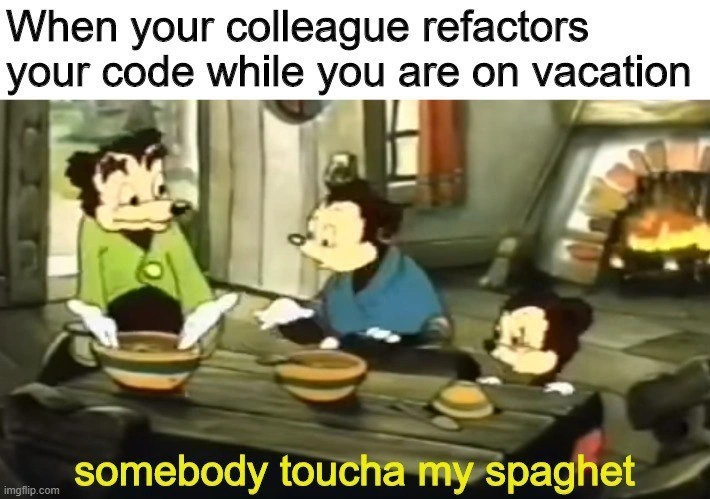
That’s exactly the feeling this meme is joking about, but with code (and spaghetti). Your code is like that sandcastle or a bowl of spaghetti that you left on the table. While you were on vacation, someone came along and stirred it all around. They reorganized your “noodles” in the code. When you return, nothing is where you put it. The meme makes it funny by showing a cartoon bear who finds his bowl of spaghetti was touched and he yells, “somebody toucha my spaghet!” in a silly accent. In real life, the developer is like that bear – humorously dramatizing how you feel when someone changes your stuff without asking. It’s a playful way to say: I know you were trying to help, but now I’m all disoriented! Even a kid can understand that feeling: it’s not so fun when you discover someone moved your toys all around, right?
Level 2: Refactoring Etiquette 101
Let’s break down the scenario in simpler terms, defining the buzzwords and context:
PTO (Paid Time Off) basically means vacation time. So you (the developer) were away on holiday, not checking work messages or code. Now, imagine coming back and finding a ton of changes in the code you wrote. That’s what happened here – while you were relaxing, a teammate decided to refactor your code.
Refactoring is a process of improving the internal structure of code without changing its external behavior. Think of it like tidying up a messy room: the goal is to reorganize and clean, but not to remove the functionality of anything. In coding, this could mean renaming variables to clearer names, breaking a long function into smaller ones, or simplifying complex logic. Refactoring is generally a good thing for CodeQuality – it makes code easier to read and maintain. However, it should be done carefully. A key part of refactoring is making sure you don’t introduce new bugs; usually developers run tests to ensure everything still works exactly the same after the cleanup.
Now, “spaghetti code” is a slang term for code that is tangled and messy. Just like a heap of spaghetti noodles, it’s hard to follow one strand from start to finish. Spaghetti code might have lots of interdependencies, unclear structure, or hacks piled on top of hacks. For example, deeply nested if statements, global variables modified all over the place, or functions that do ten different things – that’s spaghetti code. It’s not a compliment; it means the code is hard to understand and maintain. Developers call it that because, in the past, some programs (especially ones using many GOTO statements back in the 80s/90s) looked like a bowl of spaghetti in terms of flow control. In our meme, your code was possibly considered “spaghetti” by your colleague. They attempted to clean it up, i.e., turn spaghetti into something more structured.
Code ownership refers to the idea that developers often feel responsible (and sometimes possessive) over the code they wrote or the parts of the system they manage. It’s like having “your turf” in the codebase. If you wrote the user authentication module, you’re the owner or expert of that part, and you’d be the one to fix or update it usually. In modern team practices, we try to have collective ownership (anyone can improve any part of the code), but in reality people still feel a bit of personal attachment. That’s why if someone changes “your” code without telling you, it can feel upsetting – almost like someone rearranged your desk without asking. This meme plays on that feeling. The text “somebody toucha my spaghet” is intentionally broken English to mimic the cartoon character’s accent, saying “somebody touched my spaghetti.” Here, spaghetti = spaghetti code, and the phrase stands in for “someone meddled with my stuff!” The developer returning from vacation is depicted like the grumpy bear who finds his bowl of spaghetti has been touched.
Why is this a DeveloperExperience issue? Because how developers feel and work day-to-day (their experience) is affected by unexpected changes. Good developer experience means the workflow is smooth, with no nasty surprises. Coming back to find a huge refactor is the opposite of that – it creates confusion and maybe anxiety. You have to spend time relearning your part of the system to understand what your colleague changed. This can delay your work and even shake your confidence. Early-career developers (and actually, everyone) might find it challenging to jump into a big set of changes like this, especially if they weren’t involved in them.
Let’s talk about the merge-conflict chaos mentioned. In software development, multiple people often work on the code at the same time in parallel. You had your version of the code when you left; your colleague created a different version by refactoring. When two versions conflict – say you both edited the same lines but in different ways – you get a merge conflict when trying to combine them. It’s like two people editing the same sentence in different copies of a document; when you try to merge the copies, the system goes, “Hmm, which change should I keep? I don’t know automatically.” You then have to manually resolve it, which can be tedious if there are many conflicts. A surprise refactor can cause a ton of merge conflicts because the refactor likely touched many parts of the code, including lines you might also have been working on or were planning to change.
The meme’s rustic cartoon image actually comes from a 1930s animation of Goldilocks and the Three Bears. In that story, Goldilocks enters the bears’ house while they’re away and trifles with their stuff – she eats Papa Bear’s porridge (spaghetti in an later parody), sits in their chairs, etc. When the bears return, Papa Bear finds his bowl and famously exclaims in an accent, “Somebody toucha my spaghet!” (It was an Italian-accent gag – spaghetti instead of porridge in that parody). That line became a popular internet meme around 2018 for expressing outrage when someone messes with your things. In this developer meme rendition, you are the bear, and your code is the spaghetti. The colleague is effectively Goldilocks, who “touched” (refactored) your stuff while you were gone. The image of the bears in a cottage with empty bowls on the table is directly referencing that cartoon scene. Even the text styling – top caption in bold, bottom in yellow like subtitles – mimics the format of many meme images. It’s visually saying: This situation = cartoonish outrage of someone unwittingly tampering with someone else’s cherished property.
For a junior developer, this scenario is a mix of lesson and laughter. Lesson: It’s important to coordinate with your team when you make big changes. Even if code isn’t “yours” (we work in teams, after all), courtesy and communication go a long way. If you think part of the codebase needs a big improvement, it’s usually best to discuss it first, maybe do it in smaller pieces, and definitely ensure it’s well-tested. That avoids nasty surprises and hurt feelings. Laughter: the exaggeration in the meme is a way to cope with the fact that yes, these things do happen and they’re super frustrating in the moment – but later, they become war stories that developers joke about. “Remember when Alice refactored Bob’s module over the weekend and Bob nearly spit coffee on Monday morning?” It’s a shared humor in the dev community, captured by this meme with a catchphrase everyone finds silly and memorable.
In summary, the meme is explaining a situation where a developer’s code was heavily changed without warning. It uses a funny old cartoon reference (“somebody touch my spaghetti!”) to make light of the refactoring pain and code ownership drama that can happen on software teams. As a newcomer to coding, it’s good to understand both why refactoring is valuable and why communication about it is key. The result of not communicating is exactly what this joke shows: confusion, surprise, and a bit of drama in the otherwise peaceful world of code.
Level 3: Ambush Refactoring
Returning from PTO to find your codebase unrecognizably “improved” is a classic developer nightmare wrapped in dark humor. In this meme scenario, a well-meaning (or overly zealous) colleague undertook a massive refactoring of your module while you were on vacation. You come back to a 5,000-line Git diff and a feeling that your workspace was burglarized. It’s funny because it’s painfully relatable: every senior dev has either witnessed or lived this. The top caption sets the scene: “When your colleague refactors your code while you are on vacation.” This implies an unsolicited overhaul in your absence – essentially ambush refactoring. The bottom text, “somebody toucha my spaghet,” perfectly encapsulates the outrage. It’s a famous meme phrase spoken by a cartoon bear discovering his meal was tampered with; here it’s repurposed for a developer discovering their spaghetti code was “fixed” without permission. The humor lands on two levels: one, the code was messy (spaghetti code) and someone touched it; two, it evokes the absurd accent and indignation of that meme, turning a frustrating situation into a comedic outburst.
Beyond the chuckle, this meme spotlights real developer experience (DX) issues. Code ownership is a double-edged sword on teams: on one hand, someone owning a piece of code means they deeply understand it; on the other, they might feel territorial. This meme exaggerates that territorial instinct – “Who dared touch my code?!” In healthy practice, code is collectively owned, but let’s be real: engineers often imprint their identity on the code they craft (especially if they wrangled that spaghetti into a working dish). A surprise refactor violates unwritten etiquette. It’s like an architectural “jump-scare” in the repository: suddenly your familiar code isn’t where you left it, names have changed, logic is split into new functions, maybe an entire new pattern has been introduced (oh look, your colleague decided to sprinkle some singleton dependency injection or turn your simple script into a full Factory pattern assembly line). The result? A cocktail of DeveloperFrustration and begrudging admiration – sure, maybe it’s cleaner, but navigating it for the first time under surprise circumstances is harrowing.
From a senior engineer’s perspective, the real horror isn’t just ego or ownership – it’s the merge conflict carnage and potential bugs this surprise refactor spawns. If you had branches or pending work, good luck: the diff is so large that git merge practically throws up its hands. You might open your project to find dozens of <<<<<<< HEAD conflict markers littering your files. The repository has turned into a minefield:
<<<<<<< YOUR_CHANGES
function calculateOrderTotal(order) {
- // Old implementation (messy but it worked)
- let total = 0;
- for (let i = 0; i < order.items.length; i++) {
- total += order.items[i].price;
- }
- sharedState.lastTotal = total; // update global state (spaghetti!)
- return total;
+ return calculateOrderTotal(order.items);
}
=======
function calculateOrderTotal(order) {
+ // Colleague's refactored implementation (fancy but untested)
+ return order.items.reduce((sum, item) => sum + item.price, 0);
}
>>>>>>> MAIN_BRANCH
(Above: A hypothetical merge conflict. Your original code on the left was imperative and even updated a global sharedState. The colleague’s refactor on the right uses a sleek array method and removes the global. Cleaner? Yes. But if other code depended on sharedState.lastTotal, that behavior is now lost – a subtle break in functionality.)
This example highlights the refactoring pain that makes experienced devs cringe. In theory, a refactor is behavior-preserving: it shouldn’t alter what the code does, only how it’s organized internally (improving readability, reducing duplication, etc.). But in practice, big bang refactors often introduce regressions. Your colleague might not realize some “dead code” was actually initializing a crucial side-effect, or that the odd variable name they renamed was referenced via reflection somewhere else. Without comprehensive tests, it’s easy to accidentally change behavior. There’s a classic Murphy’s Law variant for this: if anything can break during a refactor, it will (and not necessarily on the refactoring engineer’s machine). Veteran developers have learned to be wary of phrases like “I just cleaned it up a bit” – often that’s the prelude to a long night of debugging.
Let’s talk spaghetti code. The term itself is decades old, coined to describe code with a flow as tangled as a bowl of pasta (imagine early Fortran or BASIC with every other line a GOTO, jumping around wildly – that’s the original spaghetti). Spaghetti code is hard to follow, hard to maintain, but somehow it works because the original author kept all those twisty paths in their head. Now along comes a colleague who sees this tangle and, with good intentions, refactors it into what they consider a well-structured meal. Maybe they split a 500-line function into many bite-sized functions, or replaced a bunch of manual loops with fancy functional programming calls. Technically, these changes should improve CodeQuality – making the code more readable or efficient. But here’s the catch: such widespread changes can feel like someone reseasoning your sauce without asking. The original flavor (implementation) is now different, and you’re left wondering if the dish still satisfies all the requirements. The meme captures that sentiment with “somebody touched my spaghet,” implying “someone meddled with my messy but beloved code.” It’s a humorous way to voice a real anxiety: what did they break or change that I haven’t discovered yet?
On a team dynamics level, surprising a teammate with a massive refactor reveals cracks in collaboration boundaries. Ideally, refactors – especially large-scale ones – are discussed openly. Maybe the team agrees, “Yes, this module needs cleanup,” and you plan it into the sprint, write tests first, review each other’s changes. When it’s done clandestinely while someone is out, it hints at either impatience or avoidance. The colleague might have thought, “If I ask, they’ll say no, so I’ll do it now and present it as a fait accompli.” It’s a bit of a trust breach, even if not intended that way. The returning developer might feel blind-sided and perhaps defensive (“Was my code so terrible you had to rewrite it the moment I took PTO?”). In the worst case, it can become a blame game if bugs were introduced: “Well, you touched it last, you fix it.” This is why seasoned devs preach communication and peer review. The meme lampoons the failure of that process in a tongue-in-cheek way.
Despite the comedic exaggeration, every element rings true to industry veterans:
- Unsolicited Refactor = Risk: Major code changes done without the author can misinterpret the original intent. The humor masks a cautionary tale: even well-intentioned fixes can backfire without context.
- Merge-Conflict Chaos: The description mentions “merge-conflict chaos waiting in the repository.” Indeed, merging personal branches after a surprise overhaul is like untangling a pile of cables – tedious and error-prone. This resonates strongly with anyone who’s spent a whole day resolving conflicts line by line.
- “Works on My Machine”™: A cynical veteran might joke that the colleague’s refactor undoubtedly worked on their machine or in the limited tests they ran. But production or other developers’ workflows? That’s a different story. We smirk because we know how often that assurance falls flat in real environments.
- Ego and Ownership: The meme implicitly touches on ego – both the refactorer’s possible overconfidence (“I can fix this mess easily”) and the original coder’s pride being wounded. In real life, neither side is fully right or wrong, which is why the situation is awkwardly humorous. Code is often a collective asset, but here it’s treated like Papa Bear’s personal bowl of porridge.
- Refactoring Etiquette: There’s an unwritten rule: Don’t overhaul someone’s code without at least dropping a heads-up. The meme exaggerates the breach of this etiquette to get a laugh and nod from those who’ve been burned by a “side project refactor.” It’s poking fun at that one teammate who doesn’t wait for consensus.
In sum, the meme takes a very real source of DeveloperFrustration – coming back from a relaxing vacation to a stressful code surprise – and diffuses it with vintage cartoon humor. It’s a form of collective commiseration. We laugh because we’ve either had this happen or nervously imagine it could. And perhaps next time we’re itching to fix “spaghetti” that someone else owns, we’ll remember the image of an angry cartoon bear and think twice. After all, nobody wants to be the colleague who touched the spaghet and started a spaghetti code ownership crisis.
Description
A classic meme using the 'Somebody Toucha My Spaghet' format, which originates from a 1939 animated adaptation of 'Goldilocks and the Three Bears'. The image shows the three bears looking distressed at their dinner table. The top caption reads, 'When your colleague refactors your code while you are on vacation'. The bottom text, in a prominent yellow font, is the meme's catchphrase: 'somebody toucha my spaghet'. The humor comes from equating the bewildered outrage of the bear finding his food has been touched with the feeling of violation a developer experiences when returning from vacation to find their code has been altered without their input. This is especially poignant in programming, where 'spaghetti code' is a term for tangled, hard-to-maintain code, adding a clever layer of meaning
Comments
7Comment deleted
I came back from vacation to find my carefully crafted, artisanal spaghetti code had been refactored into some kind of abstract lasagna. Sure, it's organized into layers now, but I have no idea where the meatballs are
Left for PTO with a single pot of spaghetti code; came back to seven microservices, three queues, and a saga - congrats, the pasta’s now distributed but still sticks together
The real horror isn't that they refactored your code - it's discovering they renamed all your carefully crafted variable names to 'data1', 'data2', and 'temp', then marked the PR as 'minor cleanup' with no migration guide for the 47 microservices that depended on your original API contract
The real horror isn't the refactoring itself - it's coming back to find your colleague 'improved' your carefully crafted abstractions into a completely different architectural pattern, merged it to main without tests, and is now on *their* vacation. At least they left you a commit message: 'cleaned up some stuff.'
They refactored your spaghetti into lasagna while you were gone - now it's layered, maintainable, and mysteriously slower
Pro tip: if your "refactor" lands during my PTO and needs an ADR, a schema migration, and a force-push, it isn’t “no behavior change” - it’s organized crime against git blame
Back from PTO to a PR titled “minor refactor”: my spaghetti became lasagna - more layers, same sauce - 863 files changed, zero tests, and git blame still points to me