Alert Fatigue: The Biscuit Incident
Why is this OnCall ProductionIssues meme funny?
Level 1: Fancy School Supplies
Imagine you have a friend at school who has to do a simple art project. But before they even start coloring, they insist on having the most expensive crayons and markers, a super high-tech notebook, and the latest tablet – even though plain crayons and paper would work fine. They also bought a special mechanical pencil with sparkly custom grips that cost a lot, just because it looks cool. Before doing any homework, they make a big cup of fancy hot chocolate from a coffee-shop style machine in the kitchen. When they finally sit down to work, they spend a bunch of time adding stickers and smiley faces to the title of their project (and even in the notes they hand in to the teacher!). Every few minutes, they stop to tell all their friends online about a tiny tip on how to color inside the lines, and share a silly cookie meme they found. Meanwhile, it’s taking forever for their super-fancy art software to load on the tablet – they joke that it might literally take an hour. And oh, they also turned on their special star projector night-light so the room looks like outer space while they work. 🌟
Does your friend really need all this fancy stuff to do a simple art project? Not really! They could draw with a regular pencil on normal paper and it would turn out fine. But having all the cool gear and fun extras makes them feel like a serious artist and it’s kind of their “thing.” It’s funny because they’ve gone way overboard – spending more time setting up and showing off than actually doing the project. This meme is just like that: it’s making fun of a coder who uses a ton of shiny tools and toys for basic coding. The joke is that sometimes people focus on the extras (fancy computers, gadgets, emojis, online bragging) more than the actual work. It’s playful teasing, like saying, “Look at this person with all their cool pens and gadgets – they’re acting like it’s a huge deal, when really they just need to do some simple homework.” In the end, it’s a silly way to remind us that you don’t need all those bells and whistles to be good at something – but it sure is entertaining to watch someone try!
Level 2: Macs, Emojis & Espresso
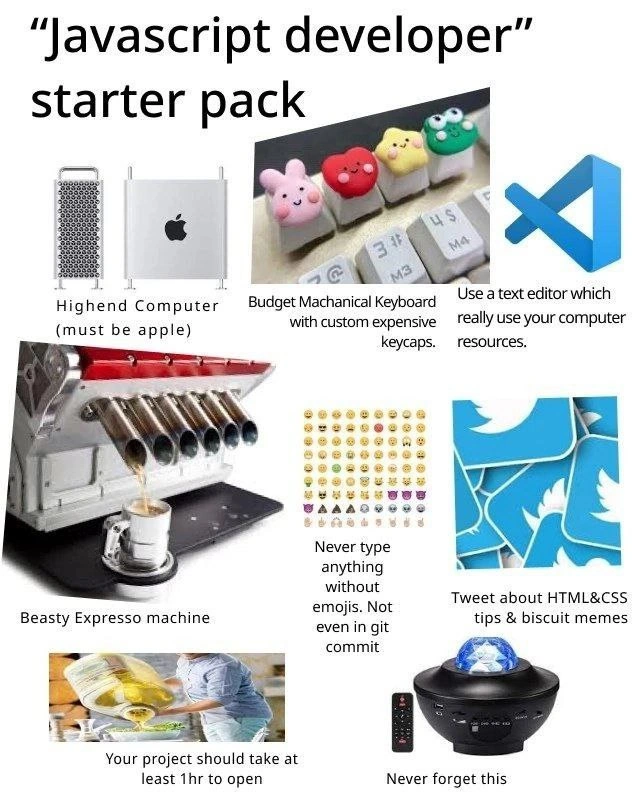
Let’s break down the meme’s pieces in plain terms. This “JavaScript developer starter pack” is listing things a stereotypical front-end web developer might have or do. If you’re newer to the developer scene, here’s what each part means and why it’s mentioned:
Must be Apple (High-End Mac Computer): A lot of web developers prefer using Apple Macintosh computers (like MacBook laptops or Mac Pro desktops). One reason is that macOS is built on UNIX, similar to Linux, making it easy to run servers and developer tools. Another reason is culture: many tech communities and tools first support Mac/Linux and treat Windows as an afterthought. In this meme, they specifically show an expensive Mac Pro tower (with the famous “cheese grater” holes) and even an older Apple PowerMac. The caption says “must be apple” because it’s joking that to be a “real” JavaScript dev, you have to use a Mac. Of course, that’s not true – you can code JavaScript on any decent computer – but it reflects a common preference. Apple devices are seen as high-quality (and they are high-price), so our stereotype dev insists on a high-end computer beyond what they truly need. This sets the stage: right from the hardware, we’re talking top-tier, maybe a bit over the top.
Mechanical Keyboard with Custom Keycaps: The next image is a mechanical keyboard decked out with cute, colorful keycaps that look like little animal faces. Mechanical keyboards are loved by programmers because they have physical switches that give a satisfying “click” or “thunk” with each key press. They’re durable and pleasant to type on. A “budget” mechanical keyboard might be an affordable model, but the meme says it has “custom expensive keycaps.” Keycaps are the little covers on each key. Enthusiasts often buy or even artisan-make special keycaps (in fun designs or colors) to personalize their keyboard. These can be surprisingly expensive – sometimes more than the keyboard itself! So why is this in the starter pack? It’s highlighting that our JavaScript dev isn’t just about coding; they’re also into the accessories and aesthetic. Having a fancy keyboard is almost a badge in the developer world – it shows you take your typing seriously (or just have a fun hobby). The meme finds humor in calling it “budget” while it’s clearly been made costly by all the custom parts. For a new developer, this says: front-end folks often have flashy keyboards on their desk, not just the plain office Dell keyboard. It’s part of the developer experience, making your workspace enjoyable.
VS Code (Resource-Intensive Text Editor): The blue logo in one panel is Microsoft Visual Studio Code, commonly just called VS Code. This is one of the most popular code editors for JavaScript and web development today. It’s free, has a ton of extensions (for syntax highlighting, debugging, etc.), and is relatively easy to use. However, VS Code runs on a framework called Electron, which means it’s essentially a web app running on your desktop, packaged with its own Chrome browser engine. As a result, VS Code can use a lot of memory and CPU – sometimes more than you’d expect from a “text editor.” The meme’s caption “Use a text editor which really use your computer resources” is a sarcastic way to say VS Code will tax even a powerful computer. It’s hinting that VS Code isn’t lightweight: if you open a big JavaScript project with multiple VS Code extensions, your fancy Mac’s fans might kick in. For a junior dev: don’t be alarmed, VS Code is great and widely used – but yes, it can be a bit heavy on resources. That’s why some devs joke that you need a strong machine (like that Mac) to comfortably run your editor, browser, and development server all at once. This is part of the modern DeveloperExperience_DX – we choose convenient tools like VS Code even if they are a bit bloated, because they make coding easier with features like IntelliSense and integrated Git.
Espresso Machine (Developer Fuel): One panel shows a multi-nozzle espresso machine with the caption “Beasty Espresso machine.” This points to the stereotype that programmers drink a lot of coffee. Coffee is practically the official drink of coding. Many coders joke “I can’t function without my morning coffee” or “code runs on caffeine.” In real life, you’ll find coffee machines in every tech office and plenty of devs making a cup at home before settling in to code. Some developers indeed get connoisseur-level about their coffee – they’ll have a fancy espresso setup, grind their own beans, etc. The meme exaggerates it to a commercial-grade machine, which is humorous because imagine someone at home with a huge café machine next to their laptop! The misspelling “Expresso” is actually a common typo (it should be espresso). That might be part of the joke too, since developers are usually precise about spelling (like in code). Anyway, for a newcomer: expect coffee (or tea, or energy drinks) to be a common theme in developer culture. It’s seen as the fuel that keeps us coding during late-night debugging sessions. This part of the starter pack just says, “front-end devs love their coffee, perhaps a bit too much.” ☕
Emojis Everywhere (Even in Git Commits): The sheet of emoji icons and the rule “Never type anything without emojis. Not even in git commit” highlights how casually and frequently emojis are used by modern developers. Emojis are those little pictorial icons (smiley faces, thumbs up, etc.) used in text communications to express emotion or just for fun. Git is a version control system that developers use to keep track of code changes; a git commit is basically saving a set of changes with a message describing what you did. Traditionally, commit messages are plain text (and usually somewhat serious). However, lately, it’s become popular to spice them up with an emoji or two. For example, a developer might write a commit message like “Add login feature ✨” with a sparkles emoji to imply it’s something new or fancy. There’s even a thing called gitmoji which provides guidelines on which emoji to use for what kind of change (🐛 for bug fix, 🔥 for removing code, etc.). The meme playfully says our stereotypical JavaScript dev never types anything without emojis. That includes casual chat messages (where adding 😀😜👍 is super common) and even commit messages or documentation comments. For someone newer, this signals that the communication style in many dev teams today is informal and expressive. Using emojis is seen as friendly and fun. Of course, it’s exaggerating – no, you don’t need an emoji in every commit – but it’s poking fun at how emoji-crazy we’ve become. The broader point: modern devs often blur the line between professional and social communication, bringing a bit of Slack/Twitter-style expressiveness into their coding workflows.
Tweeting HTML/CSS Tips & Memes (Developer Twitter): Another part of the starter pack says “Tweet about HTML & CSS tips & biscuit memes” next to a bunch of Twitter logos. This refers to how many front-end developers are very active on Twitter, sharing knowledge and humor. If you hop on Tech Twitter, you’ll see lots of folks posting neat little tricks about HTML, CSS, and JavaScript. Often these are bite-sized tips (“Did you know you can use
position: stickyfor navbars?”) meant to help others or just show off a clever solution. At the same time, developers on Twitter love to share and create memes – funny images or jokes about programming life. “Biscuit memes” is a silly specific example (there might have been a trending joke about biscuits or cookies at one point – possibly a play on web cookies vs. biscuits as a joke, or maybe just random humor). The point is, being a visible, meme-sharing, tip-tweeting person is somewhat characteristic of the modern dev community. For a junior dev, this means you might find a lot of learning and camaraderie on Twitter (or similar platforms), but also a lot of noise and silly jokes. Our stereotypical JavaScript dev from the meme doesn’t just quietly code; they also constantly broadcast on social media – building a personal brand as a guru with those tips, and also keeping things fun with memes. It’s highlighting the DevCommunities aspect: coding isn’t done in isolation, it’s also about interacting with peers online. The humor here is gently ribbing those who maybe spend as much time tweeting about coding as actually coding. It says, “Part of being a front-end dev today is tweeting and meme-ing about being a front-end dev.” 😅Long Project Load Times (Heavy Build Processes): The panel with batter being poured and the text “Your project should take at least 1hr to open” is jabbing at how complex and slow setting up a modern JavaScript project can be. When they say “open” a project, they mean getting it running on your machine – which usually involves steps like installing dependencies, starting a development server, or building the project. Modern front-end frameworks (like React, Angular, Vue) often come with hundreds of dependencies (external libraries) managed via
npmoryarn(package managers). The joke here is that by the time you donpm install(which might fetch thousands of packages) and then run the app, it could take an absurd amount of time – “at least an hour” in the meme as a gross exaggeration. In real terms, a large project might indeed take several minutes to install and start up, especially the first time. For context, older simpler websites didn’t have this huge tooling step – you could just openindex.htmlin a browser or at most compile a bit of code and bam, it’s up. Now, due to things like transpilers (converting new JS/JSX syntax to browser-compatible JS), module bundlers (packaging all your JS/ CSS modules together), and other build steps (minification, hot-reloading, etc.), there’s a lot of waiting involved. So the meme is saying: it’s almost a badge of honor that your project is so fancy that it needs a beefy computer and still takes forever to start. For a newcomer, this part is basically pointing out a real frustration: you often need patience (and good hardware) when working with big modern front-end codebases. It’s in the “starter pack” as a warning-slash-joke: welcome to JavaScript development, where even starting the dev environment can test your patience.Galaxy Projector (Fun Workspace Gadget): Lastly, that black device projecting a colorful night sky (galaxy) onto the ceiling, with the caption “Never forget this,” is including a fun, non-essential gadget that many developers might have. In recent years, people like to deck out their home offices or coding spaces with cool lighting – LED strips, neon signs, or these star projectors that make the room look like outer space. It’s all about creating a vibe. “Never forget this” implies that to be the ultimate JavaScript dev, you don’t want to miss out on the cool ambiance. It’s of course not a serious requirement at all, just a playful addition. The presence of this item shows that the meme is also about the lifestyle and comfort of developers. Front-end devs (especially those active in creative communities) often value aesthetics – not just in their web designs but in their work environment too. A galaxy lamp doesn’t help you code better, but it might make you happy or relaxed. So, the starter pack humorously lists it as if it’s as important as the computer itself. For a new dev, this is saying: developers often have quirky toys or setups at their desk to personalize their space, whether it’s figurines, special lighting, or fancy chairs. It’s part of the modern developer identity – we like to make our coding cave cozy or uniquely “us.” And yes, some will definitely show these setups off in pictures or video calls!
Putting it all together, this starter pack is a light-hearted caricature of a modern front-end developer’s life. It combines tools (Mac, VS Code, keyboard), habits (drinking espresso, using emojis), online behavior (tweeting tips and memes), and even workspace atmosphere (galaxy lights). Each element is grounded in truth – many devs will relate to at least a couple of these – but exaggerated to be funny. The meme is basically good-natured teasing of the fact that front-end development in the JavaScript era has become more than just writing code: it’s almost a full lifestyle with specific gear and social norms.
So if you’re just starting out, don’t worry – you don’t actually need all this stuff to be a developer! You can run JavaScript on an average laptop, any keyboard will do, coffee is optional (tea or water works too!), commit messages can be emoji-free, and you can code even if your project opens in 10 seconds instead of 60 minutes 😉. The humor is in recognizing these community in-jokes and stereotypes. As you spend more time in the dev world, you’ll likely encounter each of these in some form and chuckle remembering this meme. It’s essentially saying: welcome to front-end development, where the tools are heavy, the coffee is strong, the commits are colorful, the tweets are flying, and the LEDs are twinkling. Enjoy the ride!
Level 3: Bloat-Driven Development
This meme lampoons the extravagant ecosystem surrounding a modern JavaScript front-end developer. It’s a classic “starter pack” collage, and each item satirically represents a piece of the culture. Taken together, they illustrate how building a simple website today can involve massive overkill in both tools and habits. Let’s break down why seasoned engineers smirk at this:
High-End Apple Hardware (Must be Mac) – The meme shows a shiny Mac Pro “cheese grater” tower (and even an old PowerMac G5) labeled “Highend Computer (must be apple)”. It’s poking fun at the unwritten rule in web dev circles that your rig has to be a Mac. Historically, Macs became popular for development because of their robust UNIX-based OS (great for running Node, Docker, etc.). But here it’s exaggerated: our JavaScript dev insists on a top-of-the-line $5,000+ Apple machine just to run Chrome and Node.js. Seasoned devs chuckle because they know you could code a website on a much cheaper PC – yet many won’t, citing the AppleEcosystem vibe. The joke is that trivial tasks (like tweaking HTML/CSS) are being done on hardware powerful enough for Hollywood CGI. In reality, that power often gets gobbled up by bloated build tools and Chrome tabs. So the Mac isn’t completely idle – but the overkill is real, and that’s the humor.
Custom Mechanical Keyboard (with Artisan Keycaps) – Next, we see a “Budget Mechanical Keyboard with custom expensive keycaps” featuring pastel animal keycaps. This highlights the keyboard fanaticism in developer culture. Mechanical keyboards provide tactile feedback and satisfying “clack” sounds that many programmers love – but the meme cranks it to 11. Those cute artisan keycaps can cost $30 each and often turn a so-called “budget” keyboard into a pricey collectible. Senior engineers smile because they’ve watched this trend explode: younger devs spend hours modding keyboards, swapping switches, and buying designer keycaps shaped like cats or Pokémon. It’s become a hobby (and money sink) in the dev community. The underlying irony: none of it makes the code run better – but it feels awesome to type on. Veterans who used to pound out code on grimy Dell keyboards or ThinkPad laptops find it amusing that today’s “serious” front-end dev comes with a rainbow LED, custom-spring keyboard as part of the standard gear. It’s a symbol of the DeveloperExperience_DX obsession – optimizing the feel of coding, sometimes more than the code itself.
VS Code – The Resource-Hungry Editor – The Visual Studio Code logo appears with the caption “Use a text editor which really use your computer resources.” This is a tongue-in-cheek jab at VS Code (a hugely popular code editor, especially for JavaScript). VS Code is built on Electron, which means under the hood it’s essentially a Chrome browser running a text editor. All those plugins and IntelliSense features come at a cost: high memory and CPU usage. The meme jokes that VS Code will truly soak up every bit of RAM and CPU your fancy Mac can offer – hence “really use your computer resources.” Experienced devs know the drill: you open VS Code to edit one file, and suddenly it’s running several helper processes and eating hundreds of MB of RAM. 😅 Compared to older editors (like Vim, Emacs, or Sublime Text), VS Code is downright heavy. We laugh because it’s true: a “lightweight” modern editor now rivals full IDEs in resource demands. The meme exaggerates it as if using VS Code justifies needing that Mac Pro. It’s resource_hungry_ide humor – highlighting how our tooling has become as bloated as our browsers. A senior dev might quip: “We’ve come full circle – writing web pages in an environment as heavy as the web itself.”
The “Beasty Espresso Machine” – Ah yes, the caffeine pipeline. The image of a multi-spout commercial espresso machine labeled “Beasty Expresso machine” (spelling espresso hilariously wrong, which eagle-eyed devs would nitpick) captures the coffee culture of developers. There’s a long-standing joke that software developers run on coffee (and sometimes on energy drinks). Here the front-end dev’s coffee obsession is so extreme, they’ve installed a café-grade espresso machine in their life. This is poking fun at how programming forums and offices often treat coffee as fuel for coding marathons. Many coders do take pride in brewing the perfect cup: grinding fresh beans, using a fancy espresso or pour-over setup. The meme exaggerates it to a “beastly” extreme – as if a true JavaScript dev’s setup isn’t complete without a $2,000 espresso rig next to the monitor. Seasoned devs laugh because they’ve seen colleagues brag about their coffee setups almost as much as their code. The subtext: we pour so much ritual into coding (must have coffee in hand, mechanical keyboard clicking) that it borders on absurd. Also, pairing the high-end Mac with a high-end espresso machine says: this starter pack is all about premium lifestyle, not just coding.
Emoji-Driven Communication (Even in Commits) – One panel shows a sheet of colorful emoji icons with the rule: “Never type anything without emojis. Not even in git commit.” This mocks the modern habit of emoji overuse, especially among younger devs on Slack, Discord, and yes, even GitHub. In the old days, commit messages were plain, utilitarian (“Fix bug in login flow”). Now, you might see something like
git commit -m "Fix alignment issues 🐞🎨"– complete with a bug emoji and artist palette emoji, just for flair. There’s even a popular gitmoji convention where specific emojis represent types of changes (🎨 for code style improvements, 🐛 for bug fix, 🚀 for performance boost, etc.). The meme playfully roasts this practice. Senior folks find it funny because it’s a big generational shift – they recall when using non-ASCII characters in code or commits was unthinkable. Now commits look like sticker collections! The statement “Never type anything without emojis” exaggerates how some devs pepper everything with 😀👍🔥 just to express tone. It also hints at communication style: modern dev communities tend to be more informal and expressive. So even professional artifacts like commit logs get the emoji treatment for fun. The humor (tinged with a bit of eyeroll) comes from imagining a hyper-serious codebase filled with smileys and rockets. It’s a benign mockery of DevCommunities culture on Slack/Twitter where every sentence ends in an emoji for friendliness.Tweeting HTML/CSS Tips & “Biscuit Memes” – Another panel shows a pile of Twitter bird logos and says: “Tweet about HTML & CSS tips & biscuit memes.” This riffs on the phenomenon of devs building a presence on TechTwitter. Many JavaScript and CSS enthusiasts love to share daily tips (“Pro tip: you can center a div by…”) or neat tricks in 280 characters. Often these tips are basic (“Did you know CSS has a
display: flex? 😱”), but they get tons of likes from newbies. The meme pairs that with “biscuit memes,” which seems absurd – why biscuits? Likely it’s just a goofy example of the random, non-sequitur humor dev Twitter engages in. (It might reference cookies vs biscuits, a playful dig at web “cookies”? Or maybe just a running joke among certain dev circles). Either way, the idea is that our stereotypical JS dev doesn’t just code; they also constantly curate their social media persona by tweeting tech tips and silly memes, even during work. DevCommunities on Twitter thrive on this mix of knowledge sharing and humor. For a senior engineer, the funny part is imagining someone spending as much time tweeting about coding as actually coding, or feeling “to be a real front-end dev, I must tweet daily and join the meme parade.” It highlights a truth: some developers gain notoriety more for their Twitter activity than code – a very modern development. The meme’s tone exaggerates it: tweeting about biscuits (utterly unrelated to coding) as equally important as HTML tips, underlining how dev social media can be an echo chamber of trivial content. One can almost hear the sarcastic commentary:“URGENT ALERT: WE NEED SOME BISCUIT MEMES”
This fake dramatic tweet (quoted in the post) epitomizes the kind of tongue-in-cheek hype over nothing that we often see online. It’s both a joke and a gentle jab at how seriously folks chase the latest silly trend or meme for clout. Seasoned devs find it hilarious because it rings true – sometimes the developer community’s online chatter does seem absurdly detached from actual software development.
Projects that Take “1 Hour to Open” – The starter pack wouldn’t be complete without mocking modern build tools. One panel shows batter being poured (as if waiting for something to bake) with the warning: “Your project should take at least 1hr to open.” This hits a painful reality of ToolingOverload: many JavaScript projects (especially large React/Angular apps) have huge dependency trees and complex build steps. Cloning a repo and getting it running can indeed be a slog. You run
npm installand watch thousands of packages download (maybe a few get stuck compiling native add-ons), thennpm startfires up Webpack or another bundler that chews through megabytes of code, opens a local server, etc. It might not literally take an hour (that’s comedic exaggeration), but it feels like it when a simple “Hello World” app involves gigabytes of Node modules. Older devs remember when “opening a project” meant clicking an HTML file or compiling a 50KB C program – done in seconds. Now the joke is you click “Run” on a modern front-end app, then go make a coffee (or a whole espresso) while the dev server boots up. The meme is essentially roasting how bloated and slow the modern JavaScript tooling pipeline can be. The high-end hardware and resource-hungry editor from earlier panels tie into this: even with an 8-core Mac Pro and 32GB of RAM, “yep, it still takes forever to launch the dev environment.” So it’s a self-inflicted problem of the ecosystem: we’ve made developer convenience tools (like module bundlers, compilers, live reload, heavy frameworks) that ironically slow us down at startup. Seasoned engineers laugh (or groan) because they’ve lived this — it’s funny ’cause it’s true.Galaxy Star Projector – “Never forget this” – The final touch: a quirky galaxy night-light projector casting starry patterns in the dev’s room, captioned “Never forget this”. This one is pure tongue-in-cheek whimsy. It suggests that to fully embody the JavaScript front-end stereotype, you even need the ambient mood lighting gadget. In recent years, it’s become trendy for streamers and dev YouTubers to have cool LED lights, neon signs, or star projectors in the background of their workspace. It’s aesthetic and fun – perhaps invoking creativity or just looking cool on camera. By including this, the meme is saying “Yep, even the vibes are part of the starter kit.” The phrase “Never forget this” implies this item is oddly essential: don’t you dare set up your coding battlestation without a cosmic light show! Senior devs chuckle because it’s so extra – a far cry from the old fluorescent-lit cubicles of enterprise software development. It caps off the meme’s theme: front-end development isn’t just coding, it’s a lifestyle (complete with mood lighting).
In summary, the meme humorously sums up a reality in modern front-end land: a focus on shiny tools, elaborate setups, and social media hype that often far exceeds the actual technical needs of the job. It resonates with senior engineers because they recognize the absurdity behind the truth. Sure, a powerful Mac, great keyboard, coffee, VS Code, etc., can genuinely improve a developer’s comfort and productivity. But here we’re laughing at the stereotype of the JavaScript dev who takes all these to an extreme – investing in every luxury and quirk while their poor project is so bloated it still runs slow. It’s a gentle roast of the DeveloperCulture: simultaneously admiring the passion (hey, who doesn’t like nice gear and coffee?) and mocking the excess. The combination of elements is what sells it – any one of these alone is normal, but all together it paints a caricature that’s hilariously spot-on to anyone who’s been around tech long enough.
Description
This meme likely uses a popular reaction format (e.g., the 'Panik, Kalm, Panik' or 'Two Buttons' meme) to contrast a genuinely critical situation with an absurdly trivial one. The setup would involve a high-stakes scenario like 'Production Database is Down' juxtaposed with the caption's text: 'URGENT ALERT: WE NEED SOME BISCUIT MEMES'. The humor stems from the inappropriate use of an 'urgent' notification for something so frivolous, satirizing the 'alert fatigue' many developers experience. In a world of constant notifications from Slack, Jira, and monitoring tools, the line between a real crisis and a mundane request can blur, and this meme captures that absurdity perfectly
Comments
18Comment deleted
In SRE, there are two types of P0 incidents: 'database is on fire' and 'the VP of Sales can't find the emoji for a clapping chicken'
Current front-end “best practice”: a $7k Mac, VS Code idling at 4 GB, a build step long enough for a double espresso, and a git log that looks like a Millennial sticker pack - somewhere a mainframe just rolled its single-core eyes
The real starter pack is missing the 47 abandoned npm packages they published, each solving the same problem slightly differently, and the 3TB node_modules folder that somehow contains the entire internet despite the project being a todo list
The real JavaScript developer starter pack is missing the most critical component: a 2GB node_modules folder that takes longer to install than it took NASA to get to the moon, and a package.json with 47 dependencies where you only actually use 3 of them - but you're too afraid to remove the others because 'it might break in production.'
JS starter pack: Mac for prestige, VS Code to nuke its thermals - because every senior knows true DX is measured in fan noise
Electron editor burns 8GB to lint four files while node_modules turns hello‑world into a cold‑start SLO - don’t forget the gitmoji to make CI green
JavaScript dev starter pack: $5k Mac to run an Electron IDE that spawns more processes than our microservices, a café-grade espresso machine because the monorepo cold start outlasts CI, and emoji commits because with 150k transitive deps, semver is the least expressive thing we ship
Never forget sapphire in a remote-controlled rice cooker? Comment deleted
Ayy lmao Comment deleted
Never forget sapphire with a Star of David symbol in a remote-controlled rice cooker? Comment deleted
I guess that looks more like Demon core Comment deleted
This is not about js devs only Comment deleted
Looks like OP to me Comment deleted
the sapphire thing reminds me of Minecraft's beacon Comment deleted
literally me Comment deleted
shed some light then whats that magically looking sapphire sphere with remotely controlled demons ? Comment deleted
Some kind of star map projector shit that makes your ceiling look like you're outside at night Comment deleted
ah beautiful Comment deleted