Skip to content
DevMeme
4543 of 7435
The 'It's a Feature, Not a Bug' Defense
Bugs Post #4984, on Nov 2, 2022 in TG

The 'It's a Feature, Not a Bug' Defense

Why is this Bugs meme funny?

Level 1: Neat Plan, Messy Reality

Imagine you set out to organize your toys in a super neat way. You have a plan: all the action figures in one box, all the cars in another, all the stuffed animals on a shelf – everything sorted like a nice tree of categories. That’s the left side of the meme: the clean plan where each thing has its place, just like each animal class was neatly arranged under “Animal” with its own sound.

But now picture what your room looks like a week later. In reality, you’ve been playing a lot and things got crazy. There are strings connecting your action figures to your toy cars, some toys are glued inside weird containers, and there’s even a big contraption in the corner that’s supposed to “organize” everything but actually just gets in the way. Your stuffed cat toy is tied to a bunch of other toys with rubber bands for no good reason. It’s a huge tangled mess – a bit like a bowl of spaghetti where you can’t lift one noodle without a whole clump coming along. That’s the right side of the meme. It’s showing that even though we planned to be organized, we ended up with chaos.

This is funny because it’s so relatable: we often start a project (or anything in life) with a simple, clear idea of how it will be structured. But as we add more stuff over time, it can become a jumbled mess. In coding, OOP was the neat plan to keep things organized, but the final result was a messy tangle of parts all knotted up. The meme makes us laugh and groan because it’s pointing out that gap between expectation and reality – we promised a tidy hierarchy, but delivered a spaghetti monster! It’s like saying, “I meant to keep my room clean, honest… but somehow it turned into this disaster.”

Level 2: Tangled Hierarchy

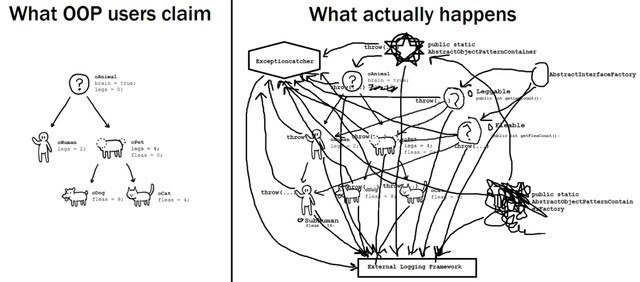
Let’s break down the meme’s joke in simpler terms. On the left side (“What OOP users claim”), we see a tidy hierarchy: a Human figure points to ? Animal (a generic animal class), which branches into a Dog class with a bark() function and a Cat class with a meow() function. This represents the classic teaching of Object-Oriented Programming (OOP). In OOP, we create classes to model concepts; for example, an Animal class can be a general template, and Dog and Cat are more specific versions (subclasses) of Animal. Each subclass can have its own behavior (dogs bark, cats meow) defined in methods. This kind of diagram looks like a family tree or an organizational chart. It implies a clear structure: Humans have Animals, Animals have specific types like Dog or Cat, and each knows how to speak. The design is straightforward, easy to understand, and each part of the code has a clear place. This is how OOP is supposed to make our code: organized and easy to extend (you can add a Bird class later with a chirp() method, for instance, without breaking the others).

Now the right side (“What actually happens”) is a scribbly chaotic diagram – basically the opposite of a clean tree. This is illustrating what programmers call “spaghetti code.” Just like a bowl of spaghetti noodles all tangled together, spaghetti code is a program structure where everything is twisted and interwoven in confusing ways. Instead of a neat hierarchy (one parent class branching into children), we have a web of relationships: arrows criss-crossing between many components. The labels in that mess give clues about what happened. We see things like:

  • ExceptionCatcher – likely a part of the code that catches errors generically. It might be a big catch-all mechanism so that if any part of the program throws an error (throw() is mentioned all over), this central piece will handle it. That might sound helpful, but dumping all error handling into one place can lead to silently ignoring problems or making it hard to know which part failed.
  • public static AbstractInterfaceContainer and its friend ...Factory – these suggest some factory pattern usage. A factory in programming is a piece of code that creates objects for you, often to separate the how of object creation from the use of those objects. Here “AbstractInterfaceContainerFactory” is an absurdly long name hinting that they made a very generic factory to produce some kind of “interface container” object. It’s abstract and static, implying it’s a globally accessible utility to get instances of something. This is probably poking fun at overly complex design patterns. Real-world enterprise code (especially in languages like Java or C#) sometimes has classes with names like this, where developers added layers of abstraction (“Container”, “Interface”, “Factory”) hoping to make the code flexible – but ended up just making it confusing.
  • Loggable – this looks like an interface (an abstract type that classes can implement) which likely forces classes to have a logging capability. For example, if a class implements Loggable, it must have a function to log messages. The presence of Loggable and an external logging framework box at the bottom suggests that logging (recording events or errors) wasn’t designed cleanly into the system. Instead, every part of the program is now directly tied to a logging system (everything is sending messages to that external logger through many arrows). This is known as a cross-cutting concern – logging is a feature that touches many parts of the code. If not modularized properly (like via a logger service or aspect), it can indeed end up woven throughout the code like a spiderweb. Here it looks like they just made everything aware of the logger, creating strong dependencies everywhere on that external logging framework.
  • The stick figure Human is still in the diagram, but now that poor Human is connected with arrows to many of these boxes (ExceptionCatcher, those abstract factories, etc). This suggests that even our high-level classes (like Human or Animal) have become entangled with low-level mechanisms (like logging and error handling). In a well-designed system following Separation of Concerns, a Human or Animal class shouldn’t need to know about how logging is done or how objects are instantiated – that would be handled elsewhere. But in this messy reality, everything is talking to everything.

In summary, the right panel shows an over-engineered architecture. Over-engineering means the design is far more complicated than necessary. Instead of just using simple inheritance and method overrides for Dog and Cat, the developers introduced extra layers: abstract containers, factories, global static helpers, and every class implementing extra interfaces like Loggable. This likely violates a lot of SOLID principles that OOP proponents preach. For instance, the Single Responsibility Principle says a class should only have one job. But if you look at something like an AbstractInterfaceContainer, it probably has many jobs (it’s an interface holder, maybe also does logging since it implements Loggable, maybe even handles exceptions). That’s a recipe for spaghetti code because when one piece tries to do too much or knows too much about others, the whole system becomes tightly coupled.

For a newer developer, this meme is highlighting the gap between OOP in textbooks vs OOP in the real world. In school or tutorials, you often see simple, clear examples (like the Animal/Dog/Cat hierarchy) showcasing inheritance or polymorphism. It looks clean and sensible. But as you start working on large, real software projects, you might encounter code that’s grown over years with many developers’ contributions. People might have added design patterns on top of design patterns, aiming to follow best practices or make the code generic. Unfortunately, without discipline, this can lead to a “big ball of mud” – a term for a system with no clear structure, just a bunch of pieces slopped together. It’s a nightmare for code quality because such code is hard to understand, hard to debug, and risky to change (fixing one thing might break something else due to all those interconnections).

The comedic effect here comes from recognition: developers claim OOP will give us perfectly organized code (left side), but in reality, we often end up deploying a messy, tangled system (right side). The meme uses an exaggerated scribble to poke fun at this tendency. It’s basically saying: “You promised me a clean architecture, but what you delivered looks like a plate of spaghetti!” Anyone who has struggled with legacy code or an over-engineered codebase will smirk at this because it’s a truth wrapped in humor. The lesson underlying the joke is clear for junior devs: just knowing OOP concepts isn’t enough – you also need to know how to apply them pragmatically. Otherwise, you might inadvertently create the kind of tangled class relationships seen here, despite your best intentions to write “good OOP code.”

Level 3: Spaghetti Factory Pattern

In theory, Object-Oriented Programming (OOP) promises a tidy hierarchical design – like the neat class tree on the left panel. We’re supposed to have a base class (e.g. Animal) and well-behaved subclasses (Dog and Cat each overriding a simple speak() or bark()/meow() method). This is the classic inheritance model every CS fundamentals class teaches: clarity through a clean taxonomy of objects. The meme’s left side labeled “What OOP users claim” shows exactly that idealized UML diagram: a stick-figure Human pointing to a single ? Animal base, branching into Dog with bark() and Cat with meow(). It’s the picture-perfect design pattern example – each class has a single job (barking or meowing), following the Single Responsibility Principle of SOLID. Everything is loosely coupled, clear, and SOLID (pun intended).

Now, smash-cut to the right panel, “What actually happens”, and every senior developer chuckles (or maybe cries). It’s a nightmare spaghetti diagram of tightly coupled classes, interfaces, factories, and global state all knotted together. This is the infamous Big Ball of Mud in action – the very opposite of that pristine hierarchy. We see classes like ExceptionCatcher, public static AbstractInterfaceContainer, public static AbstractInterfaceContainerFactory, an interface Loggable, mysterious throw() statements flying around, a Human class tangled in the web, and an external logging framework at the bottom sucking in arrows from everywhere. It’s a tour of enterprise over-engineering: all those fancy design patterns (Factory, Abstract Factory, Singleton, etc.) thrown together without restraint. The result is a spaghetti code monster where coupling is off the charts. Every component knows about too many others (violating the Law of Demeter and then some), making the code fragile and nearly indecipherable.

Why is this so hilarious (and painful) to experienced devs? Because we’ve all seen this happen in real codebases. 😅 The team starts with noble intentions: “Let’s keep our architecture clean and modular.” But over time, new requirements and overzealous pattern implementations turn that nice tree into a tangled graph. Need a flexible way to create objects? Someone introduces an Abstract Factory (hello AbstractInterfaceContainerFactory!), which produces a uber-generic container (AbstractInterfaceContainer) to hold… anything and everything. Now everything is wrapped in abstractions. Then errors need handling, so rather than letting exceptions bubble in a controlled way, an ExceptionCatcher singleton is put in place to catch all exceptions globally (often masking problems instead of solving them). Logging? Every class now implements a Loggable interface so they can call a global logging utility – leading to that external logging framework spidering into every corner of the code. Each step seems reasonable in isolation (“We’ll just add a logging interface for debugging!”), but cumulatively they violate multiple SOLID principles. For instance:

  • Single Responsibility Principle (SRP) – broken when classes like AbstractInterfaceContainer or Human start doing too much (contain data, manage lifecycles, log events, catch exceptions… everything). These become God objects or “manager” classes that handle too many concerns.
  • Dependency Inversion Principle (DIP) – meant to decouple high-level logic from low-level details via abstractions. But here it’s taken to an extreme: everything is an abstraction (AbstractInterfaceContainer, Interface everywhere) plugged into other abstractions. Ironically, instead of clear boundaries, we get a mesh of abstract classes all depending on each other in complex ways – a twisted inversion indeed.
  • Interface Segregation Principle (ISP) – supposed to keep interfaces small and specific. Our friend Loggable slapped onto every class is a one-size-fits-all interface – not terrible alone, but a sign that cross-cutting concerns weren’t separated properly (we’d prefer a logging aspect or a composition over forcing all classes to implement a logging interface).
  • Liskov Substitution Principle (LSP) – the idea that subclasses should be usable via the base class without surprises. Hard to even check LSP when the class hierarchy is drowned in factories and wrappers. If our Dog and Cat now live inside AbstractInterfaceContainer and require an external logger to function, they’re no longer straightforward Animals that can substitute for each other – they’ve got extra baggage.

The scribbled arrows in the meme scream tight coupling: e.g., that Human class likely calls directly into logging and exception handling; the AbstractInterfaceContainerFactory might be a global (public static) that everything uses to get instances (classic Singleton style, introducing hidden dependencies everywhere). With arrows going every which way, it’s clear nothing respects proper layering or dependency direction. This tangled design is sometimes jokingly referred to as an “enterprise Rube Goldberg machine” – an overly complex apparatus to accomplish something simple (like making a dog bark!). The humor is that OOP was supposed to make code more like Lego pieces (snap them together freely) but instead we often end up with a jerry-rigged contraption held together by duct tape and global state.

Experienced devs find this meme painfully relatable. It satirizes how big enterprise projects or overzealous architects can turn a simple problem into a convoluted solution. We laugh (or groan) at class names like AbstractInterfaceContainerFactory because they sound absurd, yet we’ve seen real examples. (Fun fact: the Java Spring framework once had a class literally named AbstractSingletonProxyFactoryBean – a poster child for outrageous naming and over-abstraction. True story!) The meme brilliantly contrasts the clean OOP ideal versus the spaghetti code reality. It’s a cautionary tale: just because you can layer on more abstract classes and factories doesn’t mean you should. Sometimes, chasing the “perfect” design or preemptively applying every Gang of Four pattern leads straight into a messy big ball of mud. As every seasoned developer knows, maintaining that kind of code is a nightmare – one change can break half the system because of all those intertwined dependencies. In short, the left panel is OOP 101 wishful thinking, and the right panel is what your code looks like at 2 AM after years of “quick fixes” and over-engineering. The humor cuts deep because it’s true: our code quality often falls far short of the elegant architecture we promise, leaving us untangling a spaghetti factory of our own making.

Description

This meme uses the popular 'Panik, Kalm, Panik' format. The first panel shows Meme Man panicking with the caption 'A user reports a critical bug'. The second panel shows him calm: 'I realize it's technically behaving as coded'. The final panel returns to panic: 'I now have to convince the product manager that this unexpected behavior is a powerful, undocumented feature'. The meme humorously captures the developer's journey from the initial fear of a bug to the desperate, creative rebranding of a flaw into a feature. It's a relatable scenario for senior engineers who have had to navigate the fine line between admitting a mistake and managing stakeholder expectations with creative explanations

Comments

30
Anonymous ★ Top Pick The difference between a bug and a feature is the quality of your release notes
  1. Anonymous ★ Top Pick

    The difference between a bug and a feature is the quality of your release notes

  2. Anonymous

    Our spec started with “Dog extends Animal,” and somehow ended with DogServiceProxy→AbstractInterfaceContainerFactory→LoggableRetryableDecorator→ExceptionCatcher→/dev/null - turns out the only true base class is TechnicalDebt

  3. Anonymous

    After 20 years in the industry, I've learned that every OOP architecture diagram eventually converges to the same universal truth: a logging framework trying desperately to make sense of what the AbstractSingletonFactoryBuilderStrategy actually did before everything caught fire

  4. Anonymous

    Ah yes, the classic journey from 'Animal.speak()' to 'AbstractSingletonProxyFactoryBeanFactoryBean' - because why have three classes when you can have thirty-seven layers of indirection? This perfectly captures the enterprise architect's mantra: 'If it's not wrapped in at least five factories and doesn't require a PhD to instantiate, you're not doing OOP correctly.' The left side is what they teach in bootcamps; the right side is what happens after your third 'let's make it more flexible' refactoring sprint and two framework upgrades. Bonus points if your team has a 'BeanFactoryAware' implementation that nobody remembers why it exists, but everyone's too afraid to remove

  5. Anonymous

    OOP: Peddle sheep-simple inheritance, harvest a hydra of factory-singleton observers that'd deadlock in a CAP theorem nightmare

  6. Anonymous

    In diagrams, Dog extends Animal; in prod, Dog depends on AbstractInterfaceContainerFactory<ExceptionCatcher> - and the only polymorphism left is which logger eats the stacktrace

  7. Anonymous

    OOP demo: Animal → Dog. Production: DogImpl comes from AbstractAnimalFactory via a global static container, implements Loggable/Retryable, throws AnimalNotFoundException, and every arrow eventually points to the real base class: ExternalLoggingFramework

  8. @elonmasc_official 3y

    Better quality pls

  9. @elonmasc_official 3y

    ty

  10. @abstract_factory 3y

    Oop doesn't require hierarchy

    1. @mekosko 3y

      Inheritance creates hierarchy

      1. @abstract_factory 3y

        Opp doesn't require inheritance 😂

  11. Deleted Account 3y

    Just use actors, its that easy

  12. @ZgGPuo8dZef58K6hxxGVj3Z2 3y

    Why do noobs use frameworks for simple things like logging????

    1. @ZgGPuo8dZef58K6hxxGVj3Z2 3y

      What features are there that I am not aware of and is hard to code?

      1. @RiedleroD 3y

        debug messages that don't have to be taken out in production one by one, but disabled completely. Different logging labels. logging to a file. loglevels. but I don't use them either lol

        1. @ZgGPuo8dZef58K6hxxGVj3Z2 3y

          Sounds like easy especially with C++ or C# and you can define flags or values like this: #DEFINE _DEBUG_LOGS_

          1. @ZgGPuo8dZef58K6hxxGVj3Z2 3y

            Or something like this

          2. @RiedleroD 3y

            yes, but with a log framework you can just import it and it works. And logging frameworks are usually pretty slim, so that's not really a big problem either.

            1. @ZgGPuo8dZef58K6hxxGVj3Z2 3y

              And then you will get features enabled by default that nobody knows about like log4j

              1. @RiedleroD 3y

                I don't know enough about log4j to comment on that

                1. @ZgGPuo8dZef58K6hxxGVj3Z2 3y

                  It was just a features turned on by default that most devs didn’t knew it even existed

                  1. @RiedleroD 3y

                    well, don't turn a feature on by default. simple as.

      2. @Araalith 3y

        Network / db / cloud logging. Compatibility with analyzers and monotors solutions.

        1. @ZgGPuo8dZef58K6hxxGVj3Z2 3y

          Compatibility with analyzers is what I never even tried in languages so no need for that. And no clue what monotors solution is. Even if its meant to be monitoring mo clue

  13. @SomeWhereIBelong 3y

    this is simply not true

    1. @RiedleroD 3y

      this is simply true

  14. @SomeWhereIBelong 3y

    cope

    1. @RiedleroD 3y

      cope

  15. @pavloalpha 3y

    Lmao same with vulkan API

Use J and K for navigation