The Production Bug Rollercoaster
Why is this LegacySystems meme funny?
Level 1: The Boss is Watching
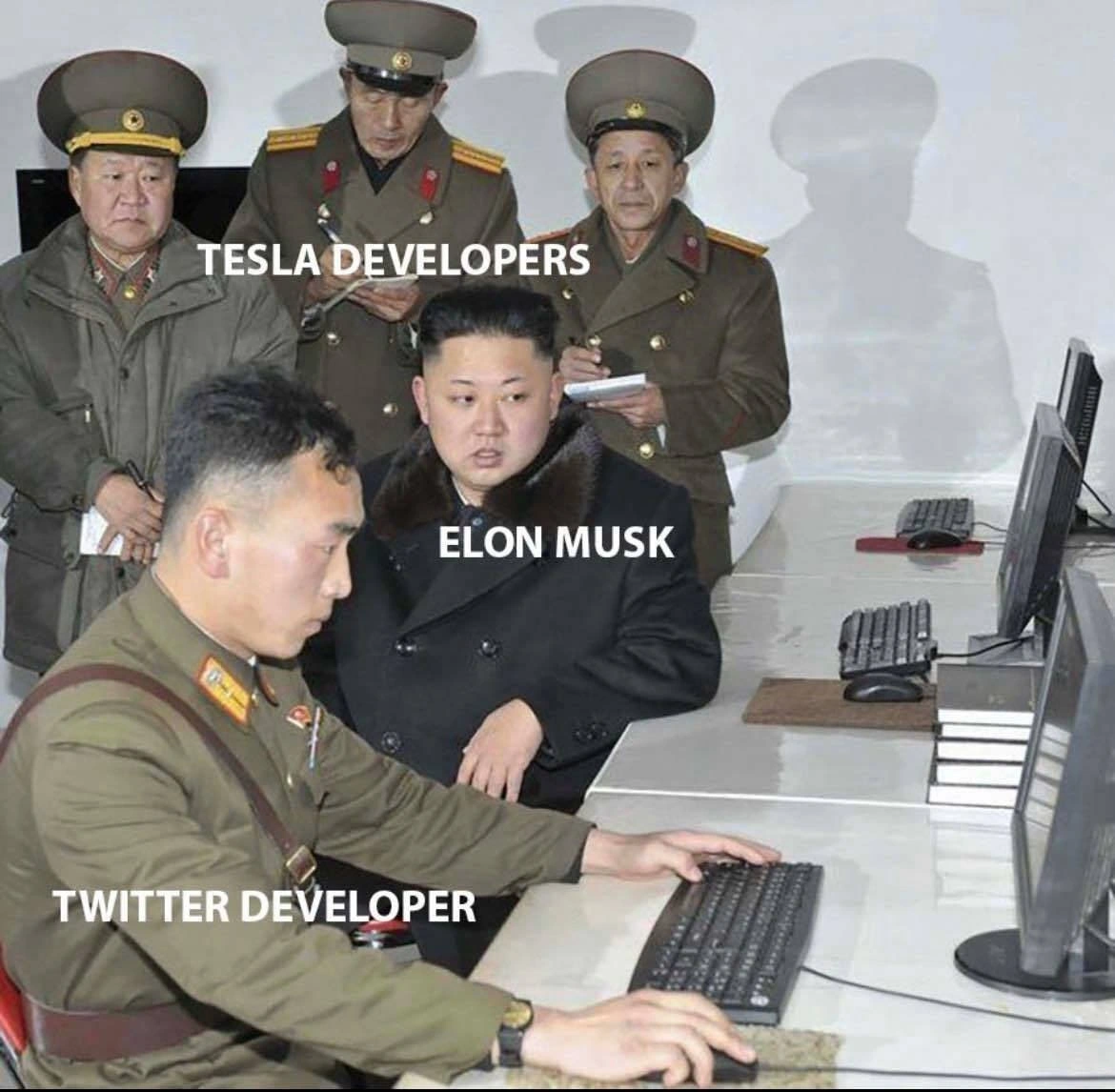
Imagine you’re at school working on a project, and suddenly the principal walks in with a bunch of teachers from another school. They all stand behind you, watching you write every word or solve every problem. Your own teacher is sitting there, super nervous, and the principal (who now runs the school) is leaning in, saying “Show me what you’ve done so far.” Scary, right? You’d probably sweat and maybe your hands would shake a little. This meme is like that scenario, but in a company. The “boss” of two companies (Elon Musk, who is kind of like a principal or a big boss in the tech world) goes to the Twitter office he now owns and watches a Twitter programmer work. And he even brings some of his favorite engineers from his other company, Tesla (like those extra teachers), to help judge the work. It feels like a super strict homework check in front of an audience. The picture makes it look like a military scene – very serious faces, uniforms, note-taking – to exaggerate how intimidating and intense it feels. It’s funny because normally writing computer code isn’t treated like a military drill, so this over-the-top setup is silly. But it also cleverly shows the poor programmer’s feelings: “Oh man, the big boss is literally watching everything I do!” It’s the kind of nervous laughter you get from seeing someone under huge pressure with so many eyes on them. Even if you’re not a coder, you can relate – nobody likes being watched that closely while they work, especially by important people. The meme takes that feeling and makes it extreme and cartoonish so we can smile about it.
Level 2: All Eyes on Code
This meme shows a dramatic scene to explain a pretty real tech-world event in simpler terms. In late 2022, Elon Musk bought Twitter, and suddenly everything changed at the company. The picture demonstrates one big change: Elon brought some of his Tesla engineers (people who work for his car company) into Twitter to help review (or audit) Twitter’s code. A code review is normally when programmers check each other’s code for mistakes or improvements before that code goes live. It’s usually a friendly, cooperative process among teammates. But here, it’s depicted as something far more intense – like a strict military inspection. Imagine your manager not only checking your work, but doing so with a team of outsiders watching over your shoulder. That’s what “all eyes on code” means: everyone is intensely observing what the Twitter developer is doing on his screen.
In the image, the person labeled “TWITTER DEVELOPER” is like a soldier at the keyboard, and “ELON MUSK” is the stern officer leaning in to supervise. The three men standing in the back labeled “TESLA DEVELOPERS” represent those engineers from Musk’s other company, Tesla. They’re holding notepads as if taking notes on the code – which is a funny exaggeration, since in reality you’d probably review code on your own computer, not scribble notes on paper like an old-school inspector. The whole setup feels like a military_inspection_meme, where the boss is treating the code review as seriously as a general would treat a critical mission briefing. This emphasizes the high pressure the Twitter developer must feel.
So, why is this happening? In real life, when Musk took over Twitter (twitter_acquisition), he didn’t fully trust the existing Twitter team right away. He had a reputation for running his companies in a very “hands-on” manner – he wanted things done fast and efficiently. By bringing in Tesla’s engineers (the people he already knew and trusted), he hoped to quickly understand Twitter’s technology and find any problems. This is a bit unusual – normally, one company’s engineers don’t just swoop into another company and start reviewing code. But Musk did it because he likely thought fresh eyes (especially eyes loyal to him) could spot issues or just verify the code’s quality. This is what we mean by cross_company_engineers: engineers from one company (Tesla) working in another (Twitter) to assess things.
Now, let’s explain some terms and context for those newer to this. Corporate culture is basically the personality or vibe of a company – how people work there, what the values are, what the pace is like. Twitter’s culture before was known to be more in line with typical social media firms: perhaps a bit more open, possibly a bit more relaxed about remote work and work-life balance. Tesla’s culture, driven by Musk, is known to be hard-charging, with very high expectations, long hours, and intense focus on results. When Musk became the boss of Twitter, these two cultures clashed. Suddenly Twitter employees had to adapt to Musk’s way (like very long work days or a no-nonsense attitude). The meme shows this clash by using a super strict, hierarchical visual: Musk as a commander and Twitter dev as a soldier. It’s an exaggerated way to say “Twitter’s workplace just got a lot more rigid and intense under the new management.” That’s a CorporateCulture shock!
ManagementVsEngineering is another theme here. In tech, there’s often some tension between management (who want things faster, cheaper, and aligned with business goals) and engineers (who know that building software is complex and takes time, and who value stability and good design). In this scenario, Musk represents management pushing hard – he wants to see the code, possibly find out why certain features or problems exist, and he wants changes ASAP. The Twitter developer represents the engineering side – likely knowing the system’s complexity, possibly nervous that things aren’t as simple as the boss hopes. The meme humorously portrays Musk literally looking over the engineer’s shoulder (over_the_shoulder_coding), which is something that can make any developer anxious. “Over-the-shoulder coding” is basically when someone stands behind you while you work on code. It’s like when a teacher stands right behind a student while they’re taking a test – pretty unnerving! Here it’s not just any teacher, it’s the principal with a team of inspectors. That’s why the pressure is sky high. This image screams executive_oversight_pressure – an executive (Musk) directly overseeing a technical process in a very intense way.
Let’s talk code for a moment: Twitter’s codebase (all the code that runs Twitter) is huge and was developed over many years. It includes code for features like tweeting, following, the timeline, ads, etc. They likely use multiple programming languages and frameworks (Twitter in the past used Ruby on Rails for some parts, Scala and Java for others, plus various databases and caching systems to handle millions of users). Tesla’s codebase, on the other hand, is very different. Tesla’s engineers work on software for electric cars – things like battery management systems, Autopilot (self-driving) algorithms, and the user interface in cars. Those involve languages like C++ or Python and deal with hardware, sensors, and real-time responsiveness. So, when Tesla engineers came to assess Twitter’s code, they were looking at something outside their normal domain. It’s a bit like a basketball coach trying to evaluate a soccer team – both are sports, but the rules and skills are different. They might spot some general things (like team organization or strategy), but they won’t know all the tricks of the game right away.
The meme exaggerates the seriousness of this code review. In a normal code review, you’d have maybe one or two colleagues giving feedback on a specific piece of code you wrote. Here, it’s shown as a whole panel of stern people reviewing potentially the entire codebase with the CEO watching. The text labels make it clear who’s who, even if the faces are blurred. It’s actually using a real photograph of a military setting to draw this parallel. By labeling the central figure “ELON MUSK” and the man at the computer “TWITTER DEVELOPER,” the meme maker tells us: this is Elon inspecting a Twitter engineer’s work. The other three are labeled “TESLA DEVELOPERS,” showing they’re Musk’s backup, like his officers. They even hold notepads, suggesting they’re writing down notes or findings. In reality, code reviews don’t involve paper note-taking; they’d probably be looking at the code on screens and maybe discussing or sending reports. But the notepads are a classic trope in military or government inspections, so it heightens the comedic effect and also hints “they’re going to report everything this poor dev does.”
The overall scene is in a sparse, grey room with old-school monitors (the boxy kind from the 90s, called CRT monitors). This setting gives a feeling of severity and old-fashioned authority, as opposed to a casual modern tech office with bean bag chairs – again highlighting the culture shock. It’s as if overnight Twitter went from a laid-back startup vibe to a rigid command center. The RelatableHumor factor for developers comes from that universal dread: having a powerful person suddenly audit your work. Many developers can relate to hurriedly explaining their code or justifying design decisions to a non-engineer boss or a new management team. It’s rarely a comfortable feeling! We usually joke about those moments because in hindsight they’re absurd, but at the time they’re quite stressful.
Finally, consider StakeholderExpectations in this context: Elon Musk and others who invested in Twitter are stakeholders – they have a lot riding on making Twitter more profitable or technically robust. Their expectations might include reducing costs, fixing bugs, adding features to make money (like new subscription models), etc., and doing it fast. By having this intense code review, Musk is signaling “I expect to find issues and address them immediately.” It’s both a fact-finding mission and a way to assert control (“I’m personally checking everything”). For a junior developer or anyone new to tech, it’s useful to know that while code reviews are normal, this style of code review is highly unusual and is being mocked here. It’s management and stakeholder pressure taken to an extreme.
In simpler terms, the meme is saying: “When Elon took over Twitter, it felt like a military boss doing a surprise drill inspection on the programmers.” It uses clear labels and that intense scene to get the point across even if you don’t know all the details. It’s funny to those in the tech community because it mixes two worlds (military-style oversight and software development) that normally don’t go together, highlighting how out-of-place and comically extreme Elon’s approach seemed to many Twitter employees and observers.
Level 3: Chain-of-Command Code Review
This meme perfectly captures a code review turned into a militaristic inquisition. Elon Musk (as the black-coated generalissimo in the meme) has literally marched into Twitter’s codebase with a squad of Tesla engineers at attention. It’s a satirical take on the real-life elon_musk_takeover of Twitter, where Musk brought in engineers from Tesla to audit Twitter’s software. The humor comes from the over-the-top portrayal of executive oversight pressure: Musk overseeing a Twitter developer like a supreme commander, while three Tesla devs stand by with notepads like stern officers ready to report any code crimes. It’s an absurd exaggeration, yet anyone in tech who’s experienced intense ManagementVsEngineering showdowns will be smirking (or cringing) in recognition.
At its core, this meme highlights a clash of CorporateCulture and a parody of cross-company code reviews. Twitter’s environment (pre-acquisition) was a typical social media tech company, whereas Tesla (and by extension Musk’s leadership style) is known for a high-intensity, top-down approach. Bringing cross_company_engineers from Tesla to scrutinize Twitter’s code is highly unorthodox – it’s like sending an elite automotive SWAT team to inspect a social media app. The meme plays on this by using a military_inspection_meme format: a serious North-Korean-command-center vibe (beige CRT monitors and all) to lampoon Musk’s hands-on, might-as-well-be-in-a-bunker management style. The visual of uniformed officers taking notes behind Musk screams "zero room for error." It’s funny because it dramatizes what Twitter devs likely felt: that sudden fear of an authoritarian code review where the new boss’s StakeholderExpectations are sky-high and every line of code could be judged as worthy or worthless.
From a senior developer’s perspective, this scenario hits close to home as a DeveloperPainPoints legend. We’ve seen scenarios where non-technical executives want to over_the_shoulder_coding review a system they barely understand, often right after an acquisition or a big outage. It usually ends up feeling performative and stressful. Here, Musk is essentially performing a surprise inspection. The Twitter engineer in the “hot seat” (labeled TWITTER DEVELOPER) has the joy of typing on command, possibly opening up source files while Musk watches like a hawk. If you’ve ever had a director or CTO hover behind your chair during a live debug session, you know how your brain starts screaming "don’t screw up, don’t screw up." That’s exactly the vibe here, dialed up to 11.
Consider the technical mismatch: Tesla’s developers are brilliant, no doubt, but they spend their days coding for self-driving cars and battery systems, not scaling a social network’s timeline or content moderation algorithms. It’s like asking a rocket scientist to critique a painter – both smart, but different expertise. The meme’s comedic genius is showing these Tesla devs dutifully “taking notes” behind Musk. What are they scribbling? Maybe DeveloperHumor observations like: “Why does this function have 5000 lines?”, “Monolith alert – no microservices here,” or “Uses Ruby on Rails? Not our usual C++.” They’re essentially outsiders performing a tesla_code_review on unfamiliar territory. The StakeholderExpectations from Musk is that they’ll identify underperformers or sloppy code instantly. But any senior engineer knows that parachuting into a massive foreign codebase and finding “the problems” in a day is borderline fantasy. Code quality and architecture can’t be evaluated with a quick glance, no matter how good you are. Musk’s approach is an example of an anti-pattern: assuming any top engineer can review any system in no time – a mix of hubris and desperation. The meme ridicules this by implying Musk needed his own Tesla DEVELOPERS platoon to make sense of Twitter’s code, as if not trusting the “enemy” code without his loyal lieutenants.
There’s a dark subtext here too: job security. In November 2022, right after the Twitter acquisition, employees feared mass layoffs (which indeed happened). So this “inspection” wasn’t just academic – it felt like a firing squad evaluation. The humor is dark because it’s basically true: picture being that Twitter dev showing your code to the new owner who has a reputation for firing people on the spot. DeveloperPainPoints? Oh, very much so – that’s a career nightmare scenario. It’s relatable humor only because many devs have been through smaller-scale versions of it (like a new boss questioning your entire project in a meeting). The meme takes that relatable fear and exaggerates it with the image of a literal authoritarian oversight. Musk’s cold stare at the monitor in the meme screams “Convince me why I shouldn’t delete this whole repository.” Meanwhile, the poor developer is probably thinking, “Please, not the quick-and-dirty patch I wrote at 2 AM last month…”.
Technically, code reviews are meant to improve code quality by having peers examine changes. They’re usually collegial, peer-to-peer, and focused on specific commits or pull requests. What’s depicted here is the polar opposite: a ManagementVsEngineering power move, a executive_oversight_pressure session with the big boss himself going through the entire codebase as if it were a battleground map. The meme is poking fun at how absurd and counterproductive that is. It hints that Musk might be looking for something (bottlenecks, bad code, or just confirming his bias that Twitter’s code is a mess). It also implicitly compares Musk to a dictator (the image is famously of Kim Jong-un with generals) – a jab at Musk’s intense, some might say authoritarian, management style during this takeover.
For seasoned devs, there’s extra irony in those old CRT-style monitors and dated command center setting. It subtly suggests that this whole approach is outdated or heavy-handed. Modern code collaboration happens on distributed version control, in remote code reviews on GitHub – not by hauling in a posse to stare at screens in person. The outdated monitors might as well represent Twitter’s alleged legacy systems that Musk believed needed overhaul. Or maybe it’s hinting that Musk’s method of handling the situation is as blunt as a 90s-era management tactic. Either way, it’s a visual gag that adds to the satire: cutting-edge tech companies shown as if they’re in a 1990s military bunker.
In summary, the meme’s humor springs from the extreme depiction of a CodeReview under duress, reflecting real anxieties from Musk’s Twitter takeover. It lampoons the CorporateCulture clash and the almost theatrical level of executive_oversight_pressure. Seasoned engineers chuckle (perhaps with a wince) because they recognize the “here comes the new boss with his own crew, and they want to rewrite everything by Monday” scenario. It’s a comedic case of truth being stranger (and funnier) than fiction – a TechIndustryHumor snapshot of that wild moment in tech history.
Description
This meme utilizes the three-panel 'Panik, Kalm, Panik' format featuring the surreal Meme Man character. In the first panel, Meme Man looks stressed with the caption 'I have a bug in production'. The second panel shows him calm, with the text 'I know exactly where the fix is'. The final panel returns to the stressed expression, captioned 'The fix is in a legacy system nobody has touched in 10 years'. This meme perfectly captures the emotional rollercoaster of incident response. It highlights the brief moment of relief and confidence when a problem is identified, immediately followed by the crushing despair of realizing the solution lies within a fragile, undocumented, and terrifying legacy codebase. It's a deeply relatable joke for senior engineers who are often the designated archaeologists for such systems
Comments
37Comment deleted
Fixing a bug in a legacy system is like defusing a bomb where the documentation is a single, faded sticky note that just says 'Good Luck'
Autopilot engineers: “Where’s the functional-safety spec?” Twitter monolith: “Here’s 14 years of git blame and a Fail Whale - mind, our safety margin is 280 characters.”
The only difference between a code review at Twitter and a military inspection is that at least the military has documented procedures and a clear chain of command that doesn't change via 2am tweets
When your CEO's context switching overhead is so high that one engineering team gets pair programming with the founder while the other team enjoys the luxury of autonomous decision-making and uninterrupted deep work - proving that sometimes the best management is benign neglect with adequate funding
Classic Brooks’s Law implementation: 1 dev + 1 exec + 4 clipboard engineers = six status updates, zero throughput
Proof the best engineers are forged in bunkers, not bootcamps
Org redesign: Twitter dev is the write-ahead log, Elon is the SPOF, and Tesla engineers are async replicas - strong consistency until the next tweet triggers a forced failover
Twitter dev's monitor: *they're forced to print all their code Comment deleted
Взять на работу жаба-скриптеров: ✖ Кидать во фронтенд челиков, занимающихся ИИ и ML: ✅ Comment deleted
Hire JS devs ❌ Force AI and ML devs to write the Frontend ✅ Comment deleted
honestly, seeing the tesla AI, they're better suited as frontenders Comment deleted
Do you have source code of Tesla AI? Comment deleted
better, I have videos of tesla autopilot running over kids Comment deleted
Send me them pls Comment deleted
too lazy, good night Comment deleted
Bruh Comment deleted
Wasn't that the vid where they had turned off autopilot? Comment deleted
they automatically turn off autopilot when they detect a crash about to happen Comment deleted
And it makes sense. It is not easy to hit a pedestrian even without autopilot. They always jump away trying to escape their destiny Comment deleted
lol, guy right there spreading rumors about videos created to damage reputation 😄 Comment deleted
This is the initial tweet you are talking about About which author confirmed that FDS were not used So he literally drove over mannequin driving your regular car Comment deleted
can I peacefully spread misinformation on the Internet thank you very much? Comment deleted
Nope ^_^ Comment deleted
https://twitter.com/i/status/1557310028167557120 Comment deleted
Btw, you’re are not censored in anyway or something. How tf I prevented you from spreading misinformation? 😄 Comment deleted
I did not say "prevent", I said "peacefully", already got like 10 replies asking for proofs lmao Comment deleted
Nobody tried to prevent it Comment deleted
I didn't say someone did Comment deleted
all I care about is that the autopilot is free (libre not gratis) Comment deleted
Based AI Comment deleted
please use english in this chat or add a translation (next message seems relatively good) Comment deleted
Где это? Comment deleted
please use english in this chat or add a translation "where is it?" Comment deleted
Sure Comment deleted
twitter Comment deleted
wtf, why they are doing it? Comment deleted
cause elon musk Comment deleted