Skip to content
DevMeme
1591 of 7435
JavaScript Developer Meets Unsigned Int
Languages Post #1779, on Jul 15, 2020 in TG

JavaScript Developer Meets Unsigned Int

Why is this Languages meme funny?

Level 1: Scary Counting

Imagine someone is comfortable counting toys normally, then another person says, "Now count them in special boxes that only hold certain numbers and can never go below zero." That feels suddenly more complicated. The meme is funny because the JavaScript developer can handle TypeScript, but old-fashioned number rules like UNSIGNED INT still sound like a monster under the bed.

Level 2: Numbers With Boundaries

An unsigned integer is a whole number type that cannot be negative. Because it does not reserve a bit for the sign, it can usually store a larger positive range than a signed integer of the same size. For example, an 8-bit unsigned integer can represent values from 0 to 255.

JavaScript developers usually work with number, strings, booleans, objects, arrays, and functions without choosing tiny numeric storage formats. TypeScript adds type safety by letting developers describe expected values, like a function taking a string or returning a number. That helps editors and compilers catch mistakes, but most TypeScript code still runs as normal JavaScript.

The meme exaggerates this gap. The JavaScript developer says TypeScript is manageable, but the phrase UNSIGNED INT sounds like a scarier world of low-level programming, memory buffers, binary files, embedded systems, and languages where picking the wrong integer type can create bugs. For someone early in frontend work, the joke is basically: "I learned types, but please do not make me learn the hardware-flavored ones yet."

Level 3: Type Erasure Panic

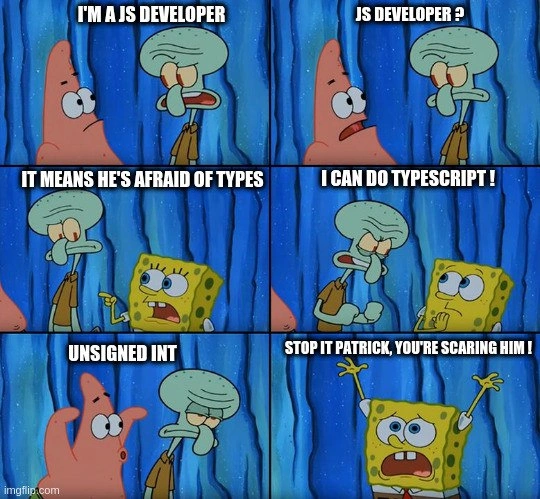
The six-panel SpongeBob meme starts with Squidward declaring, I'M A JS DEVELOPER, then escalates from I CAN DO TYPESCRIPT! to Patrick calmly saying UNSIGNED INT. SpongeBob's final warning, STOP IT PATRICK, YOU'RE SCARING HIM !, is the joke in one frame: TypeScript may make a JavaScript developer comfortable with annotations, interfaces, and compiler checks, but a real machine-sized numeric type brings the smell of bytes, overflow, and low-level consequences.

JavaScript's relationship with numbers is famously smooth until it is not. The everyday number type is a floating-point value, not a family of int8, uint16, int32, uint64, and so on. That design is convenient for web scripting because most code does not need to choose a storage width. It also means developers can spend years writing JavaScript without thinking deeply about signedness, overflow boundaries, binary representation, or whether subtracting one from zero in an unsigned type should become -1 or wrap to a very large value.

TypeScript changes the developer experience, but it does not turn JavaScript into C, Rust, or Go. Its types mostly guide tooling and compile-time checking; they do not create runtime integer primitives. You can write let count: number, but that is still JavaScript's numeric model after compilation. When the post metadata says Uint8Array goes brrr, it points at the exception: typed arrays expose fixed-width numeric storage for binary data, graphics, WebAssembly interop, network buffers, and performance-sensitive operations. Suddenly the friendly web language is asking whether this byte is signed, how many bits it has, and what happens at 255.

The humor is also a small language wars jab. Dynamic typing lets JavaScript move quickly by deciding many things at runtime. Static typing asks the compiler to catch more mistakes before execution. TypeScript is the peace treaty many frontend teams signed after enough production bugs escaped through undefined, accidental shape changes, and refactors performed with optimism. UNSIGNED INT is the next border crossing: not just "what shape is this object?" but "how exactly is this value represented in memory?" That is where the web stack's usual abstraction starts looking nervously at the floor.

Description

A six-panel SpongeBob meme shows Patrick, Squidward, and SpongeBob reacting to programming-language type systems. The visible text reads: "I'M A JS DEVELOPER", "JS DEVELOPER ?", "IT MEANS HE'S AFRAID OF TYPES", "I CAN DO TYPESCRIPT !", "UNSIGNED INT", and "STOP IT PATRICK, YOU'RE SCARING HIM !". The joke frames JavaScript developers as uncomfortable with strict or low-level types, with TypeScript as a partial concession and unsigned integers as an even scarier concept. It plays on dynamic typing versus static typing, JavaScript's number model, and the culture clash between web developers and languages with explicit primitive integer types.

Comments

1
Anonymous ★ Top Pick TypeScript gives JavaScript a seatbelt; `unsigned int` asks whether the car has a memory model and everyone gets quiet.
  1. Anonymous ★ Top Pick

    TypeScript gives JavaScript a seatbelt; `unsigned int` asks whether the car has a memory model and everyone gets quiet.

Use J and K for navigation