Skip to content
DevMeme
1590 of 7435
Failure Counter Fails First
Bugs Post #1778, on Jul 15, 2020 in TG

Failure Counter Fails First

Why is this Bugs meme funny?

Level 1: Broken Alarm

Imagine building an alarm that is supposed to ring whenever a toy breaks, but you spell the alarm button's label wrong, so the alarm breaks too. That is why the meme is funny: the programmer tried to track mistakes, and the mistake tracker immediately became another mistake.

Level 2: The Typo Tax

An incremental counter is a value that goes up by one each time something happens. In software monitoring, a failure counter might help developers answer questions like: How many requests failed? How many background jobs crashed? Did the new release make errors more common?

The image is funny because the counter is supposed to count failures, but a spelling mistake creates a new one. That could happen through a misspelled variable name, a wrong metric label, or a key that does not exist in a map or object. In many languages, that kind of mistake can cause a runtime error, meaning the program breaks while it is running instead of being caught earlier.

For junior developers, this is a useful lesson: support code is still code. Logs, metrics, alerts, and exception handlers should be tested because they often run exactly when the system is already in trouble. If the emergency flashlight has dead batteries, the power outage gets a lot more educational.

Level 3: Observability Observes Itself

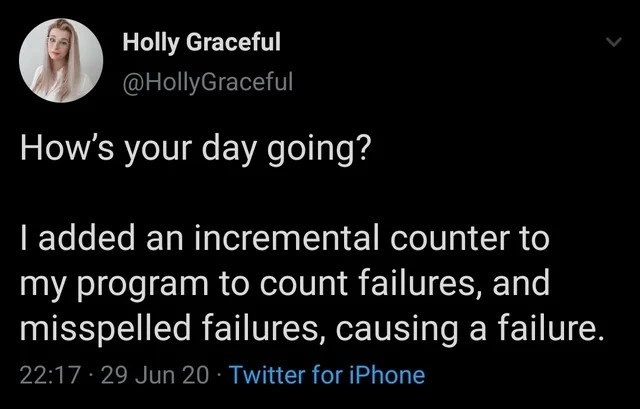
The tweet says, I added an incremental counter to my program to count failures, and misspelled failures, causing a failure. That is the whole little tragedy: code written to make failures measurable becomes the newest failure mode. Every experienced developer has seen this species of bug hiding in the supposedly "safe" parts of a system: logging, metrics, retries, alerts, cleanup handlers, and dashboards. The places meant to explain the fire are often made of slightly drier wood.

The joke is sharp because observability code is usually treated as secondary, yet it executes inside real production paths. A counter like failures_total might be incremented when an exception happens, when a job cannot process an item, or when an API request returns a bad status. If the variable, metric name, dictionary key, enum, import, or attribute is misspelled, the program can fail while trying to report that it failed.

try:
    process_job(job)
except Exception:
    metrics["failures"] += 1
    raise

# Somewhere else:
metrics = {"failures_total": 0}

That mismatch is small enough to survive code review and large enough to ruin your afternoon. It is also why error handling needs the same discipline as the main feature path. The sad comedy is that the failure counter may never count the original failures, because the counter itself interrupts the handling path first. Congratulations: the monitoring system has achieved self-awareness, immediately followed by a stack trace.

This lands especially well under code quality and debugging because it compresses a common anti-pattern into one sentence. Teams often add monitoring after something has already gone wrong, under pressure, with incomplete tests, and with the confidence that "it is just a counter." Those are the most cursed words in software after "quick fix" and "temporary migration."

Description

A dark-mode Twitter screenshot shows a post by "Holly Graceful" with handle "@HollyGraceful". The tweet reads, "How's your day going? I added an incremental counter to my program to count failures, and misspelled failures, causing a failure." The footer shows "22:17 · 29 Jun 20 · Twitter for iPhone". The joke is a self-referential bug: observability code intended to count failures introduces a new failure because of a spelling mistake, a painfully familiar class of tiny defects in instrumentation and error handling.

Comments

1
Anonymous ★ Top Pick The first metric every monitoring system emits is usually `monitoring_system_created_its_own_incident_total`.
  1. Anonymous ★ Top Pick

    The first metric every monitoring system emits is usually `monitoring_system_created_its_own_incident_total`.

Use J and K for navigation