Skip to content
DevMeme
4555 of 7435
On-Call Engineer's Weekend
OnCall ProductionIssues Post #4997, on Nov 11, 2022 in TG

On-Call Engineer's Weekend

Why is this OnCall ProductionIssues meme funny?

Level 1: Caught with a Fake ID

Imagine a friend who isn’t actually a doctor dressing up in a white coat and sneaking into a doctors’ meeting. If the organizers find out, they’d say, “Hey, you’re not a real doctor!” and kick them out. This meme is doing the same kind of pretend-play joke with JavaScript, which is a computer language. It’s as if JavaScript tried to join a club of “real programming languages” by wearing a disguise (a fake ID that says “I’m a real language!”). Twitter, acting like the club bouncer, spotted the fake and shouted, “You’re not what you say you are – out you go!” It’s funny because we know JavaScript is hugely popular and used everywhere (so it’s like a famous friend everyone knows), but some people still jokingly treat it like it doesn’t belong. Seeing Twitter “suspend” JavaScript for pretending to be real is a silly, playful way to say, “Haha, caught you pretending!” It’s basically humor about pretending to be something you’re not, set in the tech world.

Level 2: Frontend vs Backend Banter

For a junior developer or someone newer to tech, let’s break down why this meme is funny:

First, JavaScript is a programming language – one of the most popular ones, especially for web development. It’s what makes websites interactive. If you click a button and something changes on the page without reloading, that’s likely JavaScript at work. It started as a scripting language (code that runs in a host environment like a browser) mainly for frontend tasks – the part of software that users see and interact with (web pages, buttons, forms). Over time, JavaScript got more powerful and even moved to the backend (the server side, where languages like Python, Java, or C# traditionally handle data and logic).

Now, the joke in the meme is calling out an old insult: “JavaScript isn’t a real programming language.” This is something you might hear in lighthearted developer arguments (so-called language wars). It’s not a serious statement – obviously JavaScript is a real programming language (it can make loops, run logic, control hardware via Node.js – everything a programming language is supposed to do). But why do people say that jokingly? A few reasons:

  • Historical bias: Years ago, JavaScript was used only for simple webpage tricks like pop-up alerts or form validation. “Serious” applications were written in other languages. Some veteran devs formed an (unfair) opinion that JavaScript was just a toy.
  • Dynamic vs Static: JavaScript is dynamically typed, meaning you don’t have to declare variable types, and it does a lot at runtime. This can lead to odd behavior unless you know what you’re doing. By contrast, languages like Java or C++ are statically typed and compiled, catching errors early. So, a camp of developers consider that more “real” or industrial-strength. They’d jokingly say JavaScript felt more like scripting than programming because it was more permissive (and, in their view, error-prone).
  • Community Banter: There’s a friendly rivalry between frontend devs (who mostly use JavaScript) and backend devs (who use a variety of other languages). A backend dev, teasing their frontend friend, might smirk “Yeah, but when are you going to use a real language?” It’s half-joking, half-good-natured ribbing. The frontend dev might retort with jokes about backend code or say “Well, JavaScript runs everywhere now, so it’s as real as it gets!”

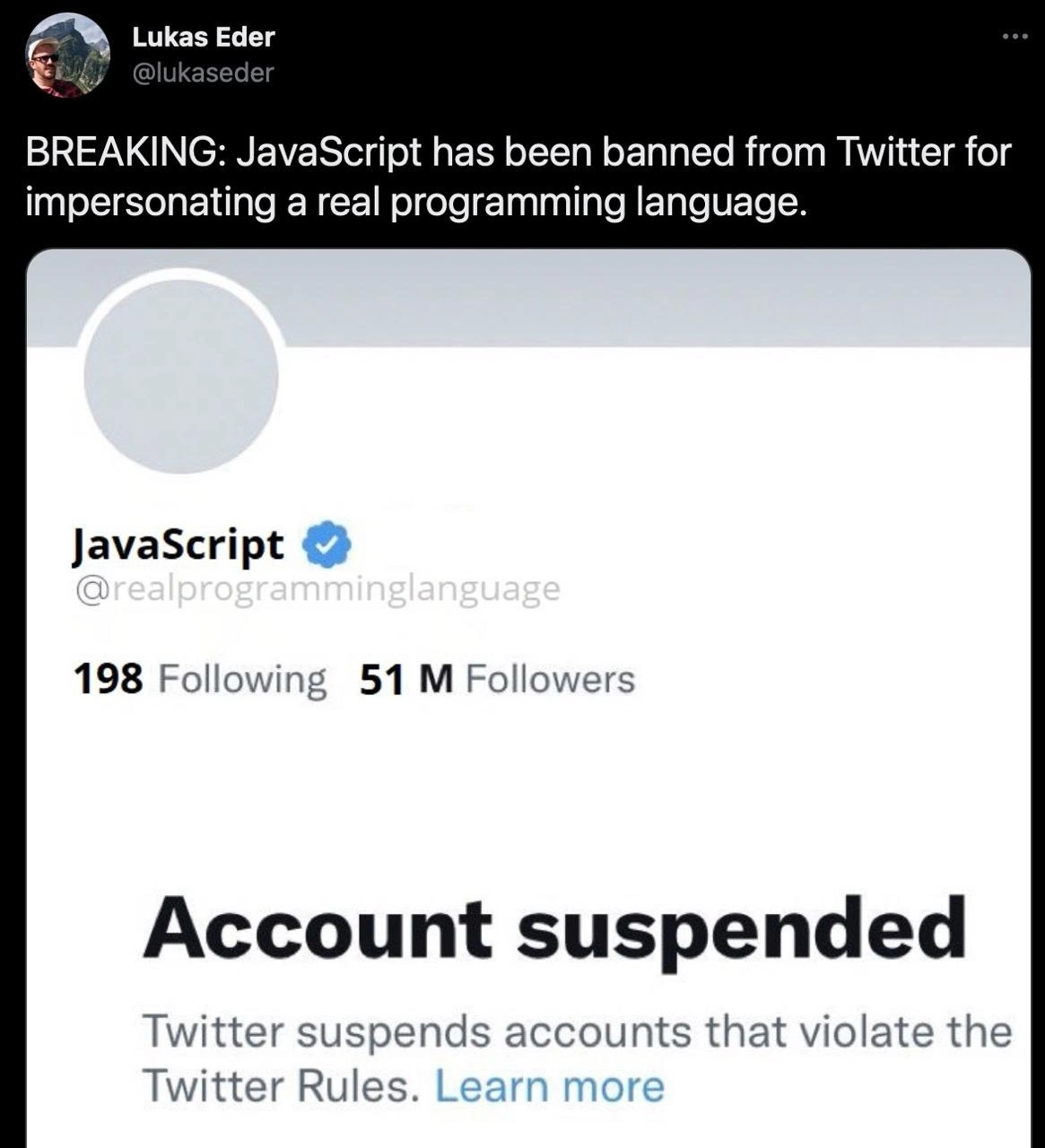
Now, about the Twitter account suspension part: The meme is formatted to look like a Twitter post from user Lukas Eder (a real developer known on Twitter). The text says: “BREAKING: JavaScript has been banned from Twitter for impersonating a real programming language.” Below that, the image shows what looks like a Twitter profile:

  • Name: “JavaScript” with a blue checkmark (which typically means the account is verified as authentic on Twitter).
  • Handle: @realprogramminglanguage – this is a made-up handle as a joke. It claims “real programming language” right in the name, like how parody or impersonation accounts often pick deceptive handles.
  • Followers/Following: “198 Following 51M Followers” – those numbers are exaggerated for humor. 51 million followers signals that if JavaScript were a person or brand, it’s extremely popular (indeed millions of developers “follow” or use it). It makes the scenario feel “official” – as if the entire dev world was following this account.
  • Suspension Banner: It says “Account suspended – Twitter suspends accounts that violate the Twitter Rules.” On Twitter, when an account is banned or suspended (especially for impersonation or rule violations), this banner appears on their profile.

So putting it together: The meme pretends that JavaScript’s official Twitter account got suspended because it violated a Twitter rule – specifically impersonation. Impersonation means pretending to be someone or something you’re not. For example, if I made a Twitter account pretending to be a famous person or company, I’d get in trouble. Here, the something JavaScript is accused of pretending to be is “a real programming language.” The phrasing is deliberately ridiculous – Twitter would never suspend a programming language’s account (there isn’t even an official account for a language like that, usually!), and certainly not for that reason. But stating it so seriously mimics tech news or a Twitter moderation message, which makes it absurd and funny.

For a new dev, it helps to know this is part of a long-running joke in dev communities. You might see memes where one language mocks another, or comments like “CSS is not a programming language” or “SQL isn’t real programming” thrown around. These are usually not meant to dismiss anyone’s skills (all these tools are important!), but rather to poke fun at each language’s quirks and the pride of its users. In this case, JavaScript – despite basically running the entire modern web – is being mocked as if it’s just pretending to be legitimate.

Why Twitter? In late 2022, Twitter was in the spotlight for suspending a bunch of accounts that were impersonating public figures (there was chaos with verified checks at that time). Devs on Twitter started making jokes riffing on that. So someone took that context and thought, “What’s a funny fake impersonation we can imagine? Oh, how about the programming language everyone loves to hate: JavaScript impersonating a real language!” The result is this meme. It resonates with developers because it references:

  • A real-world tech news event (Twitter suspending impersonators),
  • A classic programmer inside-joke (JavaScript’s status as a “proper” language being teased).

In short, as a junior dev, you should read this meme as a playful roast. It’s like a comedian making fun of a hugely successful pop star by saying “They got kicked out of the Musician’s Guild for impersonating a singer.” You know the pop star is a singer (and very popular), which makes the joke cheeky. Here, JavaScript is that pop star of programming – immensely popular, but still the target of jokes. The meme’s format and details (blue check, suspended banner, the handle name) all exaggerate the scenario to sell the joke. It’s the techie equivalent of a cartoon making fun of the cool kid on the block. And if you’ve experienced any of the JavaScript ecosystem’s wild parts (like juggling dozens of frameworks or odd language behavior), you can appreciate the roast while still loving the language. That mix of affection and teasing is key to developer humor in communities.

Level 3: Verified Impostor Language

At the senior developer level, this meme is a tongue-in-cheek mashup of Twitter’s impersonation policy with the perennial language wars in programming. In November 2022, Twitter had a crackdown on accounts pretending to be someone they’re not (impersonation, especially after the blue-check fiasco). This meme imagines that JavaScript – the hugely popular web scripting language – got caught “impersonating a real programming language.” It’s a witty senior-level jab that plays on the long-running joke: “JavaScript isn’t a real language.” Here’s why that’s funny to experienced devs:

  • Language War Satire: For decades, programmers have poked fun at each other’s favorite languages. Seasoned devs remember heated debates like Java vs. C++, tabs vs. spaces, and yes, “scripting language” vs “real language.” JavaScript has often been the butt of these jokes. It started life in 1995 as a simple browser scripting tool and was sometimes dismissed as a “toy” compared to “serious” compiled languages (like Java, C++, or even its namesake Java). By joking that Twitter banned JavaScript for impersonation, the meme satirizes this elitist attitude: JavaScript is portrayed as a fraud claiming to be on par with the big guys. It’s a playful roast that senior devs recognize from countless forum flame wars.

  • Twitter Impersonation Twist: The meme format mimics a Twitter UI screenshot. It shows a fake profile for “JavaScript” with a blue check and the handle @realprogramminglanguage. That handle is a dead giveaway of the joke – it’s like JavaScript is loudly proclaiming “I really am a proper language, guys!” Senior devs see the irony: Twitter’s verification (blue check) is supposed to confirm you are who you say you are. But here JavaScript’s claim to be a “real programming language” is treated as a false identity, hence the Account suspended banner. This directly parodies Twitter’s rule: no impersonating others. Only in this case, JavaScript is supposedly impersonating a category (real programming languages) that gatekeepers say it doesn’t belong to. It’s a clever tech humor crossover – mixing social media admin strictness with geeky language gatekeeping.

  • Shared Trauma & Jokes: Many veteran developers have either made or heard jabs about JavaScript’s quirks, so the meme hits home. For example, JavaScript’s dynamic typing can produce absurd results that purists love to mock:

    console.log([] + []);      // Outputs: ""  (empty string, wait what?)
    console.log("5" - 2);     // Outputs: 3   (string "5" becomes number 5 here)
    console.log(typeof NaN);  // Outputs: "number" (NaN means Not-a-Number... oh the irony!)
    

    These oddities have fueled the "JavaScript is weird" narrative. A grumpy systems programmer might say: “With behavior like that, is JavaScript even a real language?” It’s an exaggerated complaint, but it’s part of tech folklore now. The meme leans into this shared experience: everyone who’s wrestled with JavaScript type coercion, callback hell, or cross-browser quirks chuckles at the idea that JavaScript’s 51 million followers (a humorous exaggeration of its popularity) couldn’t save it from being deemed illegitimate by some higher authority (Twitter’s ban-hammer, in this case).

  • Frontend vs Backend Banter: Underneath the humor is a lighthearted dig at frontend developers vs backend developers culture. Historically, backend engineers (working with languages like Java, C#, C++) teased that their work was “real programming,” while frontend scripting (mostly done in JavaScript) was considered easier or less rigorous. JavaScript has since grown up – it now runs servers (Node.js), flies drones, even does machine learning – but the jokes from the old days persist. This meme is essentially one of those jabs crystallized: a backend veteran humorously suggesting JavaScript should be “suspended” for pretending to be as serious as, say, a robust backend language. It’s funny because by 2022 JavaScript dominates the dev world (web, mobile via React Native, desktop via Electron, etc.), so calling it “not real” is an absurd, deliberately provocative claim. It’s a bit like playfully telling Superman he’s not a real hero – obviously untrue, said only to get a rise and a laugh.

  • Historical Irony: For the senior geeks, there’s even a meta-joke: JavaScript literally got its name by riding on Java’s reputation. In the 90s, Netscape added a scripting language to browsers and, in a marketing move, named it "JavaScript" to sound like the hot new language Java (despite the two having almost nothing in common!). In a sense, JavaScript did “impersonate” Java’s credibility to gain acceptance. Fast forward to today, and the meme wryly suggests Twitter noticed this decades-long impersonation and finally dropped the ban hammer! It’s a deliciously nerdy full-circle: the impostor gains 50M followers and conquers the world, yet someone still yells, “You’re not legit – suspended!

In summary, at the expert level this meme is layering an inside joke on top of an inside joke. It mocks both Twitter’s heavy-handed moderation and programmers’ habit of gatekeeping what counts as a “real” language. The humor lands because it’s absurd yet familiar: every seasoned dev knows the rule – “Never feed the trolls in language wars” – but here we see Twitter feeding the biggest troll of all by banning JavaScript outright. It’s a scenario so ridiculous that it tickles the collective memory of countless late-night arguments and coding quirks we’ve all learned to live with. Senior engineers laugh (perhaps with a hint of schadenfreude), because they’ve seen this debate rage forever, and this meme “suspends” it in the most literal way imaginable.

Description

This meme uses the popular 'This is Fine' format, where a cartoon dog sits in a room engulfed in flames, calmly stating 'This is fine.' In this context, the dog represents an on-call engineer during a major production incident. The flames symbolize the chaos of servers crashing, databases failing, and alerts firing off. The dog's calm denial is a humorous exaggeration of the pressure and stress of trying to remain composed while firefighting a critical outage, especially during off-hours or weekends. It's a deeply relatable image for anyone who has been on the receiving end of a pager alert at 3 AM

Comments

12
Anonymous ★ Top Pick The 'This is fine' dog is the SRE team's official mascot. The fire is just unmonitored technical debt finally achieving its thermal potential
  1. Anonymous ★ Top Pick

    The 'This is fine' dog is the SRE team's official mascot. The fire is just unmonitored technical debt finally achieving its thermal potential

  2. Anonymous

    Twitter’s impersonation filter auto-suspended JavaScript the moment it spotted the keyword “class”; even the bot knew that was just prototype chaining in a fake moustache

  3. Anonymous

    Meanwhile, TypeScript filed an appeal claiming it's just JavaScript wearing a suit to job interviews

  4. Anonymous

    The irony here cuts deep: JavaScript, the language that runs on every browser and powers half the internet, getting suspended for 'impersonation' perfectly captures the cognitive dissonance of senior engineers who've spent decades watching it evolve from a toy scripting language into the backbone of modern web infrastructure. We've all been in that architecture review where someone dismisses JS as 'not a real language' while their entire microservices mesh communicates via Node.js APIs. The 51M followers is the real kicker - that's roughly the number of developers who've reluctantly accepted that whether we like it or not, JavaScript won the platform war

  5. Anonymous

    Twitter finally enforces type checks: JavaScript is suspended; the appeal runs after the microtask queue drains - right after TypeScript erases all the evidence at compile time

  6. Anonymous

    Twitter's auth check finally worked: typeof account !== 'real_language', so suspended - the strict mode JS devs always wanted

  7. Anonymous

    JavaScript got suspended for impersonating a real language; TypeScript tried to appeal, but tsc erased the evidence during transpilation

  8. @sundharwinston 3y

    😂😂

  9. @pinguin2001 3y

    Lol no (at least not anymore if it ever was)

    1. @TERASKULL 3y

      check the handle

    2. @princeofcanaan 3y

      You did not pay attention to the route - you’re fired

    3. @callofvoid0 3y

      lost many followers?

Use J and K for navigation