Skip to content
DevMeme
4556 of 7435
Senior Engineer's Simple Solution
DesignPatterns Architecture Post #4998, on Nov 11, 2022 in TG

Senior Engineer's Simple Solution

Why is this DesignPatterns Architecture meme funny?

Level 1: Quick Chat Gone Long

Imagine your teacher says, “This will be a super quick chat, just a minute!” but then it turns into an hour-long talk where you’re just sitting there bored. You expected a short check-in, but it never ends. This meme is laughing at that kind of situation. In software teams, there’s supposed to be a fast little morning meeting so everyone knows what’s going on – kind of like a quick huddle. But sometimes that meeting goes on and on, way longer than it should, and everyone gets restless. It’s like when Mom or Dad promises “We’ll leave the store in 5 minutes,” but an hour later you’re still there waiting. The joke here is that the team wanted true Agile (the quick meeting and fast-moving style), but what they got instead was a never-ending meeting at home. It’s funny in the same way it’s funny when a “short story” just keeps going: you laugh because you recognize the feeling of “This was supposed to be quick, why is it taking forever?!”

Level 2: Stand-Up Sit-Down

Now let’s break this down in simpler terms. Agile software development is a way of creating software in short cycles, focusing on quick delivery and frequent check-ins rather than big long-term plans. One popular Agile framework is Scrum, which has a few core rituals (often called Agile ceremonies). The daily stand-up (also known as the "daily Scrum") is one such ritual: the team meets every day, usually each morning, to keep everyone in sync. It’s nicknamed a “stand-up” because it’s meant to be so brief that people don’t even sit down for it! Ideally, it’s time-boxed (strictly limited) to 15 minutes. In those 15 minutes, each team member typically answers three questions:

  • What did I do yesterday? (Progress since the last meeting)
  • What will I do today? (Plan until the next meeting)
  • Do I have any blockers or impediments? (Is there anything stopping me from making progress?)

By design, that’s all that should happen in a stand-up. It’s not supposed to be a detailed status report or a problem-solving session – just a quick round-robin to ensure the team is coordinated and any roadblocks are identified. The goal is to communicate important updates swiftly so everyone can get back to work.

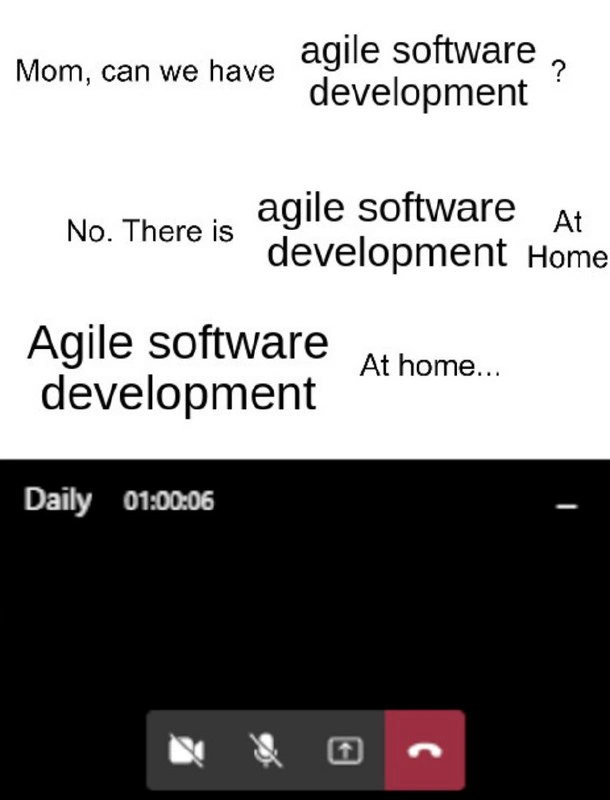
Now, look at the meme’s image. It parodies a well-known meme format where a child asks for something (here the kid asks, “Mom, can we have agile software development?”). The parent says, “No, we have agile software development at home.” The joke is that the version “at home” is a cheap or poor substitute for the real thing. In the meme, the “agile at home” is depicted as a remote "Daily" meeting that has lasted 01:00:06 (over an hour)! The screenshot looks like a video call interface – likely something like Zoom, Microsoft Teams, or Google Meet – with a black screen (perhaps everyone has their camera off) and the bottom bar showing icons: a camera icon (with a line through it, meaning cameras are off), a microphone icon (also muted), a screen-sharing icon, and a big red phone icon to hang up. The word "Daily" at top with the timer indicates this call has been going on for an hour and 6 seconds.

For a junior developer or someone new to Agile, here’s why that’s funny (and painful): a daily stand-up meeting is supposed to be 15 minutes or less. It’s so short you shouldn’t even need to sit. But in this “at home” version, the meeting has ballooned to 60 minutes – that’s four times longer! Essentially, what should be a quick team huddle has turned into a long, dragging meeting where probably one person is talking while everyone else is muted and maybe half-listening. This is a common Agile pain point in real life: many teams call themselves “Agile” and follow rituals like daily stand-ups, but they don’t stick to the spirit. Instead of a fast-paced update, the daily stand-up becomes just another long status meeting.

Remote work (RemoteWork) can make this worse. In an office, a stand-up might literally have everyone standing in a circle, which naturally pushes people to keep it short – nobody wants to be on their feet forever. But when everyone is remote at home, people are relaxed in their chairs, and there’s less pressure to wrap up quickly. Also, on a video call, it's easy for the discussion to stray: maybe someone starts sharing their screen to demonstrate a bug, others chime in, and before you know it, the "stand-up" loses focus. Communication via video can also be clunky – folks forget to unmute, talk over each other, or there’s a lag – which can waste time and lead to “Sorry, you go ahead…” back-and-forth. All these remote meeting problems mean what should be a 15-minute sync can drag on and on.

So the meme is highlighting this contrast in a humorous way. Real Agile software development should be efficient and streamlined. But the phrase “agile software development at home” in the meme implies a knockoff version: the company claims to be Agile, but their implementation is flawed. An hour-long daily meeting is as far from “agile” as you can get, and every developer who’s sat through a pointless hour on Zoom will relate to that. It’s a bit of Agile humor poking fun at workplaces that turn Scrum ceremonies into the very thing Agile was supposed to eliminate: lengthy, draining meetings.

Level 3: Timebox Overflow

At the highest complexity, this meme underscores how Agile ideals can be subverted by real-world habits. It riffs on the classic "Mom, can we have X? We have X at home." meme format, with agile software development as the coveted X. In theory, Scrum’s daily stand-up meeting is supposed to be a time-boxed 15-minute lightning round where each team member quickly shares yesterday’s progress, today’s plan, and any blockers. The punchline here is that “Agile at home” turns out to be an hour-long video call labeled "Daily 01:00:06". In other words, the team’s 15-minute stand-up has grotesquely overflowed to 60+ minutes, violating one of Agile’s most basic principles.

This is Agile in name only: the label says "Daily Stand-up", but the practice screams old-school meeting overload. The meme’s dark video-conferencing screen (with camera-off, mic-off, and share-screen icons, plus a big red hang-up button) is instantly recognizable as a remote meeting interface (think Zoom or Teams). The timer "01:00:06" in the corner reveals the painful truth: this “quick sync” has turned into a marathon meeting. Seasoned developers will chuckle (or cringe) because they’ve endured these so-called Agile ceremonies that drag on endlessly. The humor cuts deep: we've replaced one long waterfall status meeting with daily mini-waterfalls.

Why is this funny to a senior dev? Because it’s too real. Agile’s entire promise was to avoid bureaucratic time-wasters, yet here we are spending an hour on what should be a 15-minute stand-up. It’s a textbook case of cargo-cult Agile: performing the rituals without the underlying discipline. A time-box means the meeting must end at 15 minutes, forcing concise updates. But in practice, maybe Bob started discussing a bug in detail, Alice shared her screen to demo a feature, then the project manager turned the stand-up into a full status call. Before you know it, the timebox blew up. No one enforced the limit – perhaps the Scrum Master is MIA or too polite – so the meeting just sprawled. The only agile thing here is how quickly everyone’s patience ran out.

This scenario reflects a common Agile antipattern: the daily stand-up that devolves into a status meeting or design discussion. In a healthy Scrum process, deeper discussions are supposed to be parked for later (“let’s take that offline”). But in reality, teams (especially over RemoteWork) often lack other touchpoints, so the stand-up becomes a catch-all meeting. Remote communication gaps can make people overcompensate with extra talk. Plus, on a video call, folks are comfortably seated (not literally standing), so that physical reminder to keep it short is gone. The result? An exhausting hour where half the team is on mute, probably checking emails or AgileHumor memes while one person rambles. It’s a scene of MeetingOverload: the very opposite of the snappy, focused collaboration Agile advocates.

In essence, the meme highlights the tragicomic gap between Agile theory and practice – the Expectation vs. Reality of modern Scrum:

Agile Stand-Up (Ideal) "Agile" Stand-Up (Reality)
Time-boxed to 15 minutes, then stop. Bloated to 60+ minutes (time-box? What time-box?).
Everyone literally stands to encourage brevity. Everyone sits comfortably at home on Zoom, meeting drags on.
Each person shares 3 key points (yesterday, today, blockers) and that’s it. People dive into minutiae and side discussions on a "daily" call.
Quick sync to unblock and then back to coding. Full-blown status meeting or design review hijacks the morning.
Scrum Master ensures rules are followed, meeting stays on track. Scrum Master (if any) lets it slide, or manager turns it into a monologue.

Every veteran dev has experienced this irony: the methodology designed to make us agile can become so misused that it feels downright fragile. We laugh (and groan) because we recognize our own sprint planning horror stories and stand-ups that felt like *standing *in quicksand. The meme’s tongue-in-cheek format nails this contrast by showing “Agile at home” as a Frankenstein version of true Agile — a daily stand-up gone wild. In the end, it’s a form of collective commiseration: we’re bonding over the shared pain of Agile ceremonies that lost their way.

“This will just take 15 minutes.” — Famous last words before a daily stand-up mutates into an hour-long ordeal.

Description

This meme features a highly complex, multi-stage Rube Goldberg machine designed to perform a simple task, like turning on a light switch. The machine is labeled 'Senior Engineer's solution to a simple problem'. The image humorously critiques the tendency of some experienced engineers to over-engineer solutions, creating unnecessarily complex systems for straightforward problems. This often manifests as using microservices for a simple CRUD app or implementing a distributed message queue for a task that a simple script could handle. The joke resonates with developers who have witnessed or participated in creating complex architectures for simple requirements

Comments

11
Anonymous ★ Top Pick A junior asks, 'How do we solve this?' A senior asks, 'How can we solve this with Kubernetes, Kafka, and a service mesh?'
  1. Anonymous ★ Top Pick

    A junior asks, 'How do we solve this?' A senior asks, 'How can we solve this with Kubernetes, Kafka, and a service mesh?'

  2. Anonymous

    If your “15-minute stand-up” outlives the default AWS STS session, you’re not doing Scrum - you’re just renewing waterfall credentials

  3. Anonymous

    When your company's interpretation of "individuals and interactions over processes and tools" is making the Sydney team attend standups at 1am because the Scrum Master read that synchronous communication is non-negotiable

  4. Anonymous

    Ah yes, the classic 'agile transformation' where the 15-minute daily standup metastasizes into a 60+ minute status report marathon because someone decided 'agile' means 'let's have more meetings to talk about having fewer meetings.' Nothing says 'individuals and interactions over processes and tools' quite like forcing the entire team to sit through an hour-long Zoom call where three people discuss a merge conflict while everyone else contemplates their career choices. The Scrum Guide says daily standups should be timeboxed to 15 minutes, but apparently that's more of a 'guideline' than a rule - much like how 'working software' became 'working on Jira tickets.'

  5. Anonymous

    When your “Daily” hits 01:00:06, that’s not Agile - it’s synchronous status serialization with human locking; you’ve built a distributed monolith around a calendar invite

  6. Anonymous

    Daily standup hitting 60+ minutes? Congrats, you've unlocked 'Meeting Velocity Prevention' - the true MVP of dysfunctional Scrum

  7. Anonymous

    Agile at home: when the “daily” hits 01:00:06, you’ve accidentally built a distributed status monolith - Scrum by name, waterfall by Zoom

  8. Deleted Account 3y

    I can feel the agility flowing through my bones

  9. @yoyatayo 3y

    i didnt get it, pls explain to fresher

    1. dev_meme 3y

      Daily meeting should be short and straight to the point, perfectly max 15 min/1min per person

      1. @yoyatayo 3y

        oh, now its funny

Use J and K for navigation