Skip to content
DevMeme
4554 of 7435
Ignoring Technical Debt for the New Shiny Thing
TechDebt Post #4996, on Nov 10, 2022 in TG

Ignoring Technical Debt for the New Shiny Thing

Why is this TechDebt meme funny?

Level 1: My Room, My Rules

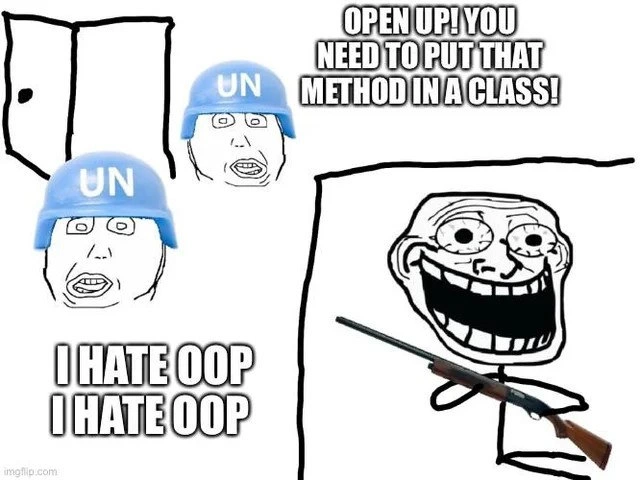
Imagine you’re playing with a toy in your room, and a strict friend or adult keeps banging on your door shouting, “Hey! You must put that toy inside a box before you play with it!” Sounds silly, right? You’re just happily playing, and now someone insists you follow an unnecessary rule. In this story, putting the toy in a box is like forcing a piece of code into a class even when you don’t need to. The person yelling is like the “rule enforcer” who takes the rule way too seriously. Now, you, the one playing, get so annoyed that you’re ready to stand your ground – picture you holding a toy sword or a water gun, saying “No! Leave me alone, let me play my way!” That’s exactly what’s happening in this meme, but with code. The trollface character is the playful kid (just with a mischievous grin and maybe a toy shotgun for comic effect), and the guys with helmets are the bossy ones trying to impose their rule. It’s funny because it’s an exaggerated playground scenario: one side yelling about a rule that feels over-the-top, and the other side comically overreacting to defend their freedom. Even if you don’t know about programming, you can laugh at the idea of someone storming into a room just to tell someone how to do a simple task “properly.” It’s a joke about being overly strict versus wanting to do things your own way. In short, the meme feels like a cartoon of a kid shouting “It’s my stuff, my rules!” when an adult demands an unnecessary formality – a clash of authority and independence, which is a pretty universal situation, whether with toys or with code.

Level 2: Method to the Madness

Let’s break down the joke in simpler terms. Object-Oriented Programming (OOP) is a way of coding where you organize functions into classes. A class is like a blueprint for an object (for example, a class Dog might define what a dog can do and what information a dog holds, like bark() method and age attribute). A method is just a function that lives inside a class – it’s an action that the object or class can perform. In contrast, not all programming is OOP: there’s Functional Programming (FP) and procedural programming where you can write functions that stand on their own, without wrapping them in a class. Think of a function as a simple recipe: you give it inputs, it gives you an output, and it doesn’t necessarily belong to any object or entity.

In the meme, the OOP enforcers (the guys with "UN" helmets) are essentially yelling, “You wrote a function by itself? That’s not allowed – put it inside a class!” They’re parodying those people (or linters/tools) who insist “proper” code means you encapsulate everything in an object. On the right side is the trollface character – a famous internet meme face that represents someone who is deliberately resisting or mocking. He’s holding a shotgun in a defensive stance, which is an exaggerated way to show he’s ready to fight back. The trollface developer is basically saying, “No! I like my function the way it is, outside any class. I don’t care about your rule – I just hate OOP!” The repeated line “I HATE OOP” underlines how fed up he is with Object-Oriented rules. It’s like he’s chanting his defiance. This reflects a developer’s resistance to a coding style he finds overbearing. It’s a classic oop_vs_fp showdown: one side (OOP) wants structure and classes everywhere, the other side (FP/procedural) wants simplicity and sees classes as extra fluff for certain tasks.

For example, consider a simple task: adding two numbers. In a procedural or functional style, you might just write a free function to do it. In Python, that could be:

# A simple standalone function (no class needed)
def add(x, y):
    return x + y

result = add(2, 3)  # result is 5

But in a strictly OOP mindset (like classic Java), you’d be told to place that in a class, perhaps as a static method:

// OOP-style: put the function inside a class
class Adder {
    public static int add(int x, int y) {
        return x + y;
    }
}

// Now you call it via the class
int result = Adder.add(2, 3);  // result is 5

As you can see, both approaches achieve the same result (adding 2 + 3 to get 5). The first is just a plain function call, straightforward. The second wraps the function in a class Adder even though we never really needed an “Adder object” – it’s just a container for the method. The meme jokes that some folks act like “code police” insisting on the second style everywhere, even when it’s arguably unnecessary.

All those tags like CodeQuality and CleanCodePrinciples come into play because the OOP enforcers believe they are improving the structure of the code by organizing it into classes. They’re picturing a clean, well-ordered codebase where every function belongs to a logical home (a class). On the flip side, the lone developer with the shotgun just sees this as nitpicking or pointless bureaucracy – he’d rather keep things simple with a standalone function. This relates to procedural_programming_preference: an older style of programming (think C language or simple scripting) where you just write sequences of commands and functions without the ceremony of classes. The meme’s humor lies in this code style conflict being blown up to absurd proportions. It’s like a SWAT team raid over something trivial.

To a newcomer, it might help to know that neither approach is “wrong” universally – it often depends on the programming language and the project. Some languages (like Java) pretty much require classes for everything, so you get used to that form. Other languages (like Python, JavaScript, or C) let you write free functions easily. Debates happen when people used to one style impose rules in a context where others don’t see the need. The trollface is an internet icon of trolling (intentionally stirring up reactions), so he might also represent that this developer is intentionally pushing the buttons of OOP purists by blatantly refusing their norm. In any case, the scene is a CodingHumor caricature of what could be an intense forum argument or a heated code review comment thread: “Method must be in a class!” vs “This rule is ridiculous!” Everyone in software has seen a version of this argument, which is why the image is both funny and relatable.

OOP Police: “Open up! You need to put that method in a class!”
Developer (Trollface): “No way, I’m not doing that – I hate OOP!”

Even if you’re new to these terms, you can catch the drift: one side is bossing with formal rules, the other is stubbornly refusing. The contrast between ObjectOrientedProgramming and FunctionalProgramming approaches is the key here, and the meme uses an over-the-top cartoon standoff to make the point.

Level 3: Class Warfare

On a more practical level, this meme nails a familiar scene in software development: the Language Wars of coding style and architecture choices. We have the so-called “OOP police” breaking down the door, yelling “Open up! You need to put that method in a class!” This is a tongue-in-cheek reference to colleagues or style guidelines that insist everything be an object. Many of us have endured code reviews or architectural discussions where someone zealously declares that even a tiny helper function must be wrapped in a class because “that’s the proper OOP way” (perhaps citing Clean Code principles about organization). The two helmeted figures with "UN" labels humorously cast these enforcers as peacekeepers – an ironic touch, since they’re not keeping the peace at all. It evokes the image of a pseudo SWAT team for code cleanliness, barging in to enforce encapsulation and class hierarchy on any free-roaming function. The repeated chant “I HATE OOP I HATE OOP” embodies the frustrated developer (the trollface on the right) who’s had enough of OOP dogma. Seasoned devs recognize that feeling: after wrestling with over-engineered architectures—huge class hierarchies, design patterns for everything, factory factories, etc.—one can indeed feel like grabbing the nearest (metaphorical) shotgun when told a simple function isn’t acceptable.

The humor bites because it’s too real: there are teams where writing a lone function is practically a crime. For example, in pure Java (a very OOP-centric language), you literally cannot have a function outside a class – every piece of code is inside some class, by language design. This leads to patterns like utility classes (MathUtils, StringUtils, and other God classes full of static methods) just to hold what could’ve been standalone functions. Many of us have seen trivial logic (like adding two numbers or formatting a string) absurdly wrapped in classes for the sake of formality. The meme’s "OOP Enforcers" personify those rigid style rules: think of a linter or senior dev barking “put it in a class or it doesn’t count as Clean Code!”. Meanwhile, the trollface with a shotgun represents the rebel developer, perhaps a fan of procedural or functional style, firmly saying “Nope.” It’s a code style conflict taken to cartoonish extremes.

This comedic standoff also reflects the tension between code quality ideals and practical simplicity. OOP proponents argue that putting functions into classes can improve organization, reuse, and testing (you can mock classes, subclass them, etc.), aligning with principles of Code Quality and maintainability. But taken too far, it leads to needless abstraction and complexity – imagine having to instantiate a BroomSwinger class just to execute a sweepFloor() method, instead of simply calling a sweep_floor() function. The trollface’s position is essentially: “Not every piece of code needs ceremonial packaging in an object.” Experienced devs often learn this the hard way. They’ve battled the resulting technical debt of over-engineered systems: forests of tiny classes and interfaces for every little action (sometimes jokingly called “enterprise FizzBuzz” or architecture astronautics). The FunctionalProgramming crowd and old-school procedural folks value simple, straightforward code – for them, a standalone function can be more readable and efficient than an artificially objectified one. So when the meme’s OOP squad yells about putting the method in a class, the trollface pointing a shotgun is basically channeling every exasperated coder who’s been told to add unnecessary layers. It’s darkly funny because it captures that excessive zeal: style guides or seniors enforcing rules that, in context, might be overkill. Every veteran developer has seen a “Trollface vs. OOP enforcers” moment in real life – whether it was resisting an unnecessary abstraction, or jokingly referring to colleagues as the “OOP police” in design discussions. This meme elicits a knowing grin (or groan) because we’ve all been in that proverbial room, defending a simple approach against the onslaught of well-intentioned but overzealous OOP purity. It’s CodingHumor drawn from our collective experience of balancing Clean Code principles with pragmatism.

Level 4: Paradigm Inquisition

At the core of this meme is a paradigm holy war – the longstanding battle between Object-Oriented Programming (OOP) and Functional Programming (FP). In theoretical computer science, these paradigms have distinct philosophies. FP traces back to Alonzo Church’s $\lambda$-calculus (treating computation as pure mathematical functions), emphasizing immutability and referential transparency (no side effects, same input always gives same output). OOP, on the other hand, evolved from the likes of Simula and Smalltalk (influenced by the needs of simulation and modeling real-world entities), focusing on encapsulation of state and behavior inside objects. Academically, one can model OOP with an object calculus – but it’s messy compared to FP’s elegant math. Hardcore FP aficionados might invoke monads and category theory to handle side effects in a principled way, while OOP practitioners cite the SOLID principles (from the gospel of Uncle Bob Robert Martin’s Clean Code scriptures) to justify designs. It’s practically a geeky religious schism: each side has its sacred tenets. No one expects the OOP Inquisition (😉 a nod to Monty Python) – yet here we are, dramatized as an absurd raid. The meme exaggerates this theoretical divide: the OOP enforcers treat an unclassed function as heresy against the one true faith of encapsulation, while the trollface heretic stands by the global function like Galileo with his telescope, muttering “Eppur si muove” (or rather, “It still works outside a class.”). In other words, fundamental design philosophy differences (state vs. pure functions, objects sending messages vs. composing functions) underlie this comedic standoff. Seasoned developers recognize that under the hood, both paradigms are Turing-complete—any algorithm you can do in one, you can do in the other—but the mindset and theory behind them couldn’t be more different. This meme humorously weaponizes those differences, as if decades of academic debates about code structure and language design have spilled out into a literal siege over a single rogue function.

Description

This meme uses the 'Distracted Boyfriend' format. The boyfriend, labeled 'Me', is looking over his shoulder at another woman, labeled 'Starting a new project with the latest framework'. His current girlfriend, looking annoyed, is labeled 'Paying off technical debt'. This meme perfectly captures the common developer dilemma of being tempted by new, exciting technologies while knowing they should be addressing the accumulated technical debt in their existing projects. It's a relatable scenario for senior engineers who understand the long-term consequences of neglecting maintenance for the allure of the 'new shiny'

Comments

10
Anonymous ★ Top Pick Why do developers love new frameworks? Because it's easier to create new technical debt than it is to pay off the old
  1. Anonymous ★ Top Pick

    Why do developers love new frameworks? Because it's easier to create new technical debt than it is to pay off the old

  2. Anonymous

    Hide that 12-line pure function - once the OOP task force finds it, it’ll be reborn as a TransactionExecutionStrategyFactoryAdapter and we’ll spend Q4 on-call untangling the dependency graph

  3. Anonymous

    After 15 years of AbstractFactoryFactoryBuilders and enterprise Java, you realize the real design pattern was Stockholm Syndrome all along - you hate OOP until someone suggests a 500-line procedural function, then suddenly you're defending SOLID principles like they're your firstborn

  4. Anonymous

    The irony here cuts deep: after decades of 'everything must be a class' dogma leading to AbstractSingletonProxyFactoryBean nightmares, we've come full circle to discover that sometimes a function is just a function. The UN peacekeepers represent every senior engineer who's had to maintain a codebase where someone put a single static method inside a class inside a package inside a module 'for organization.' Meanwhile, the OOP evangelist is still out there, insisting your pure function needs to be wrapped in a Singleton with dependency injection, because 'what if you need to mock it later?' Spoiler: you won't, and now you've got 47 lines of boilerplate for what could've been `const add = (a, b) => a + b`

  5. Anonymous

    Nothing says SOLID like wrapping a pure function in a UtilsService and an IUtilsService so the DI container has something to do - congrats, you just shipped procedural code with extra indirection and a mock tax

  6. Anonymous

    Architecture police: “Open up! That pure function needs a class!” Two PRs later: IFoo, FooImpl, FooFactory, a @Component injecting zero state, and a proudly anemic domain model

  7. Anonymous

    Because nothing enforces separation of concerns like a blue-helmet regime change in your codebase

  8. @abstract_factory 3y

    Methods don't exist out of classes... You can put function in a class.

    1. @grygree 3y

      Пздц ты душный — Fuck, you shower 🚿

      1. @abstract_factory 3y

        нюхай бебру ----- smell bebra

Use J and K for navigation