Skip to content
DevMeme
679 of 7435
Java's Pedantic Take on String vs. string
Languages Post #771, on Nov 1, 2019 in TG

Java's Pedantic Take on String vs. string

Why is this Languages meme funny?

Level 1: Magic Word, Exactly Right

Think of coding like using a magic word to do something special – you have to say it exactly right or nothing happens. In the Harry Potter stories, there’s a scene where one character says a magic spell slightly wrong and it doesn’t work, and his friend corrects him: “It’s LeviOsa, not LevioSA!” This meme is doing the same thing but with a programming twist: it’s saying, “It’s String, not string.” That one capital S is like the one correct way to say the magic word.

In simple terms, computers are very picky about spelling and letters. Java, which is a programming language, is here acting like a strict teacher or friend. If you use a capital letter when you’re supposed to, the magic spell (the code) works. If you use a lowercase when you shouldn’t, the computer just blinks and says “Nope, I don’t understand that.” It’s like trying to call your friend by a nickname with the wrong pronunciation – they might not even realize you’re addressing them. Or imagine pressing a secret code on a door lock but getting one tiny symbol wrong – the door won’t open.

So the meme is funny because it shows how even a tiny typo (just the difference of big S vs small s) can completely confuse a computer program. It makes Java (the programming language) seem like a person who’s scolding, just like in that magic school scene: “You have to get it exactly right!” For anyone who’s tried telling a computer what to do, it’s a relatable laugh – we’ve all had moments where we go “oops, I had a letter wrong and that’s why it wasn’t working!” In the end, the lesson (and the joke) is: when dealing with computers, pay attention to every character, because to the computer, String and string are as different as two entirely different words. It’s a little bit of nerdy humor about being precise, wrapped up in a Harry Potter reference to make it extra charming.

Level 2: Uppercase Matters

This meme is highlighting a simple but important rule in Java (and many programming languages): uppercase vs. lowercase letters can completely change the meaning of something in your code. We say such languages are case-sensitive. In Java, String with a capital S is the name of a very important class – the one that represents text strings. You use it whenever you want to store or manipulate words and sentences in Java. For example:

String message = "Hello, world!";

This is correct Java code. But if you wrote the same line with a lowercase s:

string message = "Hello, world!";

Java would throw a fit (in the form of a compiler error). Why? Because string (lowercase) isn’t something the Java language recognizes by default. The compiler reads that and goes, “I have no idea what a string type is supposed to be.” It’s similar to how you must spell someone’s name correctly on a letter; one wrong letter and the postal system might say this person doesn’t exist at that address. In coding, one wrong uppercase/lowercase and the compiler says “symbol not found.” The meme’s text *“Java be like: It’s ‘String’, not ‘string’”* is basically Java (as a character) scolding a programmer: “Hey, you need to capitalize that S, pal!”

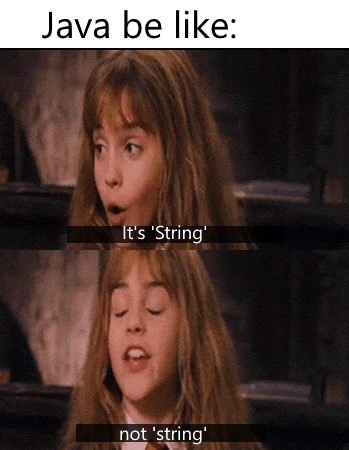
The images used are from a scene in Harry Potter (if you’ve seen it, it’s where Hermione corrects Ron on how to pronounce “Wingardium Leviosa” properly, emphasizing a certain syllable). Here, instead of a magic spell, it’s the word “String” being corrected. It’s a perfect analogy because, in both cases, saying (or spelling) it wrong causes the magic (or the code) to fail. Hermione’s expression in the first panel is kind of surprised and instructive: “It’s String.” In the second panel, she’s more insistent: “not string.” So she’s effectively playing the role of the Java compiler or a strict mentor, making sure you get that capital S right.

For a new programmer, especially if you’re coming from another language environment, this can be a gotcha. Consider C#, a language very similar to Java in many ways. In C#, you could write either:

string name = "Harry";
String name2 = "Hermione";

and both lines are fine in C#. That’s because C# treats string as a keyword alias for the System.String class (notice in one case we write lowercase string, in the other String with uppercase – C# lets you do it either way for that particular type). But Java isn’t so flexible here; it has no built-in alias for java.lang.String. So in Java, you must use the capitalized class name String every time. If you try the lowercase version, the Java compiler will error out with something like “string cannot be resolved to a type” (which is a fancy way of saying “I don’t know what string means in this context”).

Let’s break down a few terms to connect this with the meme:

  • Java: A popular programming language that is designed to be strict about types and definitions. It’s used in everything from large enterprise servers to Android apps. Java code is compiled, meaning it’s checked and converted by a compiler into a form the computer can run.
  • Compiler: A program that takes your human-readable code and translates it into machine code. On the way, it also checks that everything in your code makes sense. If something’s off – like you used a name it doesn’t recognize – it will throw a compiler error and refuse to create an executable. Think of it as an uncompromising grammar teacher for code.
  • String: In Java (capital S), this refers to the java.lang.String class, which is a built-in way to represent text. You create string variables by writing something like String title = "Developer";.
  • string (lowercase, in Java): Actually, nothing. Unlike some languages, Java doesn’t have a lowercase string keyword. So if you write string title; in Java, the compiler thinks you’re referring to a class or type named literally “string” that should exist... but it doesn’t. Hence, error.
  • Case-sensitive: This describes how Java treats String vs string as two different identifiers because the cases of the letters are different. Some languages are not case-sensitive (for example, SQL keywords or older BASIC code might treat Name and NAME as the same word), but most modern programming languages like Java, C, C++, and JavaScript distinguish case.
  • Type safety: Java is very strict about types. When you declare String story;, you’re telling Java “I will be storing text in here.” If you instead type something that Java doesn’t know as a type (like string story;), Java won’t just guess; it stops you right there. This prevents a lot of potential mistakes. It’s annoying in the short term (when you hit a compile error), but helpful in the long run because it catches typos or misuse of types early.

So, the meme’s joke in plain terms: Java demands you use the correct capital letter for its String type, and it’s playfully compared to a know-it-all student correcting someone’s pronunciation. It’s funny to programmers because we’ve all experienced the scenario of a program not working due to something as silly as the wrong letter case. It’s a mix of “ha-ha, I remember when I did that!” and a pinch of “oh Java, you strict old thing.” Essentially, uppercase matters a lot in coding, and Java will be the first to remind you of that – with no mercy but perhaps a sly Hermione-esque smile.

Level 3: Case of Mistaken Identity

For seasoned developers, this meme hits on a very real, and often chuckle-worthy, programming slip-up. It highlights how one letter – uppercase vs lowercase – can spawn a frustrating bug (or rather, a compiler error) that stops your code dead in its tracks. The two-panel format riffs on a famous Harry Potter scene (Hermione correcting Ron with “It’s LeviOsa, not Levio*SA”*), but here it’s Java itself playing the strict schoolteacher: “It’s String, not string.” The humor lies in Java’s pedantry. We’ve all been that junior dev (or seen one) who spends 20 minutes scratching their head over a red squiggly line or a build failure, only to have a teammate point out, “Hey, you capitalized that wrong.” Cue the facepalm and a sheepish commit to fix the typo.

The meme is also a gentle jab at the quirks of different programming languages – a mini arena for LanguageWars banter. Java and C# are often compared, and this is one of those tiny differences that can trip up someone switching sides. In C#, you can write string title = "Professor"; or String title = "Professor"; and both are kosher (because string is a keyword alias for the String class in .NET). But in Java, if you try to be casual and go with string title = "Professor";, Java crosses its arms and says “I have no idea what string is. Did you mean String by any chance?” – except it’s not that polite, it just errors out. Experienced Java devs know there’s no built-in alias or shortcut here: it’s String with a capital S, every time. So when a code reviewer sees string in a Java codebase, they instantly know someone has been moonlighting in C# or JavaScript or just had an overly long day.

Beyond language differences, this resonates because it exemplifies the strictness of strongly-typed languages and their compilers. We often joke that “the compiler is your first line of defense” – it’s like a really strict editor that won’t let your program even run if there’s a potential mistake. That’s a big part of Java’s type safety: catching errors early. However, it’s also the source of comedic frustration: “Really, Java? You couldn’t just figure out I meant String? It’s obvious to me!” But no – if you don’t spell it exactly as declared, Java acts like you’re talking about a completely different thing. This black-and-white thinking of the compiler is what makes the meme funny. We humans see String vs string and think, “typo.” The compiler sees String vs string and thinks, “totally unrelated token; sound the alarms!”

Seasoned programmers have a whole archive of war stories about trivial mistakes causing big headaches. A single missing semicolon, a wrong indent in Python, a misspelled variable name – tiny errors, loud failures. This meme falls right into that category. The senior dev chuckle comes from recognition: “Haha, been there, done that.” It also serves as a light-hearted caution: if you’re moving between languages, mind the details. Many of us have muscle memory from one language that sneaks into another. That one time you wrote public void doSomething(List<string> items) in Java (perhaps after a C# session) and got a rude awakening – yep, that’s the exact scenario this meme dramatizes.

The use of the Hermione “correcting” image is perfect metaphorically. Hermione is known for her know-it-all precision and correcting others’ mistakes (with a mix of exasperation and smugness). That’s basically the vibe of a Java compiler or a senior Java dev reading your code. The first panel, “It’s String”, is the gentle correction (think: code review comment). The second panel, “not string”, is a stern emphasis – the build is failing, or your team lead is now giving you the look. In a professional setting, such an error is harmless and quickly fixed, but it’s a bit embarrassing – akin to getting a basic trivia question wrong in front of peers. So, this meme captures that mix of embarrassment and the absurdity that one letter out of place can temporarily break an entire build pipeline.

In summary, the humor for the initiated is in the accuracy of it all. Java would be the one to fuss about capitalization, and we love/hate it for that. It’s a shared experience that unites Java devs (and their empathetic C#/C++ buddies) in “that time I yelled at my code because of a stupid capital letter”. The meme cleverly leverages a pop culture reference to make that point with a wink: messing up a tiny detail in code is as cringe (and memorable) as mispronouncing a famous spell in front of Hermione Granger.

Level 4: Symbol Table Sorcery

Deep inside the compiler, Java’s case-sensitive nature rules with an iron fist (or perhaps a strict wand). When you write code, every identifier's exact spelling matters. The Java compiler maintains a symbol table – a sort of catalog of all known class and variable names. If you reference String (capital S), the compiler checks this table and finds the canonical java.lang.String class (which Java auto-imports for you). But if you try string (lowercase s), the compiler will diligently search its symbol table and come up empty-handed. In compiler error parlance, you’ll get something like: “error: cannot find symbol: class string. There’s no fuzzy matching or “did you mean String?” – the compiler treats String and string as entirely different symbols. This strict separation is by design: Java’s grammar defines identifiers as case-sensitive, meaning MagicSpell, magicspell, and MAGICSPELL could all refer to different things if a programmer were crazy enough to do that.

Why so strict? It’s partly tradition and partly for unambiguous type safety. Java inherited this rule from C/C++ conventions, where uppercase vs. lowercase could distinguish variables, functions, or types. By requiring the exact capitalization, Java ensures that a class name is always spelled one way, preventing mix-ups. If the compiler encounters an unrecognized sequence of characters (like a misspelled class name), it fails fast at compile time rather than risking unpredictable behavior at runtime. It’s a bit like a magical incantation: one wrong letter and the spell won’t be cast.

Contrast this with C#: the designers of C# provided a convenient alias keyword string that the compiler internally maps to the System.String class (note the capital S in the actual .NET class name). In other words, the C# compiler is bilingual in this one case – string and String mean the same thing in C# land. The Java compiler, however, has no such alias in its spellbook; it recognizes only the exact class name String. This design choice reflects Java’s philosophy of having a lean set of keywords and letting class names speak for themselves. It also means Java devs must memorize the exact capitalization of common types (don’t worry, String is one of the first you learn).

From a language theory perspective, if a language were case-insensitive (like, say, old BASIC or Pascal for identifiers), the compiler would have to normalize names (often by converting everything to one case) before looking them up. Java skips that step entirely by simply treating different cases as different characters – simpler for the compiler, though unforgiving for the coder. The upside is precision: when Java sees StringBuilder vs Stringbuilder vs stringBuilder, it knows these could be three distinct things (and it will complain if two of them aren’t actually defined). The downside, as this meme jokes about, is that a tiny typo in capitalization is enough to bring your build to a halt. It’s a classic case (pun intended) of “the computer is always literal.”

In summary, the meme’s technical foundation is the rigidity of Java’s lexical rules. One capital letter carries weight. The compiler’s symbol resolution is all-or-nothing: either the identifier matches a known symbol exactly, or it’s an error. There’s a sort of arcane beauty to it – a bit like how Hermione’s spells in Harry Potter must be enunciated just right. And it’s precisely that connection to a strict magical incantation that sets the stage for the humor here.

Description

A two-panel meme captioned 'Java be like:'. It features the character Hermione Granger from the Harry Potter series, known for her pedantic and knowledgeable personality. In the top panel, she looks earnest and says, 'It's 'String''. In the bottom panel, her expression is more corrective and slightly condescending as she clarifies, 'not 'string''. The meme humorously personifies the Java programming language. The joke is rooted in Java's strict, case-sensitive syntax, where 'String' (with a capital S) is the name of the immutable object class, while 'string' (lowercase) is not a recognized type and would cause a compilation error. This is a common stumbling block for developers coming from languages like C# or TypeScript where 'string' is a primitive type or alias. The meme perfectly captures the language's rigid nature

Comments

7
Anonymous ★ Top Pick Java's strictness with 'String' is just preparing you for the real world, where the difference between a Deployment and a deployment is a career-limiting outage
  1. Anonymous ★ Top Pick

    Java's strictness with 'String' is just preparing you for the real world, where the difference between a Deployment and a deployment is a career-limiting outage

  2. Anonymous

    Twenty years in, and the fastest lint rule for spotting the C# expat on your team is still the rogue lowercase ‘string’ - Java’s compiler plays Sorting Hat and sends them straight back to Platform 9¾

  3. Anonymous

    After 20 years in the industry, I still occasionally type 'string' in Java and wonder why my IDE is having an existential crisis - turns out muscle memory from C# dies harder than a production server running COBOL

  4. Anonymous

    After two decades of Java development, you'd think we'd remember it's String with a capital S, but here we are at 2 AM, staring at a compilation error because muscle memory from Python kicked in. The real kicker? The JVM's helpful 'cannot find symbol' message that makes you question whether strings even exist in this language anymore, until you remember that yes, they do - they're just too important to be lowercase peasants like in those dynamically-typed languages

  5. Anonymous

    In Java, zero-trust predates OAuth - drop the capital S and javac immediately responds: cannot find symbol: class string

  6. Anonymous

    Java's case sensitivity: ensuring even your types maintain proper posture, lest the compiler judge your entire architecture

  7. Anonymous

    Java’s type system: capitalize the S or enjoy 'cannot find symbol: string' before your CI even warms the Maven cache - C# calls it an alias; javac calls it a lesson

Use J and K for navigation